When Someone Harasses You on the Subway, the Bus, or the Walk Home
By Larry Betz | Prepared Not Paranoid https://www.preparednotparanoid.com/
A stroller, a diaper bag, a toddler, and a stranger who starts yelling at you. Public transit safety with kids is different, because you can't just walk fast and you can't just run. This post is about what you can do when your hands are full and your options feel limited.
A friend of mine got off the ferry into Brooklyn and was walking home, pushing her baby in a stroller, when a disturbed person started yelling at her. Sadly, this kind of thing has happened to my wife several times, too. My friend and my wife both made it home safely. But it's scary, and in that moment, your options feel very limited.
One of the hardest questions is the phone. Do you take it out to record? Will that make it worse? And if you're recording, how are you supposed to call 911? Let's talk through it.
Why It's Different With Kids
On your own, you'd cross the street, pick up the pace, or duck into a store. With little ones, your speed is the speed of your slowest child. Your hands are full. Your attention is split. And moving a stroller, a toddler, and a five-year-old in the same direction at the same time is like herding cats.
That's why the plan has to be made before you get on the train or start the walk home, not in the moment.
The Prepared Protector Has Little Hands to Hold
The Prepared Protector isn't the strongest person on the platform. It's the mom who sat near the conductor without anyone noticing why, who has the alarm clipped where she can reach it, and whose kids already know what "come to me" means. It's someone protecting someone else.
The Prepared Protector is someone who's decided that loving someone means being ready for them, not just hoping things go fine.
Read It Early
Get a baseline as soon as you step onto the platform, the bus, or the street. What's normal here? Then watch behavior, not appearance.
Someone in a mental health crisis isn't always dangerous. Many people who are talking loudly to themselves will never come near you. But agitation, fixating on you, and closing the distance are your cues to move. (Situational Awareness, Part 6 covers urban pre-attack indicators in more detail.)
Record, Call, or Neither?
This is the question every parent asks.
Here's the honest answer.
Recording can make it worse. To some people, a phone pointed at them feels like a challenge, and that can escalate things fast. It also puts your eyes down and your hands full at the worst possible moment. And it doesn't create a single inch of distance.
And while you're recording, you're not calling 911. You can't do both well at the same time.
So here's the order:
Distance first. Gather the kids and move away. Toward people, toward staff, toward light.
Call when it's needed. If they follow you, threaten you, block your path, or touch you or your kids, call 911. Get some distance first if you can, but don't wait if you can't.
Recording comes last, if at all. If someone else on the train wants to record, let them. Your job is your kids.
Call 911 Without Fumbling
Set this up today, before you ever need it:
Emergency SOS. On an iPhone, you can press the side button five times quickly, or hold the side button and a volume button. Many Android phones can do the same by pressing the power button five times (look under Safety and emergency in Settings). Phones differ, so check your settings and know how yours works.
Use your voice. "Hey Siri, call 911" or "Hey Google, call 911" keeps your hands free for your kids.
Text to 911 works in many areas, but not all. If it isn't available where you are, you'll get an automatic message telling you to call instead. Call if you can.
If the person is only yelling from a distance and you're already moving away, you may not need to call at all. Get your family somewhere safe, then report it afterward.
Don't Engage. Don't Stare.
You don't need to win the moment. You need to leave it.
Don't argue, don't correct, and don't stare. A long look can feel like a challenge.
Keep your voice calm and your face neutral.
Put yourself between the person and the stroller or your kids.
(Situational Awareness, Part 7 covers de-escalation if you can't get away right away.)
Move Early, Move to People
The best time to move is before it escalates. Being a few minutes late beats staying put.
Here's the short version.
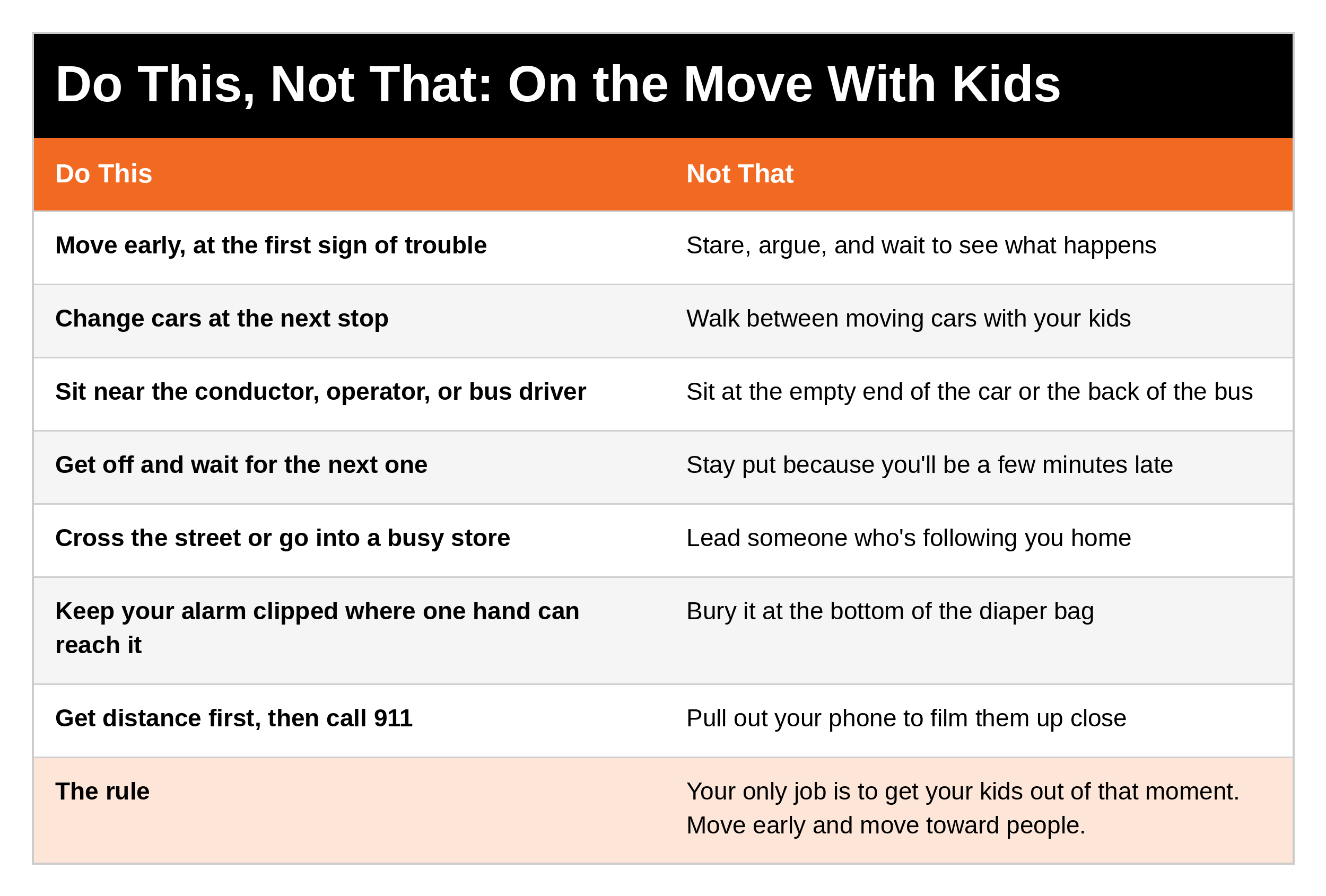
On a train: change cars at the next stop. Don't walk between cars. It's dangerous with kids, and it's against the rules on many systems except in an emergency. Check yours.
Move toward the conductor or the operator's car. On a bus, move up front near the driver.
Get off and wait for the next one. That's always an option.
On the walk home: cross the street, turn around, or go into a store. If someone keeps following you, don't lead them home. Go into a busy business and call 911.
Ask a specific person for help. "You in the blue jacket, can you stay with us?" A direct ask works far better than hoping someone steps in.
Your Personal Alarm
For a mom with her hands full, a personal alarm may be the best tool you have.
Why it helps: It's loud. It draws everyone's attention. It can startle someone into stopping. And it doesn't take eye contact, words, a free hand to dial, or a fight.
Be honest about the limits: A loud alarm can also agitate someone who's already in crisis. So use it as you move away, not to "win" the moment. It's a tool for getting attention and getting out.
Where to carry it: Clipped to the stroller handle or your bag strap, where you can reach it with one hand. Not buried in the diaper bag. Teach older kids how to pull it, too.
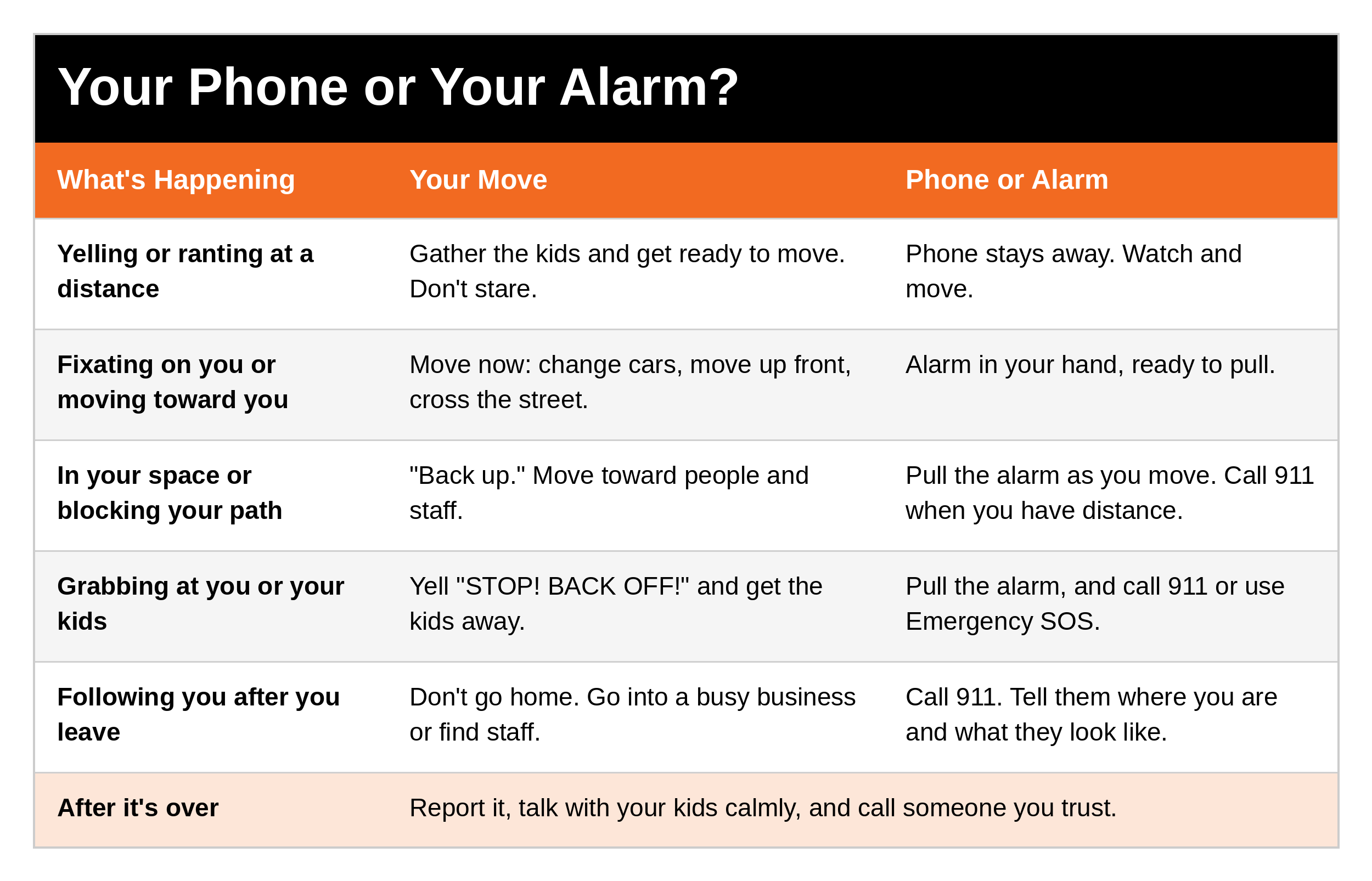
So when do you reach for your phone, and when do you reach for your alarm?
Here's when to use which.
Want to understand more about less-lethal options? A personal alarm is just one tool. My free guide, Choose Your Tool: Less-Lethal Tool Comparison, puts flashlights, pepper gel, alarms, stun guns, and more side by side, and helps you match the right tool to each person in your family. [Get it free here: LINK]
Your Family Transit Rules
Practice these at home first, like a game. When the moment comes, nobody has to think.
The hand rule: Little ones hold the stroller or your bag strap. You stay between the kids and any stranger.
The code word: One word that means "come to me right now, no questions." Like your family code word, but for moving fast.
Separated on the platform: If a child is left on the platform, they stay put and tell a worker. If a child ends up on the train without you, they get off at the next stop and wait for you there. Practice it out loud.
Snap a photo of the kids before you leave, so you know exactly what they're wearing.
What to Say
Safe and non-engaging
Say nothing. Gather the kids and move.
To your kids: "Hands on the stroller. We're moving."
Setting boundaries
Calm and firm: "Please leave us alone."
"Back up."
To a bystander: "You in the blue jacket, can you stay with us?"
If they persist
Pull your alarm, and move.
Loud: "STOP! BACK OFF!"
Get to the conductor, the driver, or transit police, and call 911.
After It's Over
Report it to transit police or 911's non-emergency line, or through your transit system's reporting line if it has one. Check what your local system offers.
Talk with your kids, calmly. Tell them what happened, what you did, and that they did a good job following the plan. Kids remember how you handled it more than what happened.
Take care of yourself, too. It's normal to be shaken afterward. Call someone you trust.
SCAN It
S, See your environment: Baseline the platform, the bus, or the block. Watch behavior, not appearance.
C, Create space: Move early. Change cars, move up front, or cross the street.
A, Act deliberately: Alarm in reach, kids in hand, move toward people. Call 911 when it's needed.
N, Never doubt your gut feelings: If someone's attention feels wrong, you don't owe them a reason to leave.
5 Quick Wins You Can Start Today
Set up Emergency SOS on your phone and learn how it works.
Clip a personal alarm to the stroller or your bag strap.
Teach your family code word that means "come to me right now."
Practice the platform rule with your kids out loud.
On your next ride, sit near the operator or driver.
Ask Yourself
If someone started yelling at us on the way home today, what would I do first?
Can I reach my alarm with one hand, or is it buried in the bag?
Do my kids know what to do if we get separated on the platform?
Remember
You don't have to win. You don't have to record. You don't have to explain.
Your only job is to get your kids out of that moment. Move early, move toward people, and let the alarm do the yelling.
That's what Prepared Protectors do. My friend and my wife both got home safe. A plan made ahead of time gives you the best chance to do the same.
Get Started Today
Get the free Travel Safety checklists. Simple, practical checklists for safer family trips. DM the word [KEYWORD] on Instagram or Facebook and I'll send them to you. [Get them here: LINK]
Go Deeper
Situational Awareness and Safe Family Travel Strategies. This post covers one of the hardest moments a parent can face in public. The book gives you the full foundation: reading your environment, more than 40 pre-event indicators, how criminals choose who to approach, de-escalation, protective strategies for moving as a family, choke points and dead space, and how to plan ahead for every trip. [Get it here: https://store.bookbaby.com/book/situational-awareness-and-safe-family-travel-strategies]
Tools I recommend: The personal safety alarms I trust, the kind you can clip to a stroller or bag strap, are in my Personal Safety Tools Amazon store. https://link.amazon/B0cVLeoJM
Related reading:
Safe Family Travel, Part 4: Protective Strategies for Family Travel [LINK]
Situational Awareness, Part 6: Urban Pre-Attack Indicators [LINK]
Situational Awareness, Part 7: De-Escalation [LINK]
Safe Family Travel, Part 6: Traveling Overseas [LINK when posted]
References
Metropolitan Transportation Authority. Rules of Conduct (moving between subway cars). https://new.mta.info/
Federal Communications Commission. Text to 911: What You Need to Know. https://www.fcc.gov/text-to-911
Apple and Android Emergency SOS settings (check your own phone's settings).
Betz, L. Situational Awareness and Safe Family Travel Strategies.
Betz, L. Navigating the Red Zone and Beyond (SCAN framework).
Disclaimer
This article is for general informational and educational purposes only. It is not a guarantee of safety and is not a substitute for professional self-defense training, legal advice, or law enforcement guidance. Transit rules and 911 services vary by city and county, so check what's available where you live and travel. Responsibility for harassment and violence always belongs to the offender. Prepared Not Paranoid and Larry Betz are not responsible for the content of third-party websites or resources linked here. Affiliate disclosure: I've linked to products from my Amazon store that I personally recommend. As an Amazon Associate, I earn from qualifying purchases, at no extra cost to you. Thank you for supporting my work.
If you're in danger right now, get to a safe place and call 911.
Awareness gives you time. Time gives you options.
The Prepared Protector is someone who's decided that loving someone means being ready for them, not just hoping things go fine.
Prepared Not Paranoid. Protecting the Most Vulnerable Among Us.