Chains vs. Off-Brand vs. Airbnb: What You Get, and What You Still Have to Check
By Larry Betz | Prepared Not Paranoid https://www.preparednotparanoid.com/
Where you sleep is where your family is most vulnerable. When it comes to hotel vs. Airbnb safety, the choice isn't about which is "safe" and which isn't. It's about what each one usually gives you, and what you still have to check yourself.
When you travel, especially overseas, your biggest safety wins usually come from two things:
Choosing lodging with consistent safety systems.
Doing a quick safety check when you arrive.
This post covers the first one. Part 8 covers the second.
What a Big-Name Hotel Usually Gives You
Major hotel chains run on brand standards: internal rules for training, safety systems, and security procedures, layered on top of whatever local law requires. IHG, for example, says it has mandatory brand safety standards for all its hotels worldwide. Hilton describes a global safety and security team built to predict risks, prevent harm, and respond to crises.
What that usually means for you:
More consistent standards from one property to the next
24/7 staff and a clear person to go to when something's wrong
Better baseline monitoring, often with more lighting, key-controlled floors, and cameras in public areas
But a brand name isn't a guarantee. Standards vary by brand, by who owns the property, and by local law. You still check the specific place you're staying.
Off-Brand Doesn't Mean Unsafe
An independent or budget hotel can be a great stay. It just means less standardization, and sometimes fewer layers. You may see:
Elevators and guest floors that don't need a room key
Fewer staff on duty overnight
Older doors, weaker locks, less lighting, and fewer cameras
Safety systems that exist but aren't tested as often
Off-brand hotels call for more "verify before you relax."
Airbnb and Short-Term Rentals
Rentals can be great for families: more space, a kitchen, laundry, and a neighborhood you choose. Airbnb gives hosts safety guidance, like smoke and carbon monoxide alarms, a fire extinguisher, and escape route information. But what's actually in place varies by listing and by country.
The tradeoffs:
Safety systems may be inconsistent. The building may not have sprinklers, monitored alarms, or marked exits.
There's no front desk at 2 a.m. If something goes wrong, it may be just you and an app.
Building codes vary, especially in older buildings overseas.
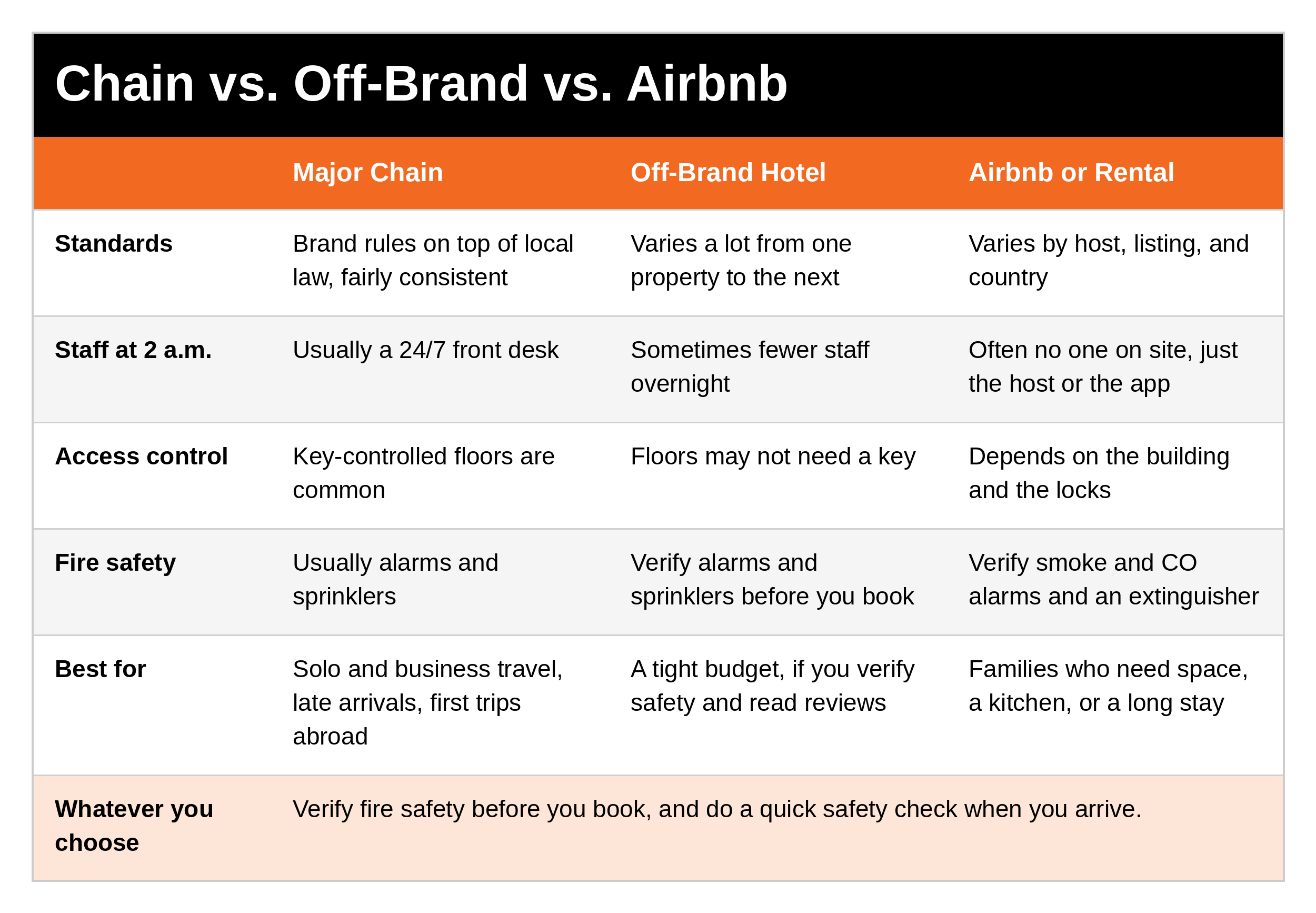
Chain, Off-Brand, or Airbnb?
None of these is right for every trip.
Here's how they compare.
Fire Safety Comes First
In many travel emergencies, the most important factor isn't a camera. It's fire and life safety: alarms, sprinklers, exits, and an evacuation plan.
The U.S. Fire Administration (USFA) says to stay in hotels with hard-wired smoke alarms and automatic sprinklers in every guest room. USFA even keeps a Hotel-Motel National Master List of properties that meet federal fire safety standards. Check it when you book.
For rentals, USFA says to make sure there are working smoke alarms in every sleeping room and on every level, carbon monoxide alarms on every level, and doors and windows you can actually open to get outside.
Overseas, don't assume anything. Sprinklers in guest rooms, modern alarms, clear exit signs, and the door locks you're used to may not be there. (Part 6 covers what to know before you travel abroad.)
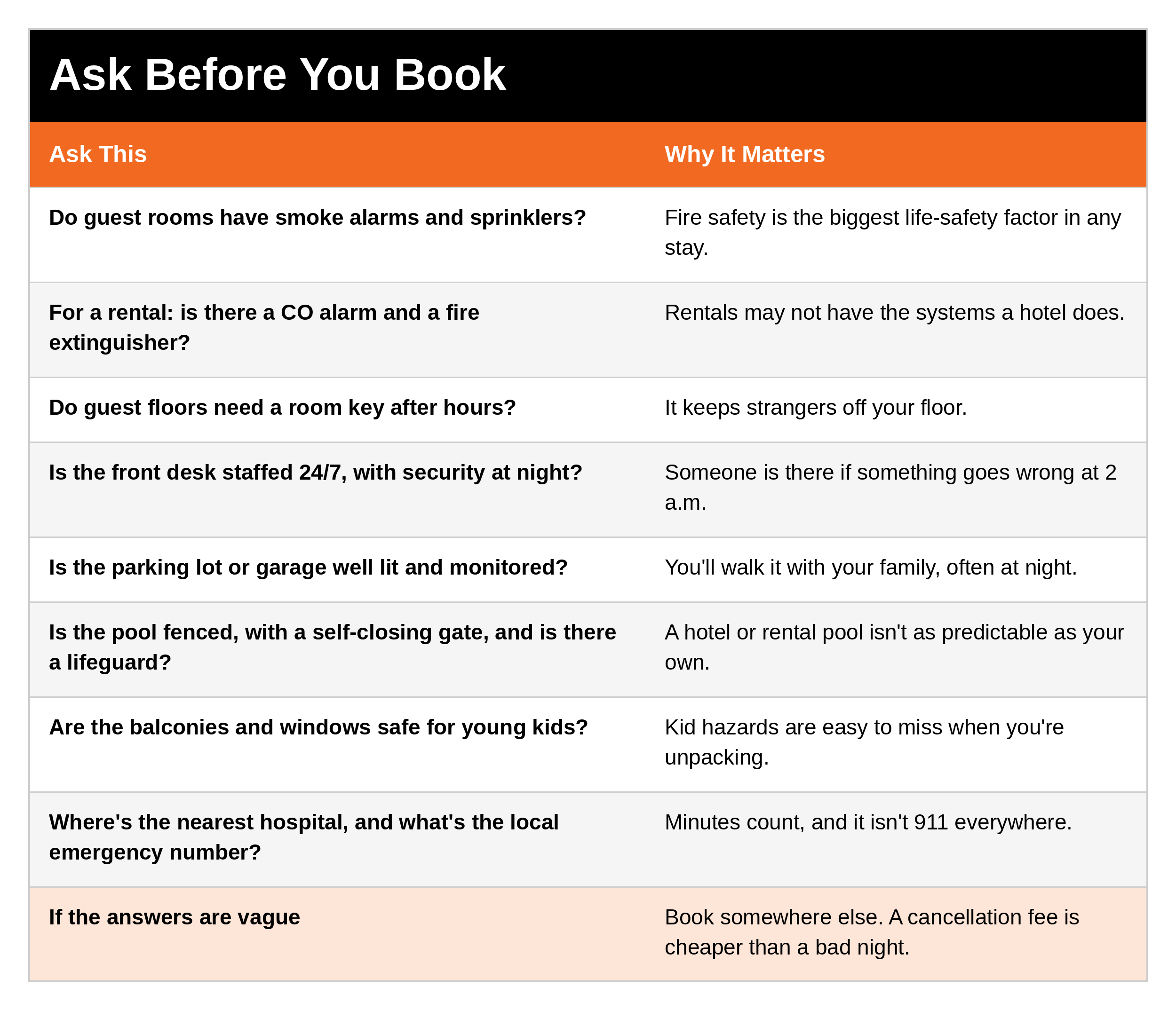
Ask Before You Book
A few questions before you book can tell you a lot.
Here's what to ask, and why.
Traveling Alone vs. Traveling With Family
Traveling alone for business, your priorities are access control (a 24/7 desk and key-controlled floors), the neighborhood and how you'll get there, especially for late arrivals, and keeping your devices secure. Staying at a major hotel and using its restaurant, bar, and pool gives you a higher baseline of staff, controlled access, and security.
Traveling with family, the list grows:
Fire safety matters even more.
Room layout: an easy way out, not too isolated.
Kid hazards: balconies, windows, and pool access.
Medical access: the nearest hospital or urgent care, a pharmacy, and the local emergency number.
Backups: medications, chargers, and the kids' essentials.
The Pool Is the Biggest Kid Hazard at Most Stays
A hotel or rental pool isn't your backyard pool. You didn't install the fence, and you don't know if the gate actually latches. Before you book, ask whether the pool is fenced on all four sides with gates that close and latch on their own, whether any bedroom or patio door opens straight onto the pool, and whether there's a lifeguard on duty or it's swim at your own risk.
When you arrive, walk the pool area before the kids get near it. One adult keeps the kids busy while the other checks the gates, doors, alarms, drain covers, and rescue equipment. Family Water Safety, Part 2: Family Water Safety on the Road covers the full walkthrough, and my free Family Water Safety Checklist puts it all on one page. [Get it here: LINK]
That said, travel is meant to be experienced. The goal isn't to stay inside a bubble. When you head out to explore local food and culture, your safety just becomes more personal: plan your rides, keep your eyes up, and trust the early warning signs.
The Quick Check When You Arrive
Part 8 goes deeper on hotel security, but here's the short version for any stay:
Read the evacuation map and find your 2 closest exits.
Count the doors to the stairwell. It helps in smoke or the dark.
Check your door. Does it fully latch, and do the secondary locks work?
Find the smoke and CO alarms. If you can't, ask.
Keep your phone, keys, shoes, and a flashlight where you can grab them fast at night.
What to Say
When you book
When booking: "Do your guest rooms have smoke alarms and sprinklers?"
To a host: "Where are the smoke alarms, the CO alarm, and the extinguisher?"
When you check in
At the desk: "We'd like a room near an exit stairwell, but not right beside it."
If something feels wrong: "This room doesn't work for us. Can we move?"
If it still doesn’t feel right
If the answers are vague or the place feels wrong: "We're going to stay somewhere else." Then go.
For a rental, contact the platform's support line. You never owe anyone a night in a place that doesn't feel safe.
SCAN It
S, See your environment: Check the reviews, the neighborhood, the lobby, and the hallway before you settle in.
C, Create space: Pick a room with an easy way out.
A, Act deliberately: Ask your questions before you book, and do your quick check when you arrive.
N, Never doubt your gut feelings: If a place feels off, move. A cancellation fee is cheaper than a bad night.
5 Quick Wins You Can Start Today
Look up your next hotel on the USFA Hotel-Motel National Master List.
Ask about smoke alarms and sprinklers before you book.
For a rental, confirm smoke and CO alarms and an extinguisher in writing from the host.
Save the exact address and unit number offline, along with the nearest hospital.
Pack a door wedge or portable door alarm in your travel bag.
Ask Yourself
Do I pick where we stay by price and photos alone?
Would I know where the 2 nearest exits are tonight, in the dark?
If we booked a rental, who would we call at 2 a.m.?
Remember
A brand name can raise your baseline, but it doesn't replace awareness. Choose a place with real fire safety, ask a few questions before you book, and do a quick check when you arrive.
Stack those small habits, and you reduce your risk without letting fear run the trip.
Get Started Today
Get the free Travel Safety checklists. Simple, practical checklists for safer family trips. DM the word [KEYWORD] on Instagram or Facebook and I'll send them to you. [Get them here: LINK]
Go Deeper
Situational Awareness and Safe Family Travel Strategies. This post helps you choose where to stay. The book shows you how to stay safe once you're there: arrival and check-in, room selection, reading evacuation maps, hotel and Airbnb room security, hidden cameras, safety for women and solo travelers, and choosing hotels overseas. [Get it here: https://store.bookbaby.com/book/situational-awareness-and-safe-family-travel-strategies]
Tools I recommend: The door wedges, portable door alarms, and travel flashlights I recommend are in my Travel Safety Amazon store. https://link.amazon/B023guhPk
Related reading:
Safe Family Travel, Part 6: Traveling Overseas [LINK]
Safe Family Travel, Part 4: Protective Strategies for Family Travel [LINK]
Family Water Safety, Part 2: Family Water Safety on the Road [LINK]
Safe Family Travel, Part 8: Hotel Security [LINK when posted]
Safe Family Travel, Part 9: Hidden Cameras [LINK when posted]
References
U.S. Fire Administration. Hotel and Vacation Rental Fire Safety and the Hotel-Motel National Master List. https://www.usfa.fema.gov/prevention/hotel-fires/
Airbnb. Safety guidance for hosts (smoke and CO alarms, extinguishers, escape routes). https://www.airbnb.com/help/article/1397
Consumer Reports. Home safety questions to ask your Airbnb host. https://www.consumerreports.org/home-safety/home-safety-questions-to-ask-your-airbnb-host/
IHG. Brand safety standards statement. https://www.ihgplc.com/en/responsible-business/policies-and-position-statements
Hilton. Global Safety and Security Services. https://travelwithpurpose.hilton.com/
Betz, L. Situational Awareness and Safe Family Travel Strategies.
Betz, L. Navigating the Red Zone and Beyond (SCAN framework).
Disclaimer
This article is for general informational and educational purposes only. It is not a guarantee of safety and is not a substitute for professional security or fire safety advice. Hotel, rental, and building standards vary by brand, property, platform, and country, so always verify the safety features of the specific place you're staying. Prepared Not Paranoid and Larry Betz are not affiliated with any hotel brand or rental platform and are not responsible for the content of third-party websites or resources linked here. Affiliate disclosure: I've linked to products from my Amazon store that I personally recommend. As an Amazon Associate, I earn from qualifying purchases, at no extra cost to you. Thank you for supporting my work.
If you're in danger or there's a fire, get out and call 911 (or the local emergency number when you're overseas).
Awareness gives you time. Time gives you options.
The Prepared Protector is someone who's decided that loving someone means being ready for them, not just hoping things go fine.
Prepared Not Paranoid. Protecting the Most Vulnerable Among Us.