Games, Concerts, and Festivals: Where Families Are Really Vulnerable
By Larry Betz | Prepared Not Paranoid https://www.preparednotparanoid.com/
Large event safety doesn't start at the stadium gate. It starts the moment you leave home, and the riskiest parts of the day are often the ones you spend getting there and back. Whether it's a ballgame, a concert, a festival, or a parade, a little planning lets your family enjoy the day instead of worrying about it.
Watching the World Cup this summer, I couldn't stop thinking about what goes into keeping an event like that safe. Sixteen stadiums. Three countries. Millions of fans. And my mind went where it always goes: What would I do if I were there with my family?
I don't come from a military, law enforcement, or executive protection background. I'm someone who's always been passionate about protection and preparedness. So I did what I always do. I started researching. What I found is that many of the principles security professionals use work just as well for everyday families.
The Threat Isn't Always Inside the Stadium
When most people think about event safety, they think about the venue. But major venues plan for years. They have controlled entrances, screening, cameras, police, private security, and emergency plans. In many cases, the stadium is one of the most secure places in the area.
The challenge is everything around it: parking lots and garages, transit stations, rideshare pickups, fan zones, restaurants, bars, and hotels. Security professionals call these soft targets. They're open, they have many ways in and out, there's little or no screening, and they're full of distracted people.
That doesn't make them unsafe. It means they need a different kind of attention, and they're where your family will spend most of the day.
The Event Starts When You Leave Home
In Part 10, we talked about transition zones, the moments when you move from one space to another and your attention gets pulled in five directions. An event day is one transition after another.
Here's what a typical event day looks like.
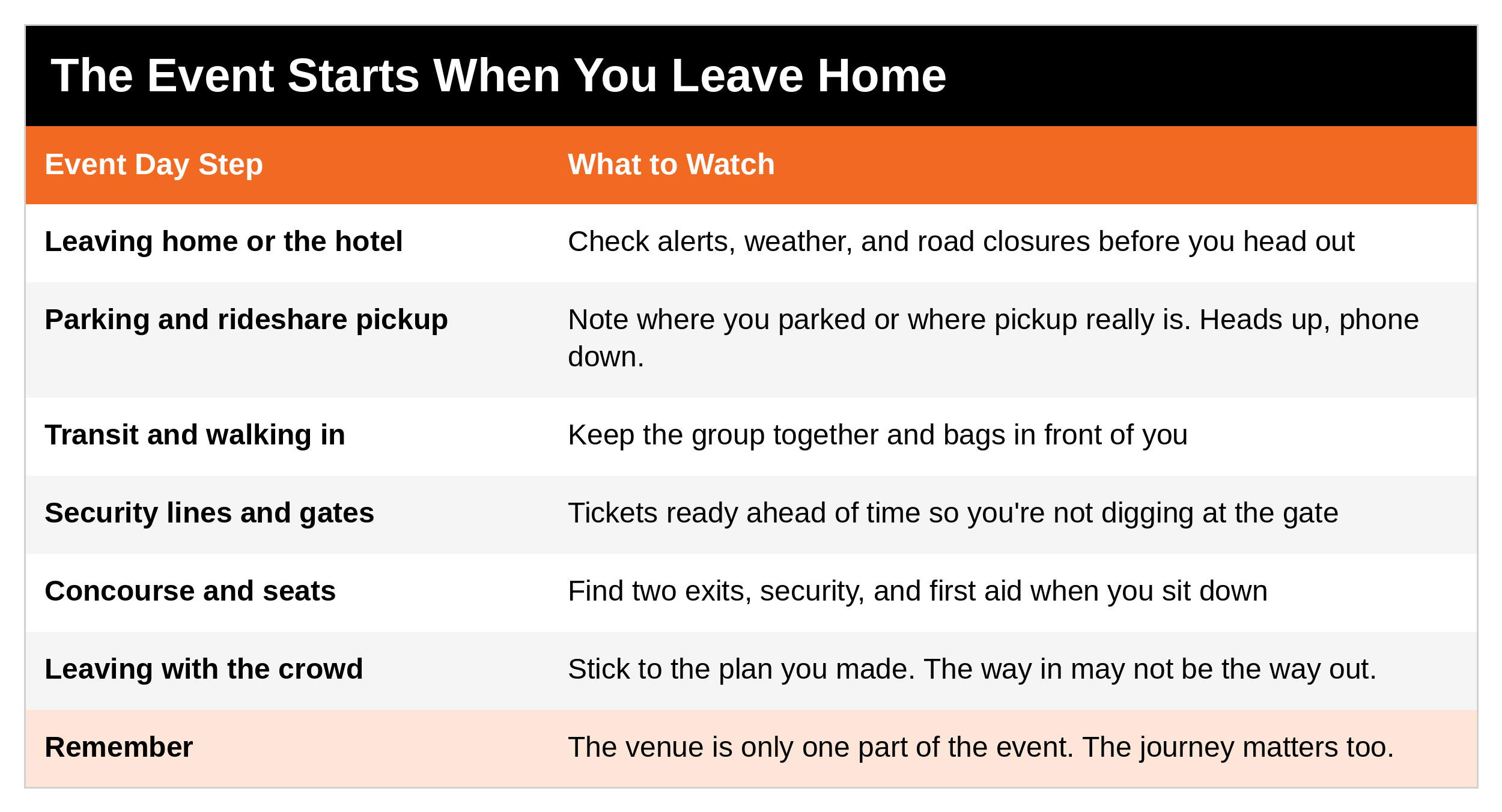
At every step, people are checking tickets, following GPS, managing kids, carrying bags, and looking for their ride. Criminals know that. Pickpockets, scammers, and worse look for people who are rushed, confused, or separated from their group.
A simple habit helps: every so often, pause and ask yourself, "Where am I? Where are my people? Where's the way out?" It takes a few seconds.
Four Conversations Before You Go
Most families spend weeks planning tickets, hotels, and where to eat. Very few spend five minutes talking about what they'd do if something unexpected happened. You don't need a complicated plan. You need a few decisions made ahead of time.
Here they are.
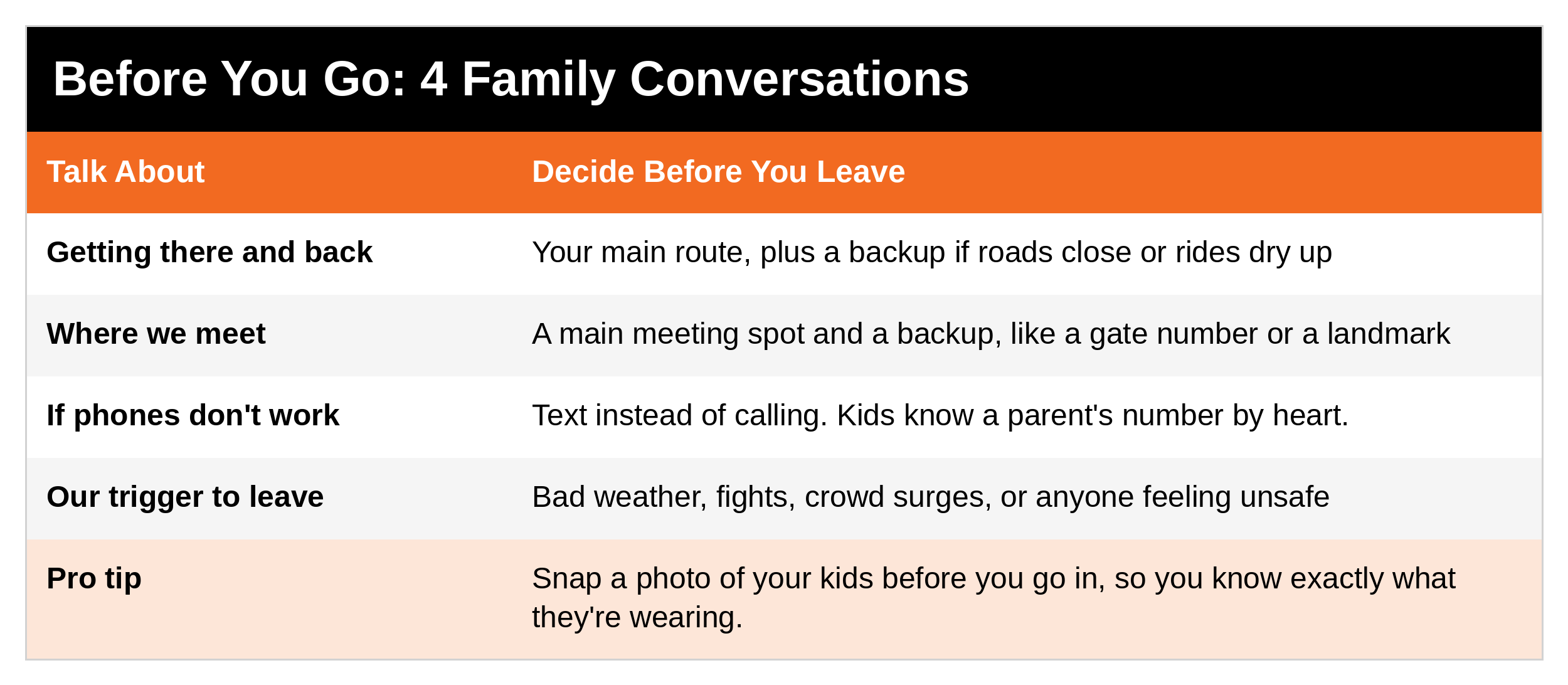
Two of these deserve a little more attention.
Your phone might not work. When tens of thousands of people are in one place, cell networks can get overloaded, and it gets worse if something happens and everyone tries to call at once. A short text like "At Gate B" often gets through when a call won't. But your plan shouldn't depend on your phone. Everyone should know the meeting spots by heart.
Decide your trigger to leave before you need it. Severe weather, a fight that's getting worse, a crowd that's pushing, a medical problem, or simply someone in your group saying, "I don't feel safe here." When you've agreed on it ahead of time, nobody hesitates and nobody argues.
SCAN It
See your environment. Find two exits, security, and first aid as soon as you get to your seats.
Create space. If a crowd starts to compress or someone's getting aggressive, move away early. Distance gives you time.
Act deliberately. Don't panic, and don't follow the herd. Talk to your group and stick to the plan.
Never doubt your gut feelings. If something feels wrong, you don't need a reason to leave.
5 Quick Wins You Can Start Today
Pick your meeting spots before you walk in. A main one and a backup. Make sure the kids can say them back to you.
Take a photo of your kids before you go in, so you know exactly what they're wearing.
Charge everything. Bring a portable charger, and download your tickets and maps ahead of time.
Teach kids who to go to if they get lost: a worker with a badge, a police officer, or a mom with kids.
Leave a little early or a little late. Avoiding the biggest crush at the gates is one of the easiest safety moves there is.
What to Say: In a Crowd
Most problems at events are pushy crowds, people who've had too much to drink, and short tempers. Keep it short and keep moving.
Safe and non-engaging
"Excuse me." Then move away.
Say nothing. Gather your group and change seats or spots.
Setting boundaries
"Please give us some room."
"We're going to move. Enjoy the game."
If they persist
Go straight to an usher, security, or police, and tell them exactly what's happening.
If you're in danger, call 911 or use the venue's emergency number or text line if they have one.
Ask Yourself
Does everyone in my family know where we'd meet if we got separated?
If our phones stopped working, would we still be okay?
Have we agreed on what would make us leave early?
Remember
The venue is only one part of the event. The journey matters too. Most people will go to games, concerts, and festivals their whole lives without a serious problem. Being prepared isn't about expecting the worst. It's about having options if something changes.
That wraps up the Situational Awareness series. Over 11 posts, we've gone from what awareness really means to how predators work, how to read danger early, what to say, and how to put it all into practice. If you're just finding this series, start with Part 1 and work your way through. Then make it a family habit.
The Prepared Protector is someone who's decided that loving someone means being ready for them, not just hoping things go fine. At a big event, that means a plan, a meeting spot, and your head up.
Get Started Today
Start with the free Personal Safety and Awareness checklists from The Family Safety Toolkit. Simple checklists to help you and your family practice awareness every day. DM the word AWARE on Instagram or Facebook and I'll send it to you. [Get it here: LINK]
Go Deeper
Situational Awareness and Safe Family Travel Strategies. The book gives you the foundation for every part of this series: the manipulation tactics, Cooper's Color Code and the OODA Loop, the Hostile Planning Cycle, more than 40 pre-event indicators, and de-escalation. Then it takes those skills on the road, with vehicle safety, carjacking, family travel, hotels, and overseas travel. [Get it here: https://store.bookbaby.com/book/situational-awareness-and-safe-family-travel-strategies]
Coming in the 2nd edition: the complete guide to staying safe at large events, including how security professionals use public information before an event, the official sources worth checking before you go, a full family communication and exit plan, and a simple family risk check you can do in five minutes.
Tools I recommend: The personal safety alarms, flashlights, and other everyday safety tools I recommend are in my Personal Safety Tools Amazon store. https://link.amazon/B0cVLeoJM
Related reading:
Situational Awareness, Part 1: What It Really Means https://www.preparednotparanoid.com/pnp-library/situational-awareness-intro
Situational Awareness, Part 10: Putting It Into Practice [LINK]
Safe Family Travel, Part 1: Vehicle Safety and Road Rage [LINK when posted]
Disclaimer
This article is for general informational and educational purposes only. It is not a guarantee of safety and is not a substitute for professional training, legal advice, or guidance from law enforcement or event security. Always follow instructions from venue staff and emergency personnel. It's meant to start conversations in your family about staying aware and safe. Affiliate disclosure: I've linked to products from my Amazon store that I personally recommend. As an Amazon Associate, I earn from qualifying purchases, at no extra cost to you. Thank you for supporting my work.
If you're in danger right now, get to a safe place and call 911.
Awareness gives you time. Time gives you options.
The Prepared Protector is someone who's decided that loving someone means being ready for them, not just hoping things go fine.
Prepared Not Paranoid. Protecting the Most Vulnerable Among Us.