The Manipulation Tactics That Come Before Any Contact
By Larry Betz | Prepared Not Paranoid https://www.preparednotparanoid.com/
Most people picture danger as a sudden attack. But predators rarely start with force. They start with manipulation tactics: a friendly smile, an offer to help, a promise you didn't ask for. Each one is designed to get you to lower your guard. Once you know what they look like, you'll start to see them, and you'll be able to step away early.
Danger Doesn't Always Look Dangerous
Some of the most dangerous people don't look dangerous at all. They're charming, polite, or even seem to need help. Ted Bundy, for example, would fake an injury and ask women to help him carry things to his car. His clean-cut looks and gentle voice made him seem safe.
That's why these tactics work. They play on our natural instinct to be kind, polite, and helpful. Most people who are friendly to you mean no harm. But a stranger's charm doesn't earn your trust, and refusing to engage isn't rude. It's prioritizing your safety.
The Seven Tactics
In The Gift of Fear, Gavin de Becker describes several of these, like "forced teaming" and "loan sharking." In my book Navigating the Red Zone and Beyond, I put them into plain words families can remember.
Here are all seven at a glance.
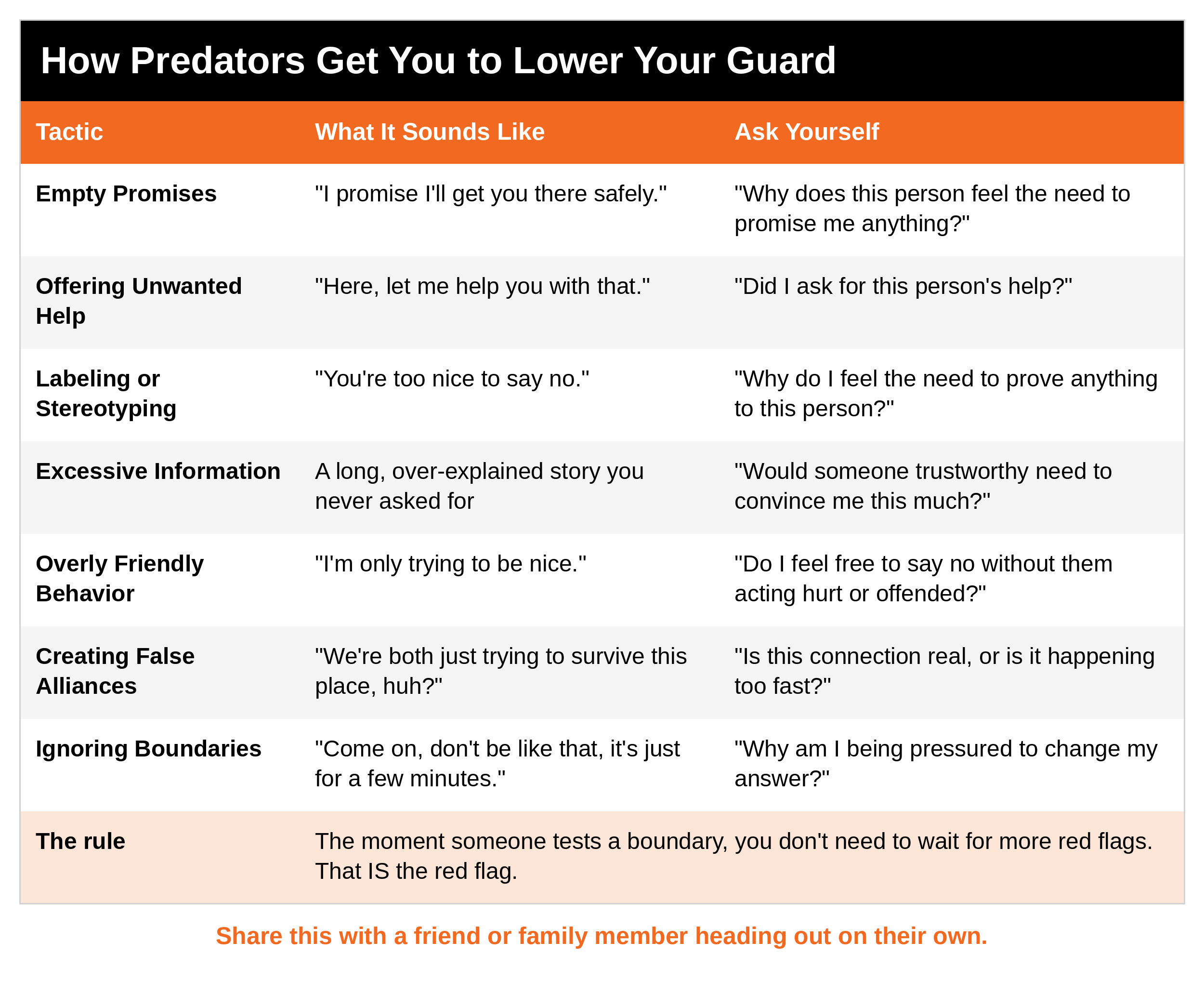
Here's the short version of each:
Empty Promises. Reassurance from a stranger is not a contract. If someone promises you something you didn't ask for, ask yourself why they feel the need to.
Offering Unwanted Help. Help you didn't ask for creates a feeling that you owe them. Genuine help respects your no. Manipulation ignores it.
Labeling or Stereotyping. "You're too nice to say no." A label is a hook designed to make you prove them wrong. You don't have to prove anything to a stranger.
Excessive Information. Honest people are usually brief. When someone over-explains, they may be trying to sound believable or keep you talking.
Overly Friendly Behavior. Kindness is not a contract. When friendliness feels too intense, too fast, or comes with expectations, pay attention.
Creating False Alliances. "We're in the same boat." Instant connection with a stranger is a shortcut to trust. Real trust takes time.
Ignoring Boundaries. This is the biggest red flag of all. When someone won't accept your no, they're showing you exactly how they handle limits.
Boundary Respecter or Boundary Tester?
One of the fastest ways to tell a safe person from a dangerous one is to watch what happens when you say no.
Here's how to tell the difference.
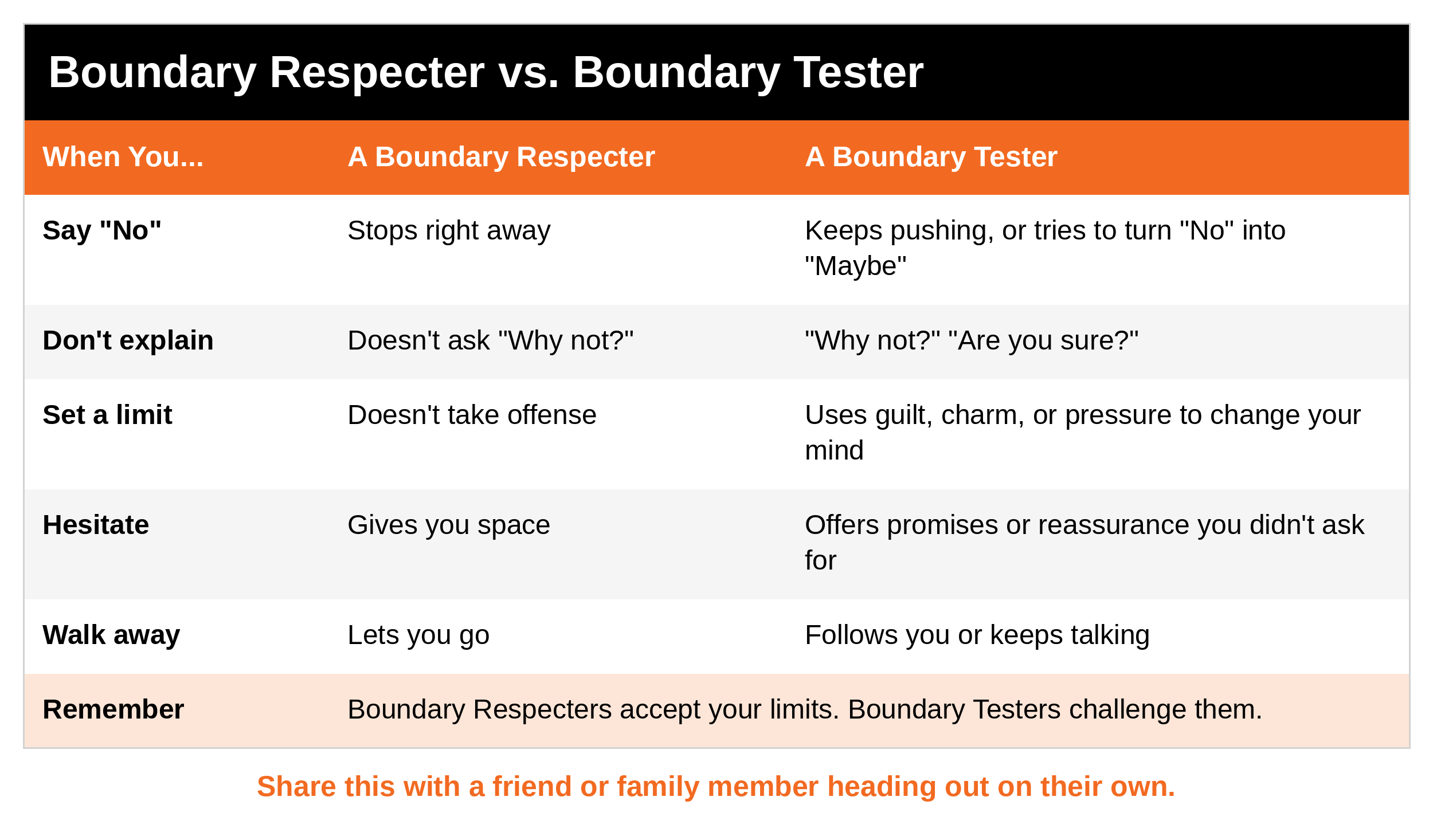
The moment someone tests a boundary, you don't need to wait for more red flags. That IS the red flag.
What to Say
You don't owe anyone an explanation. Start low-key and get firmer only if you need to.
Safe and non-engaging
"No thanks, I'm fine."
"I'm good, my friend's meeting me here."
Turn away and keep moving with purpose. Don't explain or apologize.
Setting boundaries
"I didn't ask for help, but thank you."
"I said no, and I meant it."
"You don't need to promise me anything."
If they persist
"You're making me uncomfortable. Back off."
"I said no. Leave me alone."
Move toward people, light, or staff, and get your phone ready to call 911.
The 3 L's: Lie. Leave. Live.
If your instincts are screaming at you, you don't owe a stranger the truth. Lie. Leave. Live. Say something like, "My husband is pulling the car around," or "My friend is right inside," then move to a safe place: a store, a lobby, a group of people, or a security desk. Your safety matters more than your honesty with someone who's making you feel unsafe.
SCAN It
See the tactic for what it is.
Create space. Step back and put distance between you.
Act deliberately. Say no once, clearly, and move.
Never doubt your gut. If it feels like pressure, it is.
Ask Yourself
Did I ask for this person's help, or did they insert themselves?
Do I feel respected, or managed?
Would a safe, trustworthy person ignore my no?
Remember
Genuine people don't need to make promises, push help on you, or argue with your no. Trust actions, not words. "No" is a complete sentence, and it's a powerful one.
The Prepared Protector is someone who's decided that loving someone means being ready for them, not just hoping things go fine. Teaching your kids these seven tactics is one of the best ways to do it.
Get Started Today
Start with the free Personal Safety and Awareness checklists from The Family Safety Toolkit. Simple checklists to help you and your family practice awareness every day. DM the word AWARE on Instagram or Facebook and I'll send it to you. [Get it here: LINK]
Go Deeper
Situational Awareness and Safe Family Travel Strategies. This post gives you the short version of each tactic. The book walks through every one in detail with suggested verbal and nonverbal responses, then builds on it with the reactionary gap, Cooper's Color Code and the OODA Loop, the Hostile Planning Cycle, more than 40 pre-event indicators, and de-escalation, plus vehicle and travel safety. [Get it here: https://store.bookbaby.com/book/situational-awareness-and-safe-family-travel-strategies]
Have a son or daughter heading off to college? Navigating the Red Zone and Beyond takes these tactics further for college students, with a real scenario, three Ask Yourself questions, a full set of responses, and a safety strategy for every tactic, plus drink safety, rideshares, stalking, and cyber safety. Give your student the conversation, and the tools, before move-in day. [Get it here: LINK]
Tools I recommend: The personal safety alarms, flashlights, and other everyday safety tools I recommend are in my Personal Safety Tools Amazon store. https://link.amazon/B0cVLeoJM
Related reading:
Situational Awareness, Part 1: What It Really Means https://www.preparednotparanoid.com/pnp-library/situational-awareness-intro
Situational Awareness, Part 3: Awareness Buys You Time [LINK when posted]
College Safety series [LINK]
References
Betz, L. (2026). Navigating the Red Zone and Beyond.
de Becker, G. (1997). The gift of fear: Survival signals that protect us from violence. Little, Brown.
Disclaimer
This article is for general informational and educational purposes only. It is not a substitute for professional self-defense training, legal advice, or guidance from law enforcement. It's meant to start conversations in your family about staying aware and safe. If you suspect someone is being abused or exploited, contact a professional or law enforcement right away. Affiliate disclosure: I've linked to products from my Amazon store that I personally recommend. As an Amazon Associate, I earn from qualifying purchases, at no extra cost to you. Thank you for supporting my work.
If you're in danger right now, get to a safe place and call 911.
Awareness gives you time. Time gives you options.
The Prepared Protector is someone who's decided that loving someone means being ready for them, not just hoping things go fine.
Prepared Not Paranoid. Protecting the Most Vulnerable Among Us.