From Cooper's Color Code to SCAN
By Larry Betz | Prepared Not Paranoid https://www.preparednotparanoid.com/
Every second you notice trouble sooner is a second you get to think. That's what situational awareness really gives you: time. In this post, I'll walk you through the two tools most awareness training is built on, Cooper's Color Code and the OODA Loop, and show you how SCAN turns them into something your whole family can use.
The Reactionary Gap
The reactionary gap is the distance between you and a possible threat. It's the space you need to see a problem coming and respond before it reaches you.
In the early 1980s, Salt Lake City police officer Dennis Tueller showed that an average person can cover about 21 feet in about 1.5 seconds. That became known as the Tueller Drill, or the "21-foot rule." It was designed for a specific situation, but the lesson is for everyone: things happen faster than you think.
You can't always control how close someone gets. But you can control when you notice them. The earlier you see something, the more of that gap you have, and the more options you have.
The Foundation: Two Tools From the Military and Law Enforcement
The two tools below have been used for decades to teach awareness in the military and law enforcement. They're the foundation of nearly everything in this series. The goal isn't to make you hypervigilant. It's to give you a simple way to check in with yourself.
Cooper's Color Code
Jeff Cooper, a Marine Corps officer and firearms instructor, created the Color Code as a simple way to ask, "How aware am I right now?"
Here are the four levels.
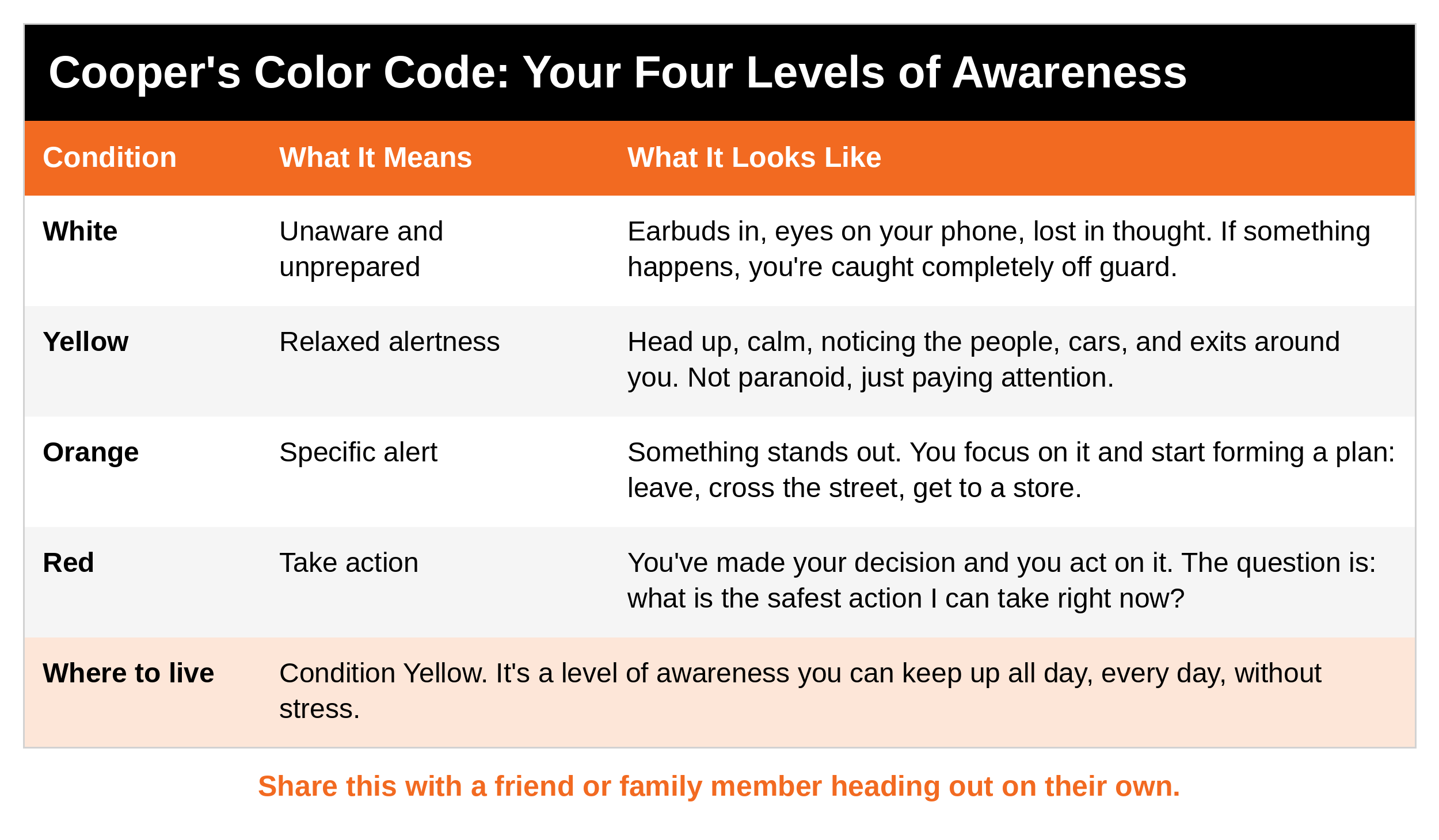
The goal isn't to live in Orange. That's exhausting, and it's not what being Prepared Not Paranoid is about. The goal is to live in Yellow: relaxed, aware, and ready to shift gears if something stands out.
The OODA Loop
Air Force Colonel John Boyd, a fighter pilot and military strategist, developed the OODA Loop to describe how people make decisions under pressure:
Observe: Notice what's happening around you.
Orient: Figure out what it means.
Decide: Choose what to do.
Act: Do it.
Then you start over, because the situation keeps changing. I call it a rolling threat assessment. Your mind can run through the whole loop in a fraction of a second.
SCAN: The Family Version
The Color Code and the OODA Loop are great tools, but they can be a lot to remember in the moment, especially for kids. That's why I teach families SCAN. It puts both tools into four simple steps.
Here's how they line up.

S - See your environment. This is living in Yellow and observing.
C - Create space. When something stands out, you move to Orange. Distance buys you time to orient and think.
A - Act deliberately. This is Red: decide, then act with purpose.
N - Never doubt your gut feelings. Your gut is usually what moves you from Yellow to Orange in the first place. Trust it, and keep watching even after you act.
SCAN in Real Life
Here's what it looks like. You're walking to your car in a grocery store parking lot with your kids. Your phone is in your pocket, and you're glancing around as you walk. (See.) You notice a man near your car who isn't loading groceries or heading anywhere. He's just standing there, watching. Something about it doesn't sit right. (Never doubt your gut.) You slow down and angle away so there are a few cars between you. (Create space.) Then you turn around, head back into the store, and ask an employee to walk out with you. (Act deliberately.)
Maybe he was waiting for his wife.
Maybe not. It doesn't matter.
You lost two minutes, and you kept every option open.
5 Quick Wins You Can Start Today
Check your color. A few times a day, ask yourself, "What color am I in right now?" If the answer is White, look up.
Watch the transitions. Parking lots, doorways, elevators, and gas stations are where most people drop into White. Make those your Yellow moments.
Give yourself room. When you can, keep a car, a counter, or a few steps between you and anyone who makes you uneasy.
Have a "what if." When you walk into a store or restaurant, take two seconds to ask, "If something happened, where would I go?"
Teach your kids "heads up." Make Yellow a family word. "Heads up" can mean "phones away, look around."
What to Say: When You Move to Orange
If someone is getting too close and your gut says something is off, use your voice to create space.
Safe and non-engaging
Say nothing, change direction, and walk with purpose.
"Excuse me." Then step past and keep moving.
Setting boundaries
"Please stay back."
"I don't need anything, thanks."
If they persist
"Stop. Back off."
Move toward people and light, and get your phone ready to call 911.
Ask Yourself
What color am I in most of the day, especially when I'm with my kids?
Where in my daily routine do I drop into White without noticing?
Does everyone in my family know what to do when something feels off?
Remember
You can't always control how close someone gets. You can control when you notice them. Live in Yellow, trust your gut, and let SCAN take it from there. Awareness gives you time, and time gives you options.
The Prepared Protector is someone who's decided that loving someone means being ready for them, not just hoping things go fine. Teaching your family SCAN is one of the simplest ways to start.
Get Started Today
Start with the free Personal Safety and Awareness checklists from The Family Safety Toolkit. Simple checklists to help you and your family practice awareness every day. DM the word AWARE on Instagram or Facebook and I'll send it to you. [Get it here: LINK]
Go Deeper
Situational Awareness and Safe Family Travel Strategies. This post gives you the foundation. The book gives you the rest: the full Color Code and OODA Loop breakdown, the reactionary gap in more depth, the seven fighting distances and what each one means for you, and how to use these tools at an ATM, on a night out, and on public transit. It also covers the Hostile Planning Cycle, more than 40 pre-event indicators, de-escalation, and vehicle and travel safety. [Get it here: https://store.bookbaby.com/book/situational-awareness-and-safe-family-travel-strategies]
Tools I recommend: The personal safety alarms, flashlights, and other everyday safety tools I recommend are in my Personal Safety Tools Amazon store. https://link.amazon/B0cVLeoJM
Related reading:
Situational Awareness, Part 1: What It Really Means https://www.preparednotparanoid.com/pnp-library/situational-awareness-intro
Situational Awareness, Part 2: How Predators Get You to Lower Your Guard https://www.preparednotparanoid.com/pnp-library/how-predators-lower-your-guard
Situational Awareness, Part 4: Don't Look Like a Target [LINK when posted]
References
Betz, L. (2026). Navigating the Red Zone and Beyond.
Boyd, J. R. (1987). A discourse on winning and losing [Briefing slides]. Air University, Maxwell Air Force Base.
Cooper, J. (1972). Principles of personal defense. Paladin Press.
Tueller, D. (1983, March). How close is too close? SWAT Magazine.
Disclaimer
This article is for general informational and educational purposes only. It is not a substitute for professional self-defense training, legal advice, or guidance from law enforcement. It's meant to start conversations in your family about staying aware and safe. Affiliate disclosure: I've linked to products from my Amazon store that I personally recommend. As an Amazon Associate, I earn from qualifying purchases, at no extra cost to you. Thank you for supporting my work.
If you're in danger right now, get to a safe place and call 911.
Awareness gives you time. Time gives you options.
The Prepared Protector is someone who's decided that loving someone means being ready for them, not just hoping things go fine.
Prepared Not Paranoid. Protecting the Most Vulnerable Among Us.