What to Say When You Can't Walk Away
By Larry Betz | Prepared Not Paranoid https://www.preparednotparanoid.com/
You've done everything right. You stayed aware, you spotted the signs, you tried to avoid it. But now someone is in your face and you can't just leave. This is where de-escalation comes in: your last chance to keep a tense moment from turning violent.
"The words we choose can either inflame a situation or bring it under control." De-escalation isn't only about the right words. It's about how you say them, when you say them, and knowing when to stop talking.
Why It Matters
Most confrontations don't start with a weapon. They start with a parking spot, a fender bender, a spilled drink, or a look someone didn't like. Then somebody's ego gets involved, and it climbs.
Your goal isn't to win the argument. Your goal is to get home. As a firearms instructor, my goal is to teach people never to have to use their firearm. De-escalation, and knowing when to walk away, is a big part of how you get there.
Let Them Talk
A good friend of mine, a seasoned police officer, shared something from his years on the job: by simply letting people talk, many confrontations defused themselves. He took real pride in that. Patience and listening calmed things down more often than force ever did.
People who feel heard usually calm down. People who feel dismissed usually get louder.
How to Bring the Temperature Down
De-escalation comes down to a few simple habits: stay calm, look non-threatening, listen, drop your ego, and protect your space.
Here's what that looks like.
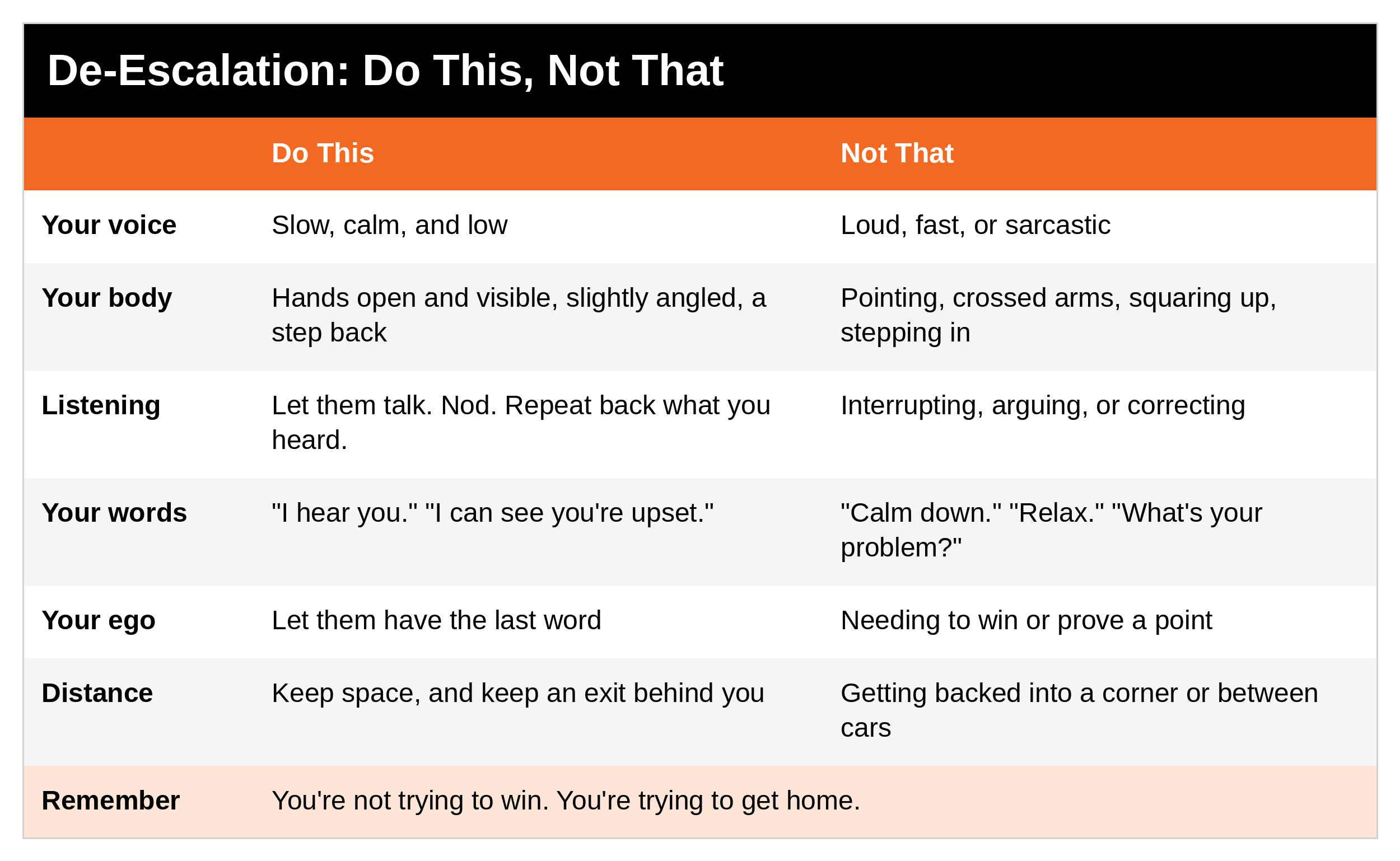
One of the most common mistakes is telling an upset person to "calm down." It almost never works. It tells them their feelings don't matter, and it usually makes things worse.
What to Say
You don't need a script, but it helps to have a few phrases ready, because under stress your mind can go blank.
Here are some words that work.
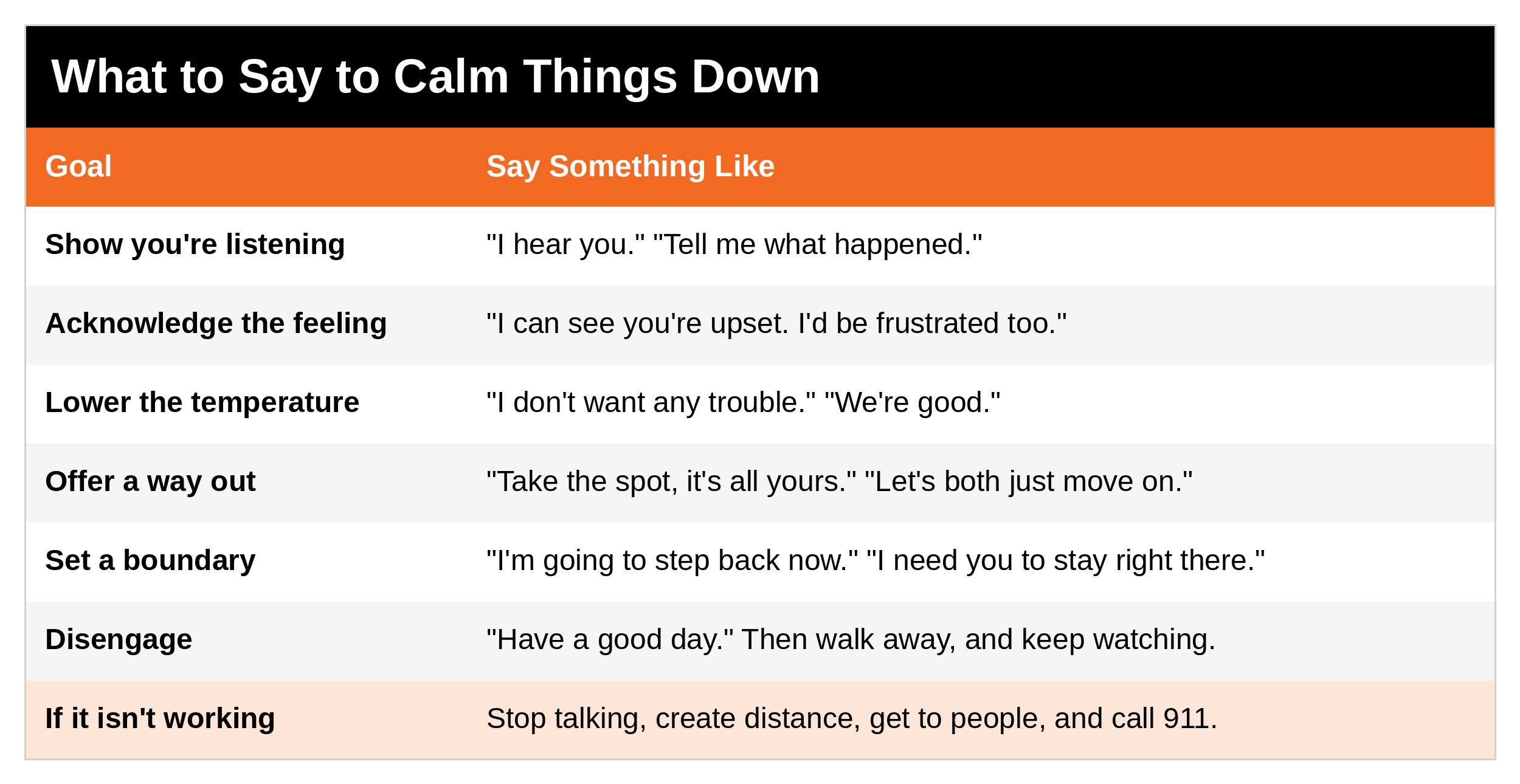
Know When to Stop Talking
De-escalation doesn't always work, and that's okay. It's a tool, not a promise. If any of these happen, stop talking and get out:
They keep closing the distance after you've stepped back.
Their hands are hidden, clenching, or reaching.
Someone else joins in or starts moving around you.
You see the warning signs from Part 5: a cluster of them, all at once.
At that point, create distance, get to people and light, and call 911. And remember the rule from Part 4: never go to a second location.
SCAN It
See your environment. Where are the exits, the people, and the barriers?
Create space. Step back and keep something between you.
Act deliberately. Slow, calm words. Then leave when you can.
Never doubt your gut feelings. If talking isn't working, trust that, and go.
5 Quick Wins You Can Start Today
Practice your phrases. Say "I hear you" and "I don't want any trouble" out loud a few times. It makes them easier to find under stress.
Lower your voice when theirs goes up. Calm is contagious, and so is anger.
Keep your hands open and visible. It shows you're not a threat without saying a word.
Always know your exit. In a store, a parking lot, or a restaurant, know which way you'd go.
Let the small stuff go. The parking spot, the last word, the rude comment. None of it is worth your safety.
What to Say: Escalating Your Response
If calming words aren't working, get firmer, and get ready to leave.
Safe and non-engaging
"You're right. I'm sorry about that." Then move on.
"Have a good day." Walk away, and keep watching.
Setting boundaries
"I'm going to step back now."
"I need you to stay right there."
If they persist
"STOP! BACK OFF!" Loud enough to draw attention.
Get to staff, security, or a crowd, and call 911.
Ask Yourself
When someone gets in my face, is my first instinct to calm it down or to win?
Do I have a few calming phrases ready, or would my mind go blank?
Have I taught my kids that walking away isn't weak?
Remember
You're not trying to win. You're trying to get home. Stay calm, let them talk, drop your ego, and protect your space. And when words stop working, stop talking and leave.
The Prepared Protector is someone who's decided that loving someone means being ready for them, not just hoping things go fine. Sometimes being ready means swallowing your pride and walking away.
Get Started Today
Start with the free Personal Safety and Awareness checklists from The Family Safety Toolkit. Simple checklists to help you and your family practice awareness every day. DM the word AWARE on Instagram or Facebook and I'll send it to you. [Get it here: LINK]
Go Deeper
Situational Awareness and Safe Family Travel Strategies. This post gives you the short version. The book walks through all nine de-escalation strategies in detail and shows how they connect to everything else in Lesson 1: the manipulation tactics, the reactionary gap, Cooper's Color Code and the OODA Loop, the Hostile Planning Cycle, and more than 40 pre-event indicators. Then it takes those skills on the road with vehicle safety, road rage, carjacking, and travel safety. [Get it here: https://store.bookbaby.com/book/situational-awareness-and-safe-family-travel-strategies]
Tools I recommend: The personal safety alarms, flashlights, and other everyday safety tools I recommend are in my Personal Safety Tools Amazon store. https://link.amazon/B0cVLeoJM
Related reading:
Situational Awareness, Part 6: Urban Pre-Attack Indicators https://www.preparednotparanoid.com/pnp-library/urban-pre-attack-indicators
Situational Awareness, Part 8: Awareness, Movement, and Vulnerability, Part 1 [LINK when posted]
Safe Family Travel, Part 1: Vehicle Safety and Road Rage [LINK when posted]
Disclaimer
This article is for general informational and educational purposes only. It is not a substitute for professional self-defense training, legal advice, or guidance from law enforcement. Self-defense laws vary, so check your state and county for the exact laws where you live. It's meant to start conversations in your family about staying aware and safe. Affiliate disclosure: I've linked to products from my Amazon store that I personally recommend. As an Amazon Associate, I earn from qualifying purchases, at no extra cost to you. Thank you for supporting my work.
If you're in danger right now, get to a safe place and call 911.
Awareness gives you time. Time gives you options.
The Prepared Protector is someone who's decided that loving someone means being ready for them, not just hoping things go fine.
Prepared Not Paranoid. Protecting the Most Vulnerable Among Us.