Street-Level Warning Signs, From Someone Who's Been There
By Larry Betz | Prepared Not Paranoid https://www.preparednotparanoid.com/
In Part 5, you learned the warning signs that show up before something happens. On busy city streets, those urban pre-attack indicators look a little different, and they can come together fast. This post is about reading a street the way a protection professional would, so you can spot trouble early and move before it reaches you.
How I Learned These the Hard Way
While digging through resources on hostile intent, I came across a list from ALIAS Training and Security Services called "Street-Level Hostile Intent Indicators." As I read it, something hit me hard: I had lived more than half of these in real life, and never knew what to call them. I just chalked it up to being street smart.
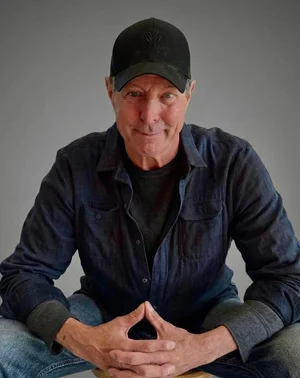
People sometimes ask, "Larry, were you in law enforcement?" No. I wasn't a cop, a soldier, or a bodyguard. I was an elevator mechanic, a tradesman working across New York City and the boroughs in the late 80s and 90s.
Many of the neighborhoods I worked in were blackouts after dark. Many buildings had no doorman, no security, and no help if something went sideways. I'd walk into projects where the stairwells were pitch black. Tradesmen like me got beat down just for their tools. One of my colleagues had an arrow shot at him from across a rooftop. We had no radios or cell phones. It was just me, a flashlight, and a tool bag, trying to get to the roof, fix the elevator, and get out of there.
So yes, I've lived many of these indicators. Not in theory. In real time. As a civilian.
You Are the Agent in Charge
In executive protection, the Agent in Charge is the person responsible for keeping the principal safe. On the street, you are the Agent in Charge of your family's safety. You don't get a briefing or a backup team, but the principles still apply: protect the people who matter most, avoid the threat, and stay ahead of the problem.
Read Behavior, Not Stereotypes
Every street has a baseline: its normal rhythm. How people move, where they gather, how fast the foot traffic flows, which cars are usually parked there. Some of that may look unusual to an outsider and still be completely normal for that block.
That's why the goal isn't to figure out who people are. It's to notice what changes. A lookout watching everyone but talking to no one. A group shifting to narrow the sidewalk. A car idling too long with people scanning instead of chatting. A busy block that suddenly goes quiet.
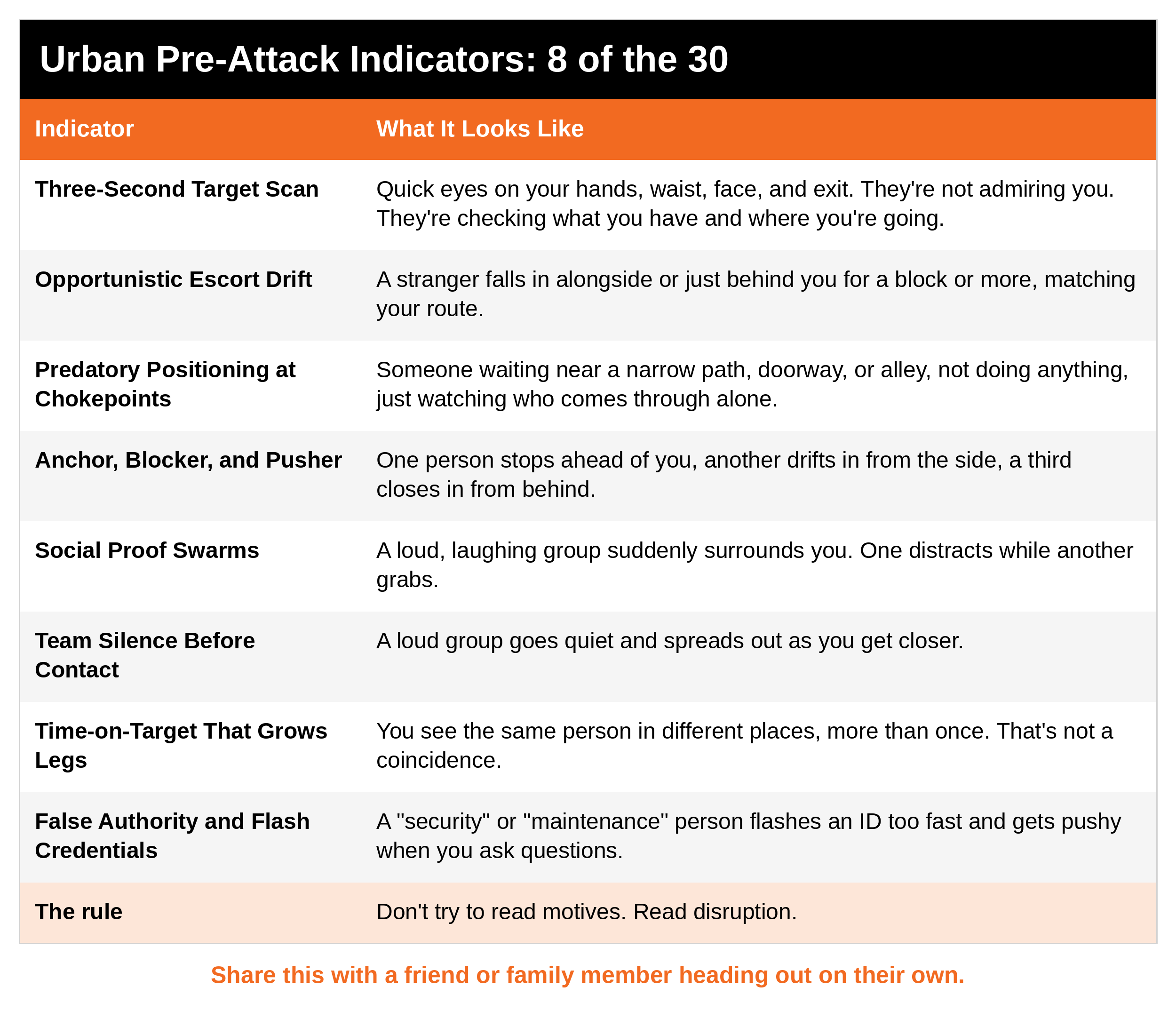
Don't try to read motives. Read disruption. One odd thing might be nothing. A cluster of them, especially with distance closing, is your cue to move.
8 of the 30
My full guide covers 30 street-level indicators.
Here are eight of them.
The 5 Core Responses
You don't need a different plan for every indicator. Most situations come down to the same five responses, used in different combinations.
Here they are.
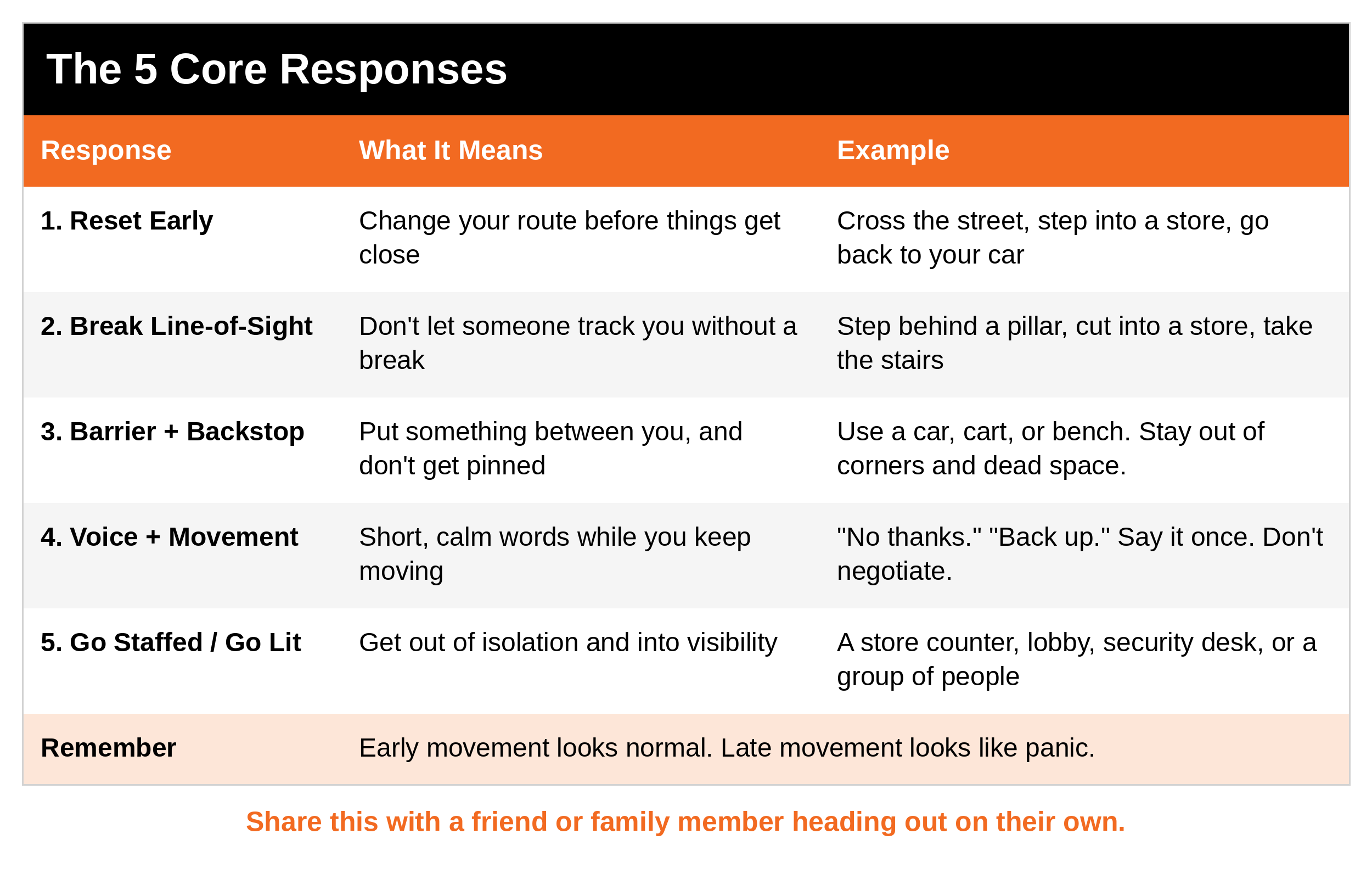
Early movement looks normal. Late movement looks like panic. Most people wait for certainty before they move. Predators count on that delay.
The Instinct Rule
Your instincts aren't magic. They're your brain noticing small shifts faster than you can explain them. Instincts aren't a verdict. They're a signal to take action.
If you feel it once: heighten your awareness and pick out your reset point: the nearest store, lobby, or group of people.
If it sticks around, or other signs stack up: Reset Early.
If someone is closing distance or getting into position: Barrier + Backstop, then Go Staffed / Go Lit.
If your instincts are wrong, you lose a few seconds. If they're right, you gain time, space, and control.
Stay Off the X
In protection circles, the "X" is the spot where an attack is most likely to happen. On the street, it isn't marked, but it's there: the dark stretch of sidewalk, the stairwell with no line of sight, the group tightening into a circle around you.
Staying off the X means don't linger in predictable spots, don't freeze when the energy shifts, and don't talk yourself out of what you're feeling. If something feels wrong, change your position. MOVE.
SCAN It
See your environment. Learn the baseline of the places you go.
Create space. Reset early, and use barriers.
Act deliberately. Go staffed, go lit. Say it once and keep moving.
Never doubt your gut feelings. You don't have to identify the threat. You just have to protect yourself and your family.
5 Quick Wins You Can Start Today
Pick your reset points. On any walk, notice the open stores, lobbies, and busy corners along the way.
Stay out of funnels. Don't stand still in narrow alleys, stairwells, or doorways.
Check behind you at turns. If the same person is still there after two or three turns, reset.
Verify before you trust. Real security, maintenance workers, and rideshare drivers expect to be checked. Fakes get irritated.
Move early. Crossing the street early looks normal. Running later looks like panic.
What to Say: Voice + Movement
You're not arguing. You're creating friction and drawing attention while you keep moving.
Safe and non-engaging
"No thanks." Keep walking.
"I can't help you."
Setting boundaries
"Stop right there."
"Back up."
If they persist
"BACK OFF!" Loud, so people around you notice.
Get to a store counter, lobby, security desk, or a group of people, and call 911.
Say it once. Keep moving. Don't negotiate.
Ask Yourself
Do I know the baseline of the streets my family walks every day?
Where are my reset points on my usual routes?
When something feels off, do I wait for certainty, or do I move early?
Remember
The best kind of self-defense is the situation that never happens, because you saw it coming and made the smart move first. Read behavior, not stereotypes. Watch for disruption. Reset early, and stay off the X.
The Prepared Protector is someone who's decided that loving someone means being ready for them, not just hoping things go fine. On the street, that means being the Agent in Charge.
Get Started Today
Start with the free Personal Safety and Awareness checklists from The Family Safety Toolkit. Simple checklists to help you and your family practice awareness every day. DM the word AWARE on Instagram or Facebook and I'll send it to you. [Get it here: LINK]
Go Deeper
Situational Awareness and Safe Family Travel Strategies. The book gives you the foundation this post is built on: the manipulation tactics, Cooper's Color Code and the OODA Loop, the Hostile Planning Cycle, more than 40 pre-event indicators, de-escalation, and vehicle and travel safety. [Get it here: https://store.bookbaby.com/book/situational-awareness-and-safe-family-travel-strategies]
Coming in the 2nd edition: the complete Urban Pre-Attack Indicators chapter, with all 30 street-level indicators, a real-world example for each one, and exactly what to do when you see it.
Tools I recommend: The personal safety alarms, flashlights, and other everyday safety tools I recommend are in my Personal Safety Tools Amazon store. https://link.amazon/B0cVLeoJM
Related reading:
Situational Awareness, Part 5: Decoding Danger https://www.preparednotparanoid.com/pnp-library/decoding-danger-pre-event-indicators
Situational Awareness, Part 4: Don't Look Like a Target https://www.preparednotparanoid.com/pnp-library/dont-look-like-a-target
Situational Awareness, Part 7: De-Escalation [LINK when posted]
References
ALIAS Training and Security Services. Street-Level Hostile Intent Indicators. https://www.cvrtoprtv.com/p/street-level-hostile-intent-indicators-
Disclaimer
This article is for general informational and educational purposes only. It is not a substitute for professional self-defense training, legal advice, or guidance from law enforcement. It's meant to start conversations in your family about staying aware and safe. Affiliate disclosure: I've linked to products from my Amazon store that I personally recommend. As an Amazon Associate, I earn from qualifying purchases, at no extra cost to you. Thank you for supporting my work.
If you're in danger right now, get to a safe place and call 911.
Awareness gives you time. Time gives you options.
The Prepared Protector is someone who's decided that loving someone means being ready for them, not just hoping things go fine.
Prepared Not Paranoid. Protecting the Most Vulnerable Among Us.