The Warning Signs That Show Up Before Something Happens
By Larry Betz | Prepared Not Paranoid https://www.preparednotparanoid.com/
Violence rarely comes out of nowhere. Before something happens, there are often warning signs, called pre-event indicators. Learning to spot them gives you something priceless: the chance to leave before you ever need to defend yourself.
This isn't about suspecting everyone. It's about noticing when something doesn't fit, and trusting yourself enough to act on it.
Start With Baseline
Security professionals use the word baseline to describe what's normal for a place. In a coffee shop, people chat, read, and look at their phones. In a parking lot, people walk to their cars and load bags. Once you know what's normal, what's out of place jumps out.
Here's what that looks like in a few everyday places.
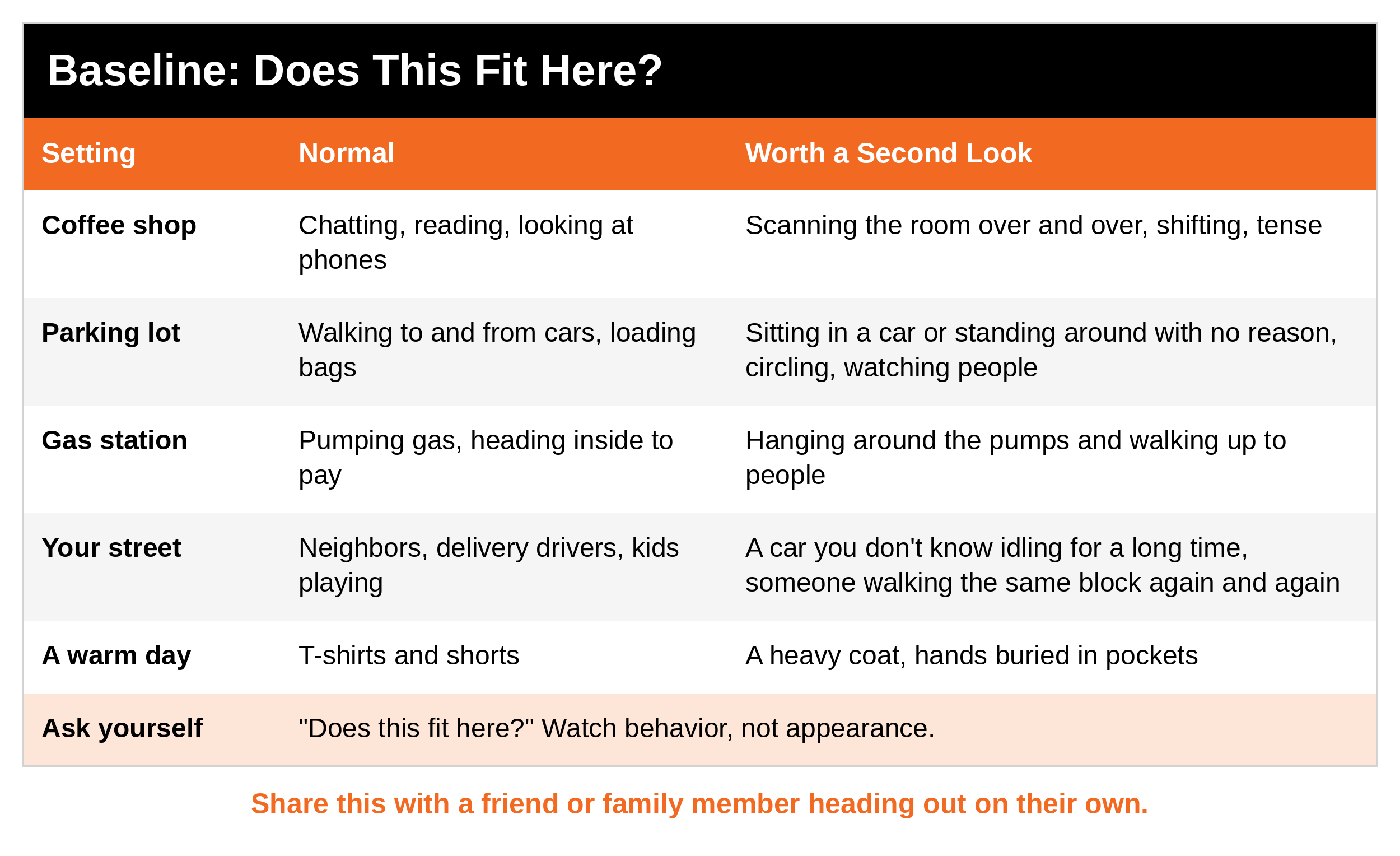
Context matters. A man adjusting his coat in the snow is normal. Doing it over and over on a warm day while glancing around is worth a second look. And always watch behavior, not appearance. How someone acts tells you far more than how they look.
Look for Clusters
One odd behavior by itself usually means nothing. People touch their faces, fidget, and look around all the time. What matters is clusters: several signs showing up together.
Someone glancing around isn't a warning. Someone glancing around, keeping his hands hidden, pacing, and watching the same person over and over? That's a cluster, and it's your cue to move.
Your Body Gives It Away, and So Does Theirs
When someone is preparing to do something violent, their body often gives them away. The anticipation triggers the same fight-or-flight response you'd feel in an emergency: a pounding heart, faster breathing, tunnel vision, sweating, and tense muscles. Many people try to burn off that energy without realizing it, by pacing, fidgeting, rubbing their hands, or touching their face and neck.
Even people who think they're hiding it usually can't fully control it. The body often shows what the mind is trying to hide.
Where to Look: Face, Hands, Face
If something feels off, start with the face, move to the hands, and go back to the face. Hands are what hurt you, so watch them.
Here are a few of the signs to watch for.
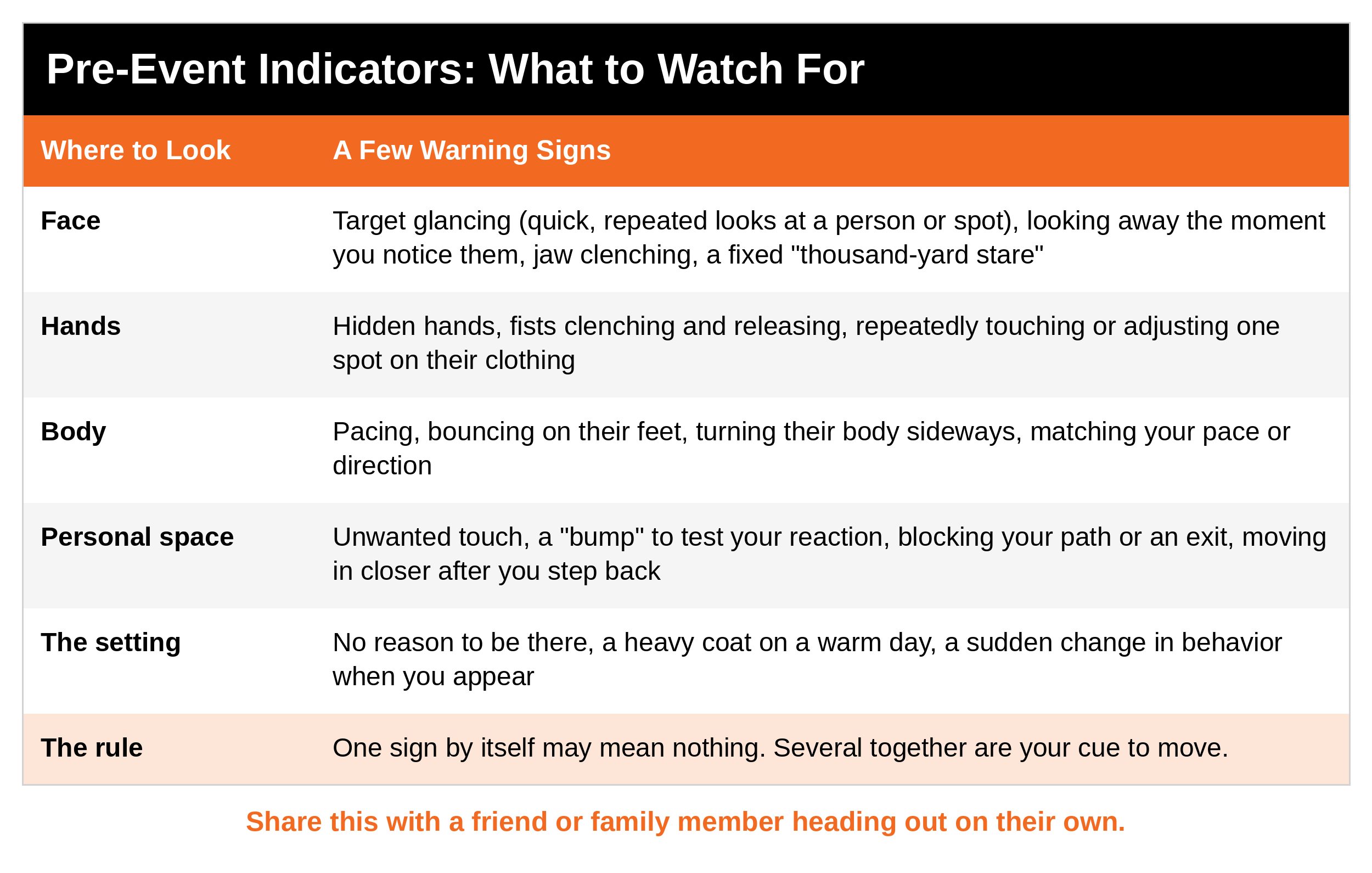
That's only a sample. My book covers more than 40 of these signs, but you don't need to memorize them all. You need to notice when something doesn't fit, and trust your gut when it tells you so.
SCAN It
See your environment. Know what's normal so you notice what isn't.
Create space. If you spot a cluster, put distance between you right away.
Act deliberately. Change your route, go inside, find staff, or leave.
Never doubt your gut feelings. Your subconscious often picks up the signs before your conscious mind can name them.
5 Quick Wins You Can Start Today
Play "does this fit here?" Wherever you are, take a few seconds to notice what's normal.
Watch hands. Make it a habit to notice where people's hands are.
Sit where you can see the door. In restaurants and waiting rooms, face the entrance when you can.
Notice changes. When someone's behavior suddenly shifts, like going quiet, getting up, or turning toward you, pay attention.
Teach your kids to notice. Games like Kim's Game train young eyes to spot details, without scaring anyone.
What to Say: When You've Spotted a Cluster
The best response is usually no response: just leave. If someone engages you, keep it short.
Safe and non-engaging
Say nothing. Change direction and walk with purpose.
"Excuse me." Keep moving toward the exit or other people.
Setting boundaries
"I don't want any trouble."
"Please stay where you are."
If they persist
"STOP! BACK OFF!" Loud enough that people around you notice.
Get to staff, security, or a crowd, and call 911.
Ask Yourself
Do I know what "normal" looks like in the places my family goes every week?
When something feels off, do I wait for proof, or do I move?
Have I taught my kids to notice what doesn't fit?
Remember
Danger often gives a warning. Your job is to notice it. Know what's normal, look for clusters, watch the hands, and trust your gut. You don't need proof to leave.
The Prepared Protector is someone who's decided that loving someone means being ready for them, not just hoping things go fine. Noticing early is how you buy the time to keep them safe.
Get Started Today
Start with the free Personal Safety and Awareness checklists from The Family Safety Toolkit. Simple checklists to help you and your family practice awareness every day. DM the word AWARE on Instagram or Facebook and I'll send it to you. [Get it here: LINK]
Go Deeper
Situational Awareness and Safe Family Travel Strategies. This post gives you a sample. The book gives you all of it: more than 40 pre-event indicators in five groups, the face, the hands, the body, personal space, and the setting, each one explained, including grooming behaviors, the signs of a concealed weapon, and the subtle signals people use to coordinate. It also covers de-escalation, the Hostile Planning Cycle, and vehicle and travel safety. [Get it here: https://store.bookbaby.com/book/situational-awareness-and-safe-family-travel-strategies]
Tools I recommend: The personal safety alarms, flashlights, and other everyday safety tools I recommend are in my Personal Safety Tools Amazon store. https://link.amazon/B0cVLeoJM
Related reading:
Situational Awareness, Part 4: Don't Look Like a Target https://www.preparednotparanoid.com/pnp-library/dont-look-like-a-target
Situational Awareness, Part 6: Urban Pre-Attack Indicators.
Kim's Game: How to Teach It to Your Kids [LINK]
Disclaimer
This article is for general informational and educational purposes only. It is not a substitute for professional self-defense training, legal advice, or guidance from law enforcement. It's meant to start conversations in your family about staying aware and safe. Affiliate disclosure: I've linked to products from my Amazon store that I personally recommend. As an Amazon Associate, I earn from qualifying purchases, at no extra cost to you. Thank you for supporting my work.
If you're in danger right now, get to a safe place and call 911.
Awareness gives you time. Time gives you options.
The Prepared Protector is someone who's decided that loving someone means being ready for them, not just hoping things go fine.
Prepared Not Paranoid. Protecting the Most Vulnerable Among Us.