Part 2: Traveling Abroad Prepared
Get Known, Stay Connected: The Embassy Connection, Your Family Check-In Plan, and the Evacuation Surprise
By Larry Betz | Prepared Not Paranoid https://www.preparednotparanoid.com/
In Part 1, I admitted that if something goes bad overseas, I want to see a few U.S. Marines immediately. I stand by that. But since the Marines are busy guarding the embassy, the next best thing is making sure the people inside that embassy know my name, know I'm in the country, and know how to reach me.
STEP gets you on the radar. This part is about going one step further, and building the plan your family falls back on when the phones start buzzing.
Getting Known: The "Presence List" Idea
You may hear experienced travelers and expats talk about getting on an embassy's "presence list." Here's what that really means, without the hype.
It's not an official program you can sign up for. There's no form for it. What travelers usually mean is that the consular section (the part of the embassy that helps U.S. citizens) knows who you are because you've been in touch. Depending on the embassy, that might mean you hear about:
Town halls and security briefings for U.S. citizens
Voting assistance for Americans overseas
Community events (the Fourth of July party is a classic)
Local updates that don't rise to the level of a formal alert
Every embassy handles this differently, and many don't keep anything like it. But introducing yourself costs nothing, and it matters most if you're:
Staying long term (expat, student, contractor, retiree)
Traveling somewhere unstable or unfamiliar
Traveling with kids or someone with medical needs
Working with an NGO, church group, or business abroad
How to Do It
Enroll in STEP first (see Part 1). That's the foundation.
Find the embassy or consulate for your destination at usembassy.gov.
Follow the embassy's website and social media for local updates.
Send a short, polite email to the consular section introducing yourself.
Sample Email
Subject: U.S. Citizen in [City] - Would Like to Stay Informed
Dear Consular Section,
I'm a U.S. citizen [visiting / living in] [City, Country] from [dates], and I have enrolled in STEP. I'd appreciate being included in any updates, briefings, or events the embassy offers for U.S. citizens in the area.
Thank you for your time and the work you do.
Sincerely, [Your Full Name] [Phone number while in country]
Important: Don't email your passport number, Social Security number, or financial information. If the embassy needs identifying details, they'll tell you how to provide them securely.
Your Family Check-In Plan
STEP and the embassy connection help the government find you. Your check-in plan helps your family find each other. Set it up at the kitchen table before you leave:
1. Pick one emergency contact back home. Everyone checks in with that one person instead of trying to reach each other when local networks are jammed. Give them a copy of your itinerary.
2. Set a check-in rhythm. For example, one text each evening. Simple. If it doesn't come, they know something's off.
3. Decide what happens after a missed check-in. Write it down: call the traveler, then call the hotel, then contact the U.S. embassy or the State Department's emergency line.
4. Pick a meeting spot. One near your hotel and one central landmark, in case your group gets separated and phones aren't working.
5. Carry it on paper. Every family member gets a card with the hotel address (in the local language), the embassy address and phone, your emergency contact, and the State Department emergency numbers below. Phones die. Paper doesn't.
The Numbers Every Traveler Should Have
If you can't reach the U.S. embassy or consulate in an emergency, the State Department says to call:
From the U.S. or Canada: 1-888-407-4747
From overseas: +1-202-501-4444
Write them on the card. Save them in your phone. Give them to your emergency contact back home.
The Evacuation Surprise
Here's something almost nobody knows until they need it: if the U.S. government helps evacuate you from a crisis, it usually isn't free.
According to the State Department, U.S. law requires evacuation help to be provided "on a reimbursable basis to the extent practicable." In practice:
You'll typically sign a promissory note (Form DS-5528) and get billed later, based on the commercial airfare before the crisis started, or the actual cost if that's lower.
You're usually taken to a nearby safe location, not home. Lodging, food, and your flight back to the U.S. are on you.
Unpaid bills can affect your passport until you set up a payment plan.
I'm not telling you this to scare you. I'm telling you because it changes how you plan:
Look at travel insurance that includes emergency evacuation coverage, and read what it actually covers (medical evacuation and security evacuation aren't always the same thing).
Keep a credit card with available room for an emergency.
Keep copies of your passport and documents stored securely, separate from the originals.
Remember: The embassy can help you get out. Your plan determines how prepared you are when you land on the other side.
Putting It Together: Your Overseas Safety Net
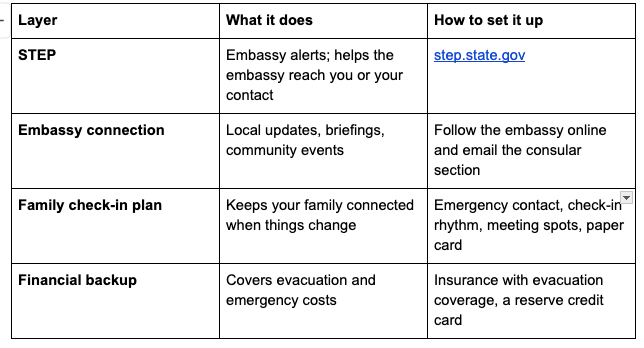
The Bottom Line
You don't need to be afraid of traveling. The world is full of places worth seeing with the people you love. But the families who handle a crisis abroad best are the ones who decided ahead of time what they'd do.
So enroll in STEP. Introduce yourself to the embassy. Set up the check-in plan. And if you ever do see those Marines at the embassy gate, thank them, because they're there for all of us.
The prepared protector is someone who's decided that loving someone means being ready for them, not just hoping things go fine.
Awareness gives you time. Time gives you options.
Ask Yourself
Does my emergency contact back home have our full itinerary?
Does every family member have a paper card with the emergency numbers?
Does my travel insurance cover evacuation, and do I know what kind?
If we got separated and our phones died, where would we meet?
Go Deeper
Everything in this series is covered in more depth in Situational Awareness and Safe Family Travel Strategies, including overseas planning, communication backups, choosing hotels abroad, and what to do when plans change. [Get the book here: LINK]
Planning a trip? The Security-Focused Travel Planner puts your itinerary, lodging, contacts, medical information, and contingency plans in one place. [Get it here: LINK] (Tip: it holds sensitive information, so keep it encrypted or printed and stored securely. Don't email it unencrypted.)
Want a free place to start? Grab my Grey Man Pocket Guide. [CTA: Comment or DM "[KEYWORD]" / or download it here: LINK]
References and Links
U.S. Department of State. Smart Traveler Enrollment Program (STEP). https://travel.state.gov/content/travel/en/international-travel/before-you-go/step.html
STEP enrollment: https://step.state.gov
U.S. Department of State. For Evacuated Citizens (evacuation costs, repayment, and emergency phone numbers). https://travel.state.gov/content/travel/en/international-travel/emergencies/for-evacuated-citizens.html
U.S. Embassies and Consulates directory: https://www.usembassy.gov
U.S. Department of State. Travel Advisories. https://travel.state.gov
U.S. Marine Corps Embassy Security Group. What Is MSG Duty. https://www.mcesg.marines.mil/Become-a-MSG/Requirements
Disclaimer
This article is for general informational and educational purposes only. It is not legal, financial, or insurance advice and is not a guarantee of safety. Government programs, procedures, and costs change, so always confirm current details directly with the U.S. Department of State, the U.S. embassy or consulate for your destination, and your insurance provider. Prepared Not Paranoid and Larry Betz are not affiliated with the U.S. government and are not responsible for the content of third-party websites linked here.
If you are in immediate danger, contact local emergency services. U.S. citizens abroad who need emergency help can call 1-888-407-4747 from the U.S. or Canada, or +1-202-501-4444 from overseas.
Prepared Not Paranoid. Protecting the Most Vulnerable Among Us.