How STEP Works and What to Do When an Alert Hits Your Phone
By Larry Betz | Prepared Not Paranoid https://www.preparednotparanoid.com/
The Smart Traveler Enrollment Program is a free, ten-minute step that puts your family on the U.S. embassy's radar before you travel. If something goes wrong overseas, it's how the embassy knows you're there, and how the warning reaches your phone.
I'll be honest with you. If I'm in another country and something bad happens, I want to see a few U.S. Marines as fast as humanly possible. Big ones. Squared away. Preferably looking at whatever the problem is and not at me.
Here's the funny part, and it's also the true part: that's not actually their job.
The Marine Security Guards at a U.S. embassy are there to protect the embassy, its people, and classified information. They don't drive around town checking hotels for Americans. If trouble starts, the Marines are guarding the building, and the people inside that building are trying to figure out which Americans are in the country, where they are, and how to reach them.
If they don't know you're there, you're not on their list.
That's where a free program called STEP comes in. Most travelers have never heard of it, and it takes about ten minutes to set up.
What Is the Smart Traveler Enrollment Program?
The Smart Traveler Enrollment Program (STEP) is a free service from the U.S. Department of State. When you enroll, you get email updates and alerts from the U.S. embassy or consulate where you're traveling, covering things like:
Security threats and demonstrations
Health alerts and disease outbreaks
Severe weather and natural disasters
Travel Advisory updates
Routine embassy services
Here's the big one: STEP helps the embassy contact you, or your emergency contact back home, if something happens. Natural disaster, civil unrest, a family emergency back home. If the embassy needs to find you, STEP is how they start.
Why I Put This on Every Overseas Checklist
I spent years as a Safety Director in the elevator industry, and one lesson stuck with me: in an emergency, people don't rise to the occasion. They fall back on whatever they set up beforehand. If nothing was set up, there's nothing to fall back on.
STEP is one of those things you set up beforehand. It costs nothing, it takes minutes, and it puts you on the radar of the one office in that country whose job is helping Americans.
The Prepared Protector sets it up before the trip, so when the phones start buzzing, the family has something to fall back on.
How to Enroll (The Current Version)
The State Department launched a new STEP system in September 2024. If you enrolled before that, your old enrollment didn't carry over. You need to sign up again.
Start here: step.state.gov (this takes you to the enrollment page at mytravel.state.gov/s/step)
You have two options:
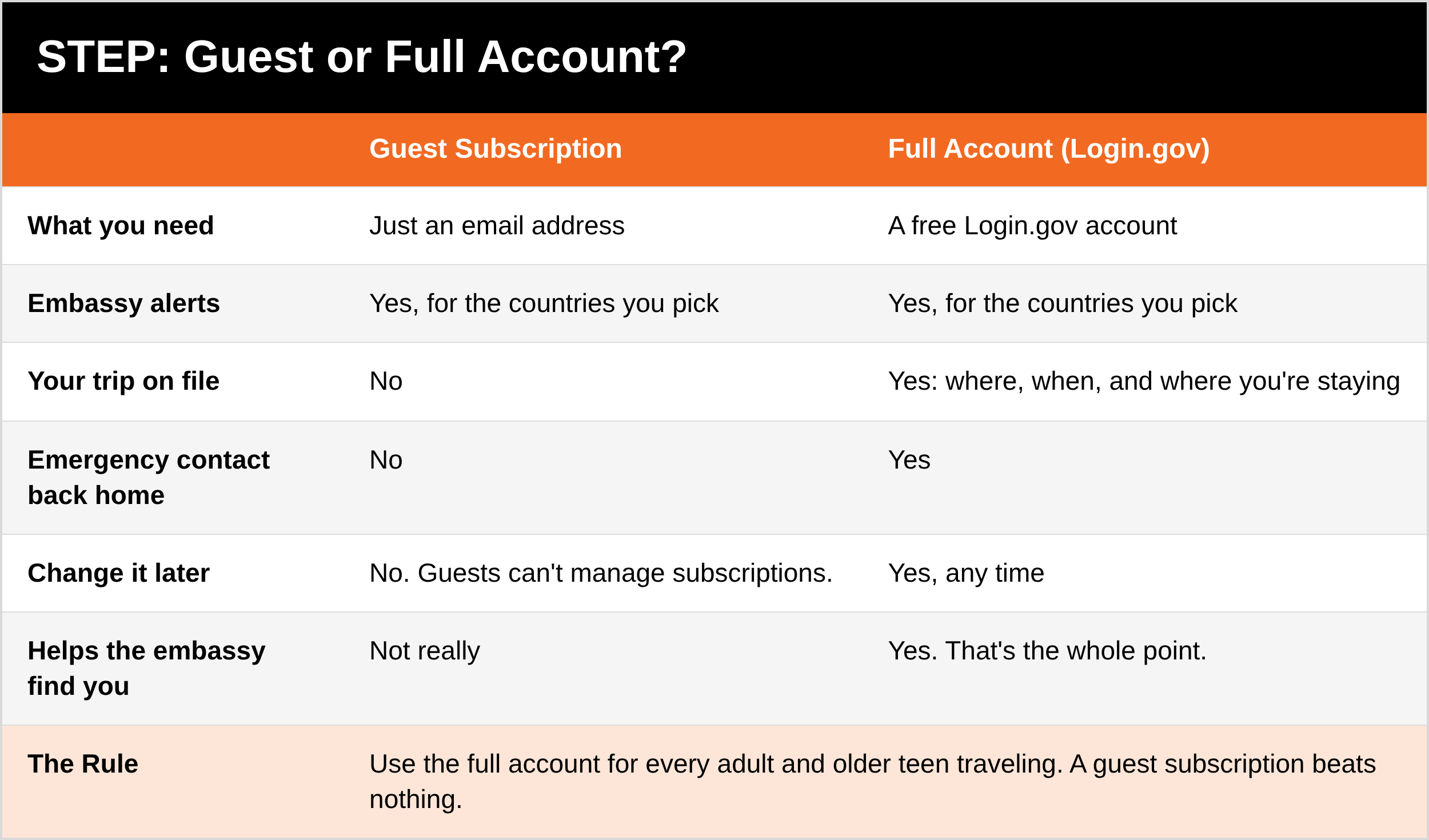
Option 1: Guest subscription (alerts only). Sign up with just your email to get alerts for the countries you choose. No account needed. Quick, but the embassy won't have your trip details.
Option 2: Full account with Login.gov (my recommendation). Create a free, secure Login.gov account. That lets you register your actual trip: where you're going, when, and where you're staying. This is the version that helps the embassy find you.
Have this ready before you start:
Your destinations (you can add more than one country or trip)
Arrival and departure dates
Where you're staying (hotel, rental, or address)
An emergency contact back home
How long you want alerts for each country
For families and groups:
Every adult and older teen with a phone should have their own enrollment, so alerts reach them directly, not just the person who planned the trip.
Traveling with a group (school trip, church group, family reunion)? STEP has a group enrollment option where one organizer enrolls everyone and each traveler accepts by email. Have each traveler's details and email address ready.
You can change your subscriptions or unenroll at any time with a full account.
"Are They Tracking Me?"
I get this question a lot, and it's a fair one.
STEP is voluntary. Your information is protected under the Privacy Act, and the State Department says it won't share it with third parties without your written permission, except in the situations the law allows. Its stated purpose is helping U.S. citizens during emergencies and coordinating evacuations.
The full privacy statement is on the STEP information page if you want to read it yourself. My take: if a disaster hits where you are, you want the embassy to know you exist. That's the trade.
When an Alert Hits Your Phone: The First 10 Minutes
Getting enrolled is only half of it. The real advantage is knowing what to do the moment an alert shows up, because the first few minutes are when most people panic, guess, or start moving without a plan.
Here's where SCAN comes in, the framework I teach in Navigating the Red Zone and Beyond: See your environment, Create space, Act deliberately, Never doubt your gut feelings.
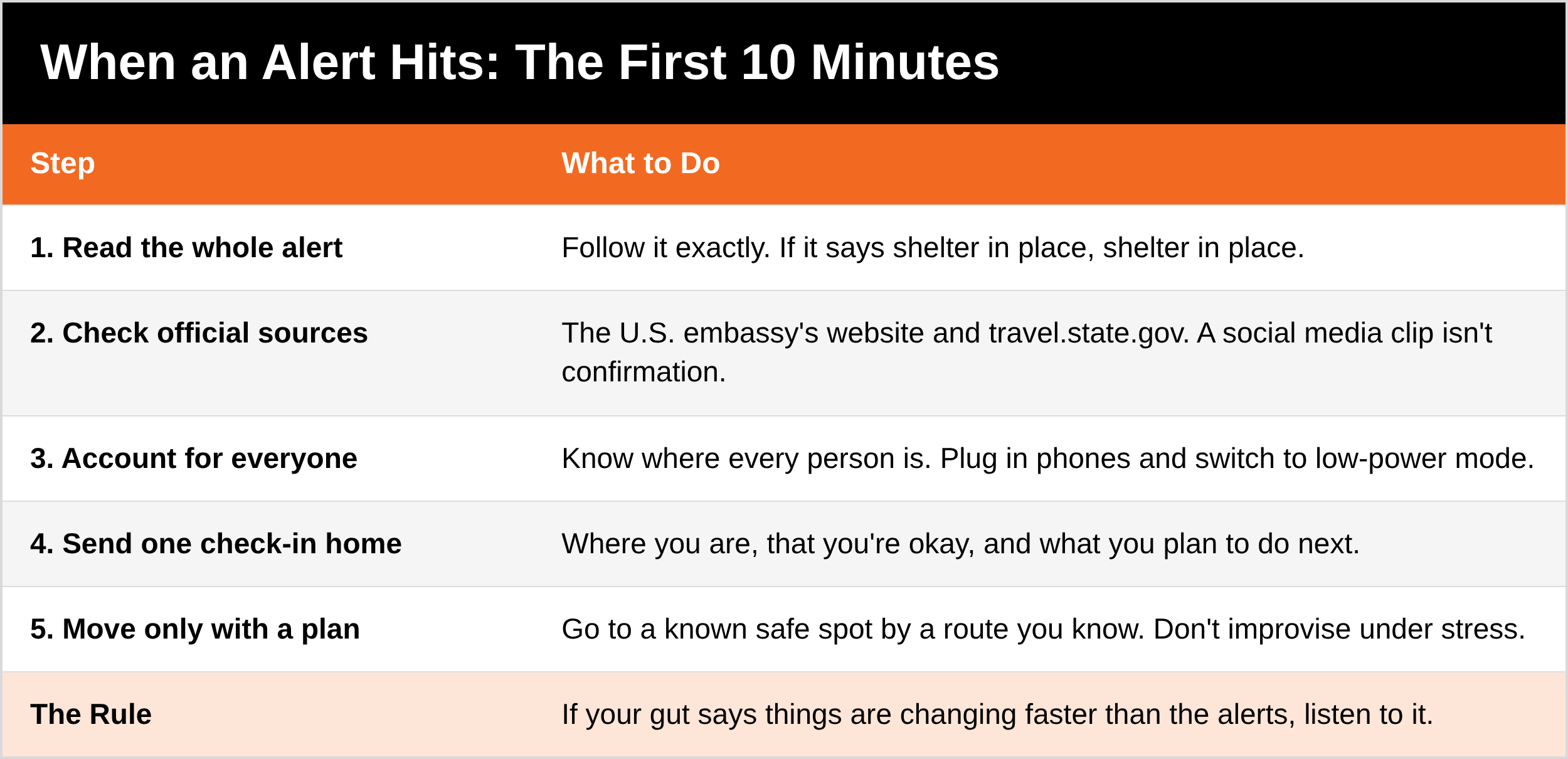
Stop and read the whole alert. Follow what it says. If it says shelter in place, shelter in place. If it says avoid an area, don't try to "beat the crowd" through it.
Check official sources, not rumors. Open the U.S. embassy's website or social accounts for that country, and check travel.state.gov. A video clip on social media is not confirmation.
Account for everyone. Where is every member of your group right now? Check phone batteries. Plug in and switch to low-power mode.
Send one check-in message home. A short status update to your emergency contact: where you are, that you're okay, and what you plan to do next.
Move only with a plan. If you need to relocate, go to a known safe spot (the hotel lobby or security desk, a meeting point you picked ahead of time, or wherever official guidance tells you). Don't improvise new routes under stress. Act deliberately.
What if something in your gut says the situation is changing faster than the alerts? Listen to it. Never doubt your gut feelings.
Ask Yourself
If I enrolled in STEP before September 2024, have I re-enrolled?
Does everyone in my family have alerts on their own phone?
Does my emergency contact back home know my itinerary?
Do we know where we'd go if we had to leave our hotel quickly?
What to Say
"Before we leave, everybody's getting the embassy alerts on their own phone. If one comes in, nobody moves until we've read it together and checked in."
5 Quick Wins You Can Start Today
Enroll in STEP at step.state.gov, or re-enroll if you signed up before September 2024.
Create a free Login.gov account so you can register your full trip.
Enroll every adult and older teen on their own phone.
Give your emergency contact back home your itinerary.
Pick a meeting spot near your hotel before you need one.
Remember: STEP gets the warning to you. Your plan decides what you do with it.
Coming Up in Part 2
Getting known by the embassy beyond STEP (what some travelers call a "presence list"), the family check-in plan that keeps everyone connected, and one thing about evacuations that surprises almost everyone: they usually aren't free.
Get Started Today
My free Grey Man Pocket Guide gives you simple habits for traveling without advertising that you're a tourist.
DM the word GREYMAN on Instagram or Facebook and I'll send it to you. [Get it here: LINK]
Go Deeper
Situational Awareness and Safe Family Travel Strategies walks you through planning a trip the way a security professional would: destination research, lodging, transportation, communication plans, and what to do when plans change. [Get it here: https://store.bookbaby.com/book/situational-awareness-and-safe-family-travel-strategies]
Planning a trip? My free Security-Focused Travel Planner puts your itinerary, lodging, contacts, medical information, and backup plans in one place. [Get it here: LINK] (Tip: it holds sensitive information, so keep it encrypted or printed and stored securely. Don't email it unencrypted.)
Tools I recommend: the luggage locks, trackers, power banks, and travel safety gear I recommend are in my Travel Safety Amazon store. https://link.amazon/B023guhPk
The Full Series
Traveling Abroad Prepared, Part 1: Get On the Radar (you are here)
Traveling Abroad Prepared, Part 2: Get Known, Stay Connected [LINK]
Related Reading
Safe Family Travel, Part 6: Traveling Overseas [LINK]
Emergency Communications, Part 8: Staying Connected Overseas [LINK]
Safe Family Travel, Part 11: Airport and Travel Day Safety [LINK]
References
U.S. Department of State. Smart Traveler Enrollment Program (STEP): https://travel.state.gov/content/travel/en/international-travel/before-you-go/step.html
STEP enrollment: https://step.state.gov (enrollment page: https://mytravel.state.gov/s/step)
University of Central Florida Global. Launch of the New Smart Traveler Enrollment Program (STEP): Re-Enroll Now (reposting the State Department's September 16, 2024 announcement): https://global.ucf.edu/launch-of-the-new-smart-traveler-enrollment-program-step-re-enroll-now
U.S. Marine Corps Embassy Security Group. What Is MSG Duty: https://www.mcesg.marines.mil/Become-a-MSG/Requirements
U.S. Department of State. Travel Advisories: https://travel.state.gov
Disclaimer: This article is for general informational and educational purposes only. It is not legal advice and is not a guarantee of safety. These suggestions are intended to help you and your family build awareness, confidence, and safer decision-making habits. No safety plan, checklist, or training can guarantee 100% protection. Government programs, websites, and procedures change, so always confirm current details directly with the U.S. Department of State and the U.S. embassy or consulate for your destination. Laws vary by country, and by state and county at home, so check the rules where you're going and where you live. Prepared Not Paranoid and Larry Betz are not affiliated with the U.S. government and are not responsible for the content of third-party websites linked here. As an Amazon Associate, I earn from qualifying purchases.
If you are in immediate danger, contact local emergency services. U.S. citizens abroad who need emergency help can call 1-888-407-4747 from the U.S. or Canada, or +1-202-501-4444 from overseas.
Awareness gives you time. Time gives you options.
The Prepared Protector is someone who's decided that loving someone means being ready for them, not just hoping things go fine.
Prepared Not Paranoid. Protecting the Most Vulnerable Among Us.