From the Curb to the Carousel: Moving Through the Airport With Your Family
By Larry Betz | Prepared Not Paranoid https://www.preparednotparanoid.com/
The best airport safety tips aren't about the plane. They're about the transitions: the curb, the checkpoint, the gate, and baggage claim. That's where bags disappear, kids wander, and your guard drops.
An airport is one of the most distracting places you'll ever take your family. Thousands of people, announcements, lines, screens, and a clock that's always ticking. Everyone is focused on their own trip, their phone, and their gate. That's exactly why it's a good place for a thief, and an easy place to lose track of a child.
The good news: a few simple habits, planned before you leave home, cover most of what can go wrong.
Before You Leave Home
Check your ID. Since May 7, 2025, adults need a REAL ID-compliant license (or a passport) to fly within the U.S. TSA doesn't require kids under 18 to show ID on domestic flights when they're with an adult, but airlines can have their own rules, so check with yours.
Check your airline's arrival time. Many suggest about 2 hours for domestic flights and 3 for international. Rushing is when people make mistakes.
Track your bags. Put an AirTag or tracker in each checked bag.
Tag smart. Use a bright, easy-to-spot luggage tag with your name, phone, and email. Skip your home address. It tells a stranger where an empty house is.
Don't post that you're leaving. Post the vacation photos after you're home. (The Home Vacation Checklist in The Family Safety Toolkit covers getting the house ready. [LINK])
Pack your power and your papers in your carry-on. Spare lithium batteries and power banks have to go in your carry-on, not checked bags. Keep passports, medications, and a change of clothes for the kids there, too.
Traveling with a firearm? Firearms and Family Safety, Part 12: Traveling With a Firearm walks you through it. [LINK]
Every Transition Is a Gap
In the Situational Awareness series, we talked about transition zones, the moments you move from one place to another. Your attention is split, your hands are full, and you're thinking about what's next instead of what's around you. Travel day is nothing but transition zones, one after another.
The fix isn't to be on high alert for 12 hours. It's to slow down for a few seconds at each transition, count heads and bags, and then move.
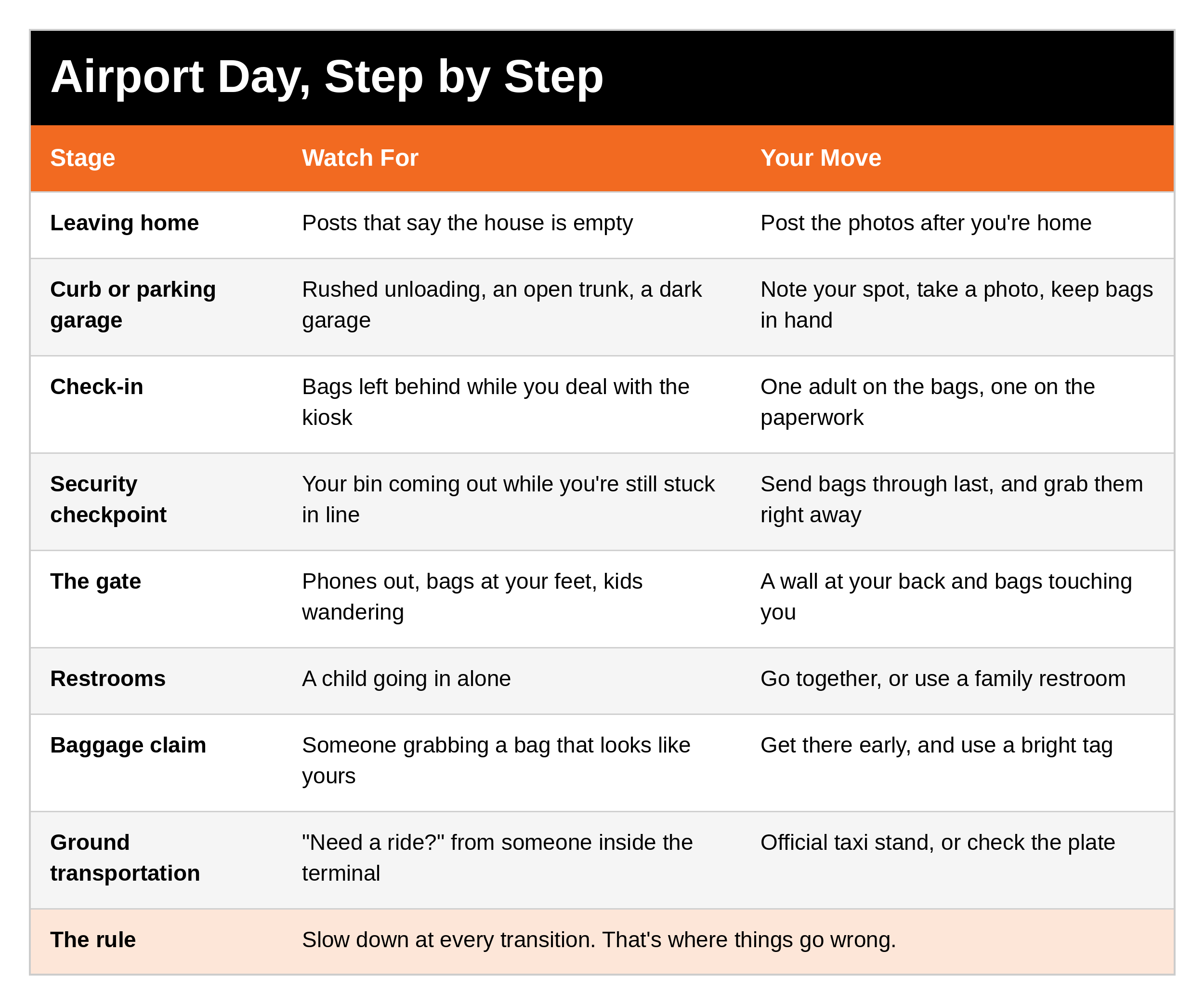
Here's the whole day, step by step.
The Curb and the Parking Garage
Drop-off is chaos: open trunks, bags on the sidewalk, kids climbing out on the traffic side. One adult unloads; the other holds the kids. If you're parking, take a photo of your spot and the level sign, and walk to the terminal with your bags in hand, not stacked on a cart you can't watch. (Parking-lot habits from Part 4 apply here: the 10-Second Rule before you get out of the car.)
The Security Checkpoint
The checkpoint is where your stuff is most exposed. Your laptop, phone, wallet, and passport sit in open bins on a belt, while you're stuck in the body scanner line, sometimes with a child who's melting down.
Put your bags on the belt last, right before you walk through, so they don't come out the other side long before you do.
Put wallets, phones, and passports inside your bag, not loose in a bin.
With two adults, split it: one goes through first to meet the bags, and the other stays with the kids.
Grab everything and step away to repack. Count your bins before you leave.
Use the family lane if your airport has one.
The Gate
You'll probably spend more time at the gate than anywhere else. Pick a seat with a wall at your back and a clear view of the gate and the walkway. Keep your bags touching you, with a strap around your foot or the chair leg. Never leave a bag "for a second" to grab a coffee.
Keep your eyes up, too. Remember the phone moment from Part 10: a stranger can read your screen, your boarding pass, and your plans from a few feet away.
Restrooms
Don't send young kids into an airport restroom alone. Go together, or use a family restroom, which most large airports have. A portable stall door lock is a small add for privacy on public restroom doors that don't latch well.
On the Plane
Keep your passport, phone, wallet, and medications on you, not in the overhead bin. And go easy on the drinks. Alcohol hits harder at cabin altitude, and the moment you land is when your guard is lowest. (Part 10 covers alcohol, altitude, and the landing-phone moment.)
Baggage Claim
Get to the carousel early. Bags that look alike get grabbed by mistake, and sometimes not by mistake. A bright tag or a strap makes yours easy to spot. Check the tag before you walk away, and keep the kids next to you, not by the belt.
Ground Transportation
Be careful with anyone who walks up to you inside the terminal offering a ride. Legitimate drivers don't usually work that way. Use the official taxi stand, a car service you booked, or a rideshare. For a rideshare, match the plate, the car, and the driver's name before you open the door, and ask, "Who are you here for?" instead of saying your name first.
If We Get Separated
Losing sight of a child in an airport is every parent's nightmare. A crowd, a turned head, and they're gone in seconds. The plan has to be made before you get to the airport, and the kids need to know it. Use the same family code word and hand rule from Part 5.
Here's the plan.
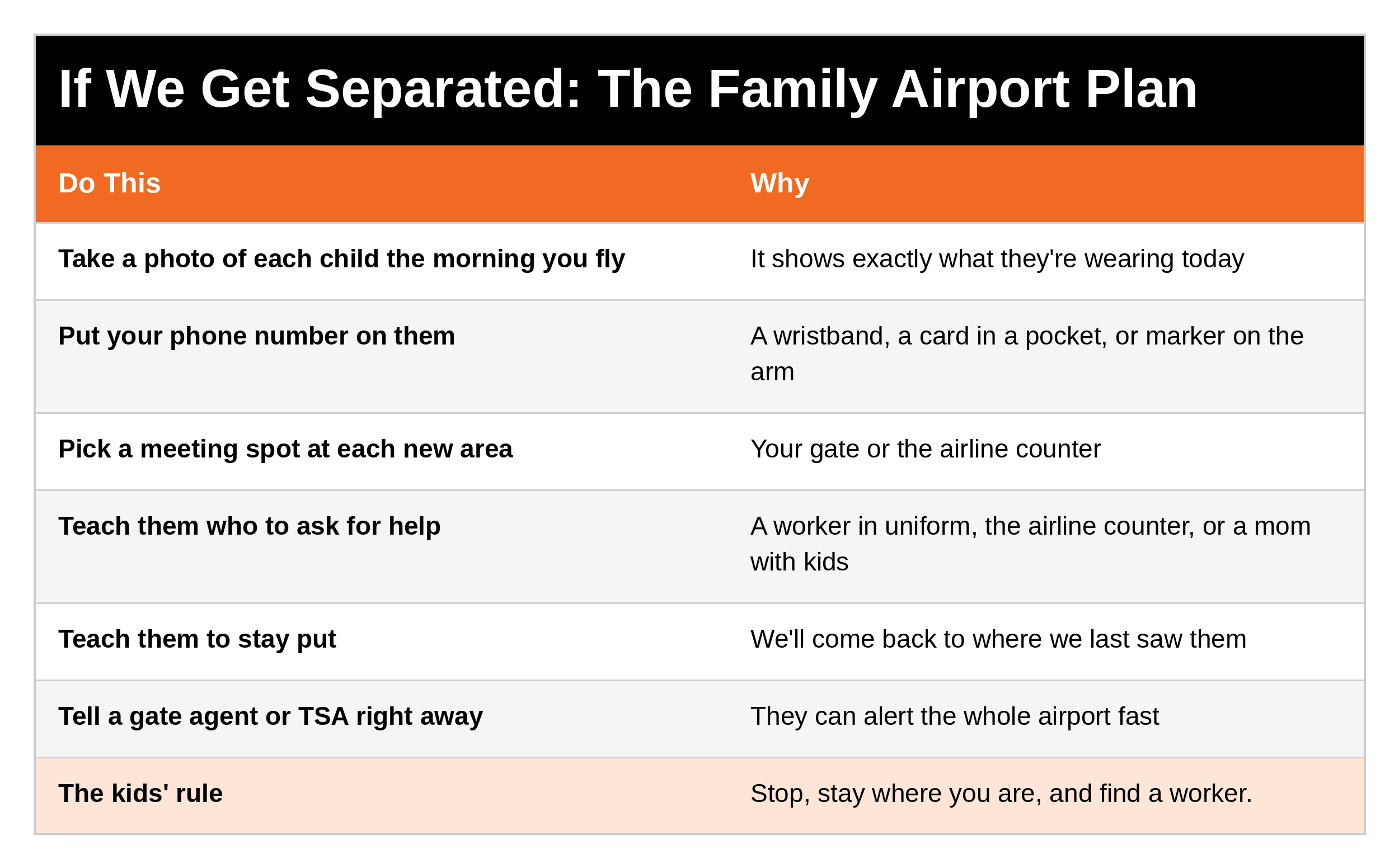
If a child is missing, don't spend minutes searching on your own. Tell the nearest gate agent, TSA officer, or airport police officer right away. They can alert the whole airport, and airports have procedures for exactly this.
The Prepared Protector Counts Heads
At every transition, the Prepared Protector does a quiet count: one, two, three kids. Two carry-ons. Passports. Phone. It takes three seconds at the curb, at the checkpoint, at the gate, and at the carousel. Nobody else in the family even notices, and that's fine. The count is how small problems get caught before they become big ones.
The Whole Series in One Place
This is the last part of the Safe Family Travel series. Here's everything, from the driveway to your destination:
Vehicle Safety and Road Rage [LINK]: positioning, safe distances, and what to do when another driver loses it
Driving in Bad Weather and Road Hazards [LINK]: floods, dust storms, snow, and when the car fails
Carjacking [LINK]: warning signs and how to protect your family
Protective Strategies for Family Travel [LINK]: the warrior mindset, the 10-Second Rule, and reading the room
Moms on the Move [LINK]: harassment on the subway or bus with little ones in tow
Traveling Overseas [LINK]: how not to look like a tourist, and how to plan like a protection detail
Choosing Safe Lodging [LINK]: chains vs. off-brand vs. Airbnb
Hotel Security [LINK]: from the parking lot to lights out
Hidden Cameras [LINK]: where they hide and how to find them
Travel Digital Defense [LINK]: Wi-Fi, USB charging, and Faraday bags
Airport and Travel Day Safety: you're here
What to Say
At the checkpoint
To the other adult: "You go first and grab the bags. I've got the kids."
At the gate
If someone's hovering near your bags: "Excuse me, those are ours." Then pull them in close.
On the curb
To someone offering a ride inside the terminal: "No thanks, we're all set." Keep walking to the official taxi stand.
To a rideshare driver: "Who are you here to pick up?" If the name's wrong, don't get in.
SCAN It
S, See your environment: At every transition, look up: the curb, the checkpoint, the gate, the carousel.
C, Create space: A wall at your back at the gate, bags touching you, and kids between you and the crowd.
A, Act deliberately: One adult on the bags, one on the kids. Count heads and bags before you move.
N, Never doubt your gut feelings: If a "helpful" stranger, a ride offer, or a person near your bags feels off, step away and find staff.
5 Quick Wins You Can Start Today
Check that your ID is REAL ID-compliant before your next flight.
Put an AirTag or tracker in every checked bag.
Take a photo of each child the morning you fly.
Write your phone number on a card in each child's pocket.
Practice "Stop, stay, and find a worker" with your kids before the trip.
Ask Yourself
If my child got separated at the airport, would they know what to do?
Who in my family watches the bags at the checkpoint, and who watches the kids?
Do my luggage tags tell a stranger where my empty house is?
Remember
Travel day doesn't have to be stressful. Plan it at home, slow down at every transition, and count heads and bags before you move. Then sit back and enjoy the trip you planned.
Get Started Today
Get the free Travel Safety checklists. Simple, practical checklists for safer family trips, including the Security-Focused Travel Checklist and the Travel Essentials Checklist. DM the word [KEYWORD] on Instagram or Facebook and I'll send them to you. [Get them here: LINK]
Go Deeper
Situational Awareness and Safe Family Travel Strategies. This series gives you the highlights. The book gives you the whole system: airport and travel safety, protective strategies for your family, vehicle safety and carjacking, traveling overseas, hotel and Airbnb security, hidden cameras, digital defense, and the complete Security-Focused Travel Itinerary Guide. [Get it here: https://store.bookbaby.com/book/situational-awareness-and-safe-family-travel-strategies]
Tools I recommend: The AirTags, bright luggage tags, luggage locks, kids' ID wristbands, power banks, and stall door locks I recommend are in my Travel Safety Amazon store. https://link.amazon/B023guhPk
Related reading:
Safe Family Travel, Part 10: Travel Digital Defense [LINK]
Safe Family Travel, Part 5: Moms on the Move [LINK]
Safe Family Travel, Part 4: Protective Strategies for Family Travel [LINK]
Situational Awareness, Part 10 (transition zones) [LINK]
Firearms and Family Safety, Part 12: Traveling With a Firearm [LINK]
References
Transportation Security Administration. REAL ID and Traveling with children. https://www.tsa.gov/
U.S. Department of Homeland Security. REAL ID enforcement (May 7, 2025).
Federal Aviation Administration. Lithium batteries in carry-on baggage. https://www.faa.gov/hazmat/packsafe
Betz, L. Situational Awareness and Safe Family Travel Strategies.
Betz, L. Navigating the Red Zone and Beyond (SCAN framework).
Disclaimer
This article is for general informational and educational purposes only. It is not a substitute for official TSA, airline, or airport guidance. Travel rules, ID requirements, and security procedures change, and airlines and airports set some of their own, so check current rules before you fly. Laws on traveling with firearms and other items vary by state, county, and country, so check them before you go. Prepared Not Paranoid and Larry Betz are not affiliated with TSA, any airline, or any airport and are not responsible for the content of third-party websites or resources linked here. Affiliate disclosure: I've linked to products from my Amazon store that I personally recommend. As an Amazon Associate, I earn from qualifying purchases, at no extra cost to you. Thank you for supporting my work.
If you're in danger or a child is missing, tell the nearest airport staff or police officer right away, or call 911 (or the local emergency number when you're overseas).
Awareness gives you time. Time gives you options.
The Prepared Protector is someone who's decided that loving someone means being ready for them, not just hoping things go fine.
Prepared Not Paranoid. Protecting the Most Vulnerable Among Us.