Red Cell Your Family: Part 2
Find Your Family's Tells: What Your Daily Routine Gives Away
By Larry Betz | Prepared Not Paranoid https://www.preparednotparanoid.com/
Back when I drove a tow truck, I could tell a lot about a driver before I ever spoke to them. The stickers on the bumper. The parking pass on the mirror. The gym bag in the back seat. The car seat. Nobody told me any of it. Their car did.
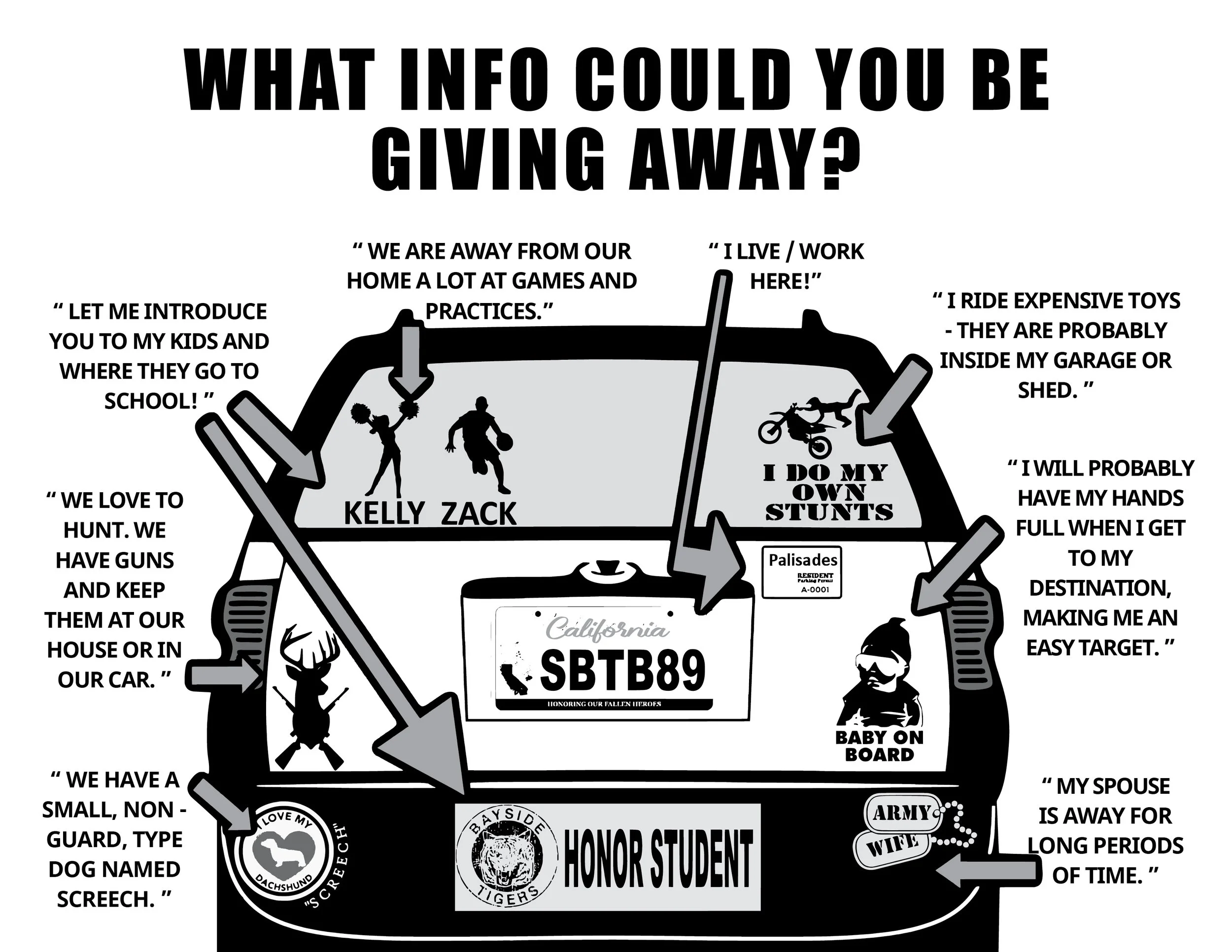
Your family is broadcasting information all day long, too. When you leave. When you come home. Who's alone, and when. Where the kids practice on Tuesdays.
In poker, a tell is a habit that gives away your hand. In red-celling, a tell is any habit, pattern, or detail that tells an outsider something useful about your family.
In Part 1, we covered the mindset. Now let's find your tells.
Step 1: Set Your Scope
Before you start, decide what you're protecting most. Be specific:
Young children from an unauthorized pickup or abduction
An aging parent who lives alone
The house from burglary or package theft
The family from scams and online exposure
Everyone during wildfire season or a long power outage
Then decide who's helping. Your spouse, an adult child, or a trusted friend can see things you've stopped noticing.
Pick an observation window:
One day for a quick overview
One week to see your real routine
Two weeks to catch the difference between weekdays and weekends
What you need: a notebook or spreadsheet, your phone camera, and a simple sketch of your house and street.
Step 2: Document Your Baseline
You can't fix what you haven't written down. For one week, track your family the way someone outside would.
Departures and Arrivals
Write down when each person leaves and comes home. You'll probably find something like this:
"Leaves for work at 7:15 every weekday. Kids on the bus by 7:40. House empty until 3:10."
That's a schedule a stranger could learn in three days of driving past.
Vehicles
Where do your cars park, and can they be seen from the street?
Is a garage opener clipped to the visor of a car parked outside?
Do you leave anything in plain view (bags, laptops, packages, a work badge)?
People Who Come and Go
Dog walkers, house cleaners, lawn crews, caregivers, contractors. Their regular visits can tell an outsider when you're not home. Write down who comes when, and who has a key or a code.
Children and Teens
Bus stops, walking routes, practice times, and the places they hang out
Are there predictable times when they're alone?
Are they sharing locations or checking in on social media?
What You Share
Does anyone in the house post schedules, travel plans, or real-time locations?
Can a stranger find your address, your workplace, or your kids' school from your social media?
Step 3: Look for the Tells
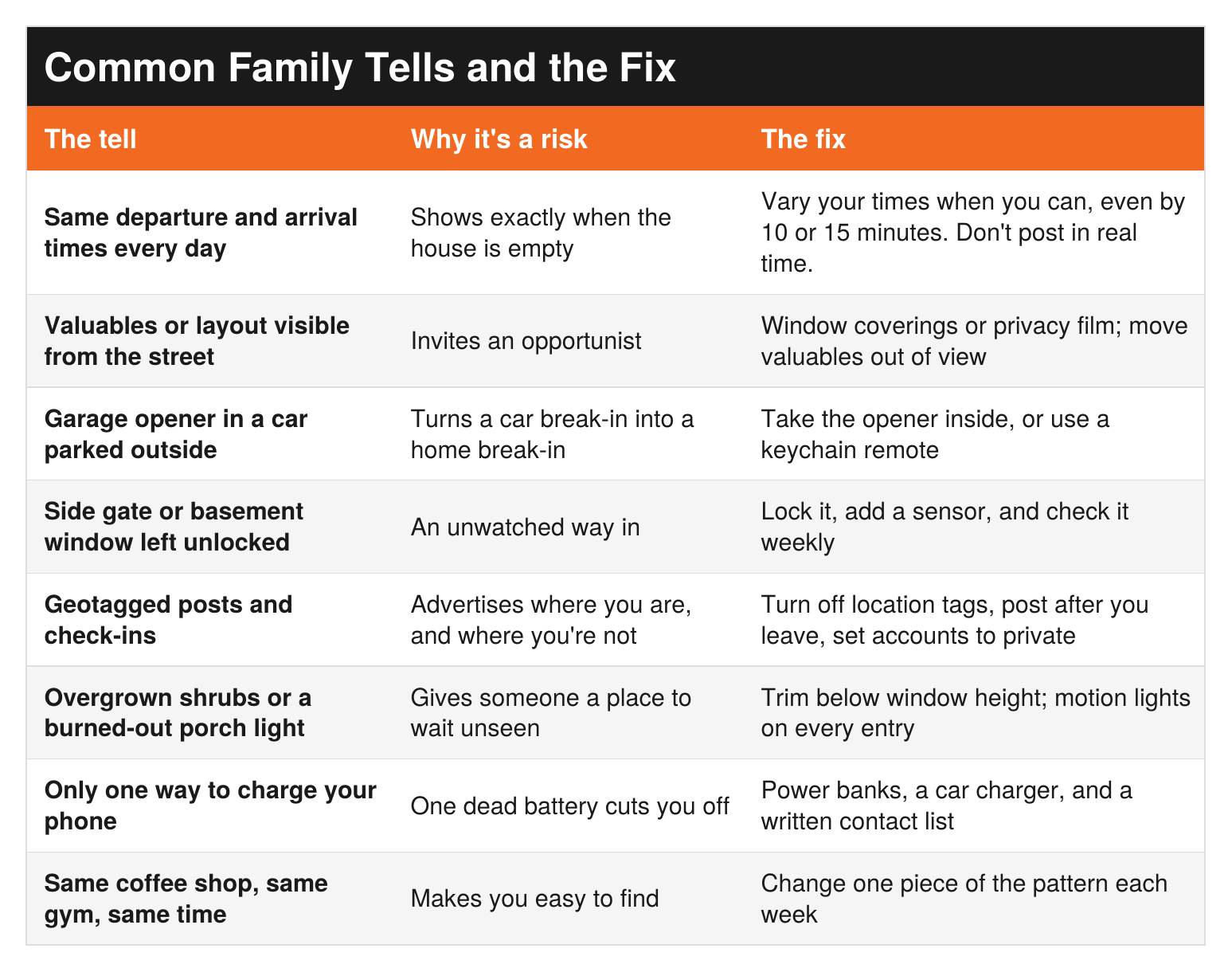
Now read your notes like an outsider would. Here are the most common family tells I see, and what to do about each one.
Step 4: Rate Each Tell
For every tell you find, write down:
What it is: "Garage opener left in the car in the driveway"
Where: "Driveway"
When: "Every night"
How visible it is: "Seen from the sidewalk"
How serious it is:
High: easy to use and would cause real harm
Medium: some risk, takes effort to use
Low: unlikely or minor
The fix, and when you'll do it
You'll use this list in Part 7 to build your plan.
What if Your Routine Can't Change?
Most of us can't change when work starts or when school lets out. That's fine. You don't have to be random. You just have to be less readable.
Change the small things:
The route you drive, a few days a week
Where you park
Which door you use
Whether the house looks empty (lights on timers, a car in the driveway, blinds that aren't always in the same position)
A threat watching your house is looking for certainty. A little uncertainty is often enough to make them move on.
The Weakest Link Is Usually a Habit
You can install cameras, reinforce doors, and arm an alarm, and all of it helps. But the things criminals and scammers count on most are habits:
The gate left open "just for a minute"
The vacation photo posted from the beach
The software update you keep putting off
The password you use everywhere
The thought that "it won't happen to us"
Security isn't just what you install. It's what you do every day.
Ask Yourself
If someone watched my house for a week, could they tell me when it's empty?
What does my car say about my family to anyone walking by?
Who outside my family knows our schedule, and do they need to?
Remember: Your routine is talking. Make sure it isn't telling strangers when you're gone.
Find Your Tells in 20 Minutes
The free Red Cell Family Audit has a full section on routines, plus five other areas most families overlook. Take it before you go any further.
[CTA: Comment or DM "REDCELL" / or download it here: LINK]- Coming Soon!
Go Deeper
Learning to read your own patterns, and the people around you, is what my book Situational Awareness and Safe Family Travel Strategies teaches step by step. [Get the book here: LINK]
Want ready-made checklists for the house, the car, and travel? The Family Safety Toolkit has 20 of them in one place. [Get the Toolkit here: LINK]
Tools I recommend: Visit my Amazon store for the products I recommend for keeping your family safe: the Children's Safety store [AMAZON CHILDREN'S SAFETY STORE LINK] and the Senior Safety store [AMAZON SENIOR SAFETY STORE LINK].
Related reading:
Situational Awareness and Movement series [LINK]
Drones Over Your Home, Part 4: A Drone Is Hovering Over My House. Now What? [LINK]
Coming Up in Part 3
Red Cell Your House. We'll walk your property the way a burglar would, from the street to the back door.
References
Kuhns, J. B., Blevins, K. R., and Lee, S. (2012). Understanding Decisions to Burglarize from the Offender's Perspective. UNC Charlotte. https://inside.charlotte.edu/news-features/2013-05-15/through-eyes-burglar-study-provides-insights-habits-and-motivations
Ready.gov, Make a Plan: https://www.ready.gov/plan
Disclaimer
This article is for general informational and educational purposes only. It is not a substitute for a professional security assessment or law enforcement guidance. If you notice someone repeatedly watching your home or following your family, write down what you see and contact your local police.
If you are in immediate danger, call 911.
Awareness gives you time. Time gives you options.
The prepared protector is someone who's decided that loving someone means being ready for them, not just hoping things go fine.
Prepared Not Paranoid. Protecting the Most Vulnerable Among Us.