Red Cell Your Family: Part 3
Red Cell Your House: Seeing Your Home Through a Burglar's Eyes
By Larry Betz | Prepared Not Paranoid https://www.preparednotparanoid.com/
As a firearms instructor, I get a lot of questions about home defense. My answer usually surprises people. The best home defense plan is one where nobody chooses your house in the first place.
Make your home a hard target.
That doesn't take a fortune. It takes looking at your house the way someone looking for an easy target would, and then taking away what they're counting on.
In Part 2, you found your family's tells. Now let's walk your property.
Why This Matters More Than You Think
Many people picture a burglary happening while the family is away. Often it is. But according to the U.S. Bureau of Justice Statistics, a household member was home during about 28 percent of burglaries, and in about 7 percent of all burglaries, someone in the home was the victim of violence.
That's why a hard target matters. It protects your stuff, and it protects your people.
The Burglar's Walk-Around
Do this twice: once in daylight and once after dark. Start at the street and work your way in. Bring your phone and take pictures of anything that bothers you.
From the Street
What can you see through the windows? TVs, computers, a home office, the gun safe?
Is there a sign your family is away (stacked packages, a full mailbox, the same lights on day and night)?
Is your house number easy to read for police and EMS?
The Approach
Can someone walk up to a door or window without being seen by neighbors or passing cars?
Are there tall shrubs, fences, or walls that hide doors and windows?
Where are the dark spots at night?
The Entry Points
Count every way in: front door, back door, garage, side doors, sliders, basement windows, ground-floor windows, the doggy door, and second-floor windows near a roof or a tree.
Doors and Locks
Most forced entries come through a door, and most doors fail at the frame, not the lock.
Solid-core or metal exterior doors
Deadbolts with at least a 1-inch throw on every exterior door
Reinforced strike plates held in with 3-inch screws that reach the wall framing. This is one of the cheapest, most effective upgrades you can make.
Hinge screws replaced with long screws too, and security hinge pins on outward-swinging doors
Sliding doors: a security bar or dowel in the track, plus an anti-lift device
The door from the garage into the house treated like a front door, with a deadbolt and a solid door
Garage doors: zip-tie or shield the emergency release so it can't be pulled from outside; turn on the remote lockout when you travel
Windows
Locks on every ground-floor window and any window reachable from a roof, deck, or tree
Security film on glass near door locks and on hidden windows, so breaking the glass takes longer and makes more noise
Window sensors on lower floors if you have an alarm
The Yard: Designing Out Crime
There's a field called Crime Prevention Through Environmental Design (CPTED). The idea is simple: shape your property so it's hard to approach unseen.
Trim shrubs below window height and trees up to about 7 feet, so nobody can hide in them
Keep clear sightlines from the street and neighbors' houses to your doors
Layer your lighting: path lights, entry lights, and motion lights on every side of the house
Gravel near windows and side paths makes quiet approaches noisy
Lock side gates and put away ladders and tools a burglar could use
Cameras and Alarms
Cameras that capture faces at the doors, not just the tops of heads from a high corner
Cover the blind spots: side yards, back gate, garage
Store footage in more than one place (cloud plus local), so stealing the camera doesn't steal the evidence
A monitored alarm if you can, with yard signs and window stickers that match
Test it every few months: sensors, batteries, and who gets the alert
Know your plan when it goes off. Who checks the app? Who calls police? Who doesn't go investigating alone?
Skip the fake cameras. They create a false sense of security, and experienced criminals often spot them.
And remember from the burglar study in Part 1: most burglars said they'd check for an alarm first, and many said an alarm would send them somewhere else. Visible deterrents work best when they're backed by real security.
Secure Storage
A bolted-down safe for firearms, passports, important papers, and emergency cash
Firearms stored according to your state's laws, locked and out of reach of children
Skip the obvious hiding spots: master bedroom dresser, nightstand, freezer, and the closet shelf
Copies of important records kept somewhere else (more on that in Part 7)
Don't Forget What's Above You
In my Drones Over Your Home series, I talked about what your backyard looks like from 100 feet up. Pool, skylights, second-story windows, where the cars park, packages on the porch. Add it to your walk-around: what could someone learn from above? Shade sails, patio covers, and trees go a long way.
Common House Tells and Quick Fixes
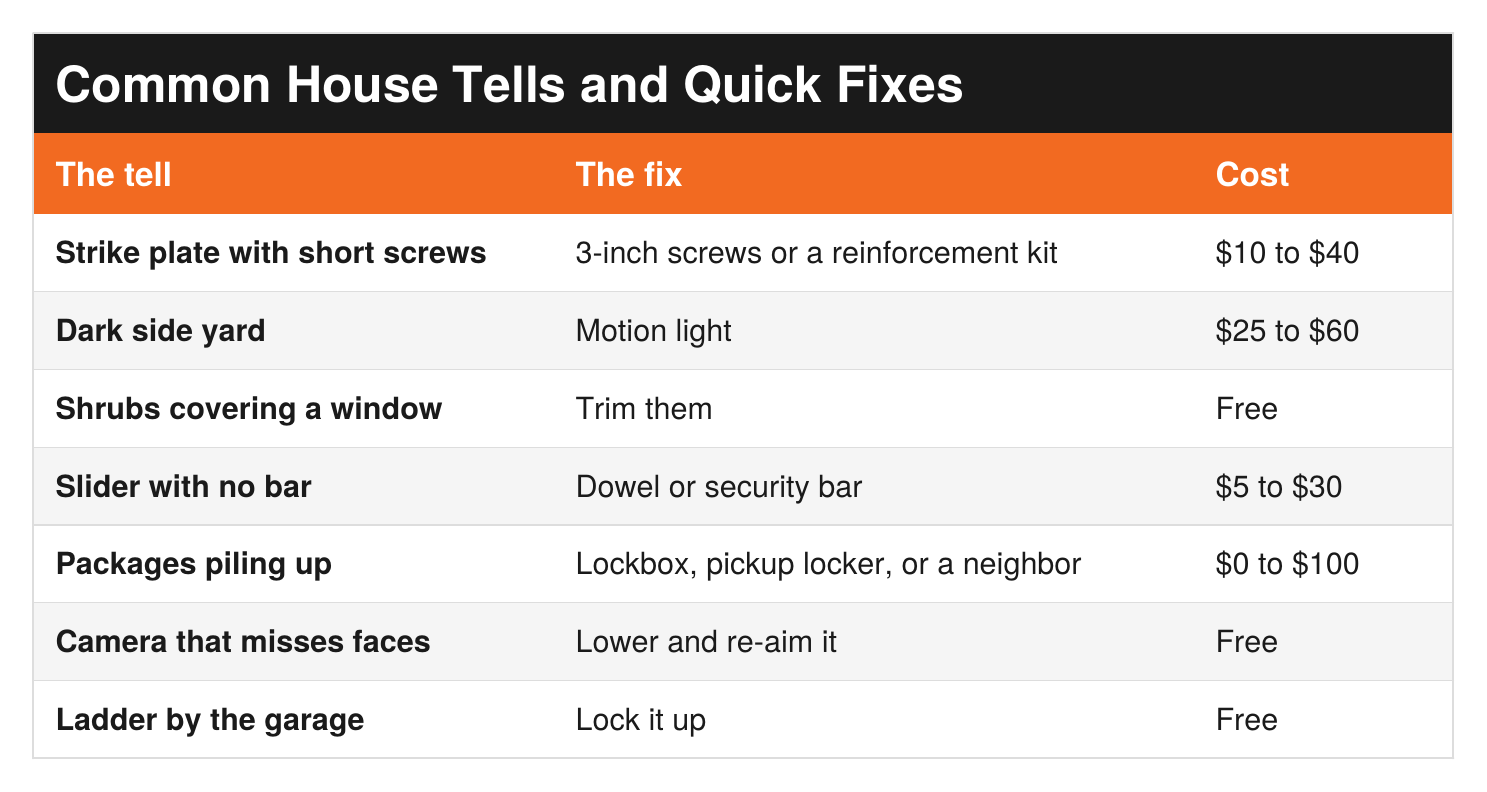
Sometimes the best fixes are usually the cheapest.
Ask Yourself
If I wanted to get into my own house without a key, how would I do it?
Which door would I pick if I didn't want anyone to see me?
If my alarm went off at 2 a.m., does everyone know exactly what to do?
Remember: A burglar is shopping for the easy house. Your job is to make sure yours isn't on the list.
Score Your House
Part 2 of the free Red Cell Family Audit covers your doors, windows, yard, and cameras in seven quick questions.
[CTA: Comment or DM "REDCELL" / or download it here: LINK]- COMING SOON!
Go Deeper
This post covers the walk-around. The Safest House on the Block covers everything else: room-by-room hardening, the four layers of home security, safe rooms, home Wi-Fi security, vacation protection, and a full home security audit. [Get The Safest House on the Block here: LINK]
The Family Safety Toolkit includes the Home Security Audit Checklist, the Home Inventory Checklist, the Home Vacation Checklist, and the Fire Safety Checklist. [Get the Toolkit here: LINK]
Tools I recommend: Visit my Amazon store for the products I recommend for keeping your family safe: the Children's Safety store [AMAZON CHILDREN'S SAFETY STORE LINK] and the Senior Safety store [AMAZON SENIOR SAFETY STORE LINK].
Related reading:
Drones Over Your Home, Part 4: The "Privacy From Above" check [LINK]
Drones Over Your Home, Part 3: Your Rights [LINK]
Coming Up in Part 4
Red Cell Your Digital Life. Your front door might be locked, but what about the one on your phone?
References
Catalano, S. (2010). Victimization During Household Burglary. U.S. Bureau of Justice Statistics. https://bjs.ojp.gov/library/publications/victimization-during-household-burglary
Kuhns, J. B., Blevins, K. R., and Lee, S. (2012). Understanding Decisions to Burglarize from the Offender's Perspective. UNC Charlotte. https://inside.charlotte.edu/news-features/2013-05-15/through-eyes-burglar-study-provides-insights-habits-and-motivations
International CPTED Association, About CPTED: https://www.cpted.net
Disclaimer
This article is for general informational and educational purposes only. It is not a substitute for a professional home security assessment. Follow your local building and fire codes, and hire a licensed professional for structural changes or wired security systems. Store firearms in compliance with your state and local laws.
If you are in immediate danger, call 911.
Awareness gives you time. Time gives you options.
The prepared protector is someone who's decided that loving someone means being ready for them, not just hoping things go fine.
Prepared Not Paranoid. Protecting the Most Vulnerable Among Us.