Home Invasion Tactics, Part B: Four Door-to-Door Scams and What to Say
By Larry Betz | Prepared Not Paranoid https://www.preparednotparanoid.com/
Many criminals don't start with force. They start with a story. A uniform, an emergency, someone who needs help, or a phone app that says your neighbor's AirPods are in your living room. Door-to-door scams work because they're built to get one thing: you opening the door. Your job isn't to win the argument about the story. Your job is to protect the door.
Deception at the Door
In Part 2, we covered how criminals pick a home. This post covers what comes next. Security professionals call it social engineering, and it works by going after the best parts of us: trust, kindness, a sense of duty, and not wanting to seem rude.
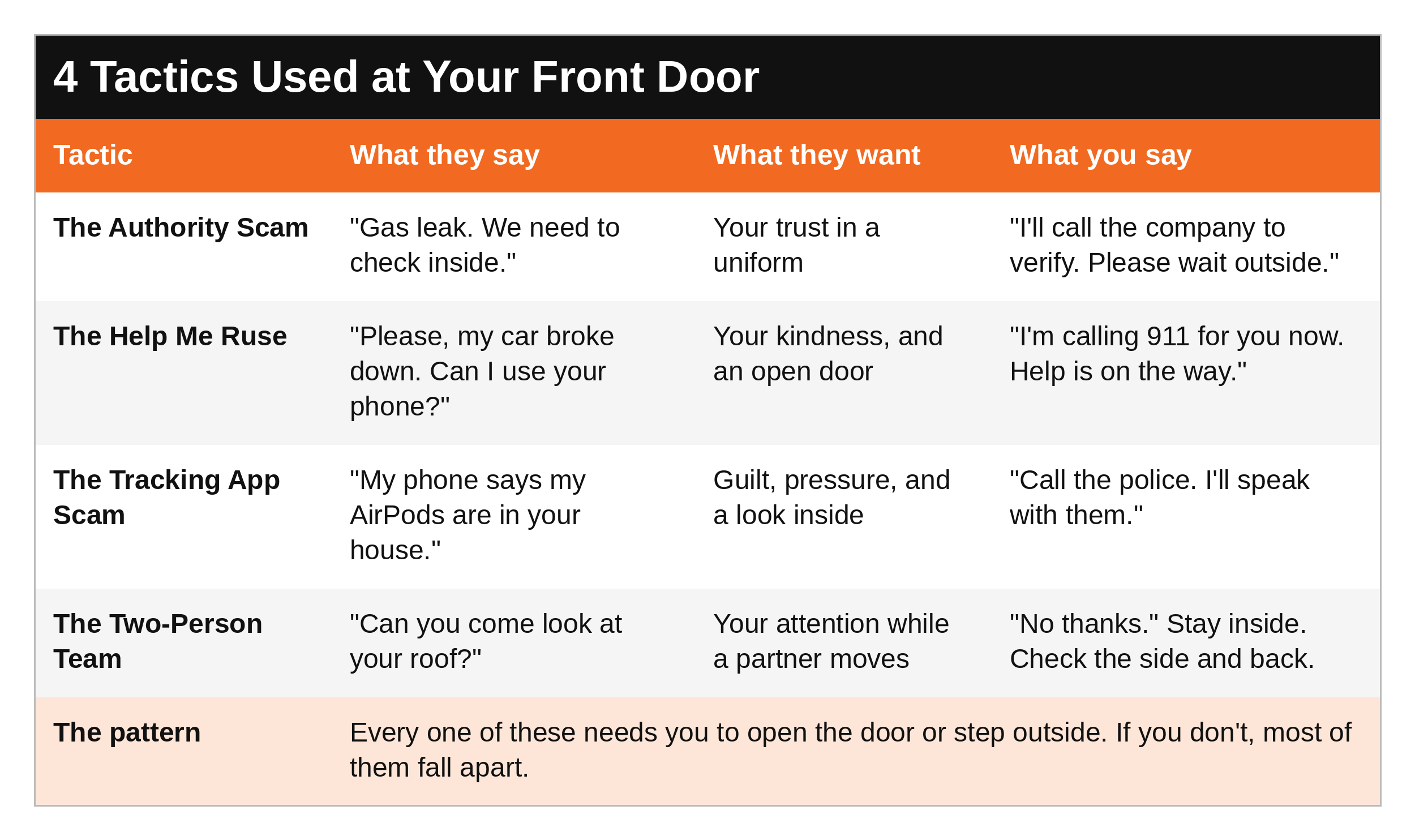
Here are all four at a glance.
Tactic 1: The Authority Scam (The Fake Utility Worker or Delivery Driver)
What it is: Someone poses as a utility worker, delivery driver, contractor, or technician to get inside, often with a vest, a clipboard, or a badge. "There's a gas leak in the area. We need to check inside." Sometimes a second person walks around the side of the house while the first one talks.
Why it works: We're taught to trust people who look official, and words like "gas leak" create urgency that shuts down careful thinking.
A note on utility workers: Utilities often have a right, called an easement, to reach meters and equipment on the outside of your property. That right doesn't include coming into your home. Real workers expect you to put your dog away first, so someone who pushes through a gate past a barking dog is acting the opposite of how a real worker acts. Easement rights vary, so check with your own utility.
Here's how to tell a real worker from an impostor.
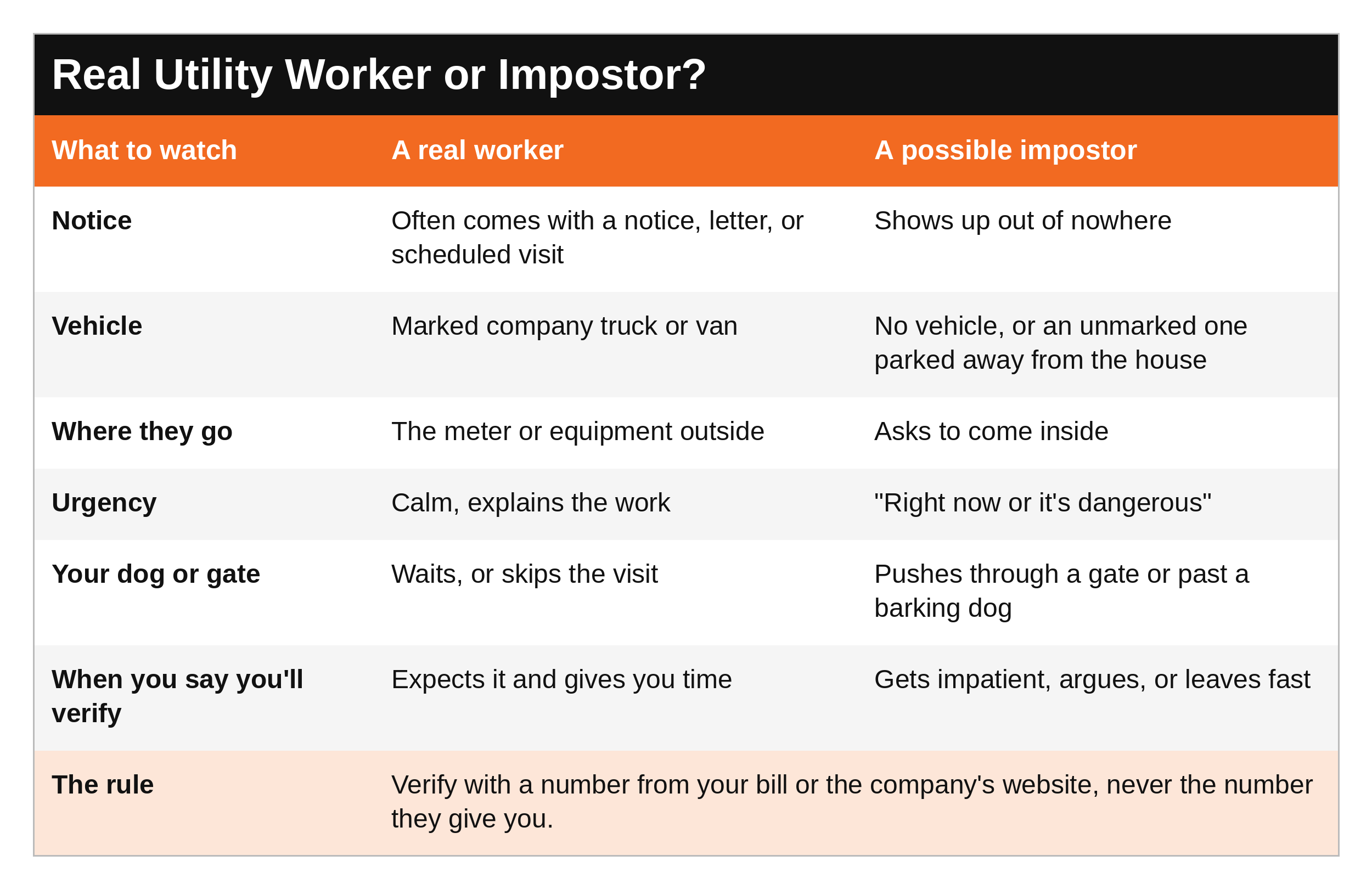
The key move: verify on your own, with the number on your bill or the company's website, never the number they give you. Real companies expect to be double-checked. If someone gets impatient or argues when you say you're going to call, that's one of the strongest warning signs you'll get.
Tactic 2: The Help Me Ruse (The Distressed Stranger)
What it is: Someone looks scared, hurt, or lost and says their car broke down, someone's following them, or their dog ran into your yard. The person is often a woman, a teenager, or a child. Once the door opens, accomplices may show up or the person may try to get in.
Why it works: It goes straight at our instinct to help someone who looks vulnerable, and nobody wants to feel heartless.
The key move: you can help without opening the door. Offer to call 911, the police, or roadside assistance for them. Someone who really needed help usually takes it. Pay attention if they leave the moment you offer.
Tactic 3: The Tracking App Scam ("Your House Has My AirPods")
What it is: Someone knocks and says their phone, AirPods, or package is showing up inside your house on a tracking app, and shows you a map to prove it. Some demand to come in. Others want you to search for them.
Tracking apps aren't as precise as they look. An AirTag doesn't have its own GPS. It shows up when a nearby iPhone picks up its signal, so the location can be off by a whole building or more. And sometimes the claim is made up entirely, as a way to get a look inside.
The key move: don't argue about the dot on the map. Tell them to call the police and say you'll speak with the police. A dot on someone's phone doesn't give them the right to come into your home.
Tactic 4: The Two-Person Distraction Team
What it is: One person keeps you busy at the front door with yard work, a petition, or "Come look at this crack in your driveway," while a second person moves around the side or back of the house.
Why it works: We focus on the person talking to us, and once you step outside, you lose your door, your barriers, and your reaction time.
The key move: stay inside and look past the person talking to you. Sometimes the bigger threat isn't the person who has your attention. It's the one you haven't noticed yet.
The Safest House on the Block gives you the full prevention steps for all four tactics, including the cameras, gates, and secondary doors that shut down a two-person team.
What to Say at the Door
You never have to open the door to have the conversation, and you don't owe a stranger an explanation.
Safe and non-engaging:
"I can't open the door, but I can call someone for you."
"We're all set, thank you."
Setting boundaries:
"I'm going to verify with the company's official number. Please wait outside."
"If you believe your property is here, call the police. I'll speak with them."
If they persist:
"I've asked you to leave. Leave my property now."
"I'm calling the police." Then do it. Stay inside, away from the door, and keep everyone with you.
Your Family Door Rule
The simplest way to stop almost every one of these tactics is a rule everyone in your home knows by heart.
Here it is in five steps.
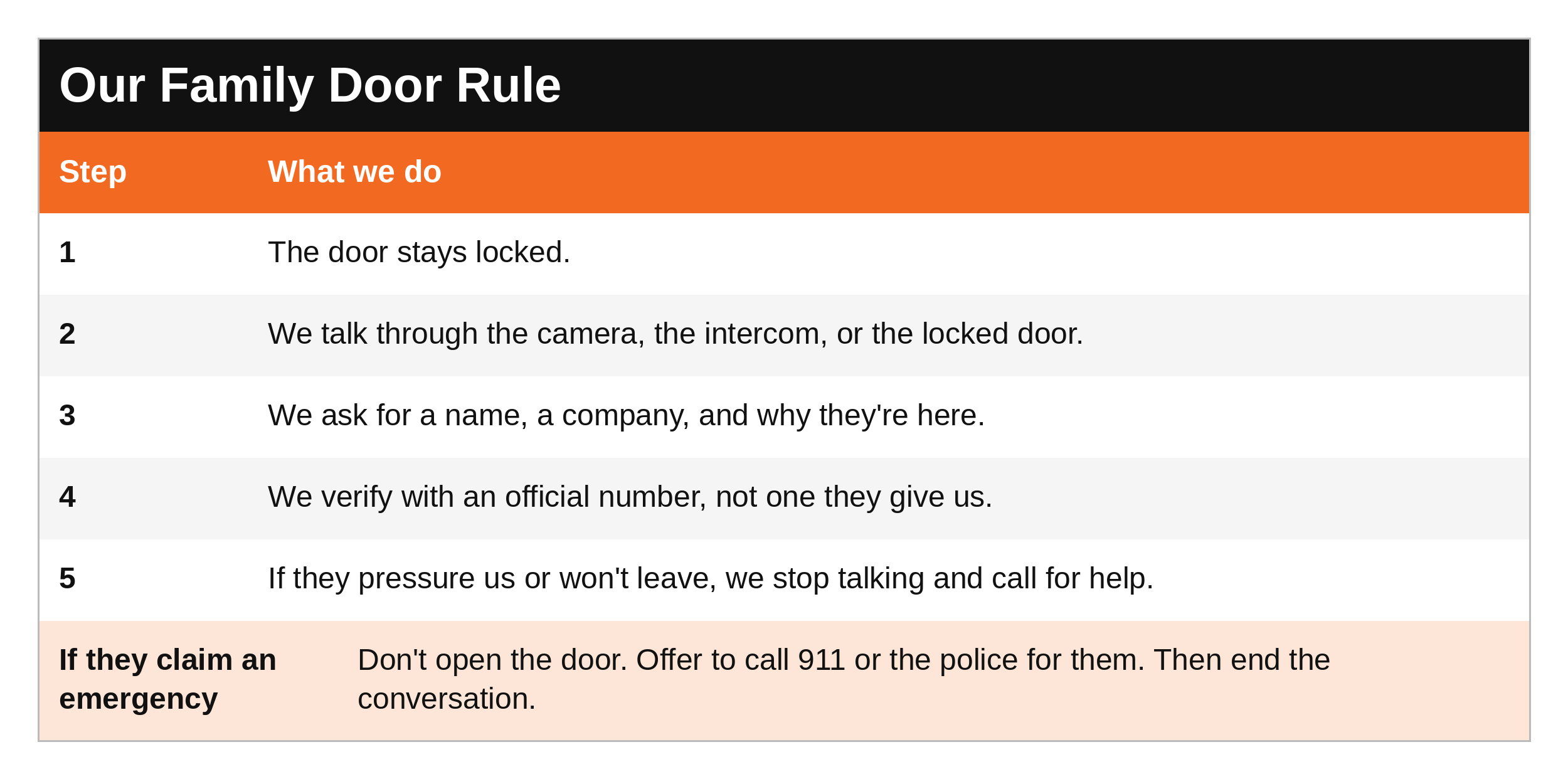
Get the free Who's at the Door? card. It puts the Door Rule, a simple rule for the kids, and the scripts on one page for the fridge or by the door, so everyone at home, from the kids to an aging parent, knows exactly what to do when someone knocks. [Get it here: LINK]
The people most likely to open the door are the ones who want to help the most: kids, teens, and older parents. If a dog, a child with special needs, or an adult with dementia is in the home, know where they are before you answer. The book walks through how to prepare each of them.
The Prepared Protector is someone who's decided that loving someone means being ready for them, not just hoping things go fine. For the people you love most, that might be as simple as one rule about one door.
SCAN at the Door
S - See your environment. Check the camera before you answer. Is there a vehicle? Is anyone else near the side of the house?
C - Create space. The locked door is your space. Keep it between you and anyone you don't know.
A - Act deliberately. Answer, keep it short, and verify anything they claim on your own.
N - Never doubt your gut feelings. If the story doesn't feel right, you don't have to explain why. Keep the door closed.
Ask Yourself
Would I open the door to someone in a vest who said there was a gas leak?
Do my kids and my parents know the Door Rule?
When someone's at the front door, do I ever check the side and back of the house?
Remember
Home invasions don't always start with force. They often start with a story. You don't have to argue the story or prove anything to anyone. Keep the door locked, talk through it, verify on your own, and call for help if they won't leave.
This post covers four door-to-door scams. The Safest House on the Block breaks down every tactic, with the warning signs and prevention steps for each. Next, Part 4: Setups and Ambushes, the tactics that target you in the driveway, the garage, and the online marketplace.
Get Started Today
Start with the free Home Security Audit. It walks you through the cameras, lighting, doors, and gates that let you see and talk to anyone at your door without opening it, and the side and back entrances a two-person team would try. DM the word AUDIT on Instagram or Facebook and I'll send it to you. [Get it here: LINK]
Go Deeper
The Safest House on the Block. This post shows you four tactics at the front door. The book gives you what you won't find on the blog: the full warning signs and prevention steps for every tactic, how to prepare kids, teens, aging parents, and family members with special needs for a knock at the door, the cameras and secondary-door upgrades that shut down a two-person team, the full 15-page Home Security Audit, and a step-by-step family security plan with a SWOT analysis for your own home. [Get it here: https://www.preparednotparanoid.com/shop/p/safest-house-on-the-block]
Tools I recommend: The video doorbells, intercoms, and home security gear I recommend are in my Safest House on the Block Amazon store. https://link.amazon/B0dSfoUkh
Related reading:
The Safest House on the Block, Part 2: How Criminals Pick a Home https://www.preparednotparanoid.com/pnp-library/home-invasion-tactics
The Safest House on the Block, Part 4: Setups and Ambushes [LINK when posted]
The Safest House on the Block, Part 11: Making a Home Security Plan https://www.preparednotparanoid.com/pnp-library/homeinvasion-homesafetyplan
Scam-Proofing the People You Love (Senior Safety) [LINK]
References
Betz, L. The Safest House on the Block. Prepared Not Paranoid. Chapter 3: Common Criminal Tactics and Ruses.
Apple. Find My network and AirTag location. Apple Support. https://support.apple.com
Your local utility company. Check its website or your bill for its official phone number and its policy on home visits.
Disclaimer
This article is for general informational and educational purposes only. It is not a substitute for a professional security assessment, legal advice, or guidance from law enforcement. Utility access rights vary, so check with your own utility company and local laws. Affiliate disclosure: I've linked to products from my Amazon store that I personally recommend. As an Amazon Associate, I earn from qualifying purchases, at no extra cost to you. Thank you for supporting my work.
If someone won't leave, tries to force their way in, or you feel threatened, stay inside, stay away from the door, and call 911.
Awareness gives you time. Time gives you options.
The Prepared Protector is someone who's decided that loving someone means being ready for them, not just hoping things go fine.
Prepared Not Paranoid. Protecting the Most Vulnerable Among Us.