How to Secure Your Front Door, Starting With a Screwdriver
By Larry Betz | Prepared Not Paranoid https://www.preparednotparanoid.com/
When a door gets kicked in, it's often not the lock that gives out. It's the frame. The deadbolt stays locked, and the wood around it splits. That's good news, because learning how to secure your front door starts with one of the cheapest fixes in home security: a few long screws.
The Middle Ring
In Part 1, we split your home into four rings. This post is the middle ring: your doors, windows, and garage, where most break-ins actually happen. This ring's job is Delay. You want your doors to cost someone time, make noise, and keep them exposed long enough to be seen, heard, or caught.
Start With the Door
Not all doors give you the same protection.
Here's how the common types compare.

The one rule: never use a hollow-core door on the outside of your house, and that includes the door from the garage into the house. Hollow-core doors are built for closets and bedrooms, and they have very little resistance to force.
Locks and Lock Grades
A door is only as secure as its lock.
Here's how they compare.
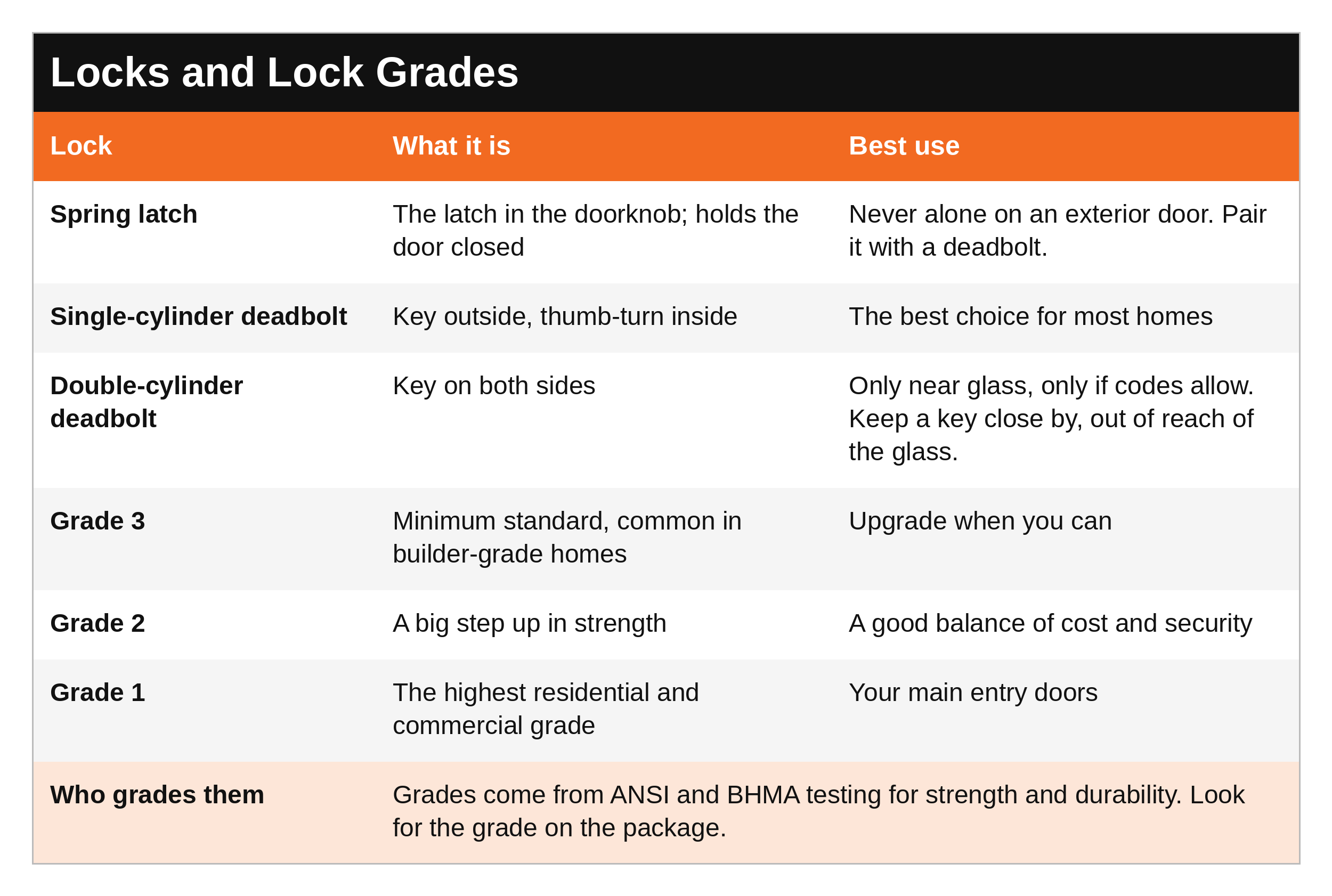
The spring latch in your doorknob gives you very little security on its own, so every exterior door needs a deadbolt. A single-cylinder deadbolt (key outside, thumb-turn inside) is the right choice for most homes.
A double-cylinder deadbolt (a key on both sides) can help when there's glass near the lock, but it's a real safety risk: in a fire, everyone has to find a key before they can get out. Many local building and fire codes restrict them. Check your local codes first, and if you use one, keep a key close by but out of reach of the glass, and make sure every adult knows where it is.
Lock grades run from Grade 3 (the minimum, often what builders install) to Grade 1 (the highest). For your main entry doors, I'd go with Grade 2 or Grade 1. Look for the grade on the package.
The Frame and the Strike Plate: The Part That Often Fails
The strike plate is the metal plate on the door frame where the deadbolt goes in. In a lot of builder-grade homes, it's a thin plate held on with short screws that only go into the door trim. One good kick, and those screws pull out and the frame splits.
The fix: a heavy-duty strike plate held in with three-inch screws that reach the wall studs behind the frame. Do the same on the hinge side. It's one of the most cost-effective security upgrades you can make.
Upgrade Your Doors, Easiest First
You don't have to do it all at once.
Here's the order I'd do it in.
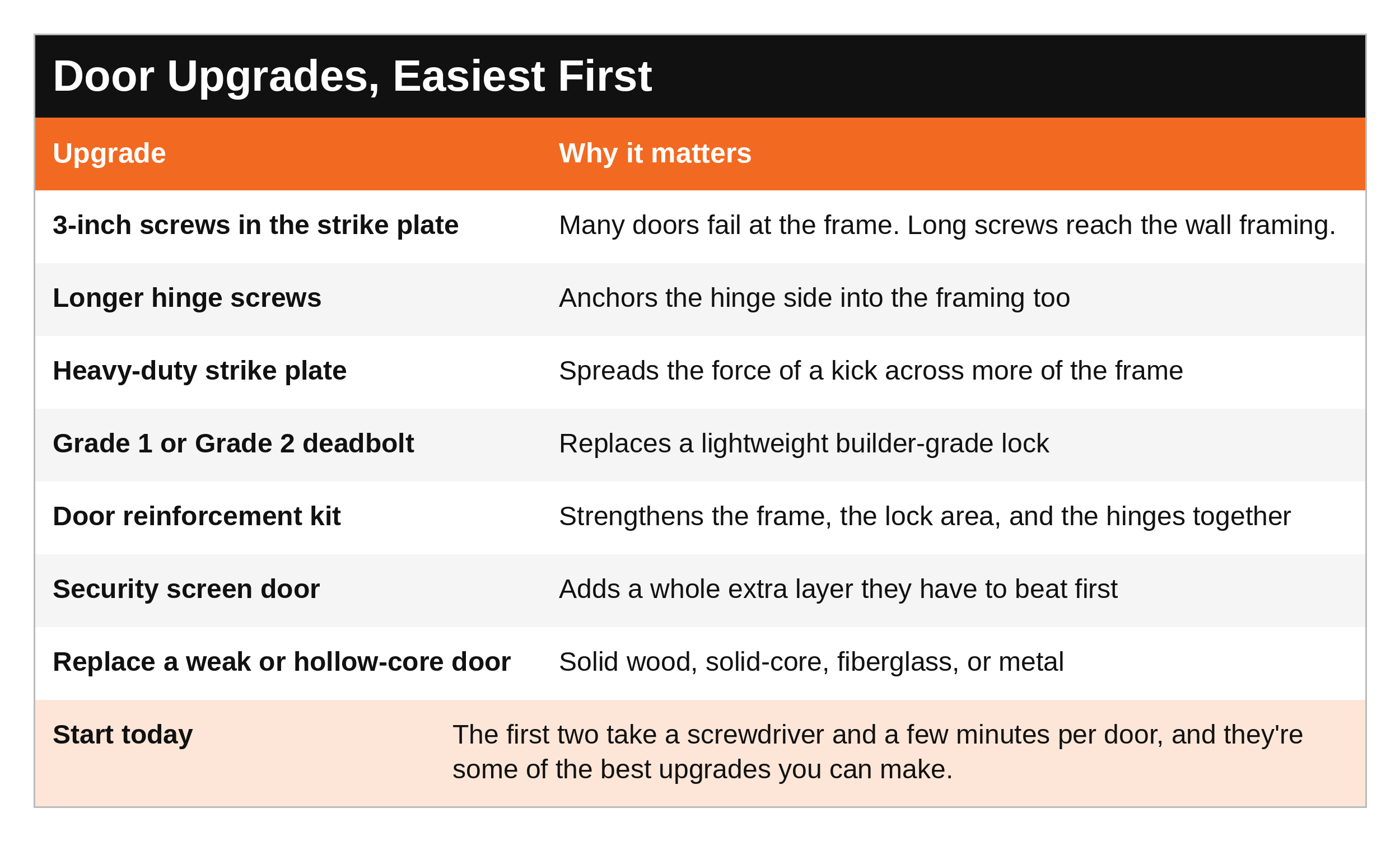
The Safest House on the Block walks through every step on that list, including how to check a frame for weak spots, when a security screen door or a reinforcement kit makes sense, how to handle glass near the lock, and what to look for in a smart lock.
Keys and Codes
Rekey or replace the locks when you move in. You have no idea how many keys the last owner handed out.
Never hide a spare key outside. Burglars know every hiding spot. Give a spare to a trusted neighbor instead.
What to Say
To a locksmith or installer:
"I want a Grade 1 or Grade 2 deadbolt on the front and back doors."
"Please use three-inch screws into the studs on the strike plate and the hinges."
To a contractor or sitter who needs access:
"I'll give you a temporary code that expires when the job's done."
To your family:
"Deadbolt every time, not just the knob."
The Prepared Protector is someone who's decided that loving someone means being ready for them, not just hoping things go fine. Sometimes that's a screwdriver and a box of long screws on a Saturday morning.
SCAN Your Doors
S - See your environment. Check every exterior door, including the back, the side, and the door from the garage. Look at the frame, the strike plate, and any glass near the lock.
C - Create space. Each door is time between you and a threat. Make every one of them buy as much as it can.
A - Act deliberately. Start with the cheap fixes: long screws, a strike plate, a deadbolt on every exterior door.
N - Never doubt your gut feelings. If a door feels flimsy when you close it, it probably is.
Ask Yourself
How long are the screws in my strike plates right now?
Does every exterior door have a deadbolt, including the door from the garage?
Do I know everyone who has a key to my house?
Remember
Often, the door isn't the weak spot. The frame is. Put a quality deadbolt on every exterior door, use three-inch screws in the strike plates and hinges, and never hide a key outside. Some of the best upgrades in home security cost less than a dinner out.
This post covers your doors, frames, and locks. The Safest House on the Block covers every layer of your home, including windows, sliding doors, the garage, cameras, Wi-Fi, and a complete family security plan. Next, Part 8: Windows, Sliding Doors, and Security Film.
Get Started Today
Grab a screwdriver and the free Home Security Audit. Its door, lock, frame, and strike plate sections walk you through every exterior door in your home, one at a time. DM the word AUDIT on Instagram or Facebook and I'll send it to you. [Get it here: LINK]
Go Deeper
The Safest House on the Block. This post gives you the door fix that matters most. The book gives you what you won't find on the blog: the complete door, lock, and frame chapter, including how to check a frame, security screen doors, reinforcement kits, glass near the lock, smart locks, and managing keys and codes, plus windows and sliding doors, garage security, the full 15-page Home Security Audit, and a step-by-step family security plan with a SWOT analysis for your own home. [Get it here: https://www.preparednotparanoid.com/shop/p/safest-house-on-the-block]
Tools I recommend: The deadbolts, heavy-duty strike plates, door reinforcement kits, and security screen doors I recommend are in my Safest House on the Block Amazon store. https://link.amazon/B0dSfoUkh
Related reading:
The Safest House on the Block, Part 6: The Outer Ring https://www.preparednotparanoid.com/pnp-library/the-outer-ring
The Safest House on the Block, Part 4: Setups and Ambushes (the garage-to-house door) https://www.preparednotparanoid.com/pnp-library/setups-and-ambushes
The Safest House on the Block, Part 8: Windows, Sliding Doors, and Security Film [LINK when posted]
Firearms and Family Safety, Intro: Your Goal Is to Never Have to Use It https://www.preparednotparanoid.com/pnp-library/firearm-home-defense-never-have-to-use-it
References
Betz, L. The Safest House on the Block. Prepared Not Paranoid. Chapter 10: Doors, Locks, Frames, and Entry Point Security.
Builders Hardware Manufacturers Association (BHMA). ANSI/BHMA lock grading standards. https://www.buildershardware.com
Disclaimer
This article is for general informational and educational purposes only. It is not a substitute for a professional security assessment. Check your local building and fire codes before installing a double-cylinder deadbolt or changing an exterior door, and keep every exit easy to open from the inside in an emergency. Affiliate disclosure: I've linked to products from my Amazon store that I personally recommend. As an Amazon Associate, I earn from qualifying purchases, at no extra cost to you. Thank you for supporting my work.
If someone is trying to force a door, get to a safe room, stay away from the door, and call 911.
Awareness gives you time. Time gives you options.
The Prepared Protector is someone who's decided that loving someone means being ready for them, not just hoping things go fine.
Prepared Not Paranoid. Protecting the Most Vulnerable Among Us.