Schools, Sitters, Neighbors, and Well-Meaning Relatives
By Larry Betz | Prepared Not Paranoid https://www.preparednotparanoid.com/
Not every risk comes from a stranger. Your teachers, coaches, sitters, neighbors, and relatives all know something about your family. Vetting babysitters and caregivers, and knowing who's in your circle, is how you keep good intentions from creating bad openings.
Your family lives inside a circle of people: teachers, coaches, sitters, cleaners, contractors, neighbors, friends, and extended family. Most of them are good people. Still, every one of them knows something about your family, and some of them have access to your home and your kids.
In Part 4, we red-celled your digital life. Now let's red cell your circle.
The Prepared Protector doesn't treat the people around them like suspects. They just decide, on purpose, who gets the keys, the codes, and the time alone with their kids.
Step 1: Map Your Circle
Make a simple list of everyone who has regular contact with your family, your home, or your kids:
Access to the house: cleaners, sitters, dog walkers, caregivers, contractors, anyone with a key or a code
Access to the kids: teachers, coaches, tutors, youth leaders, camp staff, parents of friends
Knows your schedule: neighbors, co-workers, group chats, extended family
Knows your security: anyone who knows your alarm code, where your safe is, or where the spare key is hidden
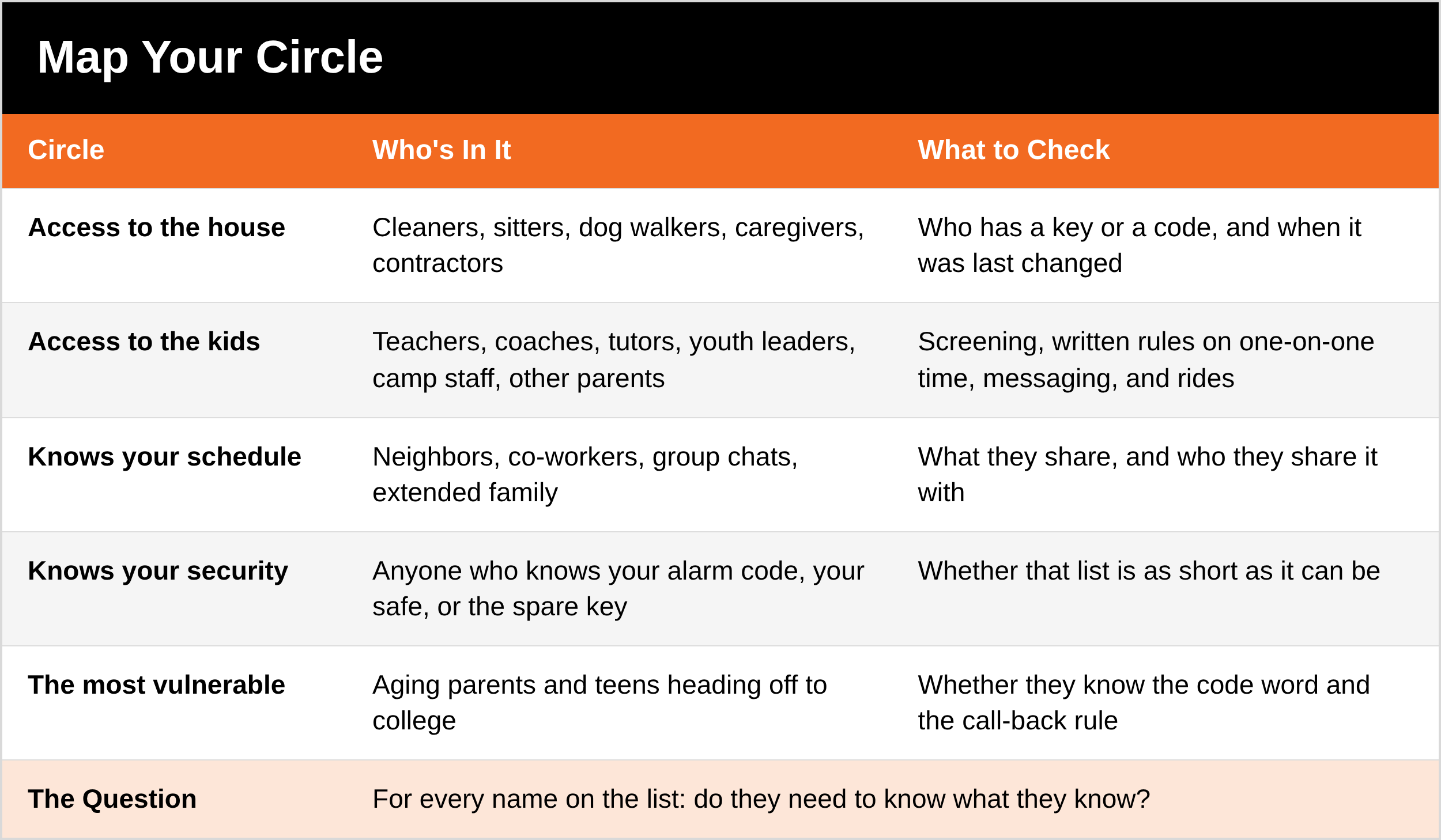
Now ask one question about each name: "Do they need to know what they know?"
Step 2: Vetting Babysitters and Caregivers: Vet the People With Access
Confirm who they are. Ask for references and check them. For anyone caring for your kids or an aging parent, a background check is reasonable. The rules on background checks vary, so check your state and county.
Give the least access that works. Smart locks and keypads let you create temporary or time-limited codes for each person.
Change codes regularly, and always when someone stops working for you.
Keep a simple log of who comes and goes, especially if you travel.
Know who they bring with them. A trusted cleaner's new helper is someone you haven't met.
Step 3: Red Cell the Adults Around Your Kids
Most harm to children comes from someone the family knows, not a stranger in a van. According to the U.S. Bureau of Justice Statistics, about 93 percent of young victims of sexual assault reported to law enforcement knew the person who hurt them. Only about 7 percent were strangers. That's hard to hear, but it's why this step matters.
Does the school, team, or camp screen its staff and volunteers? Ask.
Does it have a written policy on one-on-one time, private messaging, and rides?
Do your kids know the difference between a safe adult and an unsafe secret?
My Creepy Coach series walks through the warning signs of grooming, the questions to ask any youth program, and how to use sex offender registries (and their limits). My Summer Camp series covers how to vet a camp before you hand over your child, and My Body, My Boundaries covers how to talk with young kids about safe adults and secrets.
Check these resources monthly, or before a move:
NSOPW.gov, the national sex offender public website from the U.S. Department of Justice
Your local police department's crime map or community alerts
Remember that a registry only shows people who were caught, convicted, and registered. It's one tool, not a guarantee.
Step 4: Share Only What Protects Your Child
Schools and programs need some information in an emergency. They don't need your whole playbook.
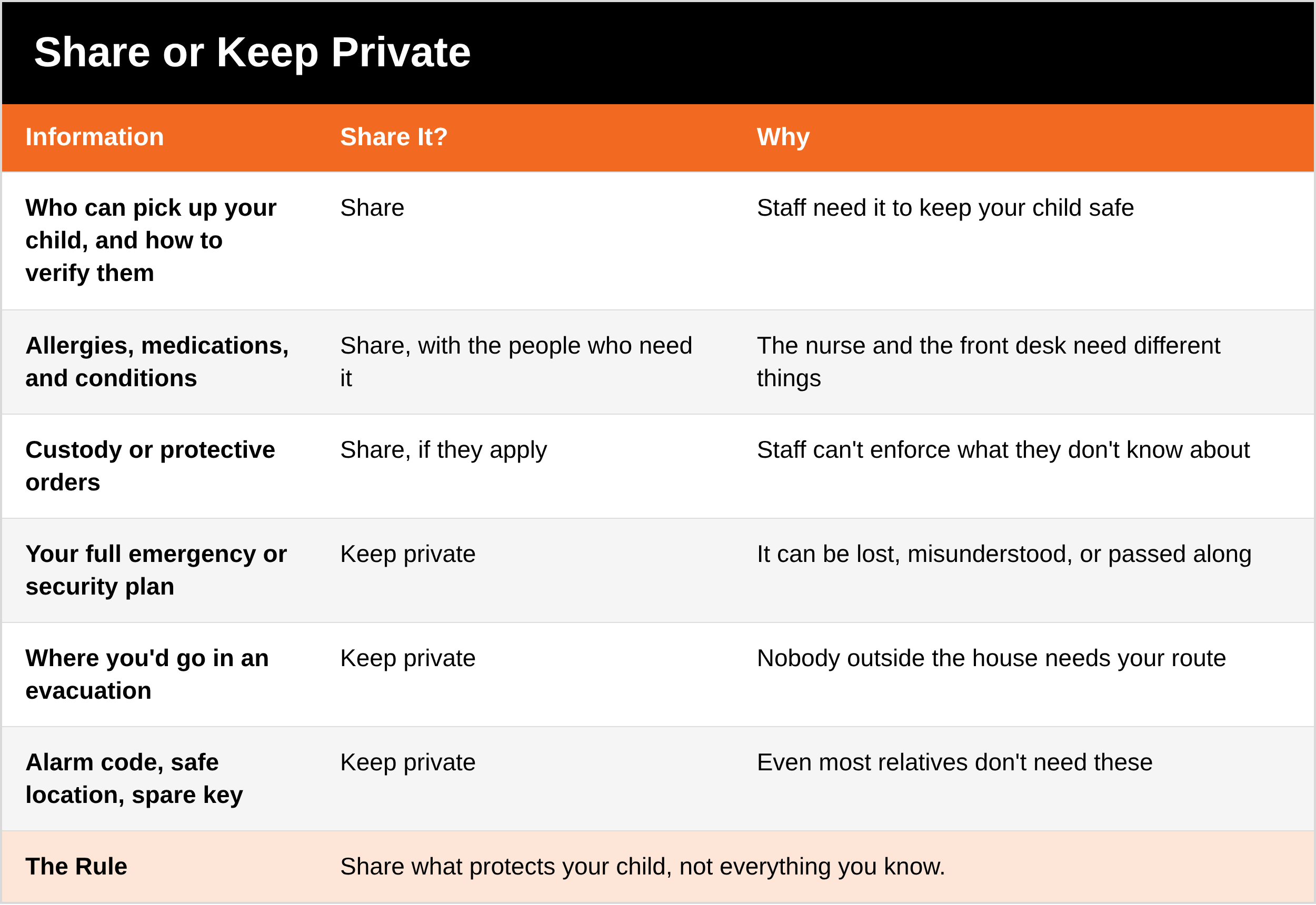
Do share:
Who is authorized to pick up your child, and how staff should verify them
Critical medical information (allergies, medications, conditions)
Custody orders or protective orders, if they apply
Don't share:
Your family's full emergency or security plan
Where you'd go in an evacuation, or how you'd move as a family
Sensitive legal or medical details that aren't needed
Make it practical:
Keep emergency contacts and medical information in a sealed, labeled envelope at the front office
Tell staff on a need-to-know basis. The school nurse may need different information than the front desk.
Consider a "limited disclosure" version of your family plan for anyone outside the house
Anything you share outside your household can be lost, misunderstood, or passed along. Share what protects your child, not everything you know.
Step 5: Build Your Neighborhood Network
Your neighbors can be your best early-warning system.
Trade check-ins with one or two trusted neighbors: packages, trash cans, lights, and a phone call if something looks wrong
Share what you see: suspicious activity, doorbell camera footage, package thefts
Encourage each other to report unusual behavior instead of assuming someone else did
Join or start a Neighborhood Watch, or a small group of engaged neighbors
Use community apps carefully. Nextdoor and local groups are useful for alerts, but verify before you act on a rumor.
Step 6: Talk to the Relatives
Some of the biggest leaks come from people who love you.
Grandma posts "So proud of my grandson at his first day at Lincoln Elementary!" with a photo of him at the school sign.
An aunt shares in the big family group chat that you'll be in Hawaii for two weeks.
A cousin tags your home in a holiday photo.
"Need to know" applies inside families too. Not everyone needs your alarm code or the location of your safe.
Step 7: Don't Forget the Most Vulnerable
Aging parents are often the most targeted people in a family circle, especially by scammers pretending to be a grandchild, a bank, or the government. Make sure they know your family's code word and the "hang up and call back" rule. My Scam-Proofing the People You Love series covers how these scams work, and we'll practice the code word in Part 6.
Teens heading to college are stepping into a whole new circle. My book Navigating the Red Zone and Beyond prepares them for it.
What to Say
To relatives: "We're being careful about what goes online about the kids and the house. Could you check with us before posting photos or plans? Thank you for looking out for them."
To a school, team, or camp: "What's your policy on one-on-one time, private messages, and rides? Can I see it in writing?"
To a sitter, cleaner, or caregiver: "Please don't bring anyone with you without checking with me first. It's nothing personal. It's the rule for everyone."
Ask Yourself
Who has a key or a code to my house right now? Am I sure?
Does every adult who spends time alone with my kids follow a clear set of rules?
What has a relative posted about my family that I wouldn't have?
5 Quick Wins You Can Start Today
Write down everyone who has a key or a code to your house tonight.
Change any code a former sitter, cleaner, or contractor still knows.
Ask your child's school, team, or program for its written policy on one-on-one time, messaging, and rides.
Swap phone numbers with one trusted neighbor and agree to call if something looks wrong.
Send the relatives script to your family group chat.
Remember: Most people in your circle mean well. Red-celling your circle isn't about distrust. It's about making sure good intentions don't create bad openings.
Coming Up in Part 6
Train Your Team. A plan only works if everyone knows it. We'll cover the drills, code words, and scripts every family should practice.
Get Started Today
Check your circle with the free Red Cell Family Audit. Its People section has 10 quick yes-or-no questions on keys and codes, sitters and caregivers, pickup lists, the adults around your kids, your neighbors, and your relatives, plus 7 more sections for the rest of your family's life.
DM the word REDCELL on Instagram or Facebook and I'll send it to you. [Get it here: LINK]
Want to know the warning signs to watch for in the adults around your kids? My free checklist When Trusted Adults Cross the Line shows you what to look for and what to do.
DM the word [KEYWORD] on Instagram or Facebook and I'll send it to you. [Get it here: LINK]
Go Deeper
The Family Safety Toolkit includes the When Trusted Adults Cross the Line checklist and the Summer Camp Safety Checklist for Parents, so you can vet the adults and programs around your kids. [Get the Toolkit here: LINK]
For teens leaving home: Navigating the Red Zone and Beyond prepares them for the new circle they'll walk into at college. [Get the book here: LINK]
For reading people and situations before they become problems: Situational Awareness and Safe Family Travel Strategies. [Get the book here: https://store.bookbaby.com/book/situational-awareness-and-safe-family-travel-strategies]
Coming soon: the Child Safety Manual and the Senior Safety Guide, with the full plans for protecting your kids and your parents from the people who might take advantage of them.
Tools I recommend: The smart locks, keypads, and safety tools I recommend for kids and aging parents are in my Children's Safety store [AMAZON CHILDREN'S SAFETY STORE LINK] and my Senior Safety store [AMAZON SENIOR SAFETY STORE LINK].
The Full Series
Part 1: Think Like the Threat: https://www.preparednotparanoid.com/pnp-library/red-cell-your-family
Part 2: Find Your Family's Tells: https://www.preparednotparanoid.com/pnp-library/family-routine-security
Part 3: Red Cell Your House: https://www.preparednotparanoid.com/pnp-library/home-security-burglar-eyes
Part 4: Red Cell Your Digital Life: https://www.preparednotparanoid.com/pnp-library/family-digital-security
Part 5: Red Cell Your Circle (you're here)
Part 6: Train Your Team: https://www.preparednotparanoid.com/pnp-library/family-safety-drills
Part 7: Just in Case: https://www.preparednotparanoid.com/pnp-library/red-cell-action-plan
Related Reading
Creepy Coach series, Parts 1 to 4 [LINK]
My Body, My Boundaries, Part 2: The Rules Apply to Everyone [LINK]
My Body, My Boundaries, Part 3: "If You Say Don't Tell, I Have to Tell" [LINK]
Summer Camp Safety, Part 2: Who Has Access to Your Child [LINK]
Scam-Proofing the People You Love, Part 3: Scams That Pull at the Heart: https://www.preparednotparanoid.com/pnp-library/grandparent-romance-scams
References
Snyder, H. N. (2000). Sexual Assault of Young Children as Reported to Law Enforcement: Victim, Incident, and Offender Characteristics. U.S. Bureau of Justice Statistics. NCJ 182990. https://bjs.ojp.gov/content/pub/pdf/saycrle.pdf
U.S. Department of Justice. Dru Sjodin National Sex Offender Public Website (NSOPW). https://www.nsopw.gov
U.S. Department of Justice, Office of Juvenile Justice and Delinquency Prevention. Child sexual abuse resources. https://ojjdp.ojp.gov
National Neighborhood Watch (National Sheriffs' Association). https://www.nnw.org
Disclaimer
These suggestions are intended to help you and your family build awareness, confidence, and safer decision-making habits. No safety plan, checklist, or training can guarantee 100% protection. There will always be people who try to exploit vulnerability, opportunity, trust, or positions of power. The goal is not to create fear, but to help guide families toward more informed, prepared, and practical safety decisions in everyday life. This article is not legal advice and is not a substitute for professional guidance. Laws on background checks and hiring vary, so check your state and county for the exact rules where you live. As an Amazon Associate, I earn from qualifying purchases.
If you suspect a child is being abused, contact local law enforcement or the Childhelp National Child Abuse Hotline at 1-800-422-4453 (call or text). If you are in immediate danger, call 911.
Awareness gives you time. Time gives you options.
The Prepared Protector is someone who's decided that loving someone means being ready for them, not just hoping things go fine.
Prepared Not Paranoid. Protecting the Most Vulnerable Among Us.