Saunas, Cold Plunges, Red Light, and More: What's Worth Your Time?
By Larry Betz | Prepared Not Paranoid https://www.preparednotparanoid.com/
Training gets all the attention. Recovery is where the work actually pays off.
For centuries, cultures around the world have turned to heat and cold for their physical and mental benefits. Sweat lodges and hot springs, ice baths and therapeutic steam: temperature-based recovery has long played a role in healing and resilience.
Today, these practices are back under the banner of "biohacking," with influencers and experts promoting the latest trends. Every week seems to bring a new product or protocol claiming to boost performance, speed up recovery, or slow aging. Some of those claims are overhyped or driven by marketing. But many of these tools do have real research behind them and practical value, especially when they're part of a consistent, realistic recovery plan.
Why Recovery Is Part of Being Prepared
Here at Prepared Not Paranoid, we say fitness is the foundation of preparedness. Being ready to carry a child to safety, help an aging parent up after a fall, or get through a long, hard day starts with a body that's strong, mobile, and able to bounce back.
After more than 20 years running gyms, with a specialty in post-rehab and the aging population, I've seen how much recovery matters. You don't get stronger during the workout. You get stronger when you recover from it.
What This Series Covers
In seven parts, we'll break down the most popular recovery tools: what each one is, what it claims to do, and most importantly, what the current research says. Personal experience and preference matter, but the goal is clear, unbiased information so you can decide what's worth your time, money, and energy.
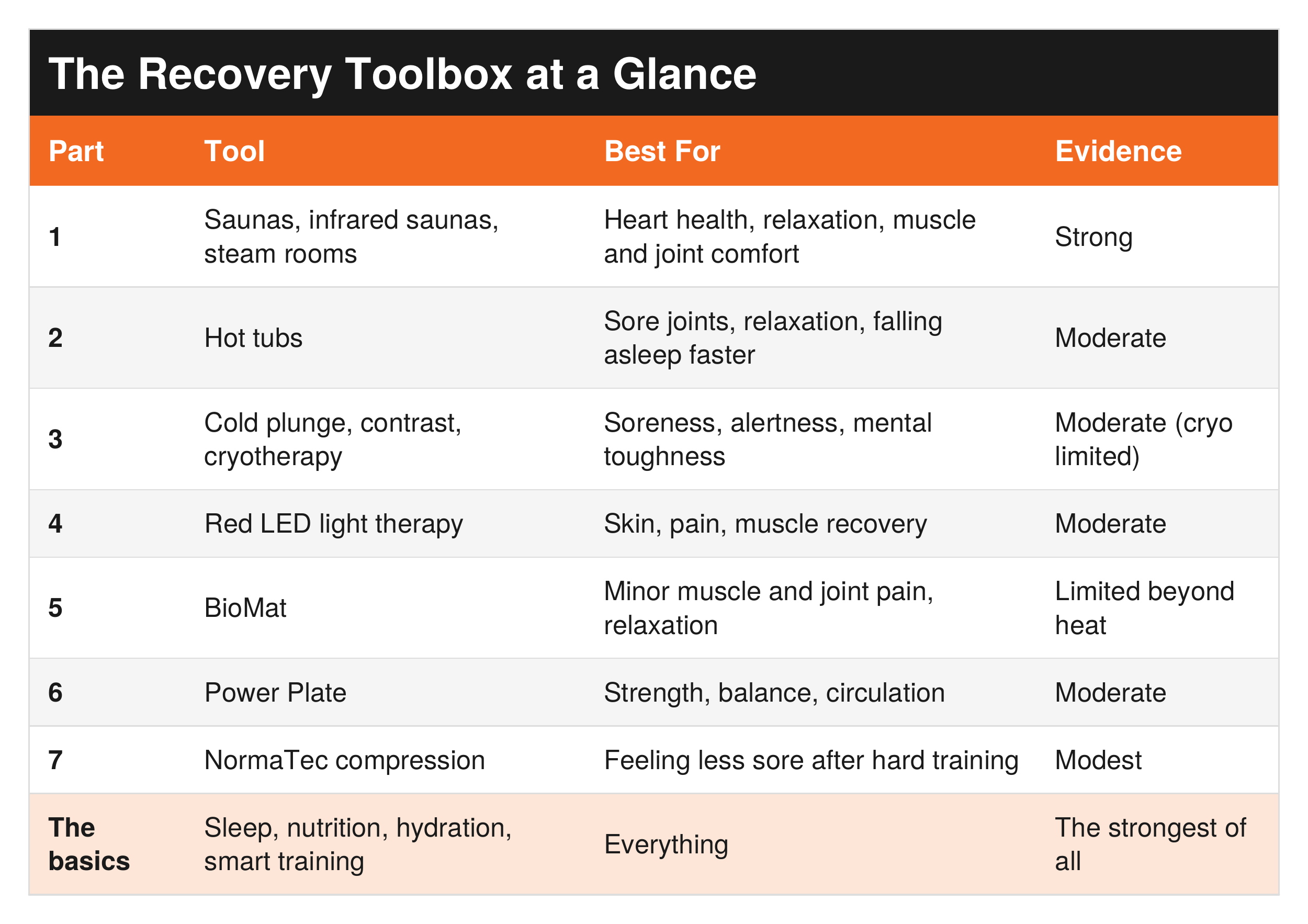
Part 1: Saunas, Infrared Saunas, and Steam Rooms. How they differ, what the research supports, and home options for every budget. [LINK]
Part 2: Hot Tubs. How heat, buoyancy, and water pressure help you recover, plus the safety limits every family should know. [LINK]
Part 3: Cold Plunges, Contrast Therapy, and Cryotherapy. The real benefits, the right temperatures and times, and when not to plunge. [LINK]
Part 4: Red LED Light Therapy. How it works, how to read wavelength and dose, and FDA cleared vs. registered. [LINK]
Part 5: BioMat Therapy. Far-infrared heat, crystals, and ions, and what the evidence actually says. [LINK]
Part 6: Power Plate Whole-Body Vibration. Strength, balance, and recovery, especially for older adults. [LINK]
Part 7: NormaTec Compression Therapy. Do compression boots really speed recovery? [LINK]
Whether your goal is faster muscle recovery, less soreness, better sleep, or better long-term health, this series will help you understand how and when to use these tools as part of a well-rounded recovery plan.
Start With the Basics
Before you buy anything, remember this: no recovery tool replaces the basics. Sleep, nutrition, hydration, and smart training do most of the work. The tools in this series help you recover a little better on top of that foundation.
And the best recovery tool is the one you'll actually use, consistently and safely.
Ask Yourself
What's my real goal: less soreness, better sleep, joint comfort, or long-term health?
Am I covering the basics first: sleep, food, water, and easy movement?
What fits my space, my budget, and my health?
Remember
Recovery is where the work pays off. Start with the basics, choose tools backed by research, and use them consistently. A body that recovers well is a body that's ready when someone needs you.
Go Deeper
Free download: My Dynamic Warm-Up Guide walks you through a 16-move, head-to-toe warm-up with a video demo for every move. Warm up before you train, recover after. [LINK TO WARM-UP GUIDE]
[PREMIUM PRODUCT CTA: confirm which product goes here]
Tools I recommend: You'll find the recovery gear I recommend in my Amazon store. [AMAZON STORE LINK]
Related reading:
Recovery Strategies, Part 1: Saunas, Infrared Saunas, and Steam Rooms [LINK]
Mobility, Stability, Stretching, and Self Care, Part 1: The Foundation of Movement [LINK]
Mobility, Stability, Stretching, and Self Care, Part 3: Movement Preparation and Self-Myofascial Release [LINK]
References
The sources for each recovery tool are listed at the end of each part in this series. Key reviews include:
Laukkanen, J. A., et al. (2018). Cardiovascular and other health benefits of sauna bathing: A review of the evidence. Mayo Clinic Proceedings, 93(8), 1111-1121. https://doi.org/10.1016/j.mayocp.2018.04.008
Bleakley, C., et al. (2012). Cold-water immersion (cryotherapy) for preventing and treating muscle soreness after exercise. Cochrane Database of Systematic Reviews, (2), CD008262. https://doi.org/10.1002/14651858.CD008262.pub2
Leal-Junior, E. C. P., et al. (2015). Effect of phototherapy (low-level laser therapy and light-emitting diode therapy) on exercise performance and markers of exercise recovery: A systematic review with meta-analysis. Lasers in Medical Science, 30(2), 925-939. https://doi.org/10.1007/s10103-013-1465-4
Maia, F., et al. (2024). Effects of lower-limb intermittent pneumatic compression on sports recovery: A systematic review and meta-analysis. Biology of Sport, 41(4), 263-275. https://doi.org/10.5114/biolsport.2024.133665
Disclaimer
This article is for general informational and educational purposes only. It is not medical advice and is not a substitute for guidance from your physician. Talk to your doctor before starting any new recovery practice, especially heat or cold therapy, if you have a heart condition, high or low blood pressure, are pregnant, or have other health concerns. Affiliate disclosure: I've linked to products from my Amazon store that I personally recommend. If you purchase through these links, I may earn a small commission at no extra cost to you. Thank you for supporting my work.
If you or someone with you has chest pain, faints, or feels confused during any recovery session, stop and call 911.
Awareness gives you time. Time gives you options.
The prepared protector is someone who's decided that loving someone means being ready for them, not just hoping things go fine.
Prepared Not Paranoid. Protecting the Most Vulnerable Among Us.