A Safer Home, and a Plan for If a Fall Happens
By Larry Betz | Prepared Not Paranoid https://www.preparednotparanoid.com/
A fall proof home for seniors doesn't mean wrapping the house in bubble wrap. It means walking every room the way your parent actually lives in it, fixing what trips them up, and having a plan ready in case a fall happens anyway.
In my Red Cell Your Family series, I asked you to walk your house the way a burglar would. Now I want you to walk it again, through different eyes.
Walk it the way your mother does at 2 a.m. on her way to the bathroom. Half asleep, no glasses, in the dark.
Where's the rug that slides? The cord across the hallway? The step with no handrail? The light switch that's on the wrong side of the room?
In Part 2, we worked on the person: strength, balance, medications, and the right support. Now let's fix the house, build better habits, and make a plan for what happens if a fall does occur.
Walk the House Together: Fall-Proofing Your Home, Room by Room
Do this with your parent, not for them. Ask them to show you where they feel unsteady. They know better than anyone.
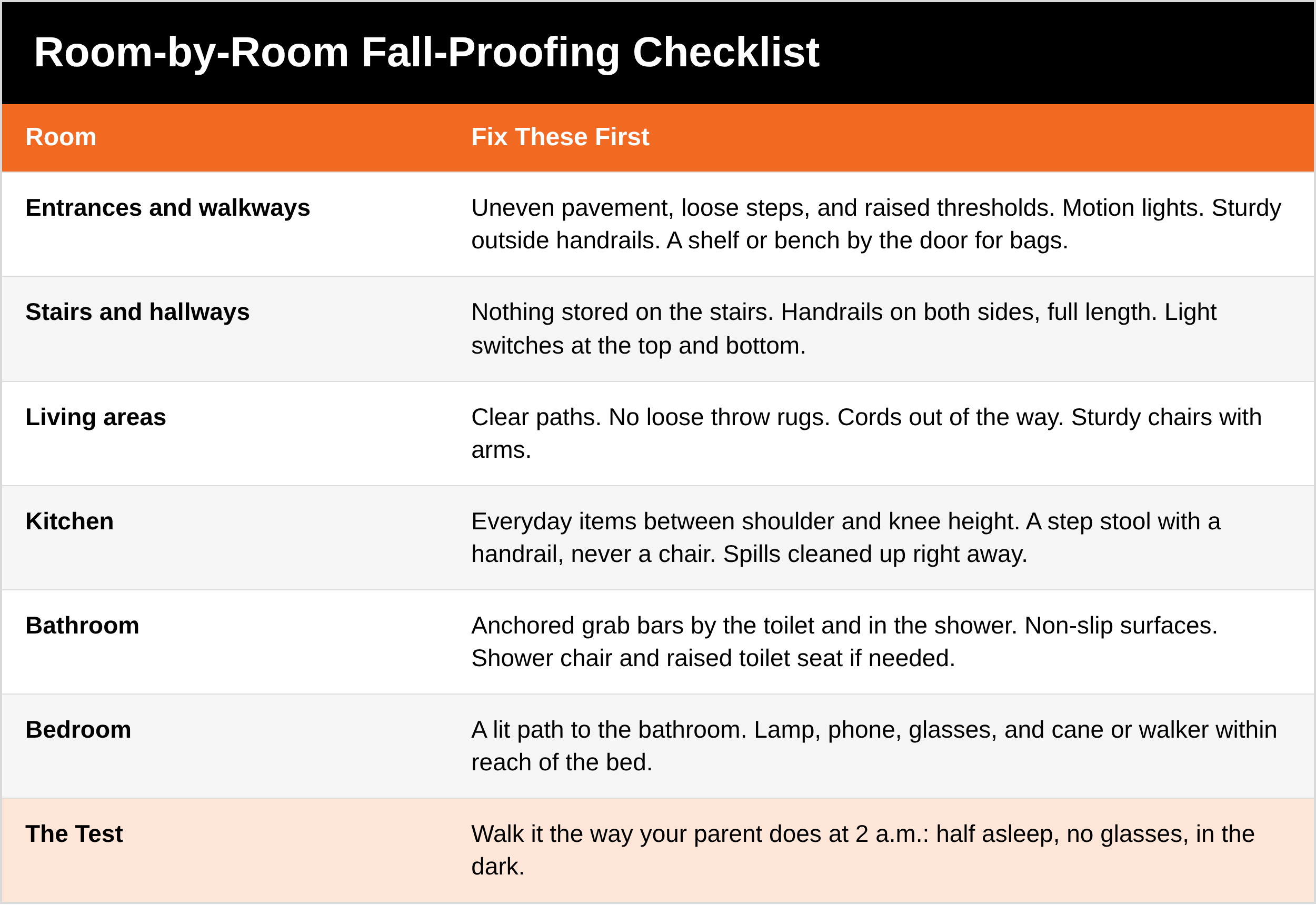
Entrances, Walkways, and the Garage
Repair uneven pavement, loose steps, and raised thresholds
Clear leaves, hoses, tools, ice, and gravel
Bright lighting or motion lights that come on before you step onto the path
Sturdy handrails on outside steps, with contrasting tape on step edges that are hard to see
A shelf or bench by the door to set down bags before unlocking
Stairs and Hallways
Nothing stored on the stairs. Ever.
Handrails on both sides, running the full length
Fix loose carpet and damaged steps
Light switches at the top and bottom
Don't carry anything that blocks your view or keeps a hand off the rail
Living Areas
Wide, clear walking paths
Remove throw rugs, or secure them with non-slip backing
Cords out of walking paths
Sturdy chairs with arms at a good height for standing up
Pet toys, oxygen tubing, and blankets off the floor
Kitchen
Everyday items between shoulder and knee height
A sturdy step stool with a handrail, only if appropriate. Never a chair.
Clean spills right away; mats that lie flat
Good task lighting, and a place to sit while cooking if fatigue is an issue
Bathroom
This is where many falls happen: hard surfaces, water, and lots of standing up and sitting down.
Properly anchored grab bars by the toilet and in the tub or shower
Non-slip surfaces, and water kept off the floor
A shower chair or transfer bench, handheld shower, and raised toilet seat if appropriate
Soap, towels, and toiletries within easy reach
Never rely on a towel bar or suction-cup handle for support unless it's rated and installed for it
Bedroom
A clear, lit path to the bathroom. Plug-in night lights or motion-activated lights work well.
Lamp, phone, glasses, and cane or walker within reach of the bed
Bed height that makes it easy to sit and stand
A chair for getting dressed, instead of standing on one leg
Safer Everyday Habits
Slow down at transitions: getting out of bed, standing up from a chair, stepping off a curb, entering a dark room
Lights on before moving. Keep a flashlight by the bed for power outages.
Don't rush to the phone or the door. Let voicemail pick up. Visitors can wait. (This one helps with scams too. Nothing good comes from rushing to the door for someone you weren't expecting. More on that in Scam-Proofing the People You Love [LINK].)
One hand on the rail on the stairs
Two trips instead of one big armload
Use the glasses, hearing aids, shoes, and walker, every time
Plan bathroom trips to avoid rushing, especially at night
Extra care in unfamiliar places: hotels, restaurants, parking lots, and other people's homes
Plan for a Fall Before It Happens
A charged phone or medical alert device within reach at all times, not across the room. Many smartwatches and medical alert devices now have fall detection.
Emergency contacts and Medical ID set up on the phone, so responders can see them even when it's locked. My free Phone Emergency Setup Checklist walks you through it step by step. [LINK]
Regular check-ins for anyone who lives alone: a daily call or text at a set time, and a plan for what happens if they don't answer
An up-to-date list of medications and conditions where responders can find it
Practice how to call for help from the floor. Don't assume someone can reach a wall phone after a fall.
A plan for emergency access so responders can get in without breaking down the door. Ask your local fire department whether they use a lockbox program such as a Knox Box, or use a secure lockbox with a code you give only to emergency services and trusted family. Never hide a key under the mat.
The Prepared Protector plans for the fall that hasn't happened yet. The best time to decide how your parent will call for help is before anyone is on the floor.
What to Do After a Fall
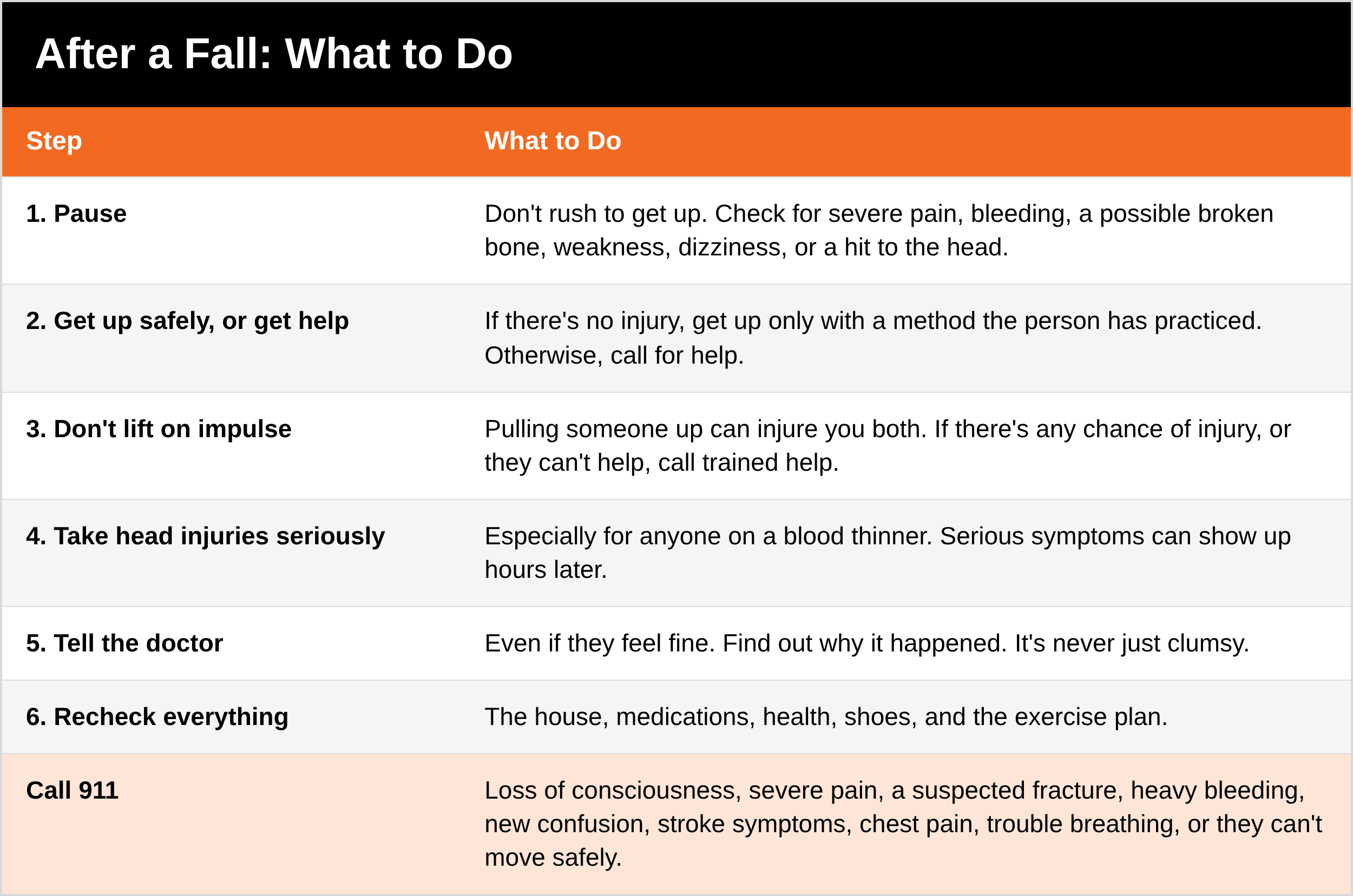
Pause. Don't rush to get up. Check for severe pain, bleeding, a possible broken bone, weakness, dizziness, or a hit to the head.
Call 911 for loss of consciousness, severe pain, a suspected fracture, heavy bleeding, new confusion, stroke symptoms, chest pain, trouble breathing, or if the person can't move safely.
Take any head injury seriously, especially for someone on a blood thinner. Serious symptoms can show up hours later.
If there's no injury, get up only with a safe method the person has practiced. Otherwise, call for help.
Tell the doctor, even if they feel fine. Find out why it happened. It's never "just clumsy."
Recheck everything: the house, medications, health, shoes, and the exercise plan.
Don't lift on impulse. Family members can injure both themselves and the person by pulling them up. If there's any chance of injury, or the person can't help, call trained help.
The Family Conversation
Talk through these together:
Have you fallen, nearly fallen, or felt unsteady this past year?
Do you avoid anything because you're worried about falling?
When do you feel most unsteady: at night, on the stairs, outside, in the shower, or standing up?
Has anything changed: medications, vision, hearing, shoes, or health?
Would a physical therapy or home safety evaluation help?
How would you call for help if you fell and couldn't reach your phone?
What one or two changes would make you feel safer without giving up your independence?
Ask Yourself
Could my parent call for help right now if they fell in the bathroom?
Is there a clear, lit path from their bed to the bathroom?
If paramedics showed up tomorrow, could they find a current medication list?
5 Quick Wins You Can Start Today
Walk the path from their bed to the bathroom with the lights off, and fix anything you trip on.
Plug in night lights along that path.
Set up Medical ID and emergency contacts on their phone. Save contacts in plain words, like "Emergency - Mom."
Move the phone or alert device to where they could reach it from the floor.
Get the spare key out from under the mat, and call your local fire department to ask about a lockbox program.
Remember: The goal isn't a house with no movement and no risk. It's a parent who stays strong, capable, and confident, in a home that makes the safe choice the easy one.
Series Wrap-Up
That's the Staying Steady series. Part 1 helped you spot the risk. Part 2 worked on the person. Part 3 fixed the house and built the plan. Pick one thing from each part this week, and you're already ahead of most families.
Get Started Today
My free Senior Fall Prevention and Emergency Information Checklist walks through every room in this post, plus the emergency information responders need, ready to print and work through together.
DM the word [KEYWORD] on Instagram or Facebook and I'll send it to you. [Get it here: LINK]
Go Deeper
The Family Safety Toolkit includes a full Senior Safety section with fall prevention and fraud prevention checklists. This post gives you the walk-through. The Toolkit gives you the checklists to track every fix, room by room. [Get it here: LINK]
The Safest House on the Block covers lighting, entryways, emergency access, and a safe, secure home for every member of the family. [Get it here: LINK]
Coming soon: the Senior Safety Guide. A full home assessment, how to practice getting up from the floor, choosing a medical alert or fall-detection device, a check-in plan for parents who live alone, and setting up emergency access the right way.
Tools I recommend: grab bars, night lights, motion lights, non-slip mats, shower chairs, and lockboxes in my Senior Safety store. [SENIOR SAFETY STORE LINK]
The Full Series
Part 1: Falls Aren't a Normal Part of Aging [LINK]
Part 2: Strong, Steady, and Independent [LINK]
Part 3: A Safer Home, Room by Room (you are here)
Related Reading
Scam-Proofing the People You Love series [LINK]
Red Cell Your Family, Part 3: Red Cell Your House [LINK]
Red Cell Your Family, Part 7: Just in Case [LINK]
References
CDC, Check for Safety: A Home Fall Prevention Checklist for Older Adults: https://www.cdc.gov/steadi/
National Institute on Aging, Preventing Falls at Home: Room by Room: https://www.nia.nih.gov/health/falls-and-falls-prevention/preventing-falls-home-room-room
CDC, STEADI Patient and Caregiver Resources: https://www.cdc.gov/steadi/
Administration for Community Living, Falls Prevention: https://acl.gov/programs/health-wellness/falls-prevention
Disclaimer: This article is for general informational and educational purposes only. It is not medical advice and does not replace an evaluation by a doctor, physical therapist, or occupational therapist. Have grab bars and handrails installed by a qualified professional. These suggestions are intended to help you and your family build awareness, confidence, and safer decision-making habits. No safety plan, checklist, or training can guarantee 100% protection. Building codes, lockbox programs, and services vary, so check your state and county for the exact rules where you live. As an Amazon Associate, I earn from qualifying purchases.
If someone has fallen and is badly hurt, has hit their head, or can't get up safely, call 911.
Awareness gives you time. Time gives you options.
The Prepared Protector is someone who's decided that loving someone means being ready for them, not just hoping things go fine.
Prepared Not Paranoid. Protecting the Most Vulnerable Among Us.