Visitors, Deliveries, and Getting Help In Fast
By Larry Betz | Prepared Not Paranoid https://www.preparednotparanoid.com/
Front door safety for seniors comes down to two jobs: keeping the wrong people out, and making sure the right people can get in fast in an emergency. Most families only think about the first one.
The front door is the first and most important barrier between your parent and someone who means harm. It's also one of the most common ways burglars get in.
As a firearms instructor, my goal is to teach people to never have to use a firearm. If home defense is the priority, you make the home a hard target. For an older parent living alone, that starts right here.
In Part 1, we looked at cameras and what the Nancy Guthrie case teaches families. Now let's talk about the door itself: who gets opened to, how packages arrive, how you know when the door opens, and how responders get in when your parent can't get to the door.
The Front Door Rules
Scammers and criminals often pose as delivery drivers, utility workers, or even police officers. Teach your parent these rules, and practice them together.
Never open the door to someone you don't know, even if they seem official.
Always check the camera or door viewer first. If you're unsure, call a family member or a trusted neighbor.
Talk through the door if you need to. You never owe a stranger an open door.
Post a visible "No Soliciting" or "No Unannounced Visitors" sign near the entrance. It sets a boundary before anyone knocks.
What to say through the door:
To a delivery: "Please leave it on the step. Thank you."
To a utility worker or inspector: "I'm not expecting anyone. I'll call the company to confirm."
To someone who says they're police: "I'm going to call the department to confirm. Please wait." A real officer will understand.
To someone asking for help: "I'll call 911 for you." The door stays closed.
When in doubt, the door stays closed.
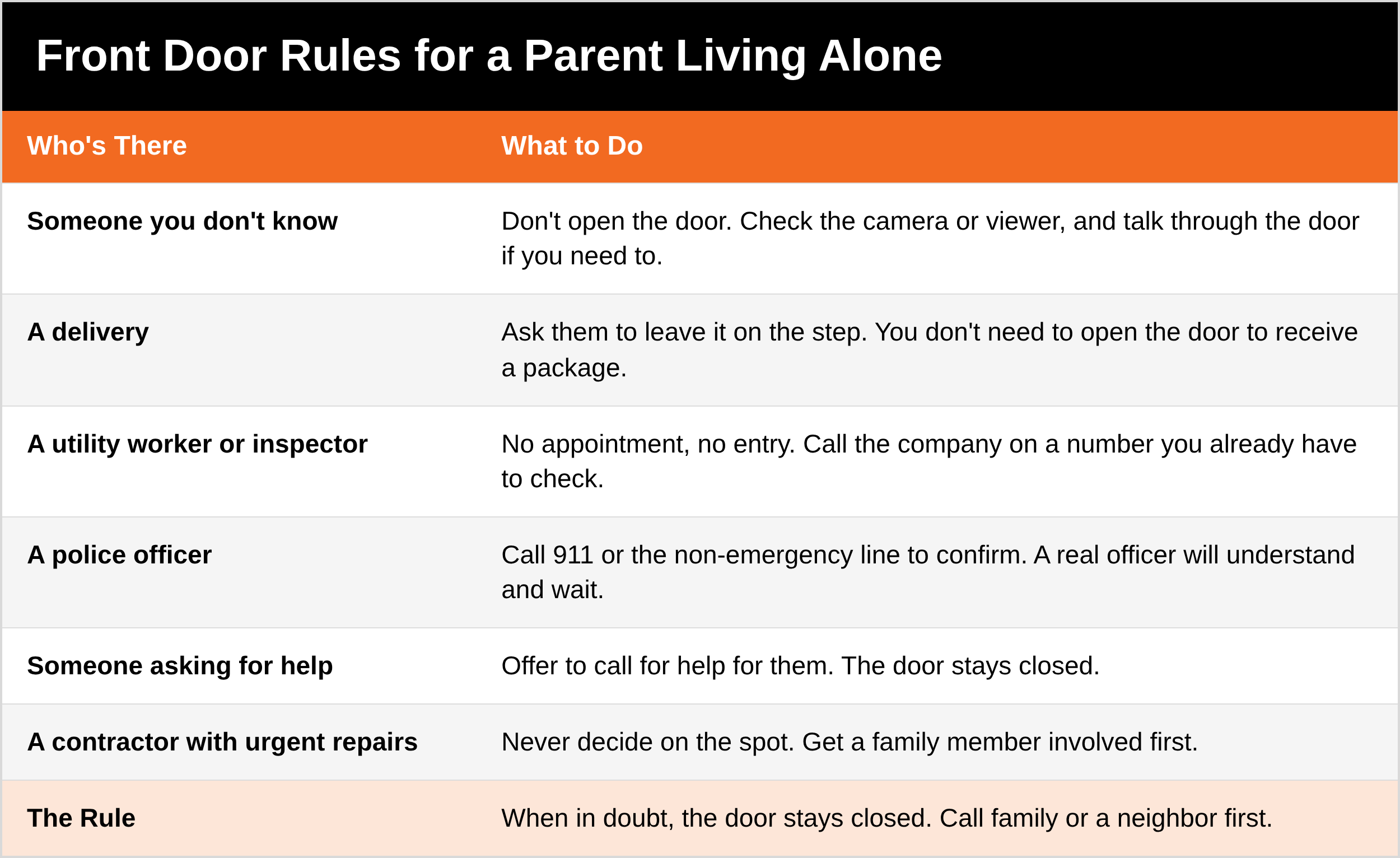
The Prepared Protector teaches one rule at the front door: a closed door is never rude. Your parent doesn't have to explain, apologize, or open up to be polite.
Packages Stay on the Step
A knock from a "delivery driver" is one of the easiest ways to get an older adult to open the door. Make it a family rule: never open the door to receive a package. Real drivers leave it on the step.
Ask family members to text before they send a delivery, so your parent knows what's coming
Bring packages in only after the driver has left
Consider a package box or locker so packages aren't sitting out
If a "driver" insists on a signature for something your parent didn't order, don't open the door. Call family first.
Know When the Door Opens
Door alerts are simple, inexpensive, and easy to overlook. A small contact sensor on the door can chime inside the house or send an alert to a family member's phone when the door opens.
They help in more than one way:
Security: you know if a door opens at 2 a.m.
Peace of mind: you know a caregiver arrived, or that your parent went out for the mail and came back.
Hearing loss: some doorbells and alerts add a flashing light or a vibrating alert, so a knock doesn't go unheard.
Doors, Frames, and Locks: The Short Version
A strong-looking lock means nothing if the door or frame is weak. Here's the quick list. For the full plan, see The Safest House on the Block [LINK].
Solid doors: solid wood or steel. Many older homes have hollow-core doors that are easy to kick in. Avoid large glass panels unless the glass is impact-resistant or has security film.
Strong frames: the frame is often the weakest point, not the lock. Install a reinforced strike plate with 3-inch screws that reach the wall studs, or add a door jamb reinforcement kit.
Good deadbolts: look for an ANSI/BHMA grade. Grade 1 is the highest rating, and Grade 2 is common and solid for most homes.
Keep a manual key: avoid smart locks that can't be opened with a key if the power or connection fails.
Double-cylinder deadbolts (keyed on both sides) can add security next to glass, but they slow escape in a fire. Check your local fire codes before installing one.
Secondary locks: door bars, wedges, or vertical bolts add protection at night.
See before you open: a wide-angle peephole or digital door viewer matters most if your parent doesn't use a phone-based camera.
The Knox Box: Getting Help In Fast
In a medical emergency, every second counts. Sometimes the biggest delay happens right at the front door.
A Knox Box is a small, secure, wall-mounted lockbox that holds a spare key to the home. Only emergency personnel, like firefighters and EMS, can open it, using a department-issued master key.
Why it matters for seniors:
If your parent falls, becomes unconscious, or can't reach the door, responders don't have to wait for a family member or break the door down
It saves precious minutes when every second counts
It prevents property damage, and it spares your parent the fear of hearing the door kicked in, which can be deeply frightening for someone who is hurt, confused, or living with memory loss
It's ideal for seniors living alone, anyone with a medical condition, and anyone at risk of falls.
Why Registration Matters
A Knox Box only helps if the responders who show up know it's there and carry the right key. That's why you set it up through your local fire department's program, not with a lockbox from the hardware store, and ask them to note it in their records. Then tell your family where it is and which door the key opens.
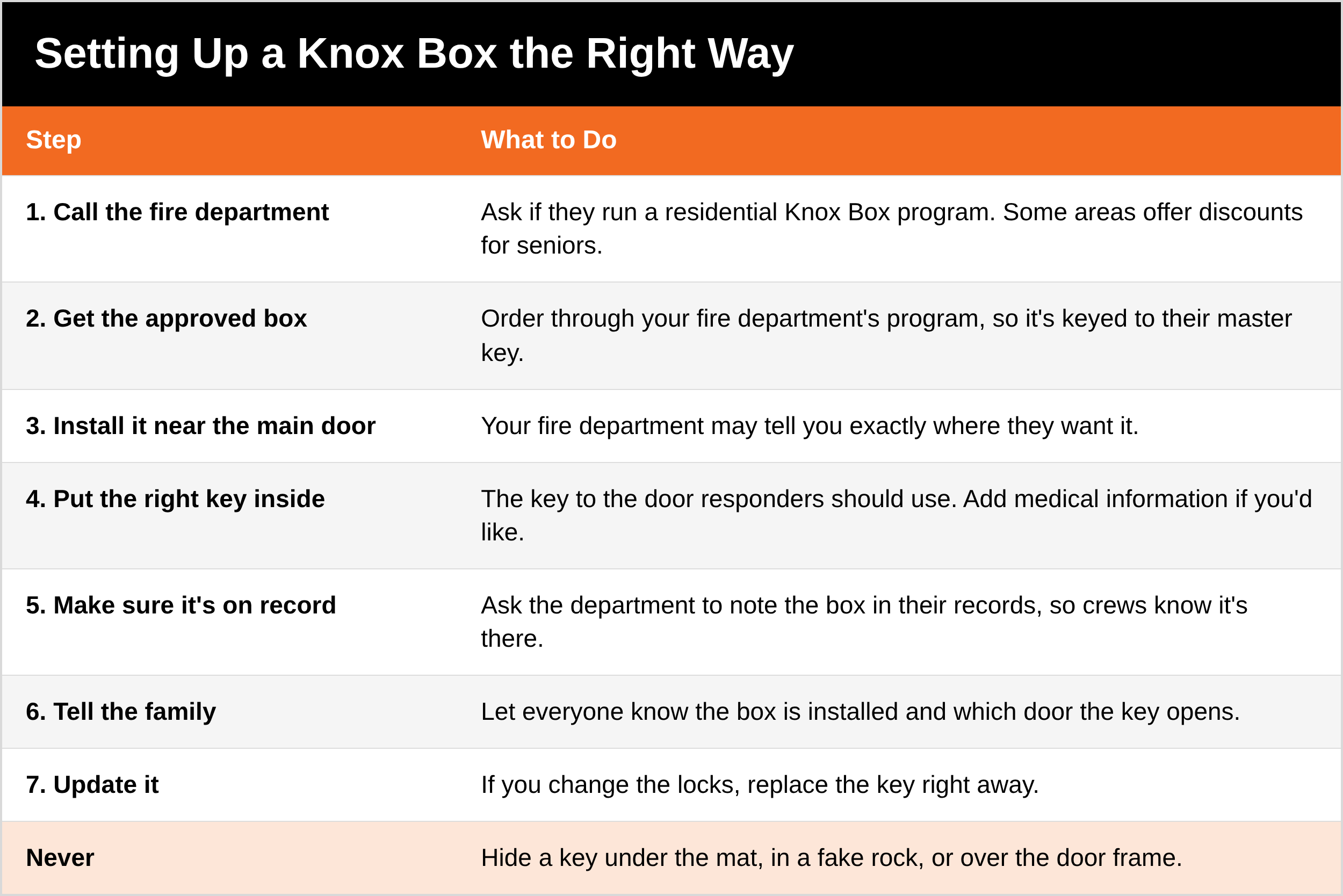
Pro tip: in some areas, fire departments offer discounted or free installation for seniors or high-risk households. Ask.
If your area doesn't have a Knox Box program, ask your fire department what they recommend. Whatever you do, never hide a key under the mat.
Don't Forget the Other Doors
Back doors, side doors, garage entries, and sliding glass doors deserve the same attention as the front door. Secure the windows, add motion-activated lighting to the lesser-used entry points, and make sure a camera covers them. These upgrades buy time, and they may stop a break-in before it starts.
Ask Yourself
Would my parent open the door for someone in a delivery uniform?
If my parent fell tonight and couldn't get to the door, how would paramedics get in?
Is there a key hidden outside my parent's house right now?
What to Say
"Dad, I want us to have the same front door rule I use: if we're not expecting someone, the door stays closed and we call each other. Packages can wait on the step."
5 Quick Wins You Can Start Today
Agree on the front door rule with your parent: not expecting anyone, the door stays closed.
Find and remove any hidden outside key.
Call your local fire department and ask about a residential Knox Box program.
Add a door sensor that sends an alert to your phone.
Check the strike plate screws on the front door. If they're short, swap in 3-inch screws.
Remember: A good front door keeps the wrong people out and lets the right people in fast. Plan for both.
Coming Up in Part 3
Tech That Keeps Them Independent. Voice assistants, wearable emergency devices, big-screen phones, and smart alarms, plus the privacy settings that matter.
Get Started Today
My free Who's at the Door? Family Door Card gives your parent simple rules and the exact words to use when someone unexpected knocks. Print it and keep it by the door.
DM the word DOOR on Instagram or Facebook and I'll send it to you. [Get it here: LINK]
Go Deeper
The Safest House on the Block covers doors, frames, locks, lighting, cameras, and the full layered plan that makes a home a hard target. This post covers the front door basics. The book gives you the whole house. [Get it here: LINK]
Coming soon: the Senior Safety Guide. Sliding doors and windows, door alerts for wandering and memory loss, emergency access options for condos and gated communities, and how to balance security with easy access for responders.
Tools I recommend: door sensors, strike plates, door bars, video doorbells, and package boxes in my Safest House on the Block store. https://link.amazon/B0dSfoUkh
The Full Series
Part 1: What the Nancy Guthrie Case Teaches Families [LINK]
Part 2: The Front Door (you are here)
Part 3: Tech That Keeps Them Independent [LINK]
Part 4: Check-Ins, Medications, and the Missed-Call Plan [LINK]
Part 5: Getting Around Safely [LINK]
Related Reading
Scam-Proofing the People You Love, Part 3: Scams That Pull at the Heart (home repair scams) [LINK]
Red Cell Your Family, Part 3: Red Cell Your House [LINK]
The Safest House on the Block blog series (doors and locks) [LINK]
References
Knox Company, Residential KnoxBox information: https://www.knoxbox.com
Builders Hardware Manufacturers Association (BHMA), ANSI/BHMA lock grades: https://buildershardware.com
Federal Trade Commission, Fake delivery and package scams: https://consumer.ftc.gov
National Institute on Aging, Aging in Place: https://www.nia.nih.gov
Disclaimer: These suggestions are intended to help you and your family build awareness, confidence, and safer decision-making habits. No safety plan, checklist, or training can guarantee 100% protection. There will always be people who try to exploit vulnerability, opportunity, trust, or positions of power. The goal is not to create fear, but to help guide families toward more informed, prepared, and practical safety decisions in everyday life. Fire codes, lock rules, and Knox Box programs vary, so check your state and county for the exact rules where you live. As an Amazon Associate, I earn from qualifying purchases.
If someone is trying to get into your home, call 911.
Awareness gives you time. Time gives you options.
The Prepared Protector is someone who's decided that loving someone means being ready for them, not just hoping things go fine.
Prepared Not Paranoid. Protecting the Most Vulnerable Among Us.