Cameras, Saved Video, and the Mistake Most Families Make
By Larry Betz | Prepared Not Paranoid https://www.preparednotparanoid.com/
Home security for elderly parents isn't about buying the most cameras. It's about making sure the cameras you have actually save the video and get the alert to someone who can act. The Nancy Guthrie case showed millions of families how easy that is to miss.
The disappearance of Nancy Guthrie is heartbreaking. Months later, her family is still waiting for answers. Out of respect for Nancy and the people who love her, I want to approach this with care. This isn't about the details of an active investigation. It's about what the rest of us can learn to protect our own parents.
For this series, I've been comparing notes with two friends who spent years in law enforcement: Justin Nichols, a former fraud detective, and Val Wilson, a retired lieutenant with the Orange County Sheriff's Department. Their input shaped a lot of what follows.
What We Know
Nancy Guthrie, the 84-year-old mother of TODAY co-anchor Savannah Guthrie, was last seen at her home near Tucson, Arizona, on the night of January 31, 2026. She was reported missing the next day.
Her front door had a Google Nest video doorbell. According to the Pima County Sheriff, it disconnected at 1:47 a.m. She didn't have a paid subscription, so in the first days, investigators said there was no saved video.
Then, on February 10, the FBI released images and video of a masked, gloved, armed person with a backpack at her front door, tampering with the camera. The footage was recovered from leftover data on Google's servers, with help from Google, after days of work.
As of this update, the case is still unsolved. The sheriff says it is not cold, DNA work continues, and no suspect has been named.
The Lesson Most Families Miss
Here's what stuck with me. The video that finally gave investigators a lead almost didn't exist. It was found only because of an extraordinary recovery effort, in one of the most closely watched cases in the country.
Most families can't count on that.
Many people install a camera and assume they're protected. But without the right settings, the right plan, or someone watching the alerts, a camera can capture everything and save nothing. Many cameras keep video for only a few hours without a paid plan, and some keep none at all.
A camera you don't understand is a camera you can't count on.
Start With a Smart Doorbell Camera, But Don't Rely on It Alone
A video doorbell is a great first layer of security. It alerts you when someone approaches the door, and it can serve as both a deterrent and a record of who visits.
The problem is that doorbell cameras are within reach. Someone with bad intentions can disable one in seconds. That's why it's essential to pair it with a second exterior camera that's out of reach, ideally placed high under an eave or angled from across the yard to capture a wider view of the entry.
When choosing a camera system:
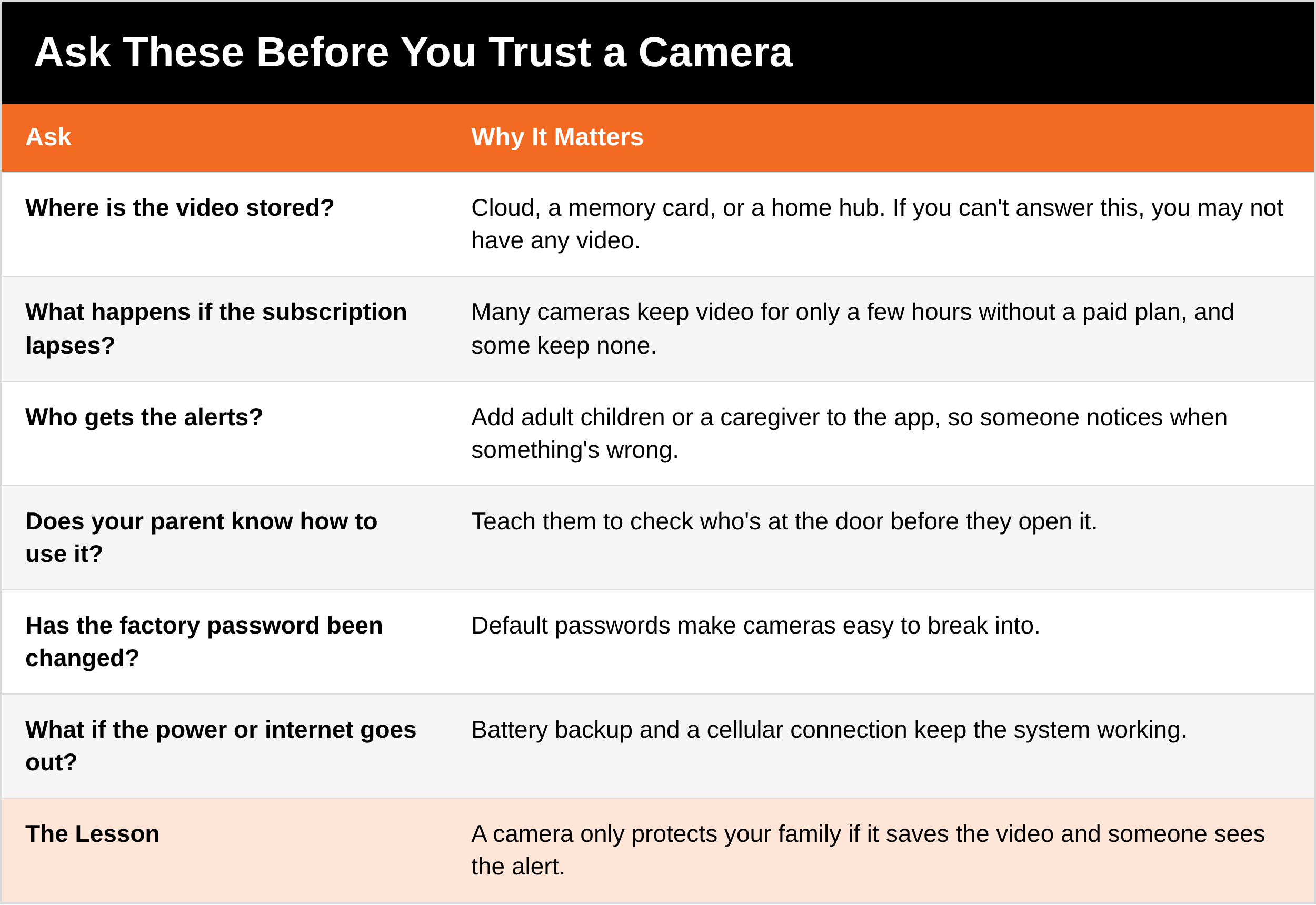
Ask where the footage is stored. Is it cloud-based or local? If it's cloud-based, what happens if the subscription lapses?
Can multiple family members monitor it through an app? That way, adult children or caregivers can check in even if the homeowner isn't tech-savvy.
Make sure someone in the home knows how to use it. Teach them how to check who's at the door and when to ignore or respond.
Keep subscriptions active and systems updated. Many systems lose core features, like remote access or recorded footage, if a paid plan lapses or software isn't updated.
Change the factory password and turn on two-factor login. Default passwords make cameras easy to break into.
For the full guide to choosing and placing cameras, see the Home Security series [LINK].
Build Layers, Not a Single Camera
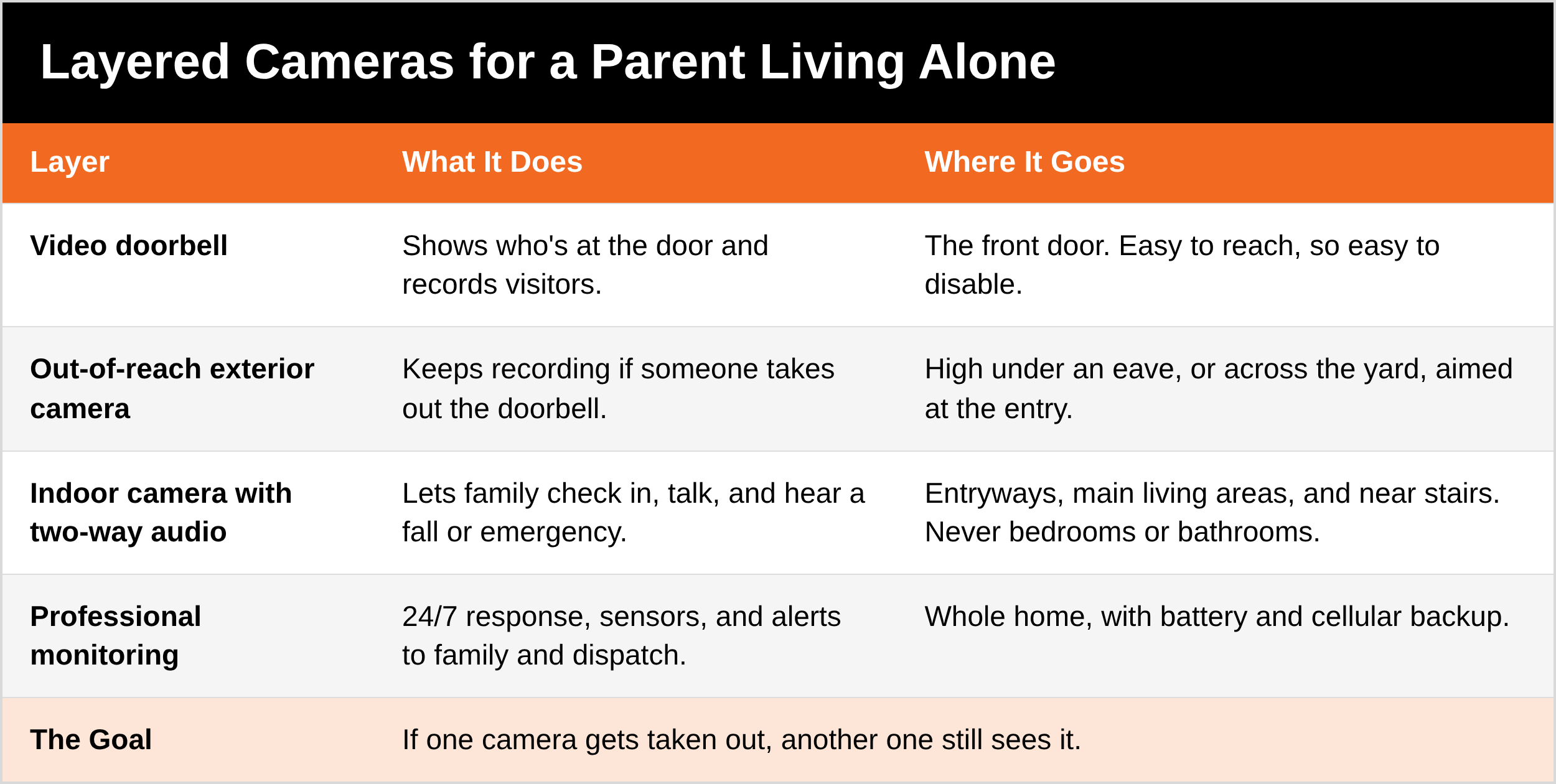
Indoor cameras with two-way audio give you two big benefits:
Security: you can check in visually if there's a break-in or an alert.
Health and safety: if a parent falls or has a medical emergency, you can hear and speak to them, and call for help right away.
They're most useful in entryways, main living spaces, and near stairs or hallways. Never put cameras in bedrooms or bathrooms, for privacy and to keep your parent's trust.
Professional monitored systems offer the highest level of protection, especially if your parent lives alone, has health or mobility issues, lives in a higher-risk area, or has had a problem before. Look for:
24/7 monitoring with dispatch
Alerts sent to family and emergency services
Door, window, and perimeter sensors
Medical alert buttons
Battery backup and cellular alerts in case the power or internet goes out
Many systems allow custom zones, so the back door can stay armed while your parent is home during the day.
The Prepared Protector doesn't just install the camera. They make sure it saves the video, that someone gets the alert, and that one cut wire doesn't leave the house blind.
Be Patient and Supportive With Technology
When you help an older parent with new technology, patience is everything. Many seniors didn't grow up with smartphones, apps, or connected devices. They come from a generation where things were more hands-on, face-to-face, and slower-paced. To them, modern tech can feel overwhelming, confusing, or even threatening.
What seems simple to us may feel foreign to them. Explain things clearly, step by step, and never make them feel behind or incapable. Focus on how these tools help them stay safe, independent, and connected to the people they love. Learning this isn't about keeping up. It's about staying in control.
When we lead with patience, we build trust. That's where real safety starts.
Ask Yourself
If someone pulled my parent's doorbell camera off the wall tonight, would any other camera see it?
Do I know where my parent's camera saves video, and for how long?
Would I get the alert, or would it go to a phone nobody checks?
What to Say
"Mom, I saw a story about how a doorbell camera almost didn't save the video that mattered. Can we look at yours together? I want to make sure it's actually recording, and that I get the alerts too."
5 Quick Wins You Can Start Today
Open the camera app and find out where the video is saved and how long it's kept.
Check the subscription renewal date, and put a reminder on your calendar.
Add yourself, and a sibling if you can, to the app so the alerts reach more than one person.
Change the factory password and turn on two-factor login.
Stand outside and ask: if someone took down the doorbell, what else would see them?
Remember: A camera only protects your family if it saves the video and someone sees the alert. Check both, before you ever need them.
Coming Up in Part 2
The Front Door: Visitors, Deliveries, and Emergency Access. Door rules for unexpected visitors, why packages should stay on the step, door alerts, and making sure responders can get in fast.
Get Started Today
My free Home Security Audit walks you through your parent's home layer by layer, from the curb to the front door, so you can find the gaps before someone else does.
DM the word AUDIT on Instagram or Facebook and I'll send it to you. [Get it here: LINK]
Go Deeper
The Safest House on the Block covers cameras, lighting, doors, locks, and the full layered plan that makes a home a hard target. This post shows you the lesson. The book gives you the plan. [Get it here: LINK]
The Family Safety Toolkit includes a Senior Safety section with checklists you can work through together. [Get it here: LINK]
Coming soon: the Senior Safety Guide. A full chapter on cameras and monitoring for older adults, including placement, protecting against tampering, storage settings, shared family access, and a monthly test routine.
Tools I recommend: cameras, doorbells, and home security gear in my Safest House on the Block store. https://link.amazon/B0dSfoUkh
The Full Series
Part 1: What the Nancy Guthrie Case Teaches Families (you are here)
Part 2: The Front Door: Visitors, Deliveries, and Emergency Access [LINK]
Part 3: Tech That Keeps Them Independent [LINK]
Part 4: Check-Ins, Medications, and the Missed-Call Plan [LINK]
Part 5: Getting Around Safely [LINK]
Related Reading
Red Cell Your Family, Part 3: Red Cell Your House [LINK]
Scam-Proofing the People You Love, Part 1: How Scams Really Work [LINK]
Home Security series [LINK]
References
NBC News, How investigators wrangled video from Nancy Guthrie's Google Nest camera: https://www.nbcnews.com/tech/tech-news/investigators-wrangled-video-nancy-guthries-google-nest-camera-backend-rcna258460
CBS News, How investigators recovered Nancy Guthrie's doorbell footage: https://www.cbsnews.com/news/cybersecurity-experts-nancy-guthrie-surveillance-footage-recovery
Tom's Guide, How did the FBI get Nancy Guthrie's Google Nest camera footage: https://www.tomsguide.com/computing/online-security/how-did-the-fbi-get-nancy-guthries-google-nest-camera-footage-if-it-was-disabled-and-what-does-it-mean-for-your-privacy
TV Insider, Sheriff Chris Nanos shares evidence update nine months later (October 2026): https://www.tvinsider.com/1301092/nancy-guthrie-sheriff-chris-nanos-rare-evidence-update-9-months-after-abduction/
Disclaimer: This post discusses an active, unsolved investigation. Case details come from public statements by law enforcement and news reports as of November 2026 and may change. These suggestions are intended to help you and your family build awareness, confidence, and safer decision-making habits. No safety plan, checklist, or training can guarantee 100% protection. There will always be people who try to exploit vulnerability, opportunity, trust, or positions of power. The goal is not to create fear, but to help guide families toward more informed, prepared, and practical safety decisions in everyday life. Laws and rules about cameras and recording vary, so check your state and county for the exact rules where you live. As an Amazon Associate, I earn from qualifying purchases.
If you have information about Nancy Guthrie, call the FBI at 1-800-CALL-FBI. If you are in immediate danger, call 911.
Awareness gives you time. Time gives you options.
The Prepared Protector is someone who's decided that loving someone means being ready for them, not just hoping things go fine.
Prepared Not Paranoid. Protecting the Most Vulnerable Among Us.