Why Food Is Part of Your Preparedness Plan
By Larry Betz | Prepared Not Paranoid https://www.preparednotparanoid.com/
When most families think about being prepared, they think about gear. Flashlights. A first aid kit. A full gas tank. Water in the garage.
All of that matters. But there's one piece of your plan that gets overlooked, and it's the one you use three times a day.
What you eat decides how well you think, move, recover, and hold up under stress. That's true on a normal Tuesday. It's even more true when the power is out, the roads are closed, or someone in your family needs you to stay steady.
No part of the country is off the hook. Hurricanes on the Gulf and East Coasts. Wildfires across the West. Tornadoes in the Plains and the South. Earthquakes on the West Coast. Floods, ice storms, heat waves, and power outages just about everywhere. The question isn’t whether your area can be hit. It’s what kind of emergency is most likely where you live, and whether your family is ready for it.
That’s why the American Red Cross recommends keeping at least a 2-week supply of food and water at home for every member of your household (1 gallon of water per person, per day), plus a 3-day supply ready to grab if you have to leave, and some extra cash on hand, since card readers and ATMs don’t work when the power is out.
Two weeks of food for your whole family is a lot of food. This series is here to help you make the best choices to fill it: food your family will actually eat, that keeps them strong, and that you can store without turning your house into a warehouse.
Here's the good news. You don't need a nutrition degree, a special diet, or a pantry full of expensive products. You need to understand a few fundamentals and build a handful of habits. That's what this series is for.
What Nutrition Really Means
Understanding the fundamentals of nutrition is crucial for maintaining optimal health and well-being. Simple nutrition involves balancing essential nutrients to support the body's functions. Nutrition includes macronutrients (proteins, carbohydrates, and fats), which provide the energy and building blocks needed for growth and repair, as well as micronutrients (vitamins and minerals), which play vital roles in various physiological processes.
Proteins, for example, are essential for muscle repair and immune function, while carbohydrates serve as the primary energy source. Fats, including omega-3, omega-6, and omega-9 fatty acids, are important for brain health, inflammation control, and hormone production.
Not all fats are equal. Artificial trans fats are harmful to your heart, and that's why the FDA removed partially hydrogenated oils from the food supply. Heavily refined seed oils are something most families should cut back on, mostly because they come packed inside ultra-processed foods. You'll get the full story in Lesson 4 and Lesson 5.
Nutrition Is Preparedness
A strong understanding of nutrition not only helps guide smarter food choices for everyday health, energy, and longevity, but also plays a critical role in overall preparedness.
Understanding these nutritional components is not only important for daily health but also for making informed choices during emergencies. With this knowledge, you can ensure that your food supplies provide adequate nutrition to sustain energy and bodily functions, strength, clarity, and endurance, even during emergencies or times of limited food access.
Think about what a hard day actually asks of you.
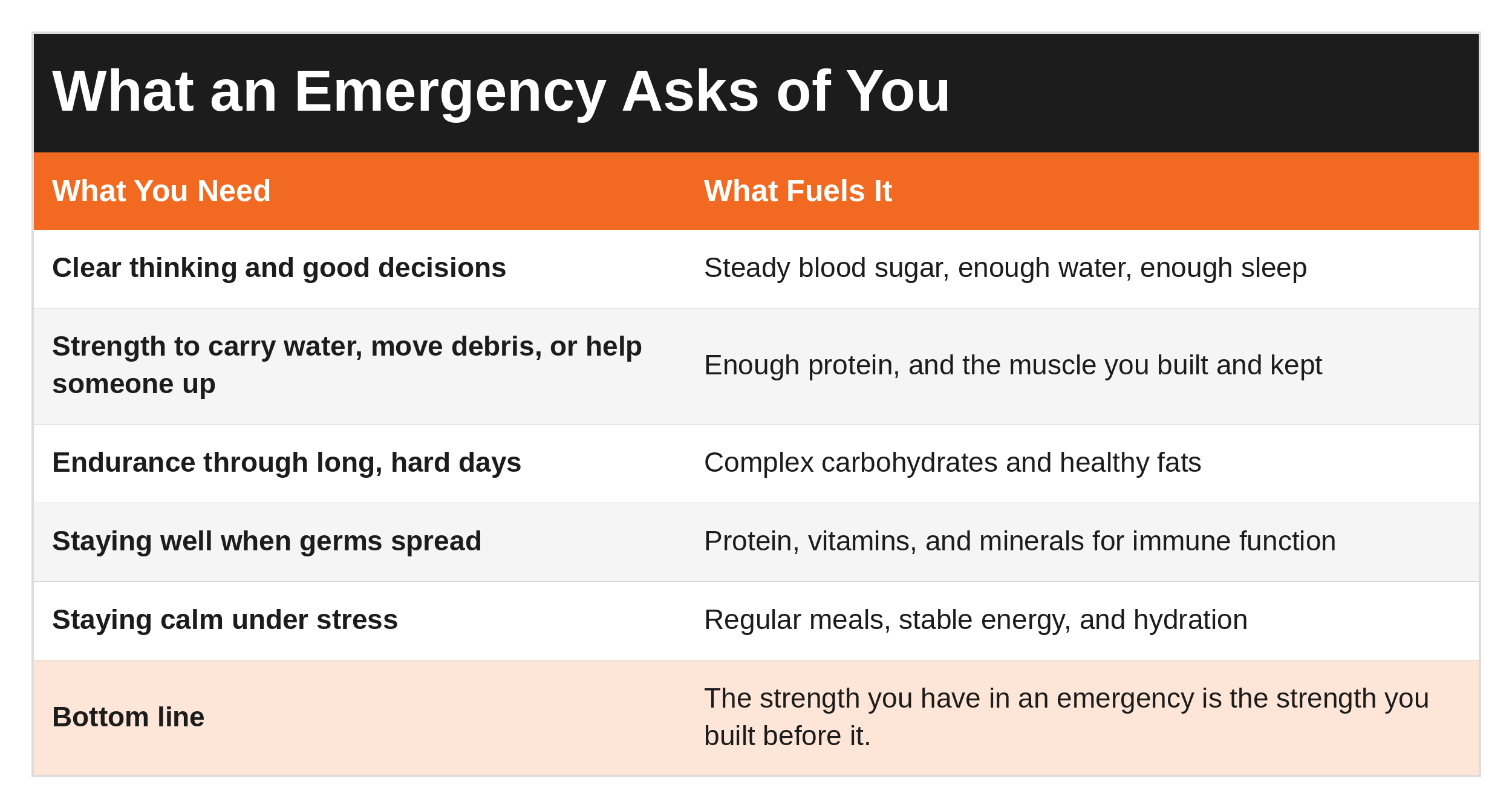
None of these are built in a day. A family that eats well most of the time starts any crisis with a reserve. A family running on drive-through food and energy drinks starts it already behind.
What Changes When Life Gets Interrupted
When normal life breaks down, eating changes fast:
Routines break. Meals get skipped, or they turn into whatever is quick.
Stress goes up. Stress affects appetite, sleep, and decision making.
Food access shrinks. Stores may be closed or empty, and your fridge is on a clock once the power goes out.
Physical demands go up. You may be lifting, walking, cleaning up, or caring for others more than usual.
Water becomes the priority. Even mild dehydration has been shown in studies to affect mood, concentration, and fatigue.
This is where preparation pays off. If you already know how to build a balanced meal, what to store, and how to make water safe, an emergency becomes a problem you can manage instead of one that manages you.
Where Most Families Stand Today
If you feel like your family's eating could use some work, you're far from alone.
Only about 1 in 10 U.S. adults eats enough vegetables, and only about 1 in 8 eats enough fruit, according to the CDC.
About 55 percent of the calories Americans eat come from ultra-processed foods. For kids and teens, it's about 62 percent, according to the CDC's National Center for Health Statistics.
Those numbers aren't meant to scare you. They're meant to show you how much room there is to improve, and how little it takes to get ahead of the average.
What's new (checked October 2026): The Dietary Guidelines for Americans, 2025 to 2030, released by the USDA and HHS on January 7, 2026, put a stronger emphasis on whole and minimally processed foods, cutting back on highly processed and ultra-processed products, limiting added sugars, and eating protein at every meal. A lot of what we've taught at Prepared Not Paranoid all along is now front and center in the federal guidelines.
Everyday Health and Emergency Food Are One Plan
Most people treat "healthy eating" and "emergency food" as two separate projects. One lives in the kitchen. The other lives in a bin in the garage, full of food that expired two years ago.
I want you to think of them as one plan.
The same knowledge that helps you pick a better cereal helps you pick better storage foods.
The same habits that keep your family strong on a normal week, like protein at breakfast and water instead of soda, keep them steady in a hard week.
The same pantry that feeds you on a busy Tuesday can carry you through a two-week outage, if you build it on purpose and rotate it.
Water comes first. In any emergency, safe water matters before food does. Plan on at least 1 gallon per person per day, for a minimum of 3 days, and work toward 14 days. My Safe Drinking Water series walks you through it.
Start Small: Four Steps This Week
You don't need to overhaul your family's diet this week. Big, sudden changes rarely last. Small, steady changes do.
Step 1: Pick one meal. Breakfast is usually the easiest place to make a real difference. Add protein and cut the sugar.
Step 2: Swap one drink. Replace one sugary drink a day with water.
Step 3: Read one label. Look at the ingredients list on something your family eats every day.
Step 4: Add one item to your pantry. Choose a shelf-stable food your family already likes, and buy an extra.
Each of those takes minutes. Do them consistently and you'll feel the difference in your energy, your focus, and how your family feels.
What This Series Covers
Each lesson stands on its own, but they build on each other. Start here and work your way through.
Lesson 1: Macronutrients and Micronutrients https://www.preparednotparanoid.com/pnp-library/nutrition-lesson-1
Lesson 2: Protein https://www.preparednotparanoid.com/pnp-library/nutrition-lesson-2
Lesson 3: Carbohydrates and the Glycemic Index https://www.preparednotparanoid.com/pnp-library/nutrition-lesson-3
Lesson 4: Fats and Oils https://www.preparednotparanoid.com/pnp-library/nutrition-lesson-4
Lesson 5: Trans Fats https://www.preparednotparanoid.com/pnp-library/nutrition-lesson-5
Lesson 6: Phytonutrients https://www.preparednotparanoid.com/pnp-library/nutrition-lesson-6
Lesson 7: High Fructose Corn Syrup https://www.preparednotparanoid.com/pnp-library/nutrition-lesson-6-8gd54
Lesson 8: Food Labels Deciphered https://www.preparednotparanoid.com/pnp-library/nutrition-lesson-8
Lesson 9: Alcohol and Your Readiness https://www.preparednotparanoid.com/pnp-library/nutrition-lesson-9
Lesson 10: Food Storage Strategies https://www.preparednotparanoid.com/pnp-library/nutrition-lesson-10
Ask Yourself
If the power went out tonight for three days, what would my family eat and drink?
Are most of our meals built from whole foods, or from packages?
Do I have the energy and strength I'd want if my family needed me in an emergency?
What is one small change I can make this week and actually keep?
Remember
The strength you have in an emergency is the strength you built before it. Feed your family well every day, and you're already preparing.
Get Started Today
[FREE DOWNLOAD: TO BE CHOSEN AFTER THE BINDER REVIEW]
Go Deeper
The Prepared Not Paranoid Family Nutrition Guide. This series gives you the foundation. The guide gives you the whole plan: what to eat, what to avoid, what to drink, and what to keep on hand, plus the Family Food Planner, a 30-day food and water calculator, 15 pantry recipes, and printable cards for your fridge and go-bag. Everyday health and emergency planning, in one place. [Get it here: LINK]
Tools I recommend: The food storage containers, water storage, and kitchen tools I recommend are in my Amazon store. https://amzn.to/4yM747h
Related reading:
Safe Drinking Water, Lesson 3: Water Storage https://www.preparednotparanoid.com/pnp-library/water-storage
Toxic Chemicals to Avoid: Introduction https://www.preparednotparanoid.com/pnp-library/toxic-chemicals-intro
Family Safety: How Emergency Response Works, Why You Are Your Own First Responder https://www.preparednotparanoid.com/pnp-library/emergency-preparedness
References
U.S. Department of Agriculture and U.S. Department of Health and Human Services. Dietary Guidelines for Americans, 2025 to 2030. Released January 7, 2026. https://www.dietaryguidelines.gov/
Lee SH, Moore LV, Park S, Harris DM, Blanck HM. Adults Meeting Fruit and Vegetable Intake Recommendations, United States, 2019. Morbidity and Mortality Weekly Report 71(1):1 to 9, 2022. https://www.cdc.gov/mmwr/volumes/71/wr/mm7101a1.htm
Williams AM, Couch CA, Emmerich SD, Ogburn DF. Ultra-processed Food Consumption in Youth and Adults: United States, August 2021 to August 2023. NCHS Data Brief No. 536, 2025. https://www.cdc.gov/nchs/products/databriefs.htm
U.S. Food and Drug Administration. Trans Fat. https://www.fda.gov/food/food-additives-petitions/trans-fat
Ganio MS, et al. Mild dehydration impairs cognitive performance and mood of men. British Journal of Nutrition 106(10):1535 to 1543, 2011.
Armstrong LE, et al. Mild dehydration affects mood in healthy young women. Journal of Nutrition 142(2):382 to 388, 2012.
Ready.gov (FEMA). Build a Kit. https://www.ready.gov/kit
American Red Cross. Be Red Cross Ready: Get a Kit (3-day supply for evacuation, 2-week supply for home; extra cash). https://www.redcross.org/content/dam/redcross/National/BE%20RED%20CROSS%20READY.pdf
Disclaimer
This article is for general informational and educational purposes only. It is not medical advice and is not a substitute for guidance from your physician or a registered dietitian. Talk to your doctor before making major changes to your diet, especially if you are pregnant or nursing, take medications, or have a medical condition such as diabetes or kidney disease. Affiliate disclosure: I've linked to products from my Amazon store that I personally recommend. As an Amazon Associate, I earn from qualifying purchases, at no extra cost to you. Thank you for supporting my work.
In a medical emergency, call 911.
Awareness gives you time. Time gives you options.
The prepared protector is someone who's decided that loving someone means being ready for them, not just hoping things go fine.
Prepared Not Paranoid. Protecting the Most Vulnerable Among Us.