Why Your Home Is Your First Line of Defense
By Larry Betz | Prepared Not Paranoid https://www.preparednotparanoid.com/
When you call 911, help is on the way. But police response time is measured in minutes, and sometimes much longer. In those minutes, the only people who can protect your family are the ones already inside your home. This series is about making sure that's enough: making your home a hard target, buying time, and having a plan everyone knows.
The United States is a big country. As of July 1, 2025, the U.S. population was estimated at about 341.8 million people. In a country that large, even crime rates that look statistically "low" still add up to millions of victims, incidents, and dangerous encounters every year.
That doesn't mean everyone is dangerous. It doesn't mean crime is happening everywhere, all the time. It does mean this: police are necessary, but they can't be everywhere, instantly, for everyone. Home security, situational awareness, and family preparedness aren't paranoia. They're practical responsibilities.
A note on the numbers: These are national statistics, and every city and neighborhood is different. To understand the risk where you live, check your local police department's crime dashboard, your city's crime reports, or a tool like CrimeMapping.com. National data shows the big picture. Local data shows what's happening on your street.
The Scale of Reported Crime in America
Here's the good news first: crime is down. The Bureau of Justice Statistics reported that from 2024 to 2025, the violent crime rate dropped 11% and the property crime rate dropped 13%.
Here's what police recorded in the last two years.
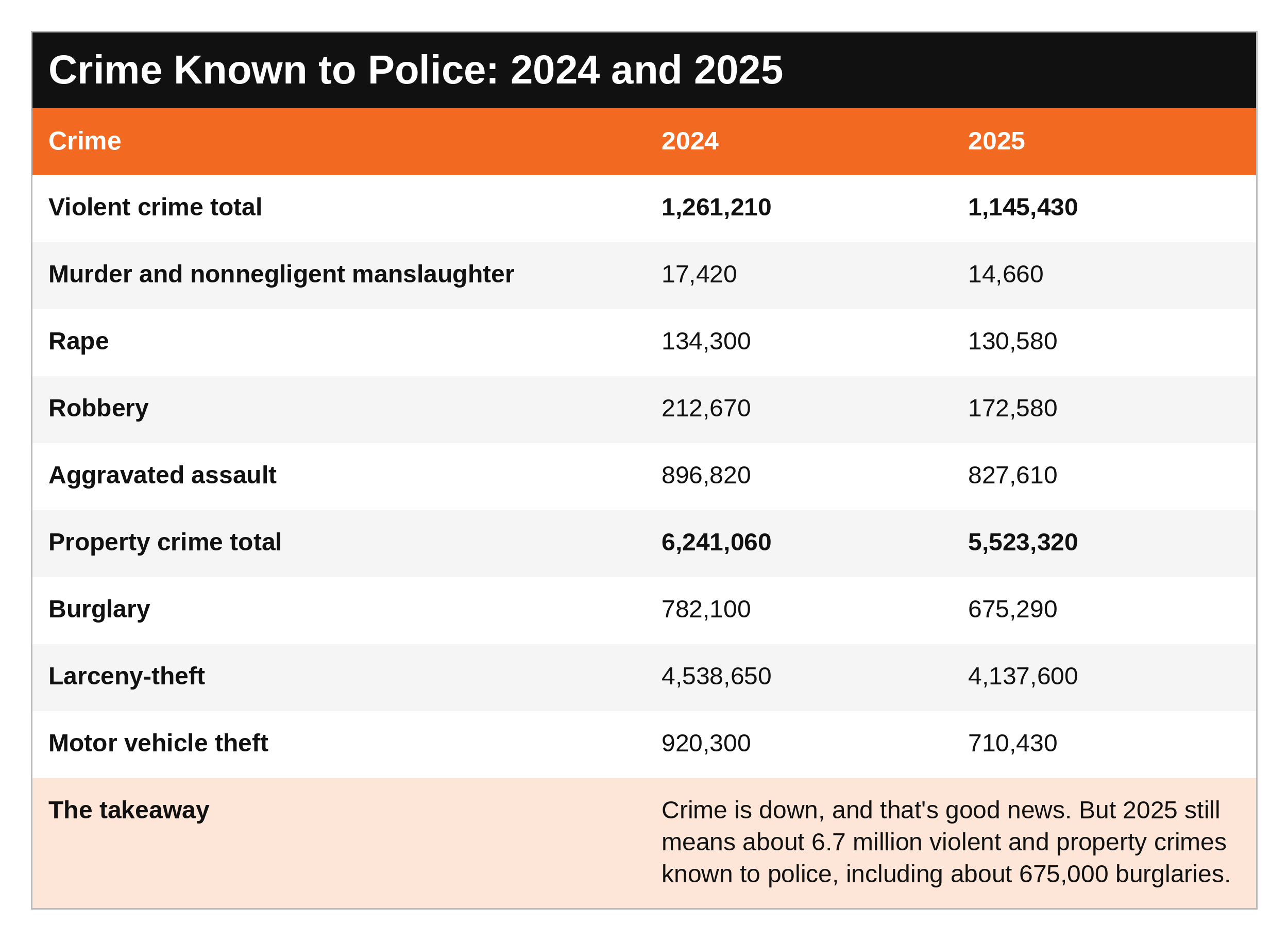
Even after that drop, 2025 still means about 6.7 million violent and property crimes known to police, including about 675,000 burglaries. Those numbers are useful, but they aren't the full picture. They only count crimes known to law enforcement and sorted into specific categories. They don't capture every suspicious encounter, attempted crime, domestic disturbance, stalking incident, online threat, or crime that was never reported.
Many Crimes Are Never Reported
One of the best sources for understanding crime is the National Crime Victimization Survey (NCVS), run by the Bureau of Justice Statistics. Instead of relying on police reports, the NCVS asks people directly about crimes they experienced, including the ones they never reported.
In 2024, the NCVS estimated about 6.1 million violent victimizations of people age 12 and older, including rape or sexual assault, robbery, aggravated assault, and simple assault. That's a big gap from what shows up in police data. People don't report crimes for a lot of reasons: fear of retaliation, embarrassment, trauma, distrust of the system, believing police can't help, fear of not being believed, or because they know the person who hurt them.
That's especially true for sexual assault, domestic violence, stalking, harassment, robbery, assault, and gang-related intimidation. Gang-related crime is especially hard to measure. Victims and witnesses may fear retaliation or live in neighborhoods where intimidation keeps people quiet. Some of that violence is never reported at all, or it's only told to family, friends, schools, hospitals, or community groups.
There's another issue too. Even when a crime is reported, the final numbers depend on how it's classified. A serious confrontation may be recorded as a lesser offense. An assault may be logged as a disturbance. A robbery may be downgraded after review. Sometimes that's legitimate, because new facts come in. But the National Institute of Justice has warned that pressure to lower crime numbers, without equal pressure to protect the integrity of the records, can invite suppressed reports and misclassified crimes. A 2026 investigation in Washington, D.C., alleged that some police officials reclassified thefts, assaults, and robberies as lesser offenses.
So when you look at crime statistics, remember three things:
Some crimes are never reported to police.
Some crimes are reported but not recorded in a way that reflects what really happened.
Some crimes are later downgraded, reclassified, or dropped from major-crime totals.
That doesn't mean every department is dishonest or every statistic is fake. It means official numbers are useful but incomplete. No police report, or a lesser label on one, doesn't always mean the danger wasn't real.
Missing Persons
Missing-person reports show another side of public safety.
Here's what the FBI recorded in 2025.
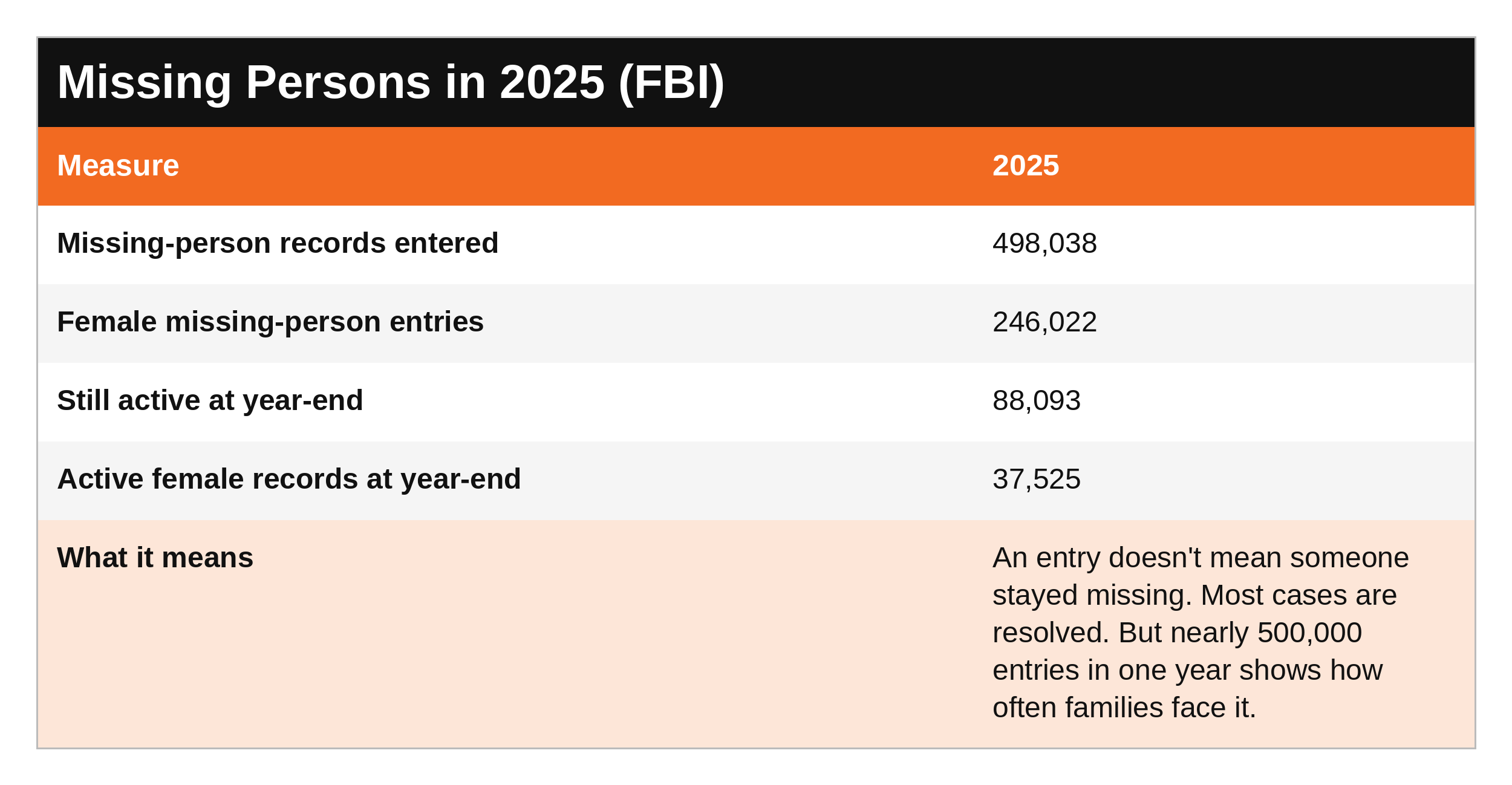
An entry doesn't mean the person stayed missing. Many records are cleared because the person is found, comes home, or the case is resolved. Still, the number shows how many families face that situation every year.
Crimes Against Children
Child safety adds another serious layer. The federal Child Maltreatment 2024 report found about 532,228 child victims of abuse or neglect known to child protective services in federal fiscal year 2024. That's about 7.2 victims for every 1,000 children. And that only counts cases known to authorities.
Online Exploitation of Children
The threat doesn't stop at the front door. In 2024, the National Center for Missing & Exploited Children's CyberTipline received about 20.5 million reports of suspected online child sexual exploitation, including more than 546,000 reports of online enticement, adults contacting children for sexual purposes, including sextortion.
Reports aren't convictions, and one offender or victim can be tied to more than one report. But the volume shows the size of the problem, and it's a reminder that "home security" now includes the phones and tablets inside your home.
The Size of Law Enforcement Compared to the Size of the Problem
Now compare all of that with the number of officers.
Here's how many officers the country has.
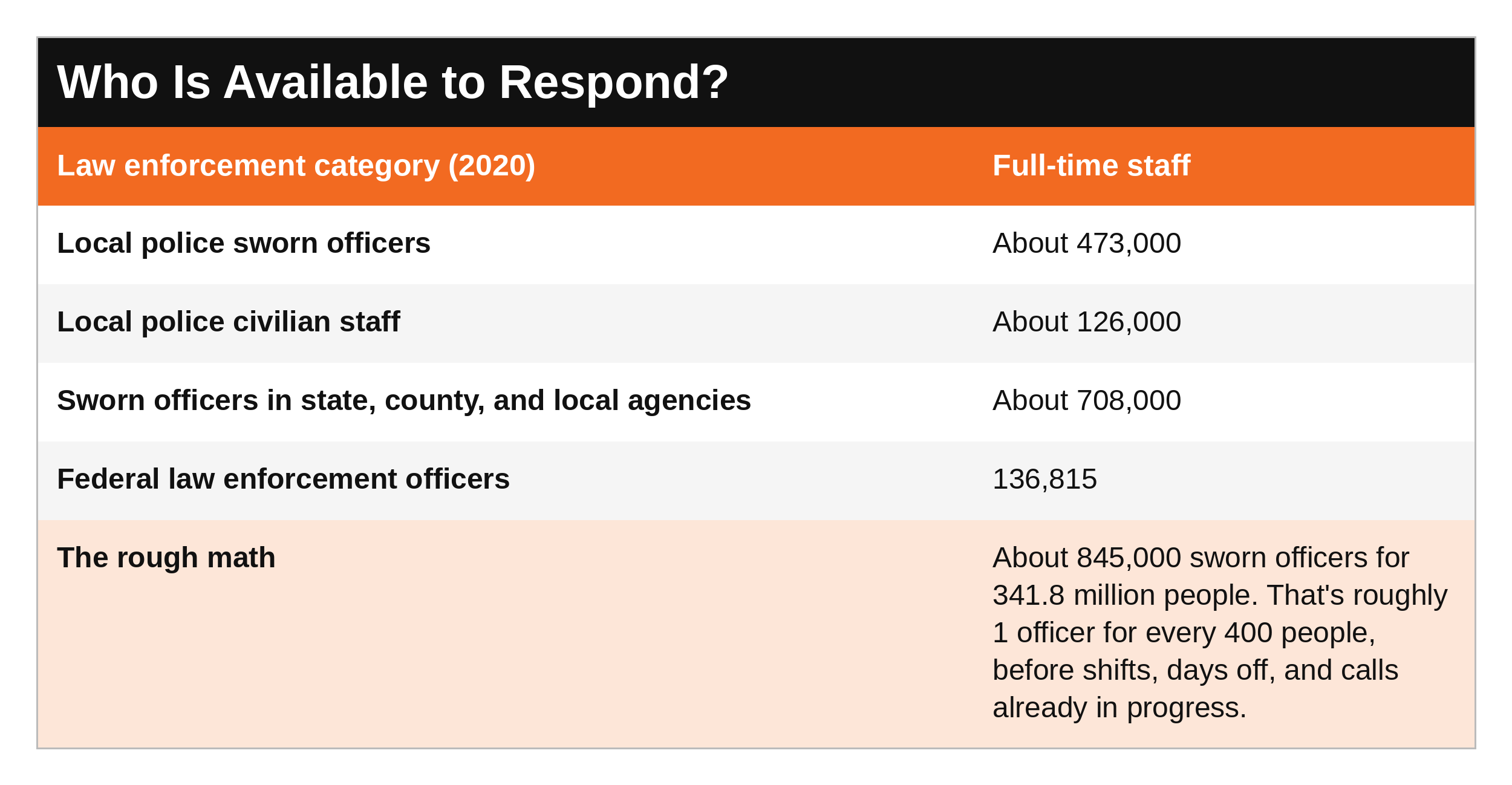
That works out to roughly one sworn officer for every 400 people. But even that number is misleading, because not every sworn officer is on patrol answering emergency calls.
Here's how local officers are assigned.
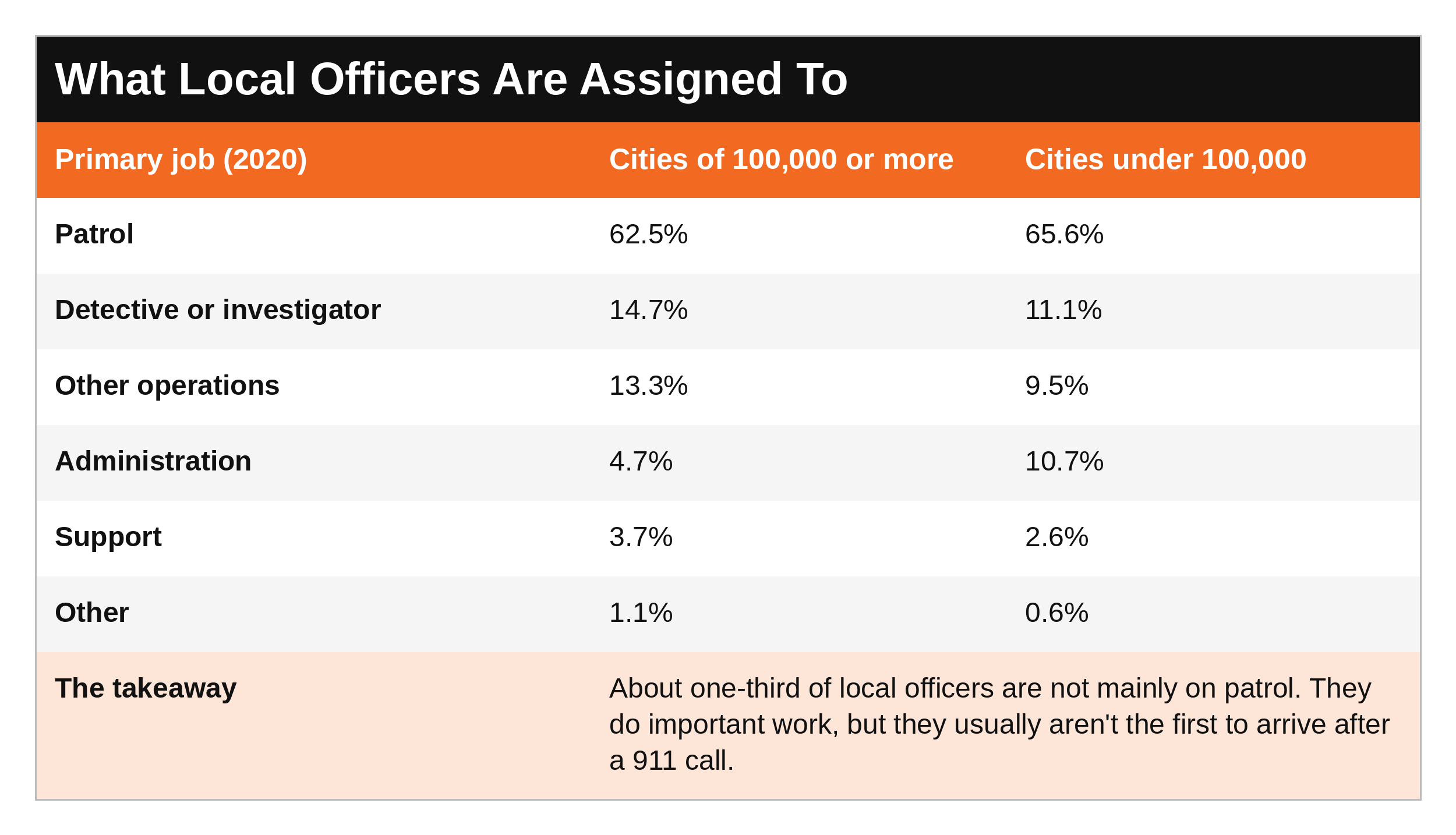
Patrol includes patrol, field, traffic, and school resource officers. Administration includes chiefs, finance, human resources, internal affairs, and other office roles. So roughly one-third or more of local officers aren't mainly on patrol. Detectives, supervisors, school resource officers, traffic officers, and administrators all do important work. But the number of officers who can respond right now to a burglary, assault, robbery, suspicious person, domestic violence call, or home invasion is much smaller than the headline number.
And it gets smaller still once you factor in shifts, days off, vacations, sick leave, court, training, paperwork, prisoner transport, big rural coverage areas, and officers already tied up on other calls.
Police Response Time: Help Usually Arrives After It Starts
Even when you call 911 right away, police still have to take the call, sort it by priority, send an available officer, and drive to you. Depending on the city, the type of call, staffing, traffic, distance, and how busy officers already are, that can take a few minutes or much longer.
There's no single national police response time. Every department measures it differently. Some start the clock when the 911 call is answered, others when an officer is dispatched. Some count only top-priority calls, others count everything.
The volume alone is huge. The Bureau of Justice Statistics reported that in 2022, about 49.2 million U.S. residents age 16 or older had contact with police. About 15.6 million contacted police to report a possible crime, and about 9.2 million to report a non-crime emergency or a traffic accident they witnessed.
And response times can change a lot.
Here's how much response times can change.
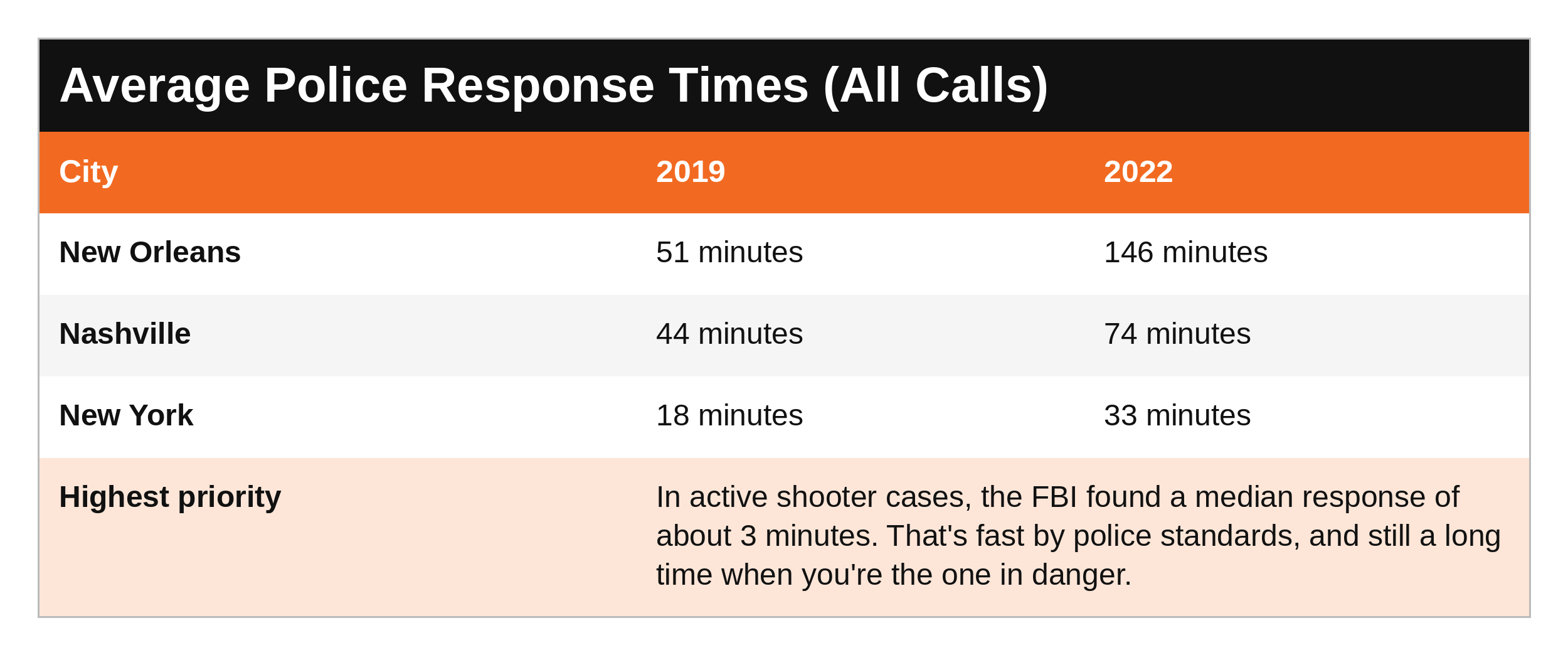
Those averages include all kinds of calls, not just emergencies. For the highest-priority calls, police often move much faster. In active shooter cases, the FBI found a median response time of about three minutes, fast by law enforcement standards. But three minutes is a long time during a home invasion, an assault, or an attempted abduction.
Police respond to danger. You may have to survive it until they arrive.
That's not a reason to skip calling 911. Always call. It's a reason to understand time and distance, and to use them.
What This Means for Your Home
Your home is where your family sleeps, where your kids play, and where your aging parents may spend most of their day. It's also the one place you have the most control over.
Most criminals aren't looking for the hardest target. They're looking for the easiest one. A burglar wants in and out without being seen. A home invader is willing to confront whoever is inside. Either way, every layer of security you add does the same thing: it buys time. Time to see it coming, time to lock a door, time to call 911, time to get your family somewhere safe.
That's the idea behind the four D's you'll learn in Part 1: Deter, Detect, Delay, and Defend, plus one more: Habits. None of them require you to live in fear. They just make your home harder to choose, harder to get into, and easier to defend.
The Prepared Protector is someone who's decided that loving someone means being ready for them, not just hoping things go fine. At home, that means not counting on help to arrive in time. It means building a house that buys you that time.
SCAN at Home
My SCAN framework works on your front porch the same way it works in a parking lot:
S - See your environment. Notice the car that keeps circling, the person who knocks and then walks around the side of the house, the gate that was closed this morning.
C - Create space. Keep a locked door between you and anyone you don't know. Talk through the door, a video doorbell, or a window.
A - Act deliberately. Lock up, move your family to a safer room, and call 911. Don't go looking for the problem.
N - Never doubt your gut feelings. If something feels wrong, it probably is. You don't need proof to lock a door or call for help.
What to Say: When You Call 911
Under stress, people forget the most important thing: where they are. Teach everyone in your home to say it in this order.
Start with your address, including the apartment or unit number. If the call drops, they still know where to send help.
Say what's happening and whether anyone is hurt. "Someone is breaking in through our back door. We're upstairs in the bedroom. No one is hurt."
Describe the person only if you can do it safely.
Stay on the line and follow instructions. Don't hang up unless they tell you to.
If speaking would put you in danger, check whether text-to-911 works where you live. Start the text with your address. And never assume an alarm company, camera app, or smart speaker has called 911 for you unless you get confirmation.
What This Series Covers
This is the start of The Safest House on the Block series. We'll work from the outside in, the same way a criminal looks at your home:
Part 1: Security in Layers: the 4 D's plus Habits
Parts 2 to 4: Home Invasion Tactics: how criminals pick a home, the knock at the door, and setups and ambushes
Part 5: Your home online: removing your home's photos from real estate sites
Part 6: The outer ring: lighting, landscaping, and fences
Part 7: Doors, frames, and locks
Part 8: Windows, sliding doors, and security film
Part 9: Choosing a home security camera
Part 10: Wi-Fi and camera security
Part 11: Making a home security plan
Ask Yourself
If someone broke in tonight, how long would it take police to reach my home?
Does everyone in my house know our full address, and what to say to 911?
Which door would someone try first, and how long would it hold?
Have I checked the crime data for my own neighborhood this year?
Remember
Police are necessary, but they can't be everywhere at once. Crime is down, and that's good news, but millions of crimes still happen every year, and help takes time to arrive. Make your home a hard target, buy yourself time, and have a plan your family has practiced. The point isn't to live in fear. The point is to live prepared.
Get Started Today
Start with the free Home Security Audit. Walk your property the way a criminal would and find the gaps before someone else does: landscaping, fences, lighting, doors, locks, windows, and the garage. DM the word AUDIT on Instagram or Facebook and I'll send it to you. [Get it here: LINK]
Go Deeper
The Safest House on the Block. This post shows you why your home's security is up to you. The book shows you how to do it: how criminals choose a home, every common ruse at the door, what convicted burglars say actually deters them, doors, locks, windows, lighting, cameras, Wi-Fi, and a complete family security plan with a SWOT analysis for your own home. [Get it here: https://www.preparednotparanoid.com/shop/p/safest-house-on-the-block]
Tools I recommend: The locks, lighting, cameras, and home security gear I recommend are in my Safest House on the Block Amazon store. https://link.amazon/B0dSfoUkh
Related reading:
The Safest House on the Block, Part 2: How Criminals Pick a Home https://www.preparednotparanoid.com/pnp-library/home-invasion-tactics
The Safest House on the Block, Part 11: Making a Home Security Plan https://www.preparednotparanoid.com/pnp-library/homeinvasion-homesafetyplan
How Emergency Response Works: Why You Are Your Own First Responder https://www.preparednotparanoid.com/pnp-library/emergency-preparedness
The Safest House on the Block, Part 1: Security in Layers [LINK when posted]
References
Bureau of Justice Statistics. (2026). Crime known to law enforcement, 2025. U.S. Department of Justice. https://bjs.ojp.gov/library/publications/crime-known-law-enforcement-2025
Bureau of Justice Statistics. (2026). Crime known to law enforcement, 2024. U.S. Department of Justice. https://bjs.ojp.gov/library/publications/crime-known-law-enforcement-2024
Bureau of Justice Statistics. (2025). Criminal victimization, 2024. U.S. Department of Justice. https://bjs.ojp.gov/library/publications/criminal-victimization-2024
Bureau of Justice Statistics. (2012). Victimizations not reported to the police, 2006 to 2010. https://bjs.ojp.gov/content/pub/pdf/vnrp0610.pdf
Bureau of Justice Statistics. (2022). Local police departments personnel, 2020. https://bjs.ojp.gov/library/publications/local-police-departments-personnel-2020
Bureau of Justice Statistics. (2022). Federal law enforcement officers, 2020: Statistical tables. https://bjs.ojp.gov/library/publications/federal-law-enforcement-officers-2020-statistical-tables
Bureau of Justice Statistics. (2024). Contacts between police and the public, 2022. https://bjs.ojp.gov/document/cbpp22.pdf
Federal Bureau of Investigation. (2016). Police response time to active shooter attacks. FBI Law Enforcement Bulletin. https://leb.fbi.gov/image-repository/police-response-time-to-active-shooter-attacks.jpg/view
Federal Bureau of Investigation. (2026). 2025 NCIC missing person and unidentified person statistics. https://www.fbi.gov/file-repository/2025-ncic-missing-person-and-unidentified-person-statistics.pdf
Henderson, K., and Grawert, A. (2024). Improving public safety through better accountability and prevention. Center for American Progress. https://www.americanprogress.org/article/improving-public-safety-through-better-accountability-and-prevention/
National Center for Missing & Exploited Children. (2025). CyberTipline data and 2024 in numbers. https://www.missingkids.org/cybertiplinedata
Sparrow, M. K. (2015). Measuring performance in a modern police organization. National Institute of Justice. https://www.ojp.gov/pdffiles1/nij/248476.pdf
The Washington Post. (2026, May 8). Inside the probe that has 13 top D.C. police officials fighting for their jobs.
U.S. Census Bureau. (2026). Population growth slows due to decline in net international migration.
U.S. Department of Health and Human Services, Children's Bureau. (2026). Child maltreatment 2024. https://acf.gov/cb/report/child-maltreatment-2024
National 911 Program. Calling 911.
Disclaimer
This article is for general informational and educational purposes only. It is not a substitute for a professional security assessment, legal advice, or guidance from law enforcement. Crime data and response times vary by city and county, so check your local sources. Affiliate disclosure: I've linked to products from my Amazon store that I personally recommend. As an Amazon Associate, I earn from qualifying purchases, at no extra cost to you. Thank you for supporting my work.
If someone is trying to get into your home, or you're in danger right now, get to safety and call 911.
Awareness gives you time. Time gives you options.
The Prepared Protector is someone who's decided that loving someone means being ready for them, not just hoping things go fine.
Prepared Not Paranoid. Protecting the Most Vulnerable Among Us.