The 4 D's of Home Security, Plus Habits
By Larry Betz | Prepared Not Paranoid https://www.preparednotparanoid.com/
Most people think home security means one thing: a good lock, a camera, or an alarm. But layered home security works because no single layer has to do everything. Each one buys a little more time, and time is what gives your family options.
Why One Layer Isn't Enough
Here's the simple truth: most criminals aren't looking for the hardest target. They're looking for the easiest one. They want a home that looks empty, valuables they can see, an unlocked door, an open garage, poor lighting, or a way in and out where no one will notice.
That's actually good news. Most break-ins come down to a quick risk-versus-reward decision. The more time, effort, noise, and uncertainty a criminal runs into, the more likely he is to move on.
The goal isn't to make your home impossible to get into. The goal is to make a criminal decide it isn't worth the effort.
Given enough time and determination, almost any lock, door, or alarm can be beaten. That's why you build in layers. If one fails, the next one is still working.
What Convicted Burglars Say
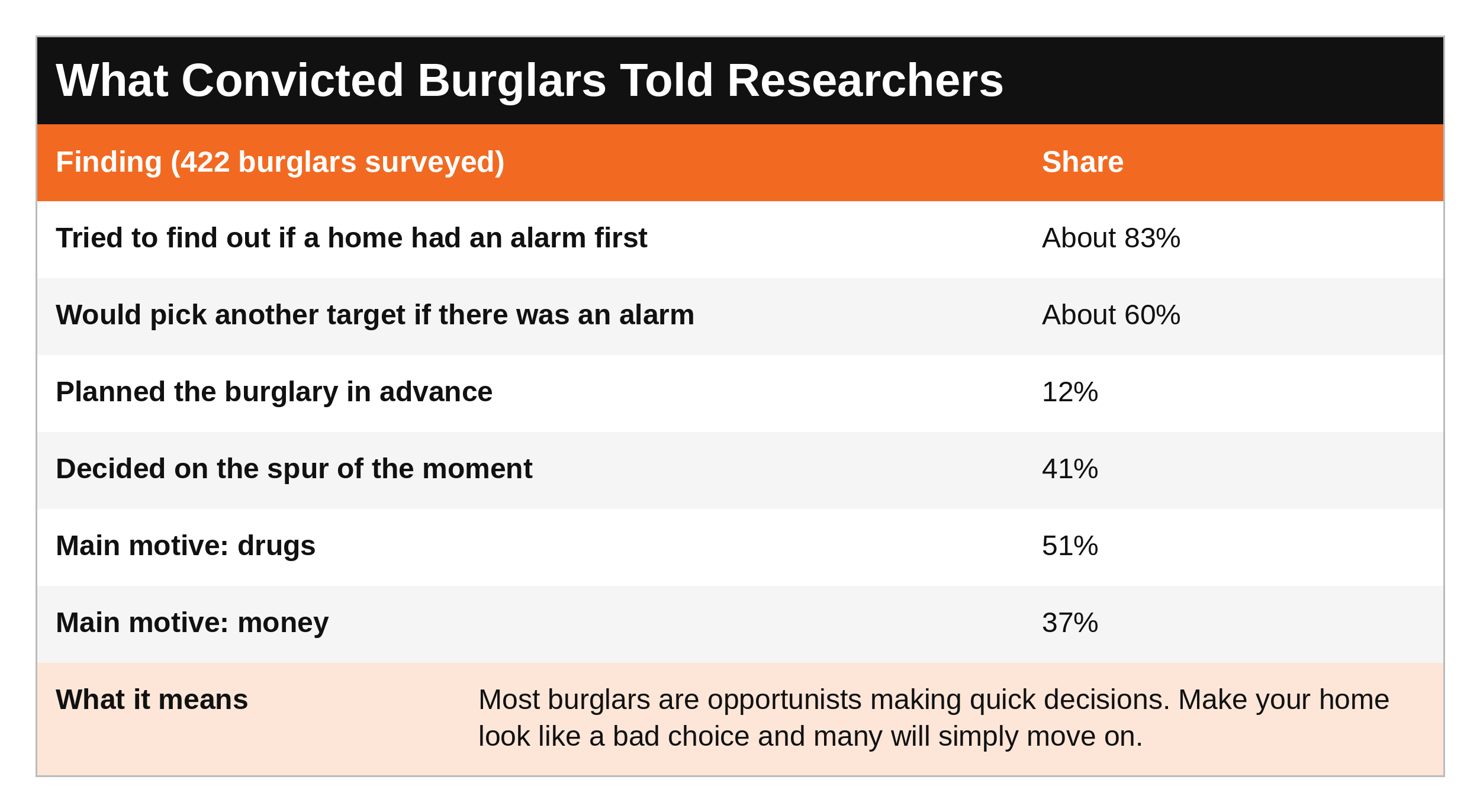
Some of the best home security advice comes from the people who used to break into homes. In a study led by researchers at the University of North Carolina at Charlotte, 422 incarcerated burglars in North Carolina, Kentucky, and Ohio were asked how they chose a target and what made them walk away. (The study was funded by the alarm industry's research foundation, so weigh the alarm numbers with that in mind.)
Here's what they said.
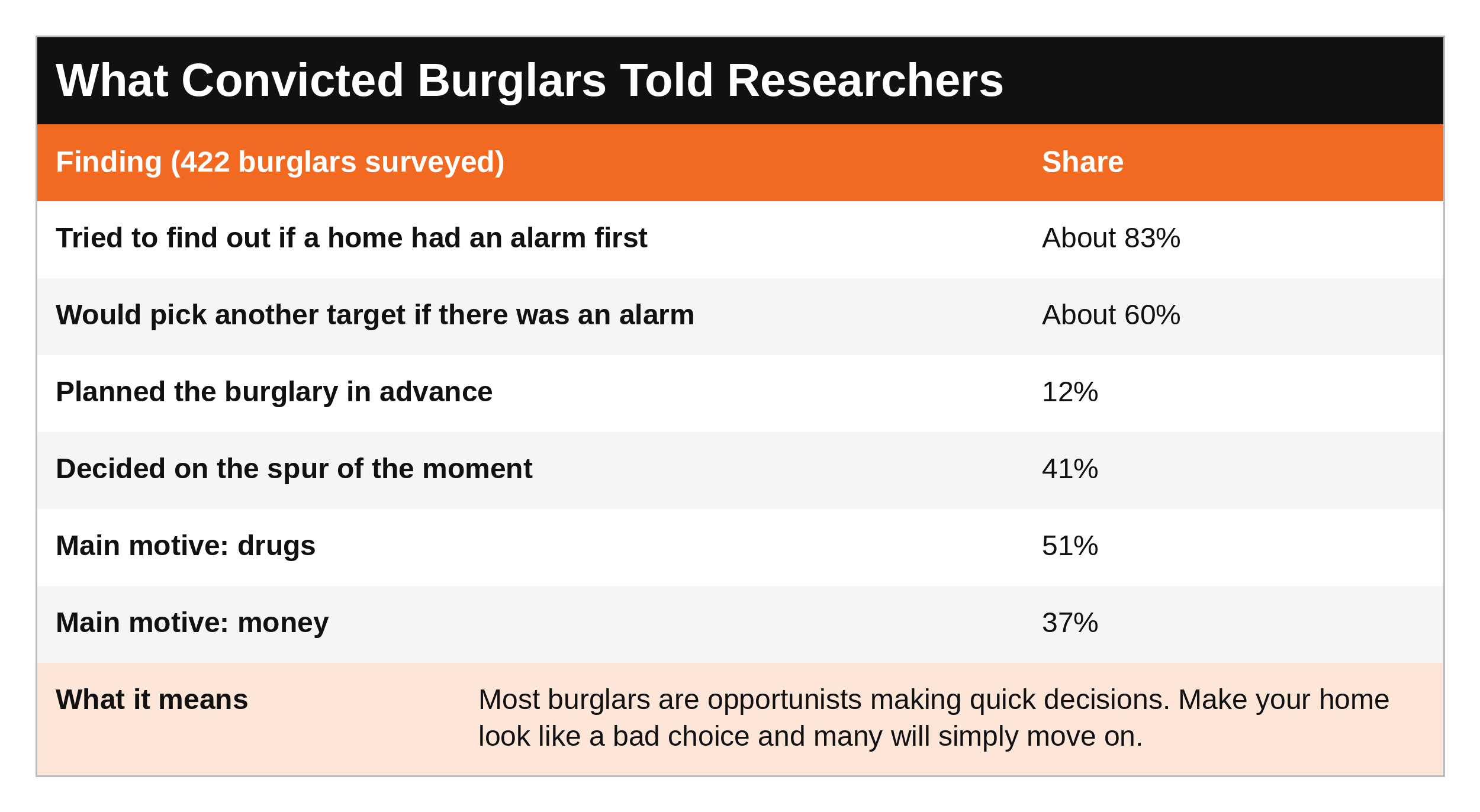
Only 12% planned ahead. Most were making a quick decision on the spot. That's exactly why visible security works: it changes the decision before it's made.
The things burglars say keep them away show up again and again:
Visible security systems. Cameras, alarm systems, video doorbells, and alarm company signs.
Good lighting. Motion lights at the doors, side yards, garage, and walkways take away the darkness they count on.
Signs someone is home. A car in the driveway, lights on timers, activity around the house.
Doors and windows that take time. Quality deadbolts, reinforced strike plates, long screws, window locks, and security film.
Dogs. Not because of the bite, but because of the noise and the attention. Even a small dog creates enough uncertainty to make someone think twice.
Neighbors who pay attention. Criminals prefer streets where no one notices anything.
What doesn't work: fake security signs with no real cameras or alarm behind them, a spare key under the mat or a flowerpot, leaving the lights on all day and night while you're away, and an unsecured sliding glass door. Criminals know exactly where to look for these.
Your house is always talking. A cared-for home with visible security says someone is paying attention. Piled-up mail, trash cans left at the curb, and an overgrown yard say no one is.
The Four Security Rings
Layered security works from the outside in. The idea comes from the way professionals protect people, scaled down for an everyday household. Think of your home as four rings, each with its own job.
Here's what each ring covers.
The outer ring is your neighborhood. Before someone reaches your door, they move through your street. Check local crime maps like CrimeMapping.com, sign up for your police department's alerts, and know your neighbors. Early awareness gives you time to decide what to do.
The second ring is your property line. Your yard, fence, gate, and driveway. This is where you make it clear your home isn't an easy target: motion lights on the paths, gates that latch, shrubs trimmed below the windows, and cameras that can be seen.
The middle ring is your doors, windows, and garage. This is where most break-ins actually happen, and where you slow someone down. Strong doors and frames, good locks, window locks, security film, and alarm sensors that tell you something is wrong.
The inner ring is inside your home. If someone gets in anyway, the focus shifts to your family: a secure room, a plan everyone knows, a charged phone, a flashlight, and a clear decision about when to get out and when to lock down.
The 4 D's of Home Security, Plus Habits
Every recommendation in this series supports one or more of five principles.
Here's how the four D's and Habits work together.
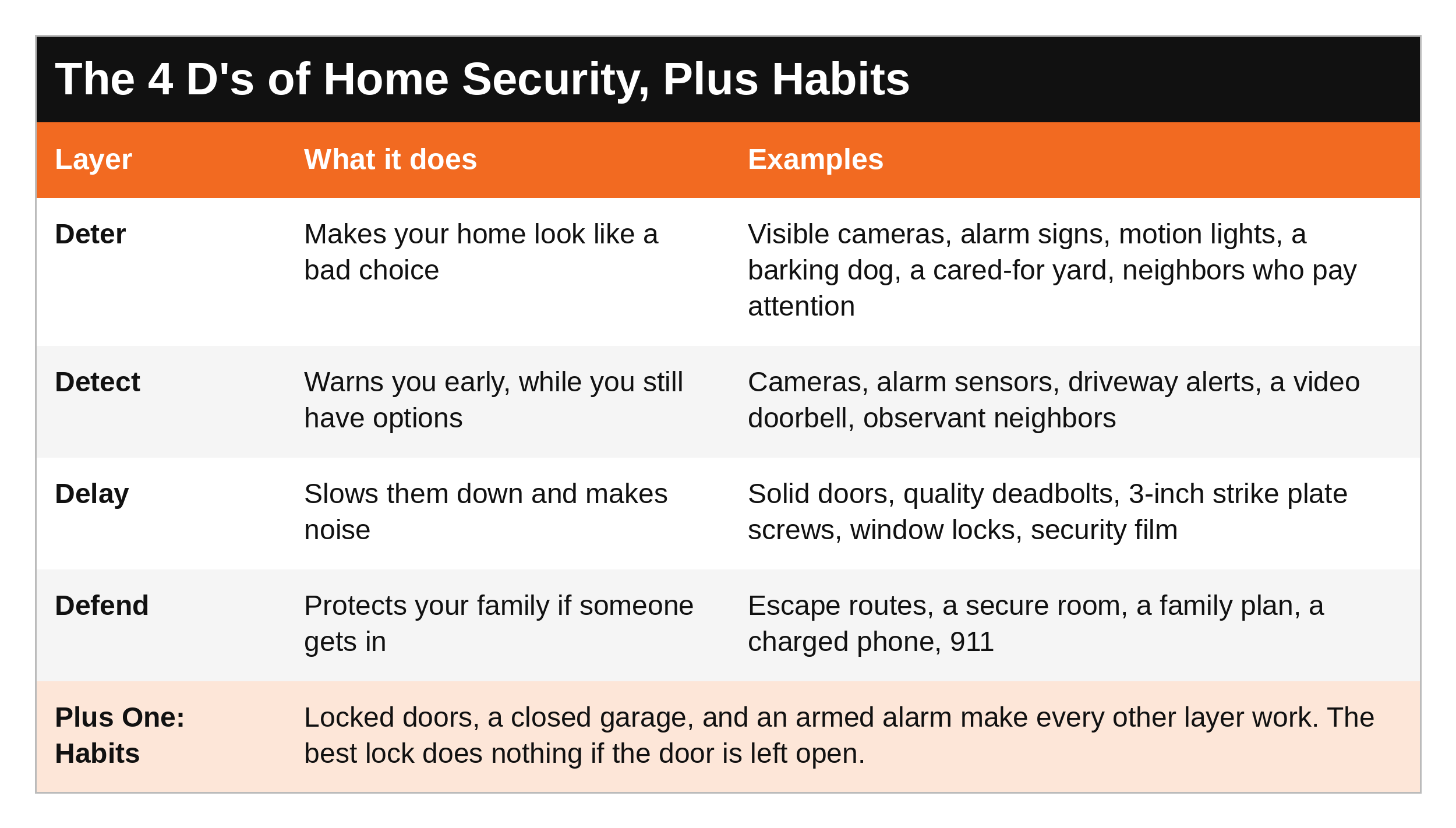
Deter. The best break-in is the one that never happens. Deterrence tells a criminal the risk of being seen, identified, or interrupted is higher than he'd like.
Detect. If deterrence fails, you want to know early. The earlier you spot a problem, the more options you have.
Delay. If someone decides to try anyway, every second counts. Delay forces them to work harder, make more noise, and stay exposed longer.
Defend. This is the last layer: escape routes, a safe place inside the home, a family communication plan, and knowing the self-defense laws where you live. Check your state and county for the exact laws. The goal isn't to live in fear of something unlikely. It's to think it through before you're forced to decide under stress.
Plus One: Habits. If there's one lesson that applies to every home, it's this: equipment doesn't create security. Habits do. You can have the strongest doors, the best locks, and a monitored alarm, but if the door is unlocked and the alarm is never set, none of it matters. A lot of break-ins happen simply because someone forgot to lock a door, close a window, shut the garage, or arm the alarm.
The rings tell you where to build your layers. The four D's tell you what each layer is doing. Together, they make your home a harder target.
The Prepared Protector is someone who's decided that loving someone means being ready for them, not just hoping things go fine. At home, that starts with the habits that cost nothing.
SCAN Your Layers
Use my SCAN framework to walk your own home, ring by ring:
S - See your environment. Walk your street, then your yard, then every door and window. Look at it the way someone with bad intentions would.
C - Create space. Add distance and barriers between your family and the street: lights, latched gates, locked doors.
A - Act deliberately. Fix the easy, cheap things first. A new habit or a few longer screws in a strike plate can matter more than a big purchase.
N - Never doubt your gut feelings. If a spot on your property feels exposed, it probably is.
What to Say: The Nightly Lock-Up
Habits stick when they're simple and spoken out loud. Pick one person to run the check every night, and say it the same way every time:
"Doors." Front, back, side, and the door from the garage. Locked and deadbolted.
"Windows." First floor and basement closed and locked.
"Garage." Door down, opener locked out if you're traveling.
"Alarm." Set, and everyone knows it's set.
"Phones." Charging where you can reach them.
Kids can learn it too. Make one of them the "door checker" a few nights a week.
Ask Yourself
Which ring of my home is the weakest right now?
If someone walked my property tonight, what would my house "say" to them?
Do we lock up the same way every night, or only when we remember?
Is there one cheap fix I could make this weekend?
Remember
No single layer has to be perfect. Build from the outside in, make each layer buy a little time, and back it all up with habits. A criminal looking for an easy target should look at your home and decide to keep walking.
Get Started Today
Walk your rings with the free Home Security Audit. It takes you through your landscaping, fences, lighting, cameras, doors, locks, windows, and garage so you can see where your layers are strong and where the gaps are. DM the word AUDIT on Instagram or Facebook and I'll send it to you. [Get it here: LINK]
Go Deeper
The Safest House on the Block. This post gives you the framework. The book builds every layer: how criminals choose a home, the ruses they use at your door, CPTED and landscaping, fences, doors and locks, windows and sliding doors, the garage, cameras, lighting, Wi-Fi, alarm systems, and a complete family security plan with a SWOT analysis for your own home. [Get it here: https://www.preparednotparanoid.com/shop/p/safest-house-on-the-block]
Tools I recommend: The motion lights, door reinforcement kits, window locks, and security gear I recommend are in my Safest House on the Block Amazon store. https://link.amazon/B0dSfoUkh
Related reading:
The Safest House on the Block, Intro: Police Can't Be Everywhere https://www.preparednotparanoid.com/pnp-library/policecantbeeverywher
The Safest House on the Block, Part 2: How Criminals Pick a Home https://www.preparednotparanoid.com/pnp-library/home-invasion-tactics
Firearms and Family Safety, Intro: Your Goal Is to Never Have to Use It https://www.preparednotparanoid.com/pnp-library/firearm-home-defense-never-have-to-use-it
The Safest House on the Block, Part 11: Making a Home Security Plan https://www.preparednotparanoid.com/pnp-library/homeinvasion-homesafetyplan
References
Kuhns, J. B., Blevins, K. R., and Lee, S. (2013). Understanding decisions to burglarize from the offender's perspective. University of North Carolina at Charlotte, Department of Criminal Justice and Criminology. Funded by the Alarm Industry Research and Educational Foundation.
University of North Carolina at Charlotte. (2013, May 15). Through the eyes of a burglar: study provides insights on habits and motivations. https://inside.charlotte.edu/news-features/2013-05-15/through-eyes-burglar-study-provides-insights-habits-and-motivations
Betz, L. The Safest House on the Block. Prepared Not Paranoid. Chapters 1, 4, and 5.
CrimeMapping.com. Local crime data from participating agencies. https://www.crimemapping.com
Disclaimer
This article is for general informational and educational purposes only. It is not a substitute for a professional security assessment, legal advice, or guidance from law enforcement. Self-defense laws vary, so check your state and county for the exact laws where you live. Affiliate disclosure: I've linked to products from my Amazon store that I personally recommend. As an Amazon Associate, I earn from qualifying purchases, at no extra cost to you. Thank you for supporting my work.
If someone is trying to get into your home, or you're in danger right now, get to safety and call 911.
Awareness gives you time. Time gives you options.
The Prepared Protector is someone who's decided that loving someone means being ready for them, not just hoping things go fine.
Prepared Not Paranoid. Protecting the Most Vulnerable Among Us.