Safe Drinking Water- Part 5: Safe Drinking Water When You Travel Abroad
The Hidden Traps, the Filter Mistake, and the Kit I Pack
By Larry Betz | Prepared Not Paranoid https://www.preparednotparanoid.com/
You plan the flights, the hotel, and the tours. Most families never plan the water. Then one glass of ice or one rinsed salad turns a vacation into three days in a hotel bathroom. According to the CDC, travelers' diarrhea is the most predictable travel illness there is: depending on where you go, 30% to 70% of travelers get it over a two-week trip.
Safe drinking water is something to plan for when you travel abroad. The United States generally has reliable water quality, but that isn't always the case in other countries. Before you go, check the CDC Travelers' Health page for your destination. It tells you about the water, the food, and any vaccines you may need.
The Simple Rules That Prevent Most Problems
Drink sealed bottled water or water you've treated yourself.
Skip ice unless it's made from safe water.
Brush your teeth with safe water.
Remember: "Boil it, cook it, peel it, or forget it."
The Hidden Water Traps
Most travelers know not to drink from the tap. The problems come from the places they don't think about.
Here's where most travelers slip up.
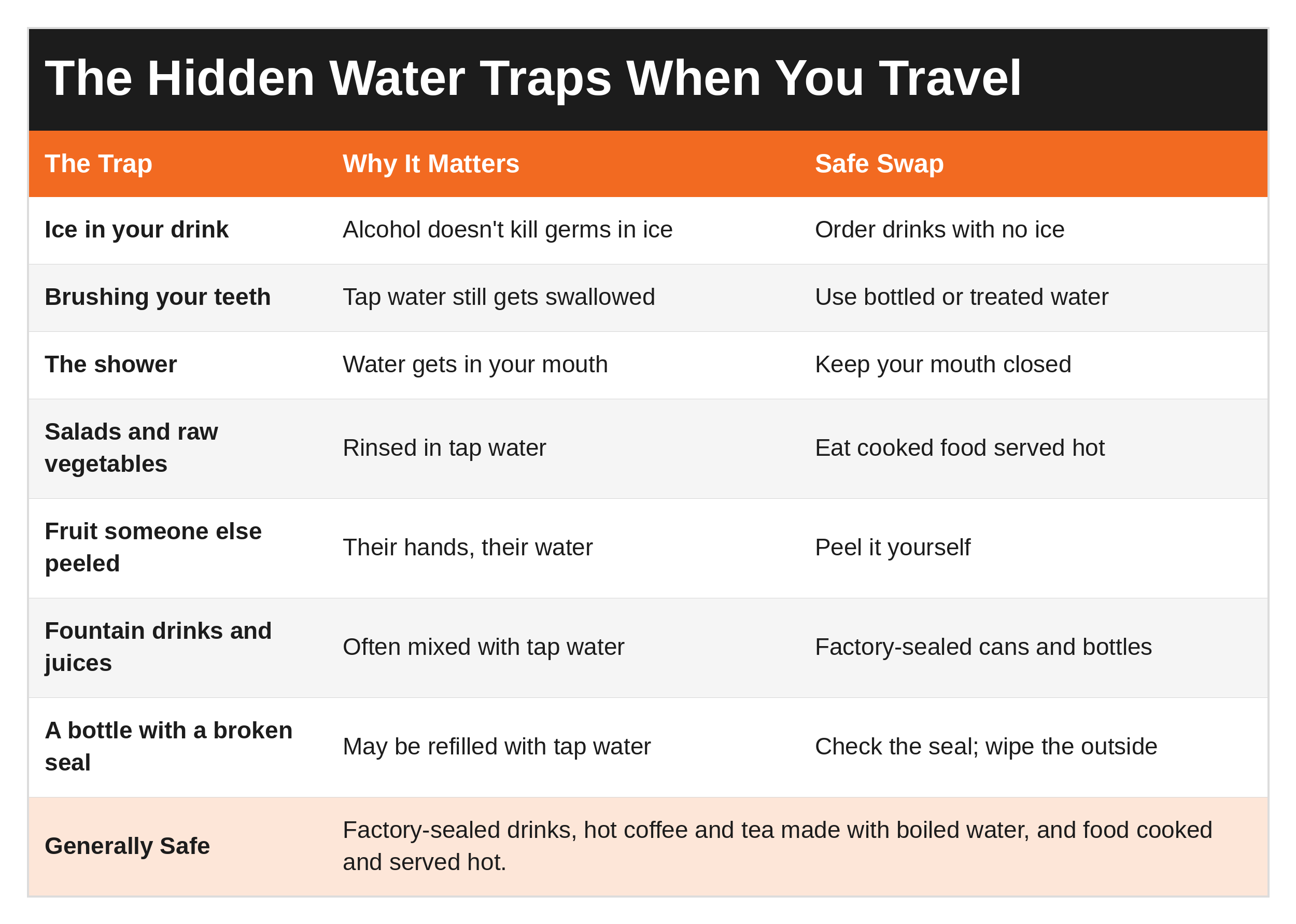
What's generally safe: drinks in factory-sealed cans and bottles (wipe the outside dry before you open them), hot coffee and tea made with boiled water, and food that's cooked and served hot. Alcohol in a drink does not make the ice safe.
Filter vs. Purifier: The Difference That Matters Abroad
Here's the mistake I see most often. People buy a filter bottle or a straw filter for the trip and think they're covered. Most travel filters remove bacteria and parasites, but not viruses. Viruses like norovirus and hepatitis A are far smaller than the holes in a typical filter.
At home in the U.S., your tap water is already disinfected, so a filter works fine. Abroad, or with any untreated water, you need something that handles viruses too:
A purifier, not just a filter. Look for a product that says "purifier" and specifically lists viruses.
A UV light pen. It works on bacteria, parasites, and viruses, but only in clear water.
Chlorine dioxide tablets. They handle all three, including Cryptosporidium, though they can take up to 4 hours for Crypto.
Boiling for 1 minute, when you have a way to heat water.
Here's what each tool stops.
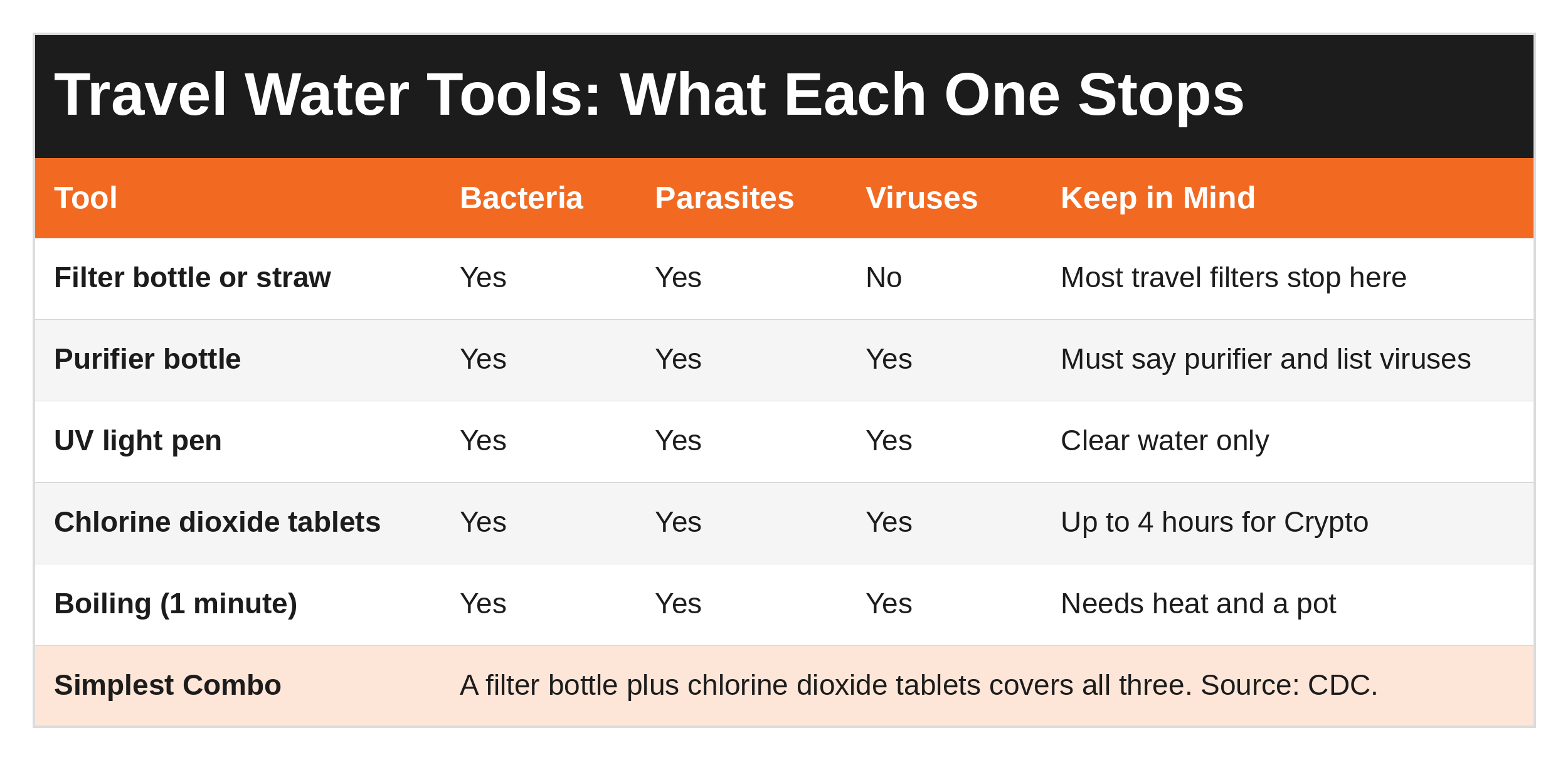
My simple combo: a filter bottle plus chlorine dioxide tablets. The filter removes the dirt and parasites, and the tablet takes care of the viruses. That's the same "filter, then disinfect" rule from Part 2.
Babies and Formula Abroad
Babies get dehydrated faster than anyone else, and their formula is only as safe as the water you mix it with.
Mix formula with bottled water from a sealed container, or water you've boiled and cooled.
Never use tap water or ice for a baby's bottle abroad.
Bring more ready-to-feed or powdered formula than you think you'll need. Your brand may not be sold where you're going.
Clean bottles with safe water, too.
Formula and breast milk are exempt from the TSA's 3-1-1 liquid limit. Tell the officer at the start of screening.
Keep breastfeeding if your baby gets sick. Breast milk helps.
Cruises and Norovirus
Cruise ships are a special case. Norovirus spreads fast in close quarters, and it's tough. Alcohol-based hand sanitizer doesn't work well against norovirus. Soap and water do.
Wash your hands with soap and water for at least 20 seconds, especially before eating and after using the bathroom.
Use sanitizer only as a backup, then wash when you can.
If you get sick, tell the ship's medical staff right away and follow their instructions to stay in your cabin. It protects everyone else.
Pack a Travel Water Kit
Here's what's in mine.
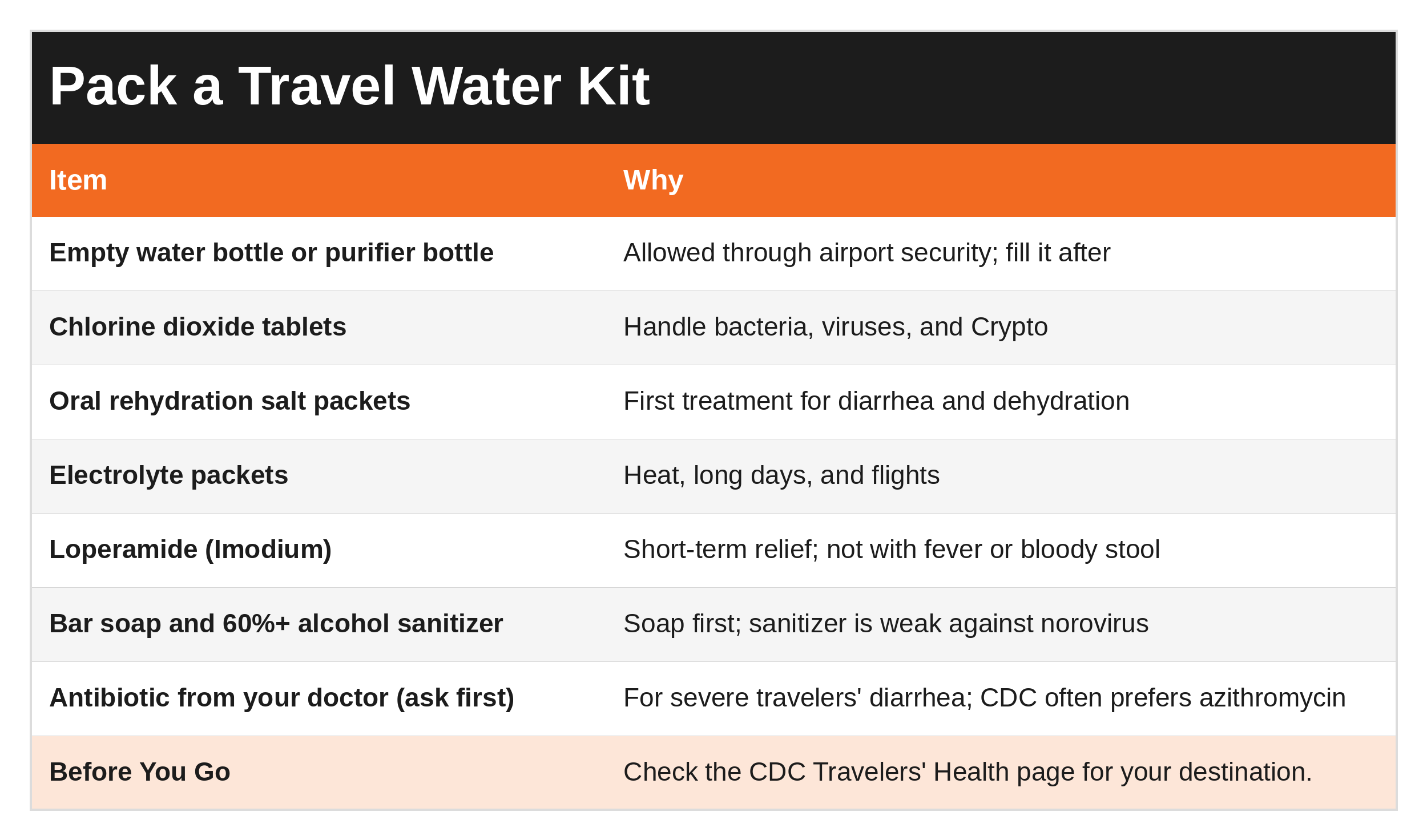
What you can bring through airport security: empty water bottles and empty filter or purifier bottles are allowed. Fill them after you clear security. The 3-1-1 liquid limit still applies to most other liquids, so check the TSA website before you fly, since the rules are changing at some airports.
Ask your doctor before you travel about bringing an antibiotic for severe travelers' diarrhea. The CDC notes that azithromycin is now often preferred, because resistance to ciprofloxacin and similar drugs is common in many parts of the world, especially South and Southeast Asia. A travel medicine clinic can tailor this to where you're going.
About Pepto-Bismol for prevention: bismuth subsalicylate can lower the risk of travelers' diarrhea, but it isn't for everyone. Skip it if you're pregnant, allergic to aspirin, take a blood thinner, or are giving it to a child under 12. Ask your doctor first. It can also turn your tongue and stool black, which is harmless but alarming if you don't expect it.
If You Get Sick
Even careful travelers get sick sometimes. The main danger is dehydration, especially for kids and older adults.
Here's what to do.
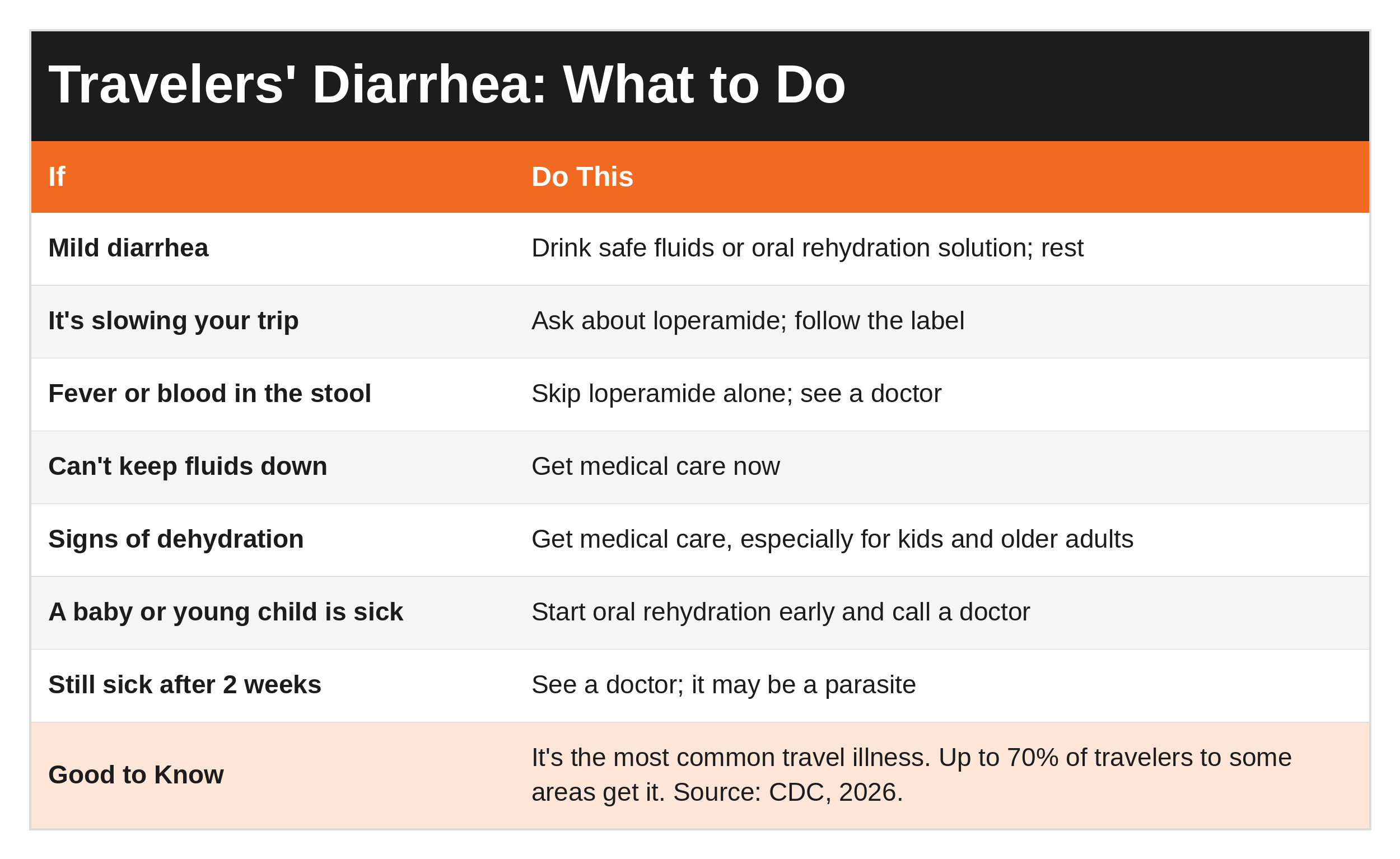
The first treatment is fluids. Oral rehydration salts mixed with safe water are best. For mild cases, sports drinks are fine. Large amounts of sugary soda can make diarrhea worse. If you don't have oral rehydration salts, use the World Health Organization recipe from Part 2, made with safe water.
Get medical care right away for a high fever, blood in the stool, vomiting so much you can't keep fluids down, confusion, very little urine, or a baby or young child who seems dehydrated or very sleepy.
Before You Go: A Quick Checklist
Check the CDC Travelers' Health page for your destination.
See your doctor or a travel clinic 4 to 6 weeks before you leave, to ask about vaccines like hepatitis A and typhoid, and about an antibiotic.
Pack your travel water kit in your carry-on, not your checked bag.
Talk to your kids about ice, brushing their teeth, and keeping their mouths closed in the shower.
Know where the nearest clinic or hospital is at your destination.
Swimming, pools, and open water abroad come with their own risks. I cover those in my 3-part Family Water Safety series.
Ask Yourself
Does my travel filter actually stop viruses, or just bacteria and parasites?
Have I talked to my kids about ice, brushing their teeth, and the shower?
Do I know what I'd do, and where I'd go, if someone in my family got sick on the trip?
Is my travel water kit in my carry-on?
Remember
Sealed, boiled, or treated. Nothing else goes in your mouth. Skip the ice, brush with safe water, carry something that stops viruses, and pack oral rehydration salts.
Get Started Today
[FREE DOWNLOAD: TO BE CHOSEN AFTER THE BINDER REVIEW]
Go Deeper
The Prepared Not Paranoid Family Nutrition Guide. This post covers water when you travel. The guide's water chapters cover everything from what's in your tap water at home to filters, storage, and the Emergency Water Purification Card, which fits in your carry-on. [Get it here: LINK]
Planning a trip? My book, Situational Awareness and Safe Family Travel Strategies, covers the rest of the trip: how to research your destination, stay aware in crowded places, protect your kids, and handle an emergency far from home. [Get it here: LINK]
Tools I recommend: The purifier bottles, UV pens, chlorine dioxide tablets, electrolytes, and oral rehydration salts I recommend are in my Amazon store. https://amzn.to/4yM747h
Related reading:
Safe Drinking Water, Part 2: How Much Water You Need and How to Make It Safe https://www.preparednotparanoid.com/pnp-library/water-intro
Safe Drinking Water, Part 3: Filters, Purifiers, and Water Trends https://www.preparednotparanoid.com/pnp-library/water-filters-and-trends
Family Water Safety, Part 2: Family Water Safety on the Road https://www.preparednotparanoid.com/pnp-library/parent-pro-tips-for-crowded-places-fmhtz-tsf5z
Family Water Safety, Part 3: Family Water Safety in Open Water https://www.preparednotparanoid.com/pnp-library/parent-pro-tips-for-crowded-places-fmhtz-8tlf3
References
Centers for Disease Control and Prevention. CDC Yellow Book 2026: Travelers' Diarrhea. March 24, 2026. https://www.cdc.gov/yellow-book/hcp/preparing-international-travelers/travelers-diarrhea.html
Centers for Disease Control and Prevention. CDC Yellow Book: Water Disinfection for Travelers. https://cdc.gov/yellow-book/hcp/preparing-international-travelers/water-disinfection-for-travelers.html
Centers for Disease Control and Prevention. CDC Yellow Book: Food and Water Precautions for Travelers. https://cdc.gov/yellow-book/hcp/preparing-international-travelers/food-and-water-precautions-for-travelers.html
Centers for Disease Control and Prevention. Travelers' Health destination pages. https://wwwnc.cdc.gov/travel
Centers for Disease Control and Prevention. Vessel Sanitation Program and norovirus guidance.
KPRC Click2Houston. How to stay safe from norovirus outbreaks on cruise ships. October 2025. https://www.click2houston.com/health/2025/10/03/how-to-stay-safe-from-norovirus-outbreaks-on-cruise-ships
Transportation Security Administration. What Can I Bring? Liquids, formula, and breast milk. https://www.tsa.gov/
Autopilot. TSA Liquid Rules in 2026: The 3-1-1 Rule, Exceptions, and What Actually Changed. May 2026. https://www.withautopilot.com/blog/tsa-liquid-rules
World Health Organization. Oral rehydration salts guidance.
Disclaimer
This article is for general informational and educational purposes only. It is not medical advice. Talk with your doctor or a travel medicine clinic before your trip about vaccines, medications, and anything you plan to give your children. Follow the label on any medication. Affiliate disclosure: I've linked to products from my Amazon store that I personally recommend. As an Amazon Associate, I earn from qualifying purchases, at no extra cost to you. Thank you for supporting my work.
If someone has a high fever, bloody diarrhea, can't keep fluids down, or shows signs of severe dehydration, get emergency care right away. Know the local emergency number before you go; it isn't 911 everywhere.
Awareness gives you time. Time gives you options.
The prepared protector is someone who's decided that loving someone means being ready for them, not just hoping things go fine.
Prepared Not Paranoid. Protecting the Most Vulnerable Among Us.