What Happens When Mom Doesn't Answer the Phone
By Larry Betz | Prepared Not Paranoid https://www.preparednotparanoid.com/
A simple check-in plan for seniors living alone answers the question every adult child dreads: if Mom doesn't pick up the phone, what happens next? Decide it now, while everyone is calm, and you won't be making it up in the middle of a scare.
In Part 3, we covered the technology that helps your parent call for help. This part covers the other side: what happens when they can't call. A fall, a sudden illness, or a medication mistake can leave someone unable to reach the phone. A daily check-in makes sure someone notices quickly, not days later.
Three Ways to Check In
The best check-in is the one that happens every day without anyone having to remember it. Pick one, or layer two.
1. People: A Daily Touchpoint
A set time: a morning call or text at the same time every day. "Good morning, I'm up" is enough.
A wellness buddy: a neighbor, friend, or someone from church who checks in, especially when family lives far away.
Share the job: split the days among siblings so no one person carries it all, and everyone knows whose day it is.
2. Programs: Reassurance Calls
Many sheriff's offices and police departments run free daily call programs, often called "Are You OK?" A computer calls your parent at the same time every day. If they don't answer after a few tries, the program contacts family or sends a deputy to the house, depending on how your county runs it.
These programs are built for seniors and people with disabilities who live alone. Not every county has one, so call your sheriff's office or police non-emergency line and ask. Your local Area Agency on Aging may know of other telephone reassurance services nearby.
3. Apps: Automatic Check-Ins
For parents who use a smartphone, a check-in app takes the remembering off your plate.
Snug Safety: a free daily check-in app for iPhone and Android. Your parent taps a button each day. If they miss it, Snug alerts their emergency contacts. A paid Dispatch Plan adds up to 3 check-ins a day and a phone call from Snug before family is alerted, which cuts down on false alarms.
Wearables and smart devices: many medical alert devices and smart pill dispensers can also alert family when something doesn't happen as expected. See Part 3 for what to look for.
Automate where you can. A check-in that depends on someone remembering will eventually get missed on a busy day.
The Neighbor Signal
Here's a low-tech idea from my friend Val Wilson, a retired lieutenant with the Orange County Sheriff's Department: agree on a simple signal a neighbor can see. Your parent opens a certain shade or turns on a porch light every morning. If the neighbor walks by and the shade is still closed by mid-morning, that's the cue to call or knock.
It costs nothing, it works without Wi-Fi or a phone, and it gives a nearby person a clear job.
Make a Missed Check-In Plan
A check-in only works if everyone knows what to do when it's missed. Without a plan, family members either panic and call 911 over a dead phone battery, or wait too long because nobody wanted to overreact.
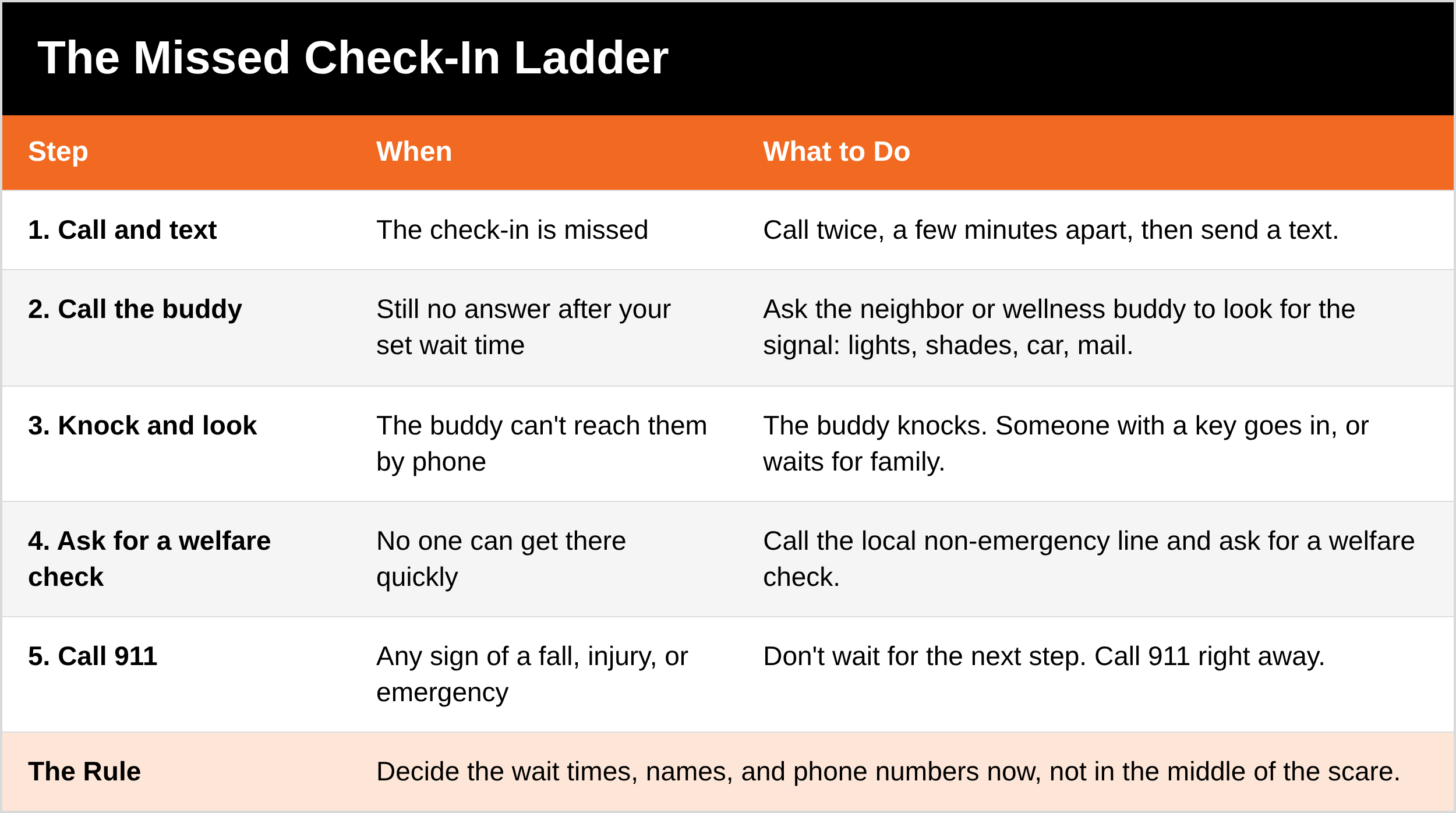
Write down four things and share them with everyone involved:
The wait time: how long after a missed check-in before you move to the next step. Shorter for a parent with health issues.
The names and numbers: who calls first, who is the nearby buddy, and who has a key.
How to get in: who has a key, and where it is. A locked door shouldn't be what slows help down.
The local non-emergency number: for a welfare check when no one nearby can go.
If there's any sign of a fall, injury, or emergency, skip the ladder and call 911.
The Prepared Protector decides who calls whom before anyone needs to. When the plan is written down, a missed check-in becomes a few calm steps, not a panic.
Medication Safety: Preventing Mistakes
Medication mistakes are one of the quiet risks of living alone. A missed dose, a double dose, or two medicines that don't mix can lead to dizziness, confusion, or a fall. A few simple systems prevent most of them.
Organizers and Dispensers
Weekly pill organizers: the simple, low-cost starting point for a parent who just needs structure.
Locking and timed organizers: these open only at the right time, which helps prevent double doses.
Smart dispensers: devices like Hero and MedMinder dispense the right pills at the right time and can alert family when a dose is missed. Hero holds up to a 90-day supply of up to 10 medications and connects over Wi-Fi. MedMinder uses cellular service, so it works in homes without Wi-Fi. Both are monthly subscriptions, so compare plans and check whether your parent's insurance or program covers one.
Reminders
Phone alarms labeled with the medicine name
Voice assistant reminders: "Alexa, remind me to take my pills at 9 a.m."
Reminder apps like Medisafe, which can also track what's been taken
The Emergency Medication List
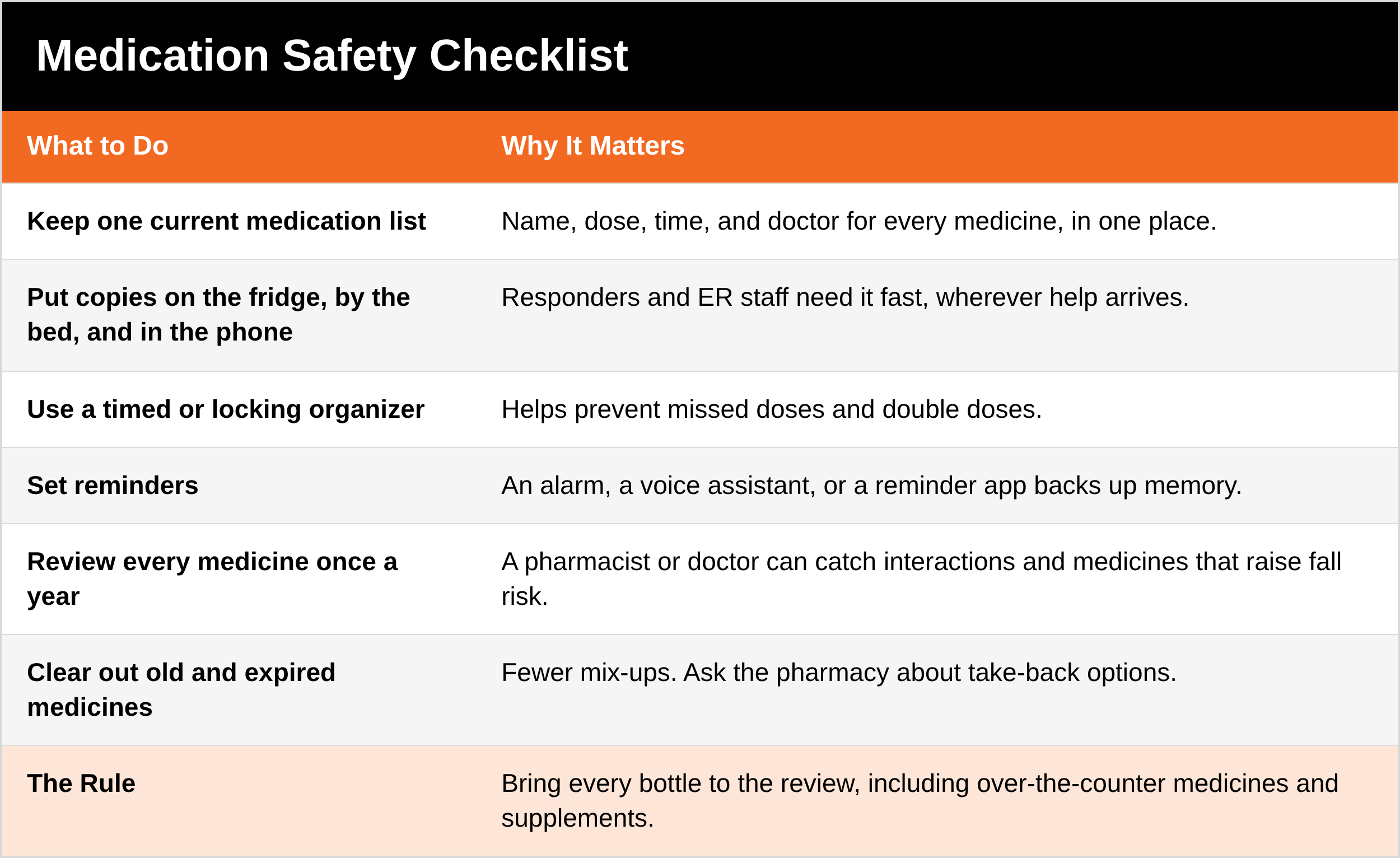
Keep one current list of every medicine: name, dose, time, and the prescribing doctor. Add allergies and the pharmacy's phone number.
Then put copies where help will arrive:
On the fridge, where responders often look first
By the bed
In the phone, in Medical ID (see Part 3)
My free Immediate Emergency Summary gives you a one-page place for the medication list, allergies, doctors, and emergency contacts. [LINK]
The Yearly Review
Once a year, or any time a new medicine is added, bring every bottle to the pharmacist or doctor. That includes over-the-counter medicines, vitamins, and supplements. They can catch interactions and flag medicines that raise the risk of falling. For more on medications and fall risk, see Staying Steady, Part 2 [LINK].
While you're at it, clear out old and expired medicines. Ask the pharmacy about take-back options in your area.
Ask Yourself
If my parent didn't answer the phone today, how long would it take before someone checked on them?
Does everyone in the family know who calls whom, and who has a key?
Is there one up-to-date medication list, and could a responder find it?
What to Say
"Dad, I'm not checking up on you. I just want a simple way to know you're okay each morning, so I'm not worrying all day. Would a quick text or a tap on an app work for you?"
5 Quick Wins You Can Start Today
Pick a daily check-in time and a backup person.
Call your sheriff's office and ask if they have an "Are You OK?" program.
Agree on a neighbor signal, like a shade opened every morning.
Write the missed check-in steps and share them with the family.
Make the medication list and put a copy on the fridge.
Remember: A check-in plan isn't about expecting the worst. It's about making sure that if something does happen, someone notices fast and knows exactly what to do.
Coming Up in Part 5
Getting Around Safely. Driving, rideshare, and getting out and about with confidence.
Get Started Today
My free Missed Check-In Protocol helps you set the wait times, the call order, the buddy, and the key plan, all on one page the whole family can share.
DM the word [KEYWORD] on Instagram or Facebook and I'll send it to you. [Get it here: LINK]
Go Deeper
The Family Safety Toolkit includes a Senior Safety section with checklists you can work through together. This post gives you the plan. The Toolkit helps you put it in place. [Get it here: LINK]
Coming soon: the Senior Safety Guide. Check-in protocols for parents who live alone, travel, or have memory loss, medication tracking sheets, a dispenser comparison, and what to do when the buddy is away.
Tools I recommend: locking pill organizers, timed dispensers, and medical alert devices in my Senior Safety store. [SENIOR SAFETY STORE LINK]
The Full Series
Part 1: What the Nancy Guthrie Case Teaches Families [LINK]
Part 2: The Front Door [LINK]
Part 3: Tech That Keeps Them Independent [LINK]
Part 4: Check-Ins, Medications, and the Missed-Call Plan (you are here)
Part 5: Getting Around Safely [LINK]
Related Reading
Staying Steady, Part 2: Strength and Balance (medication review and fall risk) [LINK]
Staying Steady, Part 3: A Safer Home, Room by Room (plan for a fall) [LINK]
References
Snug Safety: https://www.snugsafe.com
Yuma County Sheriff's Office, "Are You Ok?" Program: https://www.yumacountysheriff.org/services-ruok.htm
Norfolk County Sheriff's Office, "Are You Ok?" Program: https://norfolksheriff.com/divisions/senior/areyouok
Hero Health: https://herohealth.com
MedMinder: https://www.medminder.com
Eldercare Locator (find your Area Agency on Aging): https://eldercare.acl.gov
Disclaimer: Product features, plans, and prices change often, so check with the company before you buy. This post is not medical advice; talk with your parent's doctor or pharmacist about their medicines. These suggestions are intended to help you and your family build awareness, confidence, and safer decision-making habits. No safety plan, checklist, or training can guarantee 100% protection. There will always be people who try to exploit vulnerability, opportunity, trust, or positions of power. The goal is not to create fear, but to help guide families toward more informed, prepared, and practical safety decisions in everyday life. Programs and services vary, so check your state and county for what's available where you live. As an Amazon Associate, I earn from qualifying purchases.
If you think someone has fallen, is hurt, or took the wrong medicine and is having trouble, call 911. For questions about a possible medication mistake, call Poison Control at 1-800-222-1222.
Awareness gives you time. Time gives you options.
The Prepared Protector is someone who's decided that loving someone means being ready for them, not just hoping things go fine.
Prepared Not Paranoid. Protecting the Most Vulnerable Among Us.