Why Falls Happen and How to Spot the Risk Early
By Larry Betz | Prepared Not Paranoid https://www.preparednotparanoid.com/
Falls are common, but they are not a normal part of getting older. If you understand fall risk in older adults, you can spot the warning signs in someone you love and act long before the fall that changes everything.
I've spent more than 20 years in the fitness business, and much of my work has been with older adults and people coming back from injuries and surgery. I've seen what happens after a fall.
Sometimes it's a broken hip. Sometimes it's a head injury. But very often, the biggest damage is what comes after: fear. A person who fell once starts moving less. They skip the walk, avoid the stairs, stop going to the store. Their legs get weaker, their balance gets worse, and the next fall becomes more likely.
Falls are common, but they are not inevitable. Most of the things that cause them can be changed.
The Problem
According to the Centers for Disease Control and Prevention (CDC):
More than one in four adults age 65 and older falls each year, and fewer than half of them tell their doctor
Falls are the leading cause of injury, and injury death, for older adults
One fall doubles the chance of falling again
The National Safety Council reports that 43,020 adults 65 and older died from preventable falls in 2024.
A fall can lead to a fracture, a head injury, a hospital stay, a move out of the home, and a loss of independence. For many families, a fall is the moment everything changes.
That's why fall prevention belongs in a family safety plan, right next to the smoke detectors and the fraud rules.
Start With Three Questions
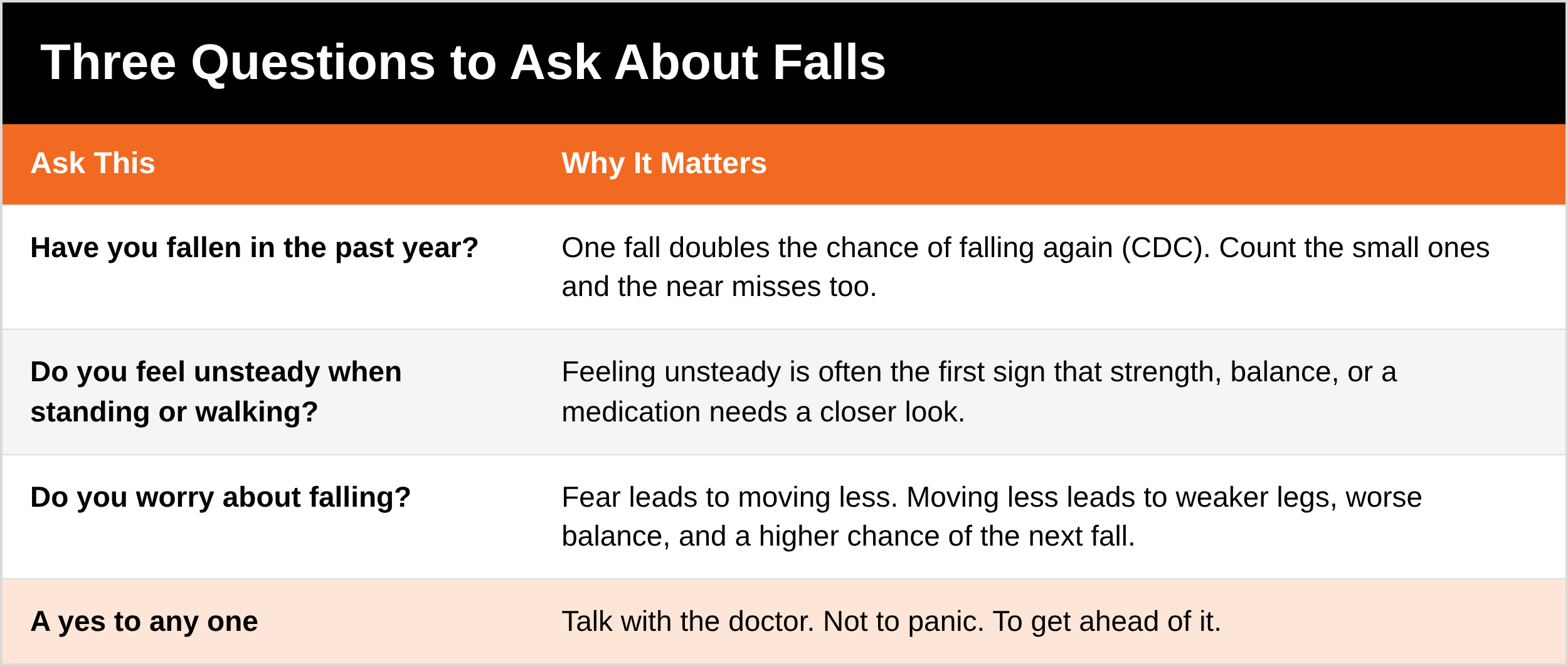
The CDC's STEADI program (Stopping Elderly Accidents, Deaths and Injuries), used by doctors across the country, starts with three simple questions:
Have you fallen in the past year?
Do you feel unsteady when standing or walking?
Do you worry about falling?
A "yes" to any one of them is a reason to talk with a doctor. Not to panic. To get ahead of it.
Why Falls Happen: Spotting Fall Risk in Older Adults
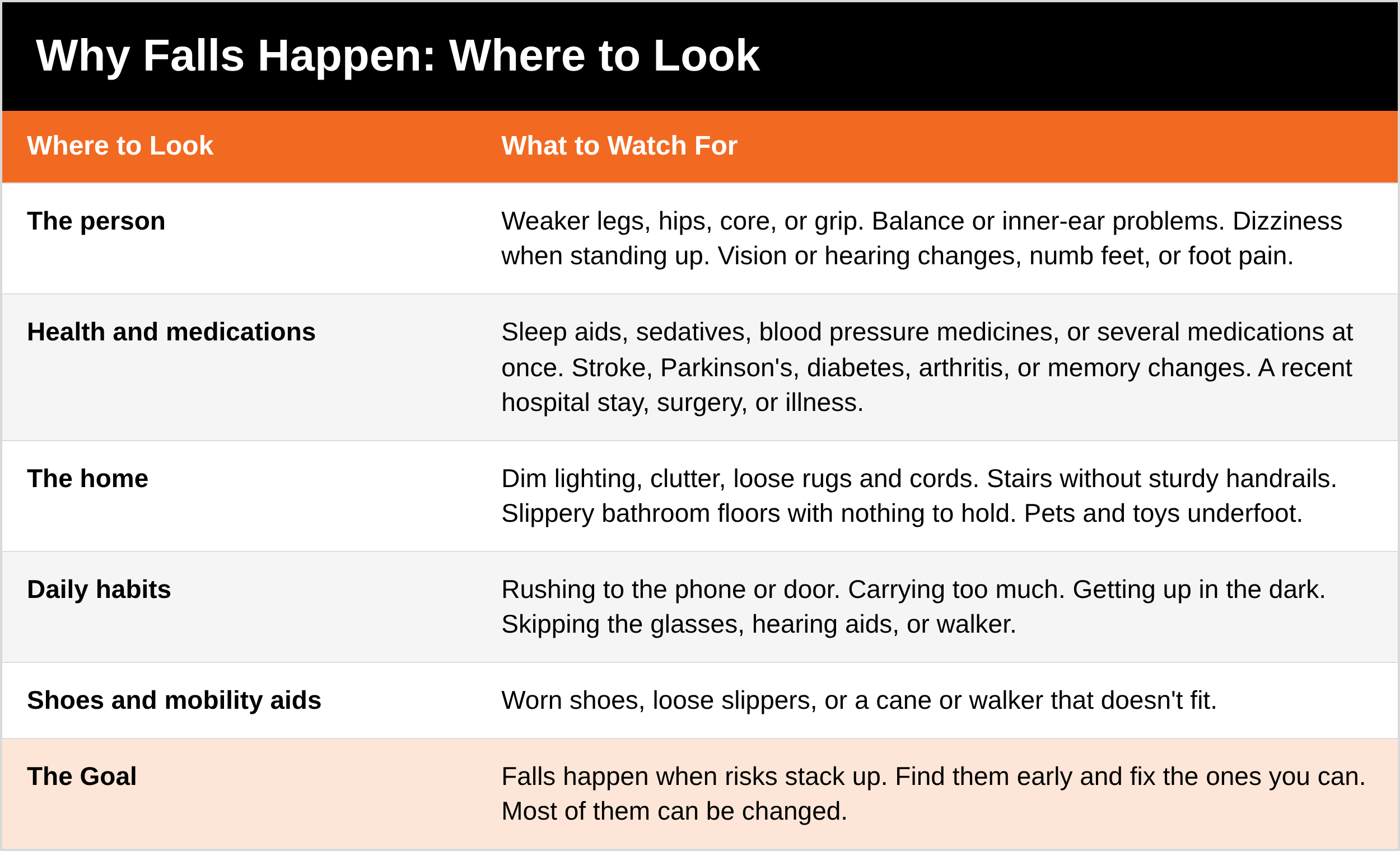
Most falls aren't caused by one thing. They happen when several risks stack up at once.
Think of it in three parts: what's changed in the person, what's in the environment, and what we do every day.
What's Changed in the Person
Weaker legs, hips, core, or grip, and slower reactions
Balance problems, including inner-ear (vestibular) issues
Dizziness or fainting, dehydration, infection, or a drop in blood pressure when standing up
Vision or hearing changes, numbness in the feet (neuropathy), or foot pain
Medications: sleep aids, sedatives, blood pressure medicines, or simply taking several medications at once
Health conditions: stroke, Parkinson's disease, diabetes, arthritis, osteoporosis, heart conditions, or memory changes
A recent hospital stay, surgery, or illness
What's in the Environment
Poor lighting, clutter, loose rugs, and cords
Stairs without sturdy handrails
Slippery bathroom floors with nothing to hold onto
Pets, grandkids' toys, and uneven steps outside
Worn shoes, loose slippers, or a cane or walker that doesn't fit
What We Do Every Day
Rushing to answer the phone or the door
Carrying too much at once
Getting up in the dark
Not using the glasses, hearing aids, or walker we were given
A home checklist matters. But it can't catch everything. You have to ask two questions: "What in the house could cause a fall?" and "What has changed in the person?"
Step One: Speak Up
Many older adults don't tell anyone when they fall, or nearly fall. They're embarrassed, or they worry it'll lead to losing their independence. But a near miss is an early warning, and it's the best time to act.
The Prepared Protector doesn't wait for the first fall to start the conversation. A near miss is your early warning. Treat it like one.
Tell the doctor about:
Every fall and near fall, even small ones
New fear of falling
Dizziness, lightheadedness, or feeling faint
Changes in walking, weakness, or numbness
Vision changes
Rushing to the bathroom, especially at night
Describe what happened before, during, and after, not just where it happened.
Ask about: physical therapy, occupational therapy, a balance (vestibular) evaluation, a podiatrist, bone health, and whether a cane or walker would help.
After any hospital stay, surgery, illness, or medication change, check the fall risk again. The old plan may not fit anymore.
How to Start the Conversation
This is personal. It touches independence, pride, and privacy. Start with their goals, not your worries.
What to Say: "I want to help you stay active and living the way you want. Would you walk through the house with me and show me the spots where you feel less steady? We can decide together what would help."
Then:
Ask what feels hard or unsafe before suggesting fixes
Let them choose the products and where they go
Don't take away every challenge. Movement is what keeps them strong.
Ask Yourself
Has my parent fallen, or nearly fallen, in the past year? Would I know?
Have they started avoiding anything because they're worried about falling?
When was their last medication review and eye exam?
5 Quick Wins You Can Start Today
Ask the three questions at your next visit or phone call, in a relaxed moment.
Put night lights in the bedroom, the hallway, and the bathroom.
Pick up one loose rug or tape down one cord in a walkway.
Write down every medication, including over-the-counter and sleep aids, and bring the list to the next doctor visit.
Book the eye exam if it's been more than a year.
Remember: Falling is not a normal part of getting older. Most fall risks can be changed, and the earlier you start, the more independence you protect.
Coming Up in Part 2
Strong, Steady, and Independent. Strength and balance training, medication reviews, vision, feet, footwear, and getting the right cane or walker.
Get Started Today
My free Senior Fall Prevention and Emergency Information Checklist helps you walk through the house, the habits, and the health questions together, and keep emergency information where it can be found fast.
DM the word [KEYWORD] on Instagram or Facebook and I'll send it to you. [Get it here: LINK]
Go Deeper
The Family Safety Toolkit includes a full Senior Safety section with fall prevention and fraud prevention checklists you can work through as a family. This post helps you spot the risk. The Toolkit gives you the checklists to fix it, room by room and habit by habit. [Get it here: LINK]
Coming soon: the Senior Safety Guide. The full fall prevention chapter, a room-by-room home assessment, what to do after a fall, medication reviews, fall-detection devices, and how to have the hard conversations with the people you love.
Tools I recommend: night lights, grab bars, non-slip mats, and other fall prevention tools in my Senior Safety store. [SENIOR SAFETY STORE LINK]
The Full Series
Part 1: Falls Aren't a Normal Part of Aging (you are here)
Part 2: Strong, Steady, and Independent [LINK]
Part 3: A Safer Home, Room by Room [LINK]
Related Reading
Walking and Balance for Seniors [LINK]
Scam-Proofing the People You Love, Part 1: How Scams Really Work [LINK]
Red Cell Your Family, Part 7: Just in Case [LINK]
References
Centers for Disease Control and Prevention, Older Adult Falls: https://www.cdc.gov/falls/
CDC, Older Adult Falls Data: https://www.cdc.gov/falls/data-research/index.html
CDC, STEADI (Stopping Elderly Accidents, Deaths and Injuries), Patient and Caregiver Resources: https://www.cdc.gov/steadi/
National Institute on Aging, Falls and Falls Prevention: https://www.nia.nih.gov/health/falls-and-falls-prevention
National Safety Council, Injury Facts: Older Adult Falls: https://injuryfacts.nsc.org/home-and-community/safety-topics/older-adult-falls/
Disclaimer: This article is for general informational and educational purposes only. It is not medical advice and does not replace an evaluation by a doctor, physical therapist, or occupational therapist. Talk to a healthcare professional about any fall, dizziness, or change in walking or balance. These suggestions are intended to help you and your family build awareness, confidence, and safer decision-making habits. No safety plan, checklist, or training can guarantee 100% protection. Programs, services, and rules vary, so check your state and county for what's available where you live. As an Amazon Associate, I earn from qualifying purchases.
If someone has fallen and is badly hurt, has hit their head, or can't get up safely, call 911.
Awareness gives you time. Time gives you options.
The Prepared Protector is someone who's decided that loving someone means being ready for them, not just hoping things go fine.
Prepared Not Paranoid. Protecting the Most Vulnerable Among Us.