My Body, My Boundaries: Part 3
"If You Say Don't Tell, I Have to Tell": Secrets, Trusted Adults, and Body Safety Online
By Larry Betz | Prepared Not Paranoid https://www.preparednotparanoid.com/
If there's one tool every person who harms a child depends on, it's this one: the secret.
Secrets keep a child quiet. Secrets keep parents in the dark. And secrets are almost always the first step, long before anything physical happens. "Don't tell your mom I gave you this." "This is just between us." "You'll get in trouble if anyone finds out."
In Parts 1 and 2, we gave our kids the words and taught them the rules apply to everyone. In this part, we take away the abuser's most important tool. We teach our kids one rule that flips the script:
"If someone tells you not to tell, that's exactly when you tell."
Surprises vs. Unsafe Secrets
We don't want kids so worried about secrets that they spoil every birthday present. So teach the difference between a surprise and an unsafe secret.
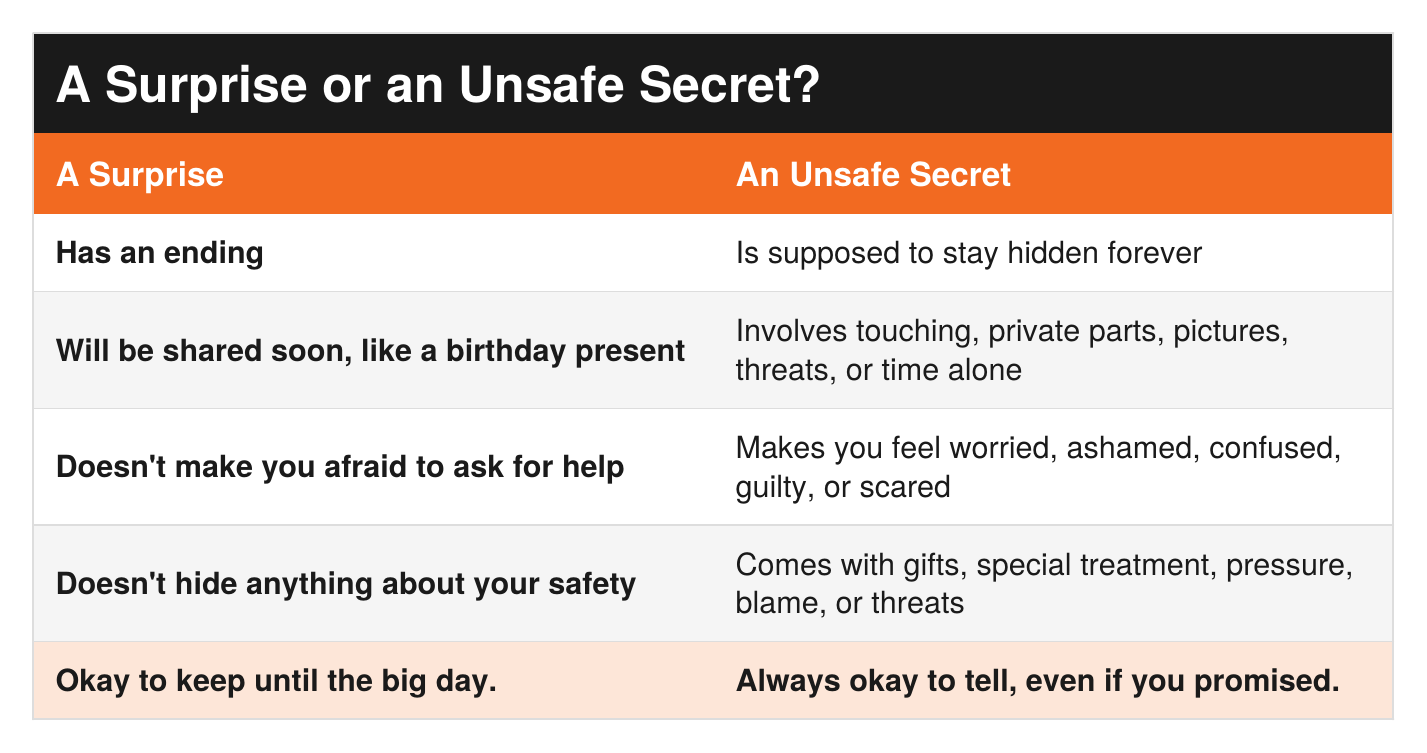
What to Say:
"Safe grown-ups don't ask kids to keep secrets about touching, private parts, pictures, or anything that makes you feel uncomfortable. You can break that kind of secret, even if you promised, even if you took a present, and even if you think someone will be mad. You will never be in trouble for asking for help."
Family Game: Surprise or Unsafe Secret?
Ask these at dinner or in the car. Let your child answer first.
Your sister's birthday present is hidden until Saturday. (Surprise.)
Someone asks you to hide a "private game" from your parents. (Unsafe secret.)
A friend asks you not to tell the ending of a movie. (Just regular privacy. It's not about safety.)
Someone sends a private picture and says something bad will happen if you tell. (Unsafe secret. Get help.)
A grown-up gives you special presents and asks you to delete their messages. (Unsafe secret. Get help.)
"You'll Never Be in Trouble for Telling"
This is the promise that makes everything else work. And we have to mean it.
Kids stay quiet when they think they'll be the one in trouble. Maybe they broke a rule to get there. They were on an app they weren't allowed on. They took the gift. They waited too long. A person with bad intentions will use every one of those things: "If you tell, they'll know you snuck out."
So tell your child, clearly and often:
"Even if you broke a rule, took a present, or waited a long time to tell me, you will not be in trouble for telling me something that made you feel unsafe. We'll deal with the safety part first. Always."
Then keep the promise. If your child comes to you and the first thing they get is a lecture about the app, they'll learn not to come to you next time.
Tell, and Keep Telling
Give your child a simple plan, and make it clear they don't have to do it perfectly.
The Body-Safety Plan:
Say it if you can: "No." "Stop." "I don't like that." "I need help."
Move away if you can. Go toward other people.
Tell a trusted adult any way you can: talking, drawing, pointing, or sending a text.
If the first person doesn't help, tell another, and another, until someone does.
What to Say:
"You don't have to yell, fight, or run away. Sometimes people freeze when they're scared, and that's okay. Whatever you did, you can always tell me later. It's never too late, and it's never your fault."
Build Your Child's Trusted-Adult Network
A trusted adult isn't just someone your child likes. It's someone who listens, follows the safety rules, doesn't ask for unsafe secrets, takes action, and never blames the child.
Help your child pick at least three trusted adults from different parts of their life:
At home: a parent, stepparent, or grandparent
At school or activities: a teacher, school counselor, or coach
Outside the home: an aunt, uncle, family friend, or neighbor
Why three? Because the first adult may not be available, may not believe them, or may be the person causing the problem. Your child needs a backup, and a backup for the backup.
Write the names down together, with how your child would reach each person. Review the list when school starts, when activities change, or when caregivers change.
The Help Sentence
Some kids freeze up when it's time to say something hard. Give them the words ahead of time, and practice it:
"I need to tell you something about my body or a safety rule. I need you to listen and help me."
Remember: Safe adults don't ask kids to keep secrets about their bodies.
Body Safety Online
Every rule in this series applies on phones, tablets, game systems, and video calls too. Online contact can come from strangers, people your child knows, older kids, classmates, or someone pretending to be a kid.
I cover how online grooming works step by step in the Who's Talking to Your Kids? series. For younger kids, start with these five family rules:
No secrets about online contact, pictures, or threats. Ever.
People online can lie about their name, age, and where they live.
Compliments, gifts, game currency, and favors can all be used as pressure.
Never pay, bargain, or send more if someone makes a threat. Get a grown-up, and don't delete anything.
You can always ask for help, even after you clicked, answered, sent something, or broke a family rule.
What to Say:
"Private parts stay private in pictures and video calls too. If anyone asks you to take off clothes, move to a private chat, hide messages, or send a picture, stop and come get me. You won't be in trouble."
For parents: If something happens online, handle the safety concern first. Don't take the device away as punishment in that moment, or your child learns that telling costs them. Save the evidence without forwarding any images, stop contact, and report it to the NCMEC CyberTipline.
Ask Yourself
Does my child know the difference between a surprise and an unsafe secret?
Can my child name three trusted adults, and do they know how to reach them?
If my child broke a rule and then something bad happened, would they still tell me?
Get Started Today
My free Child Safety Bundle includes Family Tech Rules, to set up safer habits around devices, games, messaging, and social media, and Recognizing Unsafe Adult Behavior.
[CTA: Comment or DM "[KEYWORD]" / or download it here: LINK] COMMING SOON
Go Deeper
Hooked: The Dangers of Social Media, written by Justin Nichols, a former fraud detective, walks parents through the real risks social media creates for kids, and what to do about them. [Get Hooked here: LINK]
The Family Safety Toolkit includes 20 safety checklists, with a full Child Safety section covering online safety, trusted adults, and camp. [Get the Toolkit here: LINK]
Tools I recommend: Visit my Children's Safety store on Amazon for the products I recommend for keeping kids safe at home, online, and on the go. [AMAZON CHILDREN'S SAFETY STORE LINK]
Related reading:
Who's Talking to Your Kids? Part 1: How Online Grooming Works
Red Cell Your Family, Part 6: Train Your Team (code words and family drills) [LINK]
Coming Up in Part 4
Sleepovers, Safe Words, and When Kids Harm Kids. Why I would never let my child sleep over at another family's house, the code text that gets your child out with no questions asked, and exactly what to do if your child tells you something.
References
Childhelp, National Child Abuse Hotline: https://childhelp.org/hotline/
National Center for Missing & Exploited Children, CyberTipline: https://www.missingkids.org/gethelpnow/cybertipline
RAINN, Children and Sexual Violence: https://rainn.org/get-informed/issues/children-and-sexual-violence/
Centers for Disease Control and Prevention, About Child Sexual Abuse: https://www.cdc.gov/child-abuse-neglect/about/about-child-sexual-abuse.html
Disclaimer
This article is for general informational and educational purposes only. It is designed to help families start important conversations. It is not a substitute for professional advice, training, or services, including medical, mental health, legal, or law enforcement guidance. Laws and reporting requirements vary by state. Do not use this article to investigate or repeatedly question a child. If you suspect abuse, contact a professional right away.
If you suspect a child is being abused, contact local law enforcement, your state's child protective services, or the Childhelp National Child Abuse Hotline at 1-800-422-4453 (call or text). If a child is in immediate danger, call 911.
Awareness gives you time. Time gives you options.
The prepared protector is someone who's decided that loving someone means being ready for them, not just hoping things go fine.
Prepared Not Paranoid. Protecting the Most Vulnerable Among Us.