My Body, My Boundaries: Part 2
When I was a Safety Director, no one was exempt from a safety rule. Not the newest apprentice, and not the mechanic with 30 years on the job.
Familiarity is when people start skipping steps. The rules applied to everyone.
That's not distrust. That's how you keep good people protected and keep the wrong people from slipping through.
Our kids need the same rule at home. In Part 1, we gave them the words. Now we teach them that those words work with everyone.
Stranger Danger Misses Most of the Danger
We spend a lot of time warning kids about strangers. But as we covered in Part 1, about 90% of the time, a child who is sexually abused knows the person who did it.
So the rule has to be simple and absolute:
What to Say:
"Body-safety rules are for everyone. Moms, dads, stepparents, grandparents, aunts, uncles, cousins, brothers and sisters, babysitters, teachers, coaches, doctors, people at church, older kids, friends, strangers, and people online. Even if you know someone, and even if you love them, they're not allowed to break a body-safety rule."
You can teach this without telling your child that everyone they know is dangerous. The point isn't who the person is. It's what the person does.
Remember: People aren't automatically safe because we know them. We watch whether their behavior follows the rules.
Authority Doesn't Cancel a Boundary
Kids need to follow adults' directions about health and safety. Put your shoes on. Hold my hand in the parking lot. Let the doctor look at your ear.
But no adult should ever use their age, their family role, a uniform, a title, their religion, their position on the team, a gift, or a threat to get private contact with a child or to keep a child quiet.
I told the story of a school resource officer in Bethlehem, Pennsylvania, in The Creepy Coach, Part 1. He had a badge, a uniform, and a job keeping kids safe. The badge didn't make him dangerous, and it didn't make him safe. His behavior did.
What Would You Do?
Practice these with your child as "what if" games. Keep it light. You're not testing them
Your uncle keeps asking you to sit on his lap after you said you'd rather sit next to him.
Your coach asks you to meet him alone and says not to tell your mom.
An older cousin shows you a private picture and says it's just a joke.
A teacher makes you feel uncomfortable, but you're worried no one will believe you. Who else could you tell?
Why "Good Touch, Bad Touch" Doesn't Work
A lot of us grew up with "good touch, bad touch." It sounds simple. The problem is it doesn't hold up in real life.
Unsafe touch doesn't always hurt. Sometimes it feels pleasant, and that confuses a child even more.
Safe touch can feel bad. A shot at the doctor, a splinter coming out, or cleaning a scraped knee all hurt, and they're all okay.
When a child is confused, they often decide they can't tell, because they can't figure out which box it goes in. So we give them better categories, and one rule that matters more than the categories.
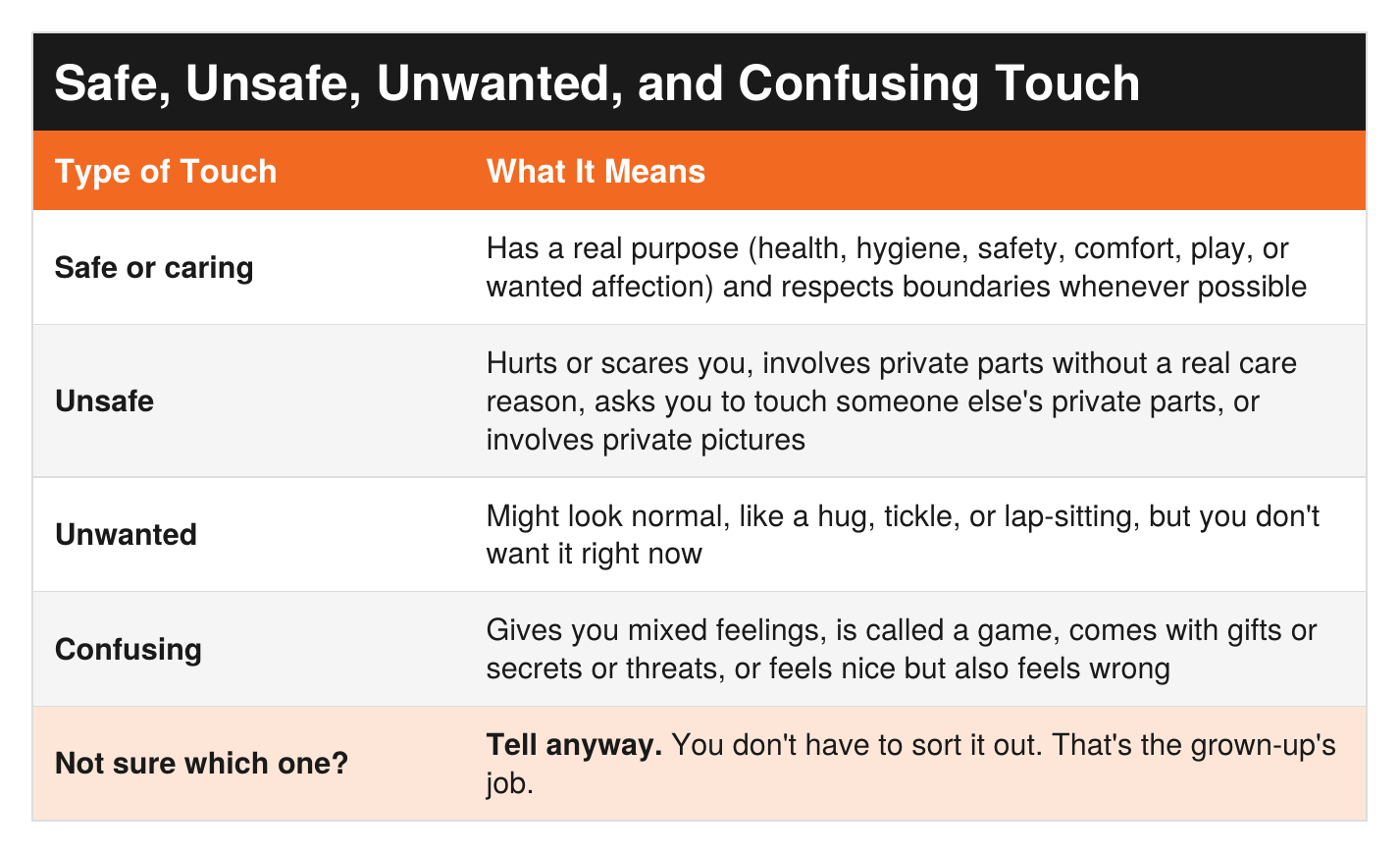
What to Say:
"You don't have to figure out exactly what kind of touch it was before you tell me. A touch can be unsafe even if it didn't hurt. If something feels worrying, secret, or confusing, you can always tell."
That last line is the one that matters most. The child doesn't have to sort it out. That's our job.
Mixed Reactions Are Normal
When something scary or confusing happens, kids don't always do what we hope they'll do. They might:
Freeze
Laugh nervously
Go quiet
Do what they're told
Figure out something was wrong days, weeks, or years later
They might also love the person and hate what the person did. All of that is normal, and none of it is the child's fault.
For adults: Never ask, "Why didn't you just say no?" A child may depend on that person, love them, fear them, or want to protect them. Keep the responsibility where it belongs, on the person who crossed the line.
Doctors, Bath Time, and Care That's Okay
Young kids, and kids with disabilities, need help with bathing, the bathroom, dressing, and medical care. That's normal. We don't want to teach a child that every touch near a private area is wrong, or they may fight care they need.
We also don't want care to become a loophole. So teach the difference.
What to Say:
"Sometimes a parent or a doctor needs to look at or touch a private part to keep you clean, healthy, or safe. There should be a real reason. The grown-up should tell you what they're doing, keep you covered when they can, have Mom or Dad there, and only do what's needed. You can ask questions, and you can always tell me afterward if anything worried you."
The Safer-Care Check
For parents, here's the quick checklist for any care involving private areas:
Is there a real health, hygiene, or safety reason?
Did the adult explain it in words the child understands?
Is the child's privacy protected?
Is a parent or chaperone present when appropriate?
Is only the needed contact happening?
Can the child ask questions and talk about it afterward?
Red flag: Any adult, including a medical professional, who tells a child to keep an exam or care secret from their parents. Safe care doesn't need secrecy.
Remember: A child may feel uncomfortable during appropriate care. Discomfort alone doesn't mean abuse. But the child should always be allowed to talk about it, and be taken seriously.
Ask Yourself
Have I told my child the body-safety rules apply to family and friends too, not just strangers?
If my child felt confused about a touch, would they know they could still tell me?
Do my child's coaches, tutors, and doctors follow an open-door, parent-present approach?
Get Started Today
My free Child Safety Bundle includes Recognizing Unsafe Adult Behavior, a quick-reference guide to the warning signs in coaches, teachers, and other trusted adults, plus the questions to ask any youth program.
Go Deeper
The Family Safety Toolkit includes 20 safety checklists, with a full Child Safety section to help you vet camps, programs, and the adults around your kids. [Get the Toolkit here: LINK]
[CTA: Comment or DM "[KEYWORD]" / or download it here: LINK]- COMING SOON!
Tools I recommend: Visit my Children's Safety store on Amazon for the products I recommend for keeping kids safe at home, online, and on the go. [AMAZON CHILDREN'S SAFETY STORE LINK]
Related reading:
The Creepy Coach, Part 1: "Creepy" Is Not a Look. It's a Pattern.
Red Cell Your Family, Part 5: Red Cell Your Circle (kids, schools, visitors, and well-meaning relatives) [LINK]
Coming Up in Part 3
"If You Say Don't Tell, I Have to Tell." Surprises versus unsafe secrets, building your child's trusted-adult network, and body safety online.
References
Centers for Disease Control and Prevention, About Child Sexual Abuse: https://www.cdc.gov/child-abuse-neglect/about/about-child-sexual-abuse.html
RAINN, Children and Sexual Violence: https://rainn.org/get-informed/issues/children-and-sexual-violence/
U.S. Center for SafeSport, Minor Athlete Abuse Prevention Policies: https://uscenterforsafesport.org/category/maapp-articles/
Former Bethlehem middle school resource officer sentenced to 10-20 years, WFMZ-TV 69 News: https://www.wfmz.com/news/area/lehighvalley/northampton-county/bethlehem-area/former-bethlehem-middle-school-resource-officer-sentenced-to-10-20-years-on-sexual-assault-charges/article_8e873ba2-735c-485c-89e6-ce5f7ea67d91.html
Disclaimer
This article is for general informational and educational purposes only. It is designed to help families start important conversations. It is not a substitute for professional advice, training, or services, including medical, mental health, legal, or law enforcement guidance. Laws and reporting requirements vary by state. Do not use this article to investigate or repeatedly question a child. If you suspect abuse, contact a professional right away.
If you suspect a child is being abused, contact local law enforcement, your state's child protective services, or the Childhelp National Child Abuse Hotline at 1-800-422-4453 (call or text). If a child is in immediate danger, call 911.
Awareness gives you time. Time gives you options.
The prepared protector is someone who's decided that loving someone means being ready for them, not just hoping things go fine.
Prepared Not Paranoid. Protecting the Most Vulnerable Among Us.