Teen Slang, Emoji, and Drug Codes Every Parent Should Know
By Larry Betz | Prepared Not Paranoid https://www.preparednotparanoid.com/
Teen slang and emoji codes can look like nonsense, or completely innocent. Most of the time they are. But some of them point to grooming, drugs, or a child who's hurting, and parents need to know the difference.
Today's kids live in texts, DMs, gaming chats, and social apps. To stay a step ahead of parents and teachers, they've built their own language of acronyms, numbers, and emoji. A lot of it is just fun. Some of it hides risky behavior: drug use, sexting, meeting strangers, or a cry for help.
Learning this language isn't about spying. It's about staying connected, spotting red flags early, and knowing when to start a conversation.
A big caveat: slang changes fast, and meaning depends on context. A peach emoji is usually just a peach. Always ask what your child meant before you react.
Parents Nearby: The Secrecy Codes
POS: parent over shoulder
PIR: parent in room
PAW / PAL: parents are watching / listening
P911: parent alert
9 / 99: parent watching / parent gone
These aren't dangerous on their own. They do tell you a conversation is something your child doesn't want you to see.
Teen Slang and Emoji Codes That Mean- Talk Now
Some codes are red flags no matter the context.
Here are the ones that mean it's time for a conversation, today.
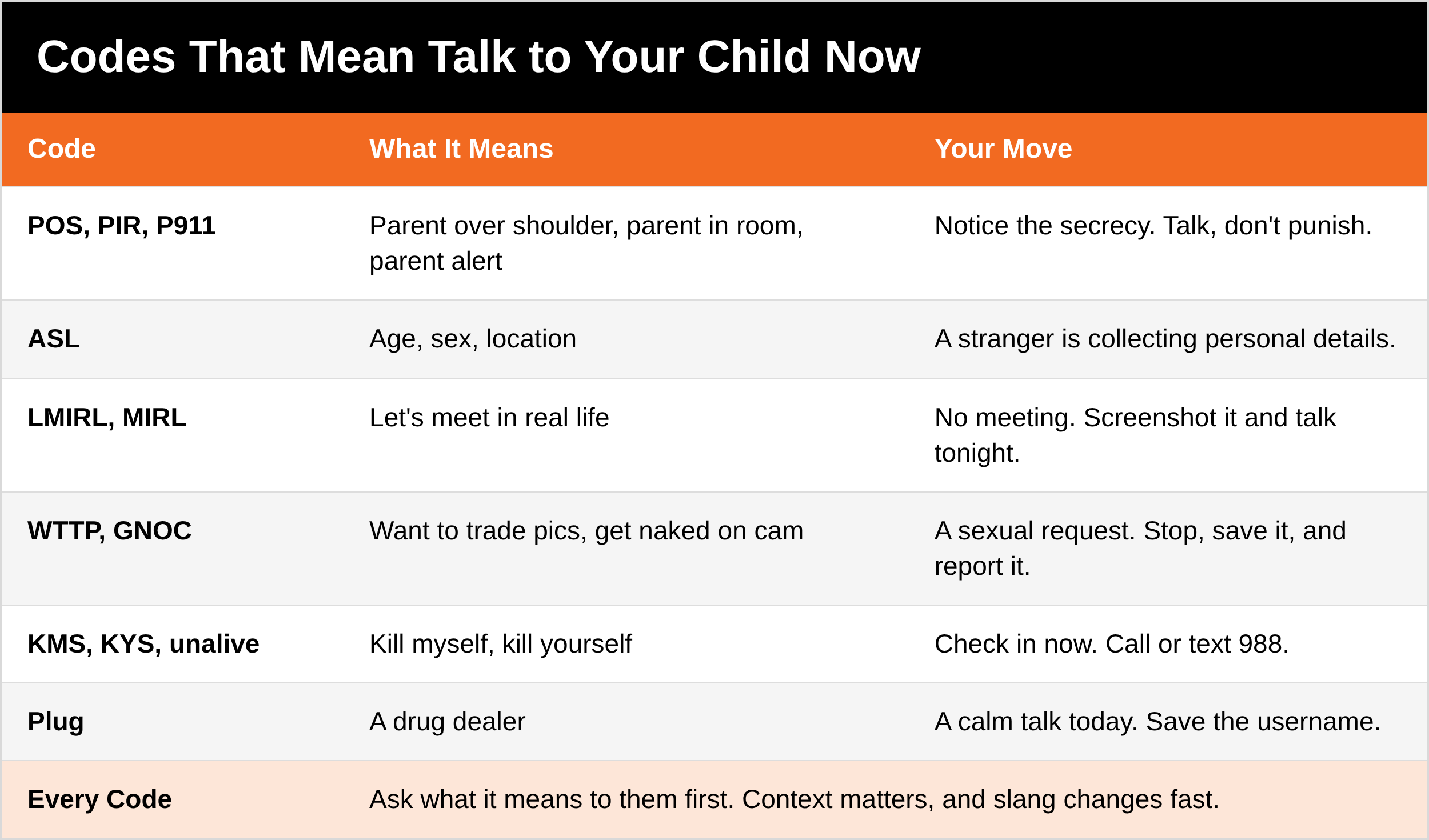
Grooming and sexting red flags: ASL (age, sex, location), LMIRL (let's meet in real life), WTTP (want to trade pics), and GNOC (get naked on cam) are classic grooming markers. Treat them as serious.
Self-harm and suicide: KMS (kill myself), KYS (kill yourself), and "unalive," a word kids use to talk about suicide without getting flagged. Take every one seriously. Check in with your child, and if you're worried, call or text the 988 Suicide & Crisis Lifeline together.
Sexual emoji shortcuts, often paired with sexting or nude-sharing: 🍆 and 🍑 for body parts, 💦 for sexual activity, 👀 for sending or looking at nudes, and 🌽 for porn. (Source: Parents.com.)
Drug Slang and the DEA's Emoji Codes
Kids and dealers use slang and emoji as code when they talk about drugs. Many look innocent.
Common words:
Plug: a dealer
Gas: strong marijuana
Lean: prescription cough syrup with codeine, mixed with soda or candy
Xans or bars: Xanax
Percs: Percocet
Blues or M30s: fake oxycodone pills, often pressed with fentanyl
From the DEA's Emoji Drug Code chart:
❄️ Cocaine (snowflake)
💎 💙 Meth (diamond, blue heart)
🚌 Xanax (school bus)
🍁 "Universal for drugs" (maple leaf)
🔌 Dealer (plug)
🚀 High potency (rocket)
🍪 Large batch (cookie)
The DEA's chart, updated in 2026, also covers Adderall, marijuana, heroin, MDMA, mushrooms, and cough syrup. It's a sample, not a complete list. See the full chart at dea.gov/onepill.
Fake Pills and Fentanyl: One Pill Can Kill
Pills sold online as Xanax, Percocet, or oxycodone are often fakes made to look real. Many contain fentanyl, a synthetic opioid the DEA says is 50 times stronger than heroin. Just 2 milligrams, about what fits on the tip of a pencil, can be deadly. In DEA lab testing in 2022, 6 out of 10 fentanyl-laced fake pills contained a potentially deadly dose.
Treat any mention of pills online as a possible fentanyl risk. The only safe pills come from a doctor and a pharmacy.
Keep naloxone (Narcan) in your home. It can reverse an opioid overdose, and it's sold over the counter at most pharmacies.
Spotted a Code? What to Do Next
If you see one of these in your child's texts or apps, how you react in the first few minutes decides whether they keep talking to you.
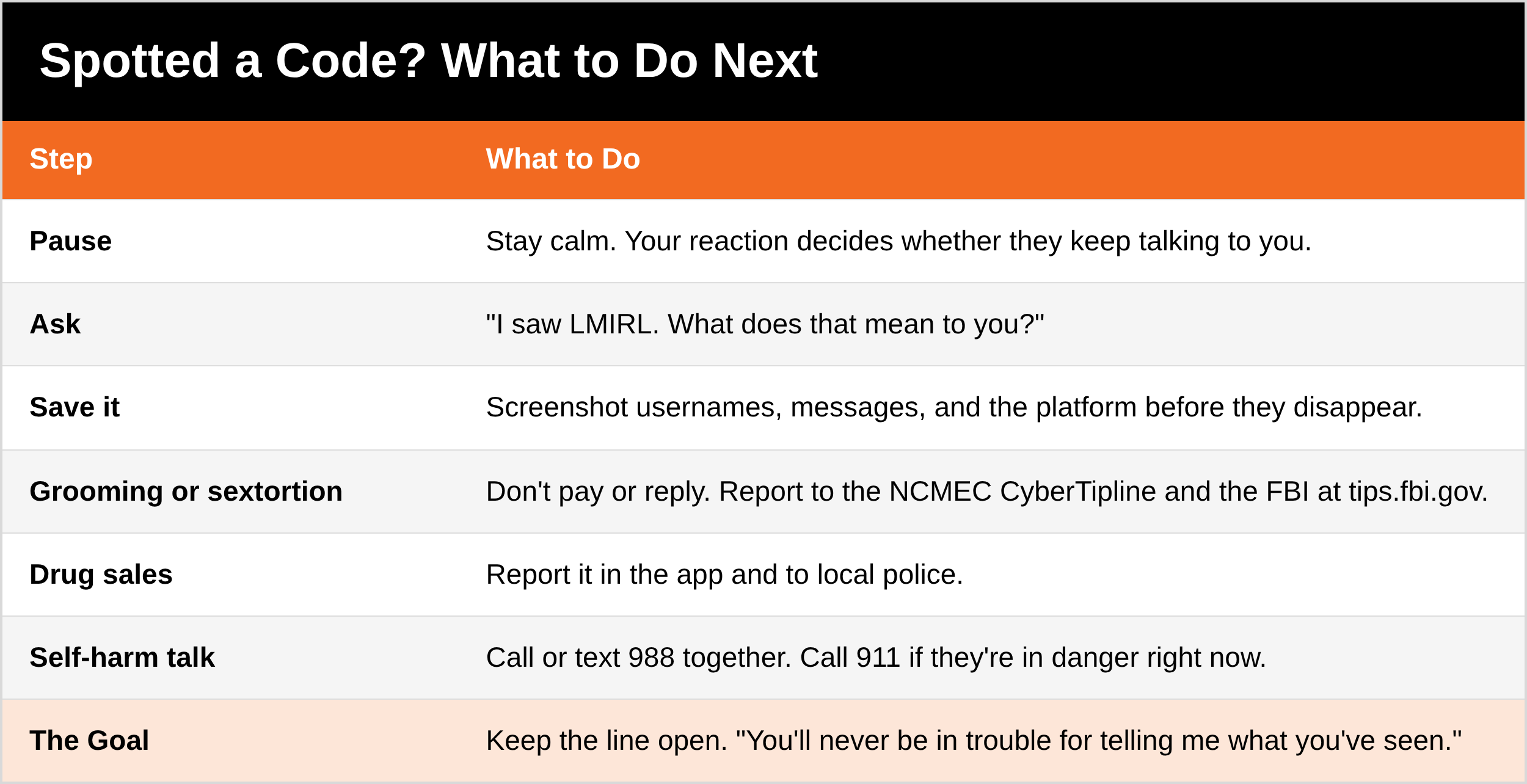
The Prepared Protector Asks Before Reacting
Your first instinct might be to take the phone and ground them for a month. That usually ends the conversation. A Prepared Protector stays calm, asks what it means, and listens. You're not trying to win the moment. You're trying to stay the person they come to when something's really wrong.
If you suspect sextortion, don't pay and don't reply. Payment usually leads to more demands. Save the messages, then report it to the NCMEC CyberTipline (report.cybertip.org) and the FBI (tips.fbi.gov or 1-800-CALL-FBI). Tell your child it's not their fault.
How to Teach This Fast
Kids don't need a lecture. Fold it into the What If Game from Part 1.
1. Use scenarios they recognize.
"If you see 🍆🍑💦 in a DM, what do you do?" Don't reply. Screenshot it. Tell a trusted adult.
"If someone messages LMIRL, how do you respond?" No contact. Screenshot. Block. Tell us.
"What if a friend says KMS in a chat?" Take it seriously. Check in. Tell an adult right away.
2. Practice in short bursts. Car rides, dinner, waiting at a restaurant. Repetition, not lectures.
3. Build a family glossary. Keep it on the fridge or in a shared note. Let your kids help add new terms. They'll feel included, not policed.
4. Stay updated. Slang can change in weeks. Check the DEA's emoji chart, the DEA's "Hidden on Your Kid's Phone" videos at getsmartaboutdrugs.gov, Common Sense Media, and your school resource officer. Set a monthly reminder, or weekly if your child is very active online.
5. Reinforce the positives. When your child spots a code, praise them for noticing. "Who can spot a new slang word first this week?"
6. Keep the conversation open. "You won't get in trouble for telling us what you've seen."
What to Say
"I saw a word I didn't know in your chat. What does it mean?"
"I'm not mad. I just want to understand."
"If anyone ever offers you a pill, it could have fentanyl in it. Even one. Promise me you'll say no and tell me."
Ask Yourself
Would I recognize LMIRL or KMS if I saw it?
Would I know what my child meant if they mentioned a "plug"?
If I found something, would I react in a way that keeps them talking?
5 Quick Wins You Can Start Today
Look at the DEA emoji chart at dea.gov/onepill.
Save 988 in your phone and your child's phone.
Pick up naloxone at your pharmacy.
Start a family glossary on the fridge.
Ask your child one question: "What's a new word everyone's using right now?"
Remember
Codes change fast, but your approach doesn't have to. Learn the red flags, ask before you react, save the evidence, and make sure your child knows they can always tell you.
Coming Up in Part 5
In Part 5, we'll cover the apps parents should know about in 2026, sorted by type, so you can spot a risky app even when the name is new.
Get Started Today
Get my free Child Safety bundle. It includes Family Tech Rules, a practical set of rules for phones, games, and screens. DM the word [KEYWORD] on Instagram or Facebook and I'll send it to you. [Get it here: LINK]
Go Deeper
Hooked: The Dangers of Social Media (written by Justin Nichols). How predators and platforms hook kids, and how to protect them. $7.99. [Get it here: LINK]
Cyber Safety. A practical guide to protecting your family online. $7.99. [Get it here: LINK]
The Family Safety Toolkit. 20 ready-to-use checklists, including Family Tech Rules. That's 244 pages, for $19.99. [Get it here: LINK]
Coming soon: the Child Safety Manual. The full family guide, with the complete code glossary sorted by category, a printable family glossary for the fridge, and age-by-age scripts for talking about drugs and sexting.
Tools I recommend: The child safety gear and books I actually recommend are in my Children's Safety Amazon store. https://amzn.to/4hcldVo
The full series:
Toddler to Teen, Part 1: The What If Game https://www.preparednotparanoid.com/pnp-library/keeping-kids-safe
Toddler to Teen, Part 2: Back to School and Out in Public https://www.preparednotparanoid.com/pnp-library/back-to-school-safety-tips
Toddler to Teen, Part 3: Is Roblox Safe? https://www.preparednotparanoid.com/pnp-library/is-roblox-safe
Toddler to Teen, Part 5: Apps Parents Should Know (2026 Edition) [LINK]
Related reading:
Who's Talking to Your Kids?, Part 2: Sextortion and AI-Generated Images [LINK]
Child Safety Resource Center [LINK]
Cyber Safety Resource Center [LINK]
References
U.S. Drug Enforcement Administration. Emoji Drug Code: Decoded (updated 2026). https://www.getsmartaboutdrugs.gov/sites/default/files/2026-06/OPCK-Emoji-Decoded-2026.pdf
U.S. Drug Enforcement Administration. One Pill Can Kill. https://www.dea.gov/onepill
U.S. Drug Enforcement Administration. DEA Laboratory Testing Reveals that 6 out of 10 Fentanyl-Laced Fake Prescription Pills Now Contain a Potentially Lethal Dose of Fentanyl. https://www.dea.gov/alert/dea-laboratory-testing-reveals-6-out-10-fentanyl-laced-fake-prescription-pills-now-contain
Parents.com. Emoji meanings guide for parents (2025).
Federal Bureau of Investigation. Sextortion (search "sextortion" at https://www.fbi.gov/). Tips: https://tips.fbi.gov/
National Center for Missing & Exploited Children. CyberTipline. https://report.cybertip.org/
988 Suicide & Crisis Lifeline. https://988lifeline.org/
Common Sense Media. https://www.commonsensemedia.org/
Disclaimer
This article is for general informational and educational purposes only. It is not a substitute for professional advice, including medical, mental health, legal, or law enforcement guidance. Slang and emoji meanings change quickly and depend on context, so talk with your child before drawing conclusions. No safety plan, checklist, or training can guarantee 100% protection. There will always be people who try to exploit vulnerability, opportunity, trust, or positions of power. The goal is not to create fear, but to help guide families toward more informed, prepared, and practical safety decisions in everyday life. Laws vary, so check your state and county for the exact rules where you live. Affiliate disclosure: I've linked to products from my Amazon store that I personally recommend. As an Amazon Associate, I earn from qualifying purchases, at no extra cost to you. Thank you for supporting my work.
If your child is thinking about suicide or self-harm, call or text 988 any time. If someone has taken a pill or may be overdosing, call 911 right away and use naloxone if you have it. If a child is being exploited online, report it to the NCMEC CyberTipline at report.cybertip.org or 1-800-843-5678.
Awareness gives you time. Time gives you options.
The Prepared Protector is someone who's decided that loving someone means being ready for them, not just hoping things go fine.
Prepared Not Paranoid. Protecting the Most Vulnerable Among Us.