Medical Care, Water, Heat, and Severe Weather
By Larry Betz | Prepared Not Paranoid https://www.preparednotparanoid.com/
Every camp says it's ready for an emergency. A real camp emergency plan is written down, practiced, and owned by someone who knows exactly what to do. Here's how to tell the difference before you send your child.
I spent years as a Safety Director in the elevator industry, and I went through EMT school. Both taught me the same lesson: when something goes wrong, people don't rise to the occasion. They fall back on their plan and their training. If there's no plan, there's nothing to fall back on.
That's what this part of the series is about. Accidents, illnesses, and storms happen at camp. The question isn't whether something will go wrong over a summer. It's whether the adults in charge already know exactly what to do when it does.
In Part 1, we looked at how to vet a camp. In Part 2, we covered who has access to your child. Now let's look at whether the camp is ready for a real emergency.
Medical Care and Medication
Start with the basics. Ask:
Who provides health care at camp? A nurse, a doctor, an EMT, or a staff member with first aid training?
When are they on site, and who covers when they're not?
How far away are the nearest hospital and EMS?
When do they call 911, and when do they call you?
Then ask about medication:
How are medications received, labeled, and stored?
Who gives them, and how is each dose documented?
Are medications refrigerated when they need to be?
Do medications go along on field trips and overnights?
Be completely honest on the camp forms. Some parents downplay a medical, behavioral, or emotional need because they worry the camp will turn their child away. I understand that worry. But a camp can't plan for something it doesn't know about. Allergies, asthma, diabetes, seizures, medications, sleep issues, mental health, and signs that your child is in distress all belong on that form.
Severe Allergies
If your child has a severe allergy, give the camp a current emergency action plan and the prescribed epinephrine. Then ask:
Where will the epinephrine be stored?
Does it travel with my child during activities and trips?
Who is trained to use it?
How quickly can staff reach it, and how do they call EMS?
No one should delay emergency treatment while trying to reach a parent. Make sure the camp knows that's your expectation.
Disability, Inclusion, and Emotional Safety
Every child deserves to feel safe at camp, and that includes kids with disabilities, sensory needs, anxiety, or behavioral challenges.
Tell the camp what helps your child communicate, calm down, handle transitions, sleep, eat, and recover when things get overwhelming. Then ask how staff handle homesickness, panic, shutdown, aggression, wandering off, or a child who says they want to hurt themselves.
Be cautious of any program that uses:
Humiliation or public embarrassment
Forced exercise as punishment
Withholding food or sleep
Isolation
Physical restraint by untrained staff
A "toughen up" culture
Discipline should never be designed to break a child down.
Water Safety
Drowning is fast and often silent. A child in trouble in the water usually can't wave or yell for help. That's why water time at camp needs constant, focused supervision.
Don't rely only on how you describe your child as a swimmer. Ask:
Does the camp test every child's swimming ability itself?
How are swim areas marked for different skill levels?
Are certified lifeguards on duty every time kids are in or near the water?
Is there a separate adult watching the group, so lifeguards only watch the water?
When are life jackets required?
How do they count kids before, during, and after water activities?
That separate adult matters. A lifeguard shouldn't be breaking up arguments on the dock while also watching swimmers.
Tell the camp if your child is afraid of water, impulsive, likely to wander, drawn to water, or has a condition that changes their risk.
For more on keeping kids safe around pools, lakes, and rivers, see my Family Water Safety series.
Heat, Sun, Air Quality, and Ticks
Kids often don't notice they're overheating until they're already in trouble. Young children depend on adults to keep them cool and hydrated.
Ask how the camp:
Adjusts activities on hot days
Provides shade and water breaks without waiting for kids to ask
Recognizes heat illness: cramps, heavy sweating, headache, dizziness, nausea, weakness, or unusual behavior
Checks the Air Quality Index (AQI) and changes plans during wildfire smoke
Protects kids with asthma or other conditions that raise the risk
For camps in wooded or grassy areas, add one more question: "Do you do daily tick checks?" Ticks can spread Lyme disease and other illnesses, and a quick check after outdoor activities is simple prevention. Pack insect repellent and teach your child to check themselves too.
Severe Weather, Floods, and Wildfire
This is where the Texas floods from Part 1 hit home. Weather emergencies can turn dangerous in minutes. Here in Arizona, I've seen how fast a monsoon storm can turn a dry wash into a river.
Why "We Get Alerts on Our Phones" Isn't a Plan
Many people ignore weather alerts. Not because they don't care, but because of alert fatigue. When phones buzz with warnings over and over, people start tuning them out, even when the danger is real.
Alerts can also fail at camp. Phones get silenced. Cell service is spotty in remote areas. Power goes out. Staff are asleep.
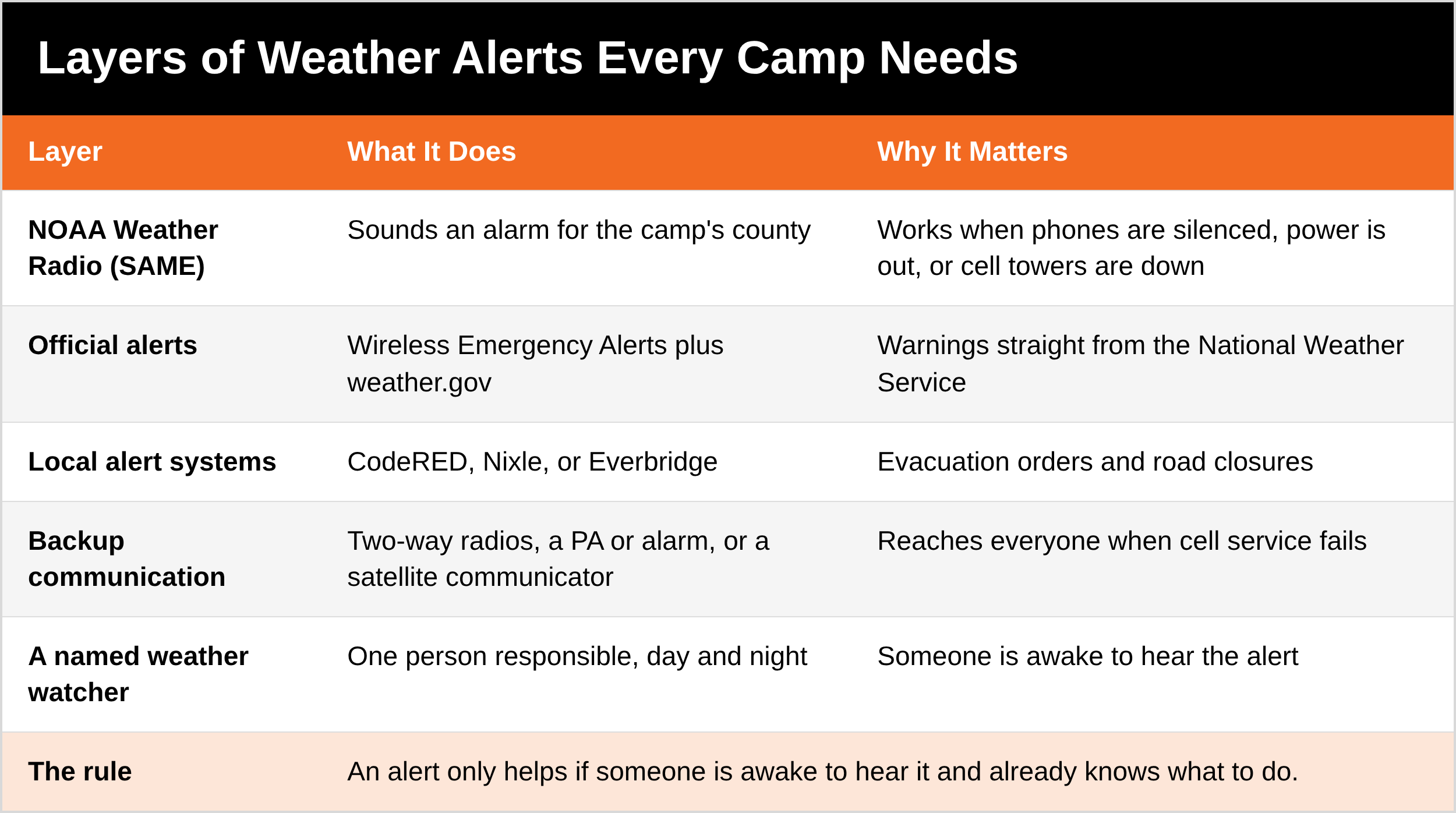
That's why a camp needs layers, not one app on the director's phone. A strong camp weather setup looks like this:
A NOAA Weather Radio with SAME technology set to the camp's county. It can sound an alarm even when phones are silenced, power is out, or cell towers are down.
Official alerts: Wireless Emergency Alerts turned on, plus the National Weather Service at weather.gov
Local alert systems like CodeRED, Nixle, or Everbridge, which often include evacuation orders and road closures
A backup way to communicate when cell service fails: two-way radios, a camp-wide alarm or PA system, or a satellite communicator like a Garmin inReach
A named person responsible for watching the weather, including overnight and during off-site trips
An alert only helps if someone is awake to hear it and already knows what to do.
Questions to Ask About Weather and Disasters
Who monitors the weather, and who does it overnight?
Are any cabins or activity areas near a river, creek, or in a floodplain?
Where is the higher ground, and how do kids get there at night?
Is there more than one way out of the camp if a road or bridge floods?
Is the camp in a wildfire-prone area? What's the evacuation plan?
How do you shelter kids during a tornado or severe storm?
How often do you practice evacuation drills with campers?
Are staff trained in CPR, first aid, and AED use?
How many trained adults are available to move kids during an emergency?
The Rules Every Camp Should Follow
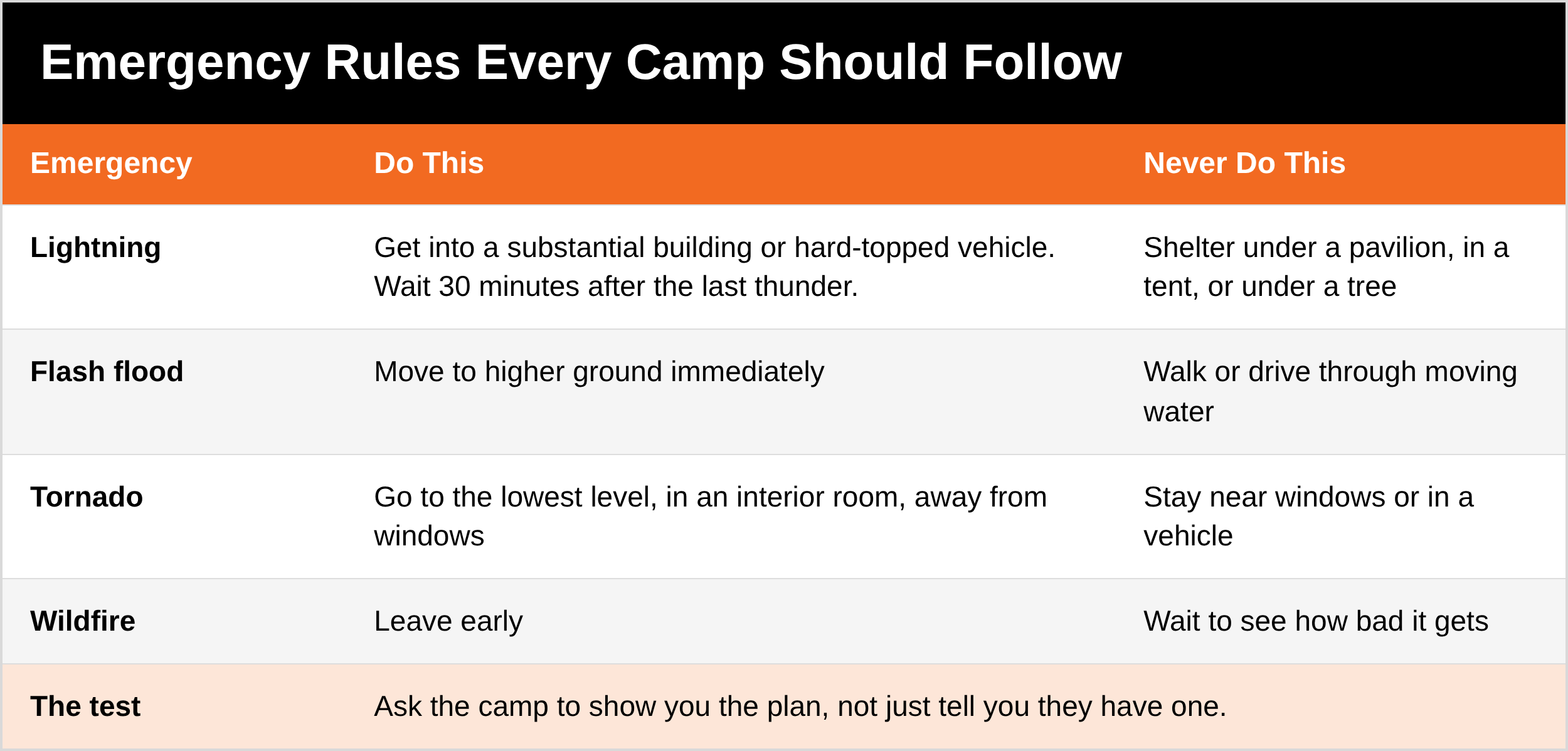
Lightning: When thunder roars, go indoors. Kids should move to a substantial building or a hard-topped vehicle, not a pavilion, tent, or tree. Wait at least 30 minutes after the last thunder before going back outside.
Flash floods: Move to higher ground immediately. Never walk or drive through moving water. Turn Around Don't Drown®.
Tornadoes: Go to the lowest level, in an interior room, away from windows.
Wildfire: Leave early. Waiting increases traffic, confusion, and danger.
For a deeper look at layered alert systems and beating alert fatigue, read my Advanced Weather Alerts blog.
Transportation and Field Trips
Ask who drives, how drivers are screened, and how vehicles are maintained and insured. Then ask:
Does every child have their own seat and seat belt?
How do staff count kids before leaving, after arriving, and before heading back?
Does an adult physically walk through the vehicle after every trip to make sure no child is left behind?
What's the plan for a breakdown, a crash, a medical emergency, or bad weather on the road?
Do medications, water, and emergency contacts travel with the group?
Never assume a headcount happened. Ask how they make sure.
Your Camp Emergency Plan Checklist: Plans and Reunification
Every camp should have a written plan for floods, fire, severe weather, power failure, medical emergencies, missing campers, violence, and communication failure. Ask to see it.
Then ask:
How will parents be notified, and how fast?
Where will children be reunited with parents?
How will you verify who's picking up each child?
What should parents do during an emergency?
That last question matters. In an emergency, your instinct will be to drive straight to camp. But parents driving into a disaster area can block roads that emergency crews need. A good camp will tell you exactly where to go and where updates will come from.
Your Family's Side of the Plan
The camp has a plan. Your family needs one too.
Make sure the camp has your current phone numbers and a backup contact
Choose an out-of-area contact everyone can call or text if local lines are jammed
Decide ahead of time who goes to the reunification site if you're at work or traveling
Sign up for alerts in the county where the camp is located, not just where you live
Talk as a family about what happens if a storm, fire, or emergency hits while your child is at camp
The best time to decide what you'll do is before the alert goes off.
The Prepared Protector Doesn't Wait for the Alert
Most parents sign up for alerts where they live and forget about the county where their child is sleeping. A Prepared Protector signs up for both, picks the out-of-area contact, and decides who goes to the reunification site before the car is even packed for camp. When the alert comes, you're not making decisions. You're following the plan you already made.
What to Say
"Can I see your emergency action plan?"
"Who watches the weather overnight, and how do they wake everyone up?"
"Are any cabins near water or in a floodplain?"
"Where is the epinephrine kept, and who's trained to use it?"
"Does a staff member walk through every vehicle after a trip?"
"Where would I go to pick up my child in an emergency?"
Remember: An alert only helps if someone already knows what to do with it. Ask the camp to show you the plan, not just tell you they have one.
Ask Yourself
Did I tell the camp everything about my child's health and needs, or did I leave something out?
Do I know who watches the weather at my child's camp overnight?
If an emergency hit tomorrow, do I know exactly where I'd go to pick up my child?
Trust Your Gut
If a camp can't answer these questions clearly, that tells you something. Preparation doesn't have to be fancy, but it does have to be real. Awareness gives you time. Time gives you options.
5 Quick Wins You Can Start Today
Fill out the camp forms honestly. Every allergy, medication, and need, even the ones you're worried about.
Ask to see the emergency plan. Not a description of it. The plan.
Ask the overnight weather question. "Who watches the weather at night, and how do they wake everyone up?"
Sign up for alerts in the camp's county. Not just where you live.
Pick your out-of-area contact. Make sure everyone in the family knows who it is.
Remember
When something goes wrong, people fall back on their plan. Make sure your child's camp has a real one, written down and practiced, and make sure your family has its side of the plan ready too.
Coming Up in Part 4
In the final part of this series, we'll focus on your child. You'll get the exact words to use before camp, how to choose trusted adults, what to do if your child tells you something concerning, and what to ask when they get home.
Get Started Today
Get the free Summer Camp Safety Checklist for Parents. All of these medical, water, weather, and emergency questions are in it. DM the word [KEYWORD] on Instagram or Facebook and I'll send it to you. [Get it here: LINK]
Go Deeper
The Family Safety Toolkit. It gives you 20 checklists in one place, including the Summer Camp Safety Checklist, Family Water Safety, Go Bag, First Aid & Trauma, and Fire Safety. That's 244 pages, for $19.99. [Get it here: LINK]
Coming soon: the Child Safety Manual. The full family guide, with a Camp Medical and Medication Handoff Form, a Family Camp Emergency Plan with reunification steps, and a pre-camp swim readiness checklist.
Tools I recommend: The child safety gear and books I actually recommend are in my Children's Safety Amazon store. https://amzn.to/4hcldVo
The full series:
Summer Camp Safety, Part 1: Who's Really Watching Your Kids? https://www.preparednotparanoid.com/pnp-library/choose-a-safe-summer-camp
Summer Camp Safety, Part 2: Who Has Access to Your Child? https://www.preparednotparanoid.com/pnp-library/camp-staff-screening
Summer Camp Safety, Part 4: Preparing Your Child and the Conversation After Camp [LINK]
Related reading:
Family Water Safety series [LINK]
Advanced Weather Alerts [LINK]
Child Safety Resource Center [LINK]
References
American Academy of Pediatrics. Improving Health and Safety at Camp.
Food Allergy Research & Education (FARE). Heading to Camp.
Centers for Disease Control and Prevention. Preventing Drowning.
Centers for Disease Control and Prevention. Heat and Infants and Children.
Centers for Disease Control and Prevention. Heat and Athletes.
Centers for Disease Control and Prevention. Preventing Tick Bites.
AirNow. Air Quality and Outdoor Activity Guidance for Schools.
National Weather Service. Lightning Safety for Outdoor Activities.
National Weather Service. Turn Around Don't Drown®.
National Weather Service. NOAA Weather Radio.
FEMA. Youth Preparedness.
Perry Weather. Heaven's 27 Camp Safety Act: New Texas Law HB1/SB1 Explained. https://perryweather.com/?p=19566
Disclaimer
This article is for general informational and educational purposes only. It is designed to help families ask better questions and start important conversations. It is not a substitute for professional advice, training, or services, including medical, emergency-management, legal, or law enforcement guidance. Always follow your child's physician and official emergency instructions. No safety plan, checklist, or training can guarantee 100% protection. Laws and requirements vary by state and change over time, so check your state and county for the exact rules where you live. Prepared Not Paranoid and Larry Betz are not responsible for the content of third-party websites or resources linked here and make no guarantee of their accuracy or completeness. Product and app examples are for information only and are not endorsements. Affiliate disclosure: I've linked to products from my Amazon store that I personally recommend. As an Amazon Associate, I earn from qualifying purchases, at no extra cost to you. Thank you for supporting my work.
In a medical emergency or any situation where a child is in immediate danger, call 911.
Awareness gives you time. Time gives you options.
The Prepared Protector is someone who's decided that loving someone means being ready for them, not just hoping things go fine.
Prepared Not Paranoid. Protecting the Most Vulnerable Among Us.