The Words to Use Before Camp, and the Questions to Ask When They Get Home
By Larry Betz | Prepared Not Paranoid https://www.preparednotparanoid.com/
Preparing your child for camp isn't about scaring them. It's a few clear rules, the right words, and the promise that you'll always have their back. Here's exactly what to say before camp, and what to ask when they get home.
Over the first three parts of this series, we focused on the camp: how to vet it, who has access to your child, and whether it's ready for an emergency.
But the best camp policies in the world work better when your child knows they can speak up.
That's what this final part is about. Not scaring your child. Not loading them up with worst-case scenarios. Just giving them a few clear rules, the words to use, and the confidence to know you'll always have their back.
Preparing Your Child for Camp Without Frightening Them
Kids take their cues from us. If you're anxious, they'll be anxious. If you're calm and matter-of-fact, they'll treat safety the way they treat buckling a seat belt: normal.
Start with the positive. Camp is supposed to be fun. Most of the adults and kids there want to help. Then explain that your family has safety rules everywhere: at school, at practice, at friends' houses, online, and at camp.
That's the whole tone. Not "the world is dangerous." Just "here's how our family does things."
Exact Words You Can Use
Kids don't need a lecture. They need a few simple sentences they'll remember. Here are the ones I recommend. Use them as written, or put them in your own words. If you've read my My Body, My Boundaries series, these will sound familiar. These are the camp versions.
Before Camp
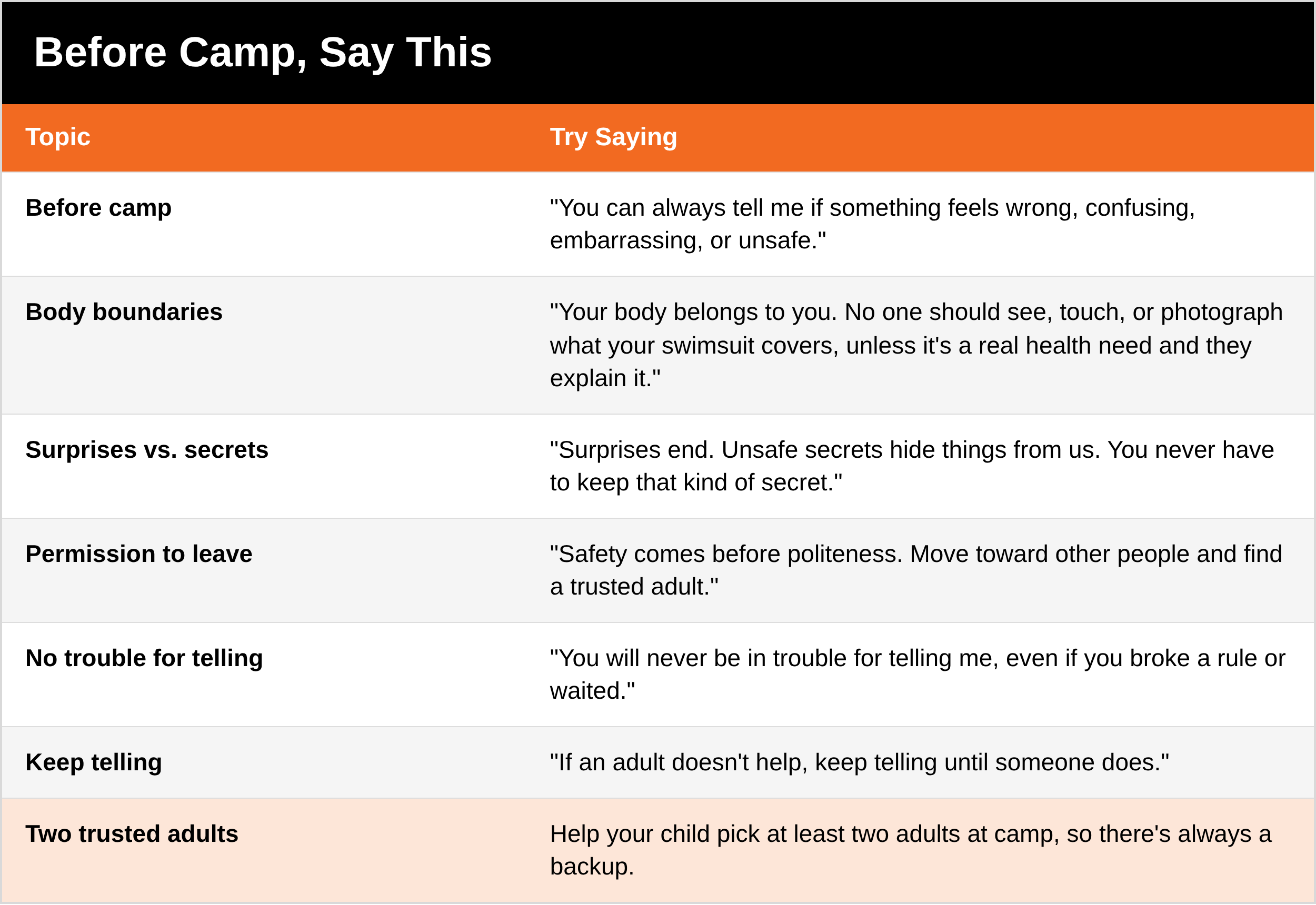
"Camp is supposed to be fun, and most people there want to help you. Our family still has safety rules. You can always tell me if something feels wrong, confusing, embarrassing, or unsafe."
Body Boundaries
"Your body belongs to you. You can say no to touch you don't want. No adult or older kid should ask to see, touch, or take pictures of the parts covered by your swimsuit. The only exception is a real health or safety need, and safe adults explain what they're doing and follow the rules."
Safe Surprises vs. Unsafe Secrets
"Surprises are fun because they end, like a birthday present. Unsafe secrets are ones where someone asks you to hide something from us, especially about touching, pictures, gifts, messages, or breaking rules. You never have to keep that kind of secret."
Permission to Leave
"You don't have to stay somewhere that feels unsafe just to be polite. Safety comes before politeness. Move toward other people, find a trusted adult, and ask for help."
No Trouble for Telling
"You will never be in trouble for telling me something, even if you broke a rule, went somewhere you weren't supposed to, accepted a gift, sent a message, or didn't tell me right away."
That one is huge. Kids often stay quiet because they're afraid they'll get in trouble for their part in it. Take that fear off the table before camp starts.
If the First Adult Doesn't Help
"If you tell an adult and they don't help, keep telling until someone does. It's okay to keep asking for help when you need it."
Choose Two Trusted Adults at Camp
Before camp starts, or on the first day, help your child pick out at least two adults at camp they can go to: a cabin counselor, the camp nurse, the director, or another staff member.
Make sure your child knows:
Their names and what they look like
Where to find them
What to do if the first adult doesn't listen (go to the second one)
Two is important. If one adult isn't available, or is the problem, your child already has a backup. These two are on top of the three trusted adults your child already has at home, school, and in the family, so they always have someone to go to, wherever they are.
For Older Kids and Teens: SCAN
Teenagers need more than rules. They need a way to think. In my book Navigating the Red Zone and Beyond, I teach a simple framework called SCAN:
S - See your environment. Notice who's around, where the exits are, and what feels off.
C - Create space. Put distance between yourself and a situation that doesn't feel right.
A - Act deliberately. Make a decision and follow through. Leave, find a friend, find an adult.
N - Never doubt your gut feelings. If something feels wrong, it's worth paying attention to.
Teach your teen this before camp. "Trust your gut" isn't just a saying. It's one of the most useful safety skills they'll ever have.
Pack for Safety
Along with sunscreen and bug spray, pack a few things that make your child easier to help:
An emergency contact card in their bag with your name, phone numbers, and a backup contact
One parent phone number memorized. Practice it until they can say it without thinking. Phones get lost, die, or get locked away at camp.
Medications labeled clearly, with the action plan included for allergies, asthma, or seizures
An understanding of how to reach you. Many camps limit phones. Find out the camp's rules for calls and letters, and tell your child exactly how they can contact you if they need to.
If Your Child Tells You Something Concerning
How you react in the first few minutes matters more than almost anything else. Kids watch your face. If you panic or get angry, they may stop talking.
Stay calm enough to listen. Then say:
"I'm glad you told me. This is not your fault. You're not in trouble. I'm going to help."
Then:
Don't interrogate. Don't ask them to repeat the story over and over, and don't suggest answers.
Don't confront the person involved.
Don't promise to keep it a secret. You may need to tell people who can help.
Write down your child's exact words, along with the date, time, and what you noticed.
Get medical help if your child is hurt.
Report it. If there's immediate danger, call 911. Report suspected abuse to law enforcement or your state's child protective services. Don't count on the camp to make the report for you.
Save everything: messages, photos, names, dates, clothing, and anything else that might matter. If an image of your child is being shared online, NCMEC's free Take It Down service can help get it removed.
Get support from a trauma-informed professional for your child, and for yourself.
For a quick chart to save, see the "If Your Child Tells You" grid in The Creepy Coach, Part 3.
The Conversation After Camp
When your child gets home, it's natural to ask, "Did you have fun?" Ask it. But don't stop there. Try open questions that invite real answers:
"What was the best part?"
"What was the hardest part?"
"Who helped you when you needed something?"
"Did anyone break a rule?"
"Was there ever a time you felt confused, embarrassed, unsafe, or pressured?"
"Did anyone ask you to keep a secret?"
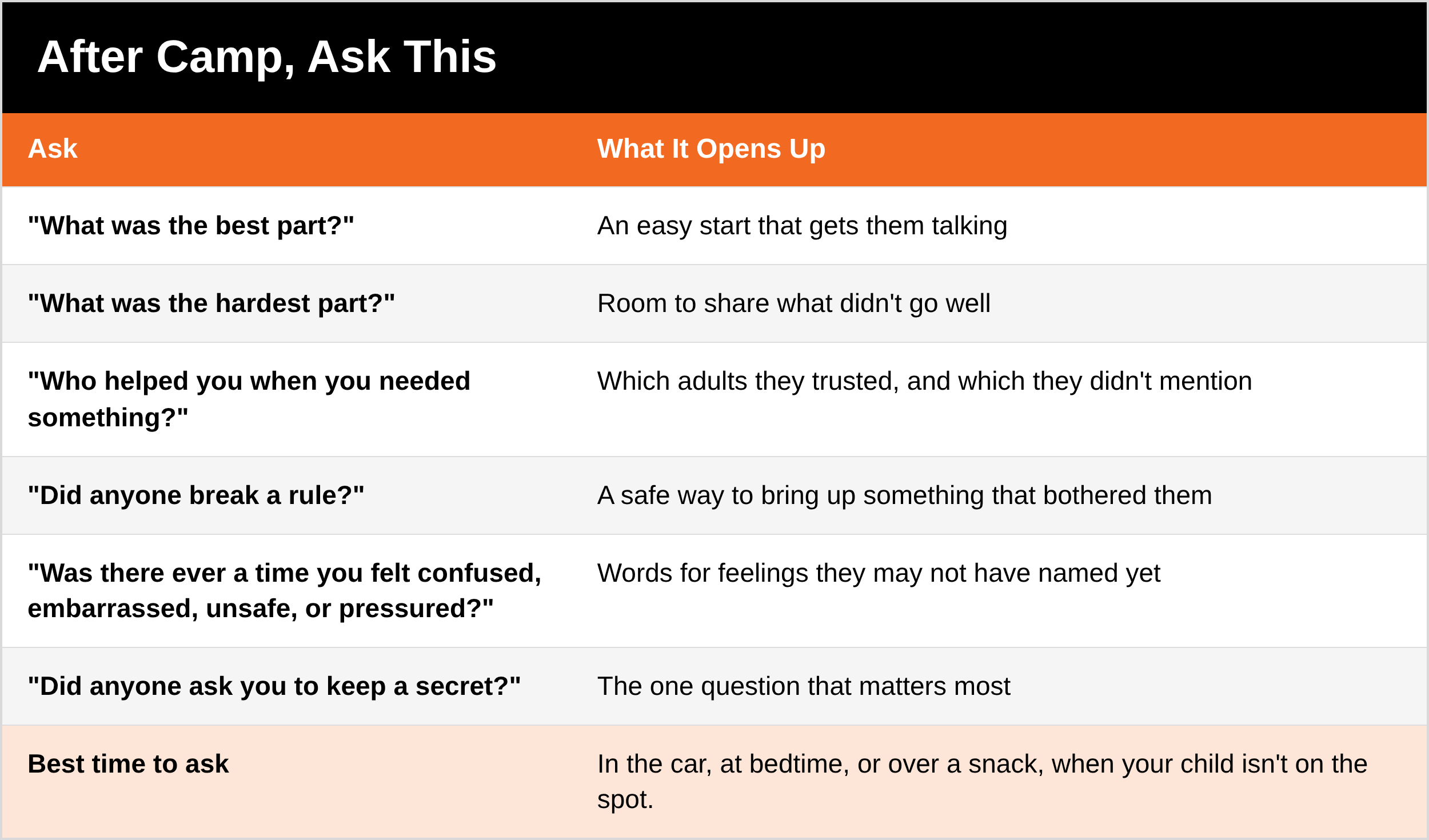
You don't have to ask them all at once. Some of the best answers come later, in the car, at bedtime, or over a snack, when your child isn't on the spot.
Changes to Watch For
Over the following weeks, notice changes in:
Sleep, mood, or appetite
Bathroom habits
New fears or withdrawal
Sexual behavior or language that's not age-appropriate
Gifts you can't explain
New private contacts on their phone or online
Strong resistance to going back to a camp or activity they used to love
One change doesn't prove anything. A pattern deserves calm attention.
The Prepared Protector Takes the Small Things Seriously
Thank your child for being honest, even when the concern seems small. Kids report big problems to adults who took the small ones seriously. A Prepared Protector listens to the story about the mean kid at the lake and the counselor who broke a rule, because that's how you stay the person they come to when it really matters.
Bringing It All Together
Here's the whole series in a few lines:
Verify the camp. Check licensing, accreditation, and written policies. Reputation is not a policy.
Know who has access. Ask about screening, boundaries, supervision, phones, and pickup.
Check the emergency plan. Medical care, water, heat, weather, and reunification all need real answers.
Prepare your child. Give them the words, two trusted adults, and the promise they'll never be in trouble for telling.
Camp should be a place for growth, confidence, friendship, and fun. With a little preparation, it can be exactly that.
Remember: You don't need to become a camp safety expert. You need to ask clear questions, listen carefully, prepare your child, and be willing to walk away when a camp won't give you straight answers.
Ask Yourself
Have I told my child they'll never be in trouble for telling me something?
Does my child know the names of two adults at camp they can go to?
When my child gets home, will I ask more than "Did you have fun?"
5 Quick Wins You Can Start Today
Pick one sentence from "Exact Words." Say it to your child this week.
Say the no-trouble promise. Out loud, before camp, and again when they get home.
Practice one phone number. Until your child can say it without thinking.
Make the contact card. Names, numbers, a backup contact, and medications.
Plan your after-camp questions. Pick two to ask in the car on the way home.
Remember
Your child is the last layer of protection, and the most important one. Give them the words, two trusted adults at camp, and a promise they can count on. Then, when they get home, keep asking and keep listening.
Get Started Today
Get the free Summer Camp Safety Checklist for Parents. Everything in this series comes together in it: the questions to ask, the red flags to watch for, and a worksheet to track your answers and your final decision. DM the word [KEYWORD] on Instagram or Facebook and I'll send it to you. [Get it here: LINK]
Go Deeper
The Family Safety Toolkit. If you want to be ready for more than camp, the Toolkit puts 20 practical checklists in one place: summer camp, water safety, trusted adults, Family Tech Rules, Halloween, home security, travel, emergency preparedness, and more. It's built for busy parents who want to protect their kids without living in fear. That's 244 pages, for $19.99. [Get it here: LINK]
Navigating the Red Zone and Beyond. SCAN comes from this book, along with the full approach to teaching teens to read a situation and act on it. [Get it here: LINK]
Coming soon: the Child Safety Manual. The full family guide, with before-camp practice scenarios by age, a teen version of the talk built around SCAN, and a follow-up plan for the weeks after camp.
Tools I recommend: The child safety gear and books I actually recommend are in my Children's Safety Amazon store. https://amzn.to/4hcldVo
The full series:
Summer Camp Safety, Part 1: Who's Really Watching Your Kids? https://www.preparednotparanoid.com/pnp-library/choose-a-safe-summer-camp
Summer Camp Safety, Part 2: Who Has Access to Your Child? https://www.preparednotparanoid.com/pnp-library/camp-staff-screening
Summer Camp Safety, Part 3: When Something Goes Wrong at Camp https://www.preparednotparanoid.com/pnp-library/camp-emergency-plan
Related reading:
My Body, My Boundaries, Part 1: "Fine" Isn't Always Fine https://www.preparednotparanoid.com/pnp-library/body-safety-for-kids
My Body, My Boundaries, Part 3: "If You Say Don't Tell, I Have to Tell" https://www.preparednotparanoid.com/pnp-library/surprises-vs-secrets
The Creepy Coach, Part 3: What to Teach, What to Ask, and What to Do [LINK]
Who's Talking to Your Kids? Part 4: Family Tech Rules That Actually Work [LINK]
Child Safety Resource Center [LINK]
References
Centers for Disease Control and Prevention. Preventing Child Abuse and Neglect.
RAINN. Children and Sexual Violence. https://rainn.org/get-informed/issues/children-and-sexual-violence/
American Camp Association. How to Choose a Camp: Safety Tips.
American Academy of Pediatrics. Improving Health and Safety at Camp.
Childhelp. National Child Abuse Hotline. https://childhelp.org/hotline/
National Center for Missing & Exploited Children. Take It Down. https://takeitdown.ncmec.org/
Betz, Larry. Navigating the Red Zone and Beyond.
Disclaimer
This article is for general informational and educational purposes only. It is designed to help families prepare their children and start important conversations. It is not a substitute for professional advice, training, or services, including legal, medical, mental health, or law enforcement guidance. No safety plan, checklist, or training can guarantee 100% protection. Laws and reporting requirements vary by state and change over time, so check your state and county for the exact rules where you live. Prepared Not Paranoid and Larry Betz are not responsible for the content of third-party websites or resources linked here and make no guarantee of their accuracy or completeness. Affiliate disclosure: I've linked to products from my Amazon store that I personally recommend. As an Amazon Associate, I earn from qualifying purchases, at no extra cost to you. Thank you for supporting my work.
If you suspect a child is being abused, contact local law enforcement, your state's child protective services, or the Childhelp National Child Abuse Hotline at 1-800-422-4453 (call or text) right away. If a child is in immediate danger, call 911.
Awareness gives you time. Time gives you options.
The Prepared Protector is someone who's decided that loving someone means being ready for them, not just hoping things go fine.
Prepared Not Paranoid. Protecting the Most Vulnerable Among Us.