Screening, Boundaries, and Grooming Warning Signs at Camp
By Larry Betz | Prepared Not Paranoid https://www.preparednotparanoid.com/
Real camp staff screening is more than a background check. Here's who actually has access to your child at camp, the one rule that protects every child, and the warning signs that should never be ignored.
In Part 1, we talked about how to look past the brochure and check who regulates a camp. Now we get to the question that matters most.
Who will have access to your child when you're not there?
Good programs train their adults on boundaries before anyone works with a child, because they take the risk seriously. Camps should be no different.
Most camp staff are wonderful people. Many of them are college kids who loved camp so much they came back to give that experience to someone else. This isn't about distrusting every counselor. It's about making sure the camp has systems that protect children no matter who gets hired.
It's More Than Counselors
When parents think about camp staff, they picture counselors. But a lot of adults may have access to your child over a week or a summer:
Senior and junior counselors
Volunteers
Contractors and maintenance workers
Nurses and medical staff
Bus and van drivers
Kitchen staff
Photographers
Visiting instructors and guest speakers
Adults who live on or near the property
Ask the camp: "Does your screening apply to everyone on this list?"
Camp Staff Screening: A Background Check Is Not the Whole Program
Background checks matter. But a criminal background check only catches people who were caught. It can miss unreported abuse, offenses in another state or country, and concerning behavior that never led to charges.
A real screening process includes:
A written application and identity verification
A structured interview
Reference checks, including the question "Would you rehire this person to work with children?"
A review of work history
A signed code of conduct
Screening of returning staff, not just new hires
Ongoing supervision after the hire date
That last one is where many programs fall short. Screening doesn't end when someone gets the job. Supervisors need to watch for boundary problems and step in early.
Ask Yourself:
When I asked about screening, did they only say "background checks"?
Did they explain what happens when a staff member breaks a boundary rule?
The Rule That Protects Everyone: Observable and Interruptible
Healthy adults don't need secret, private, or special relationships with children.
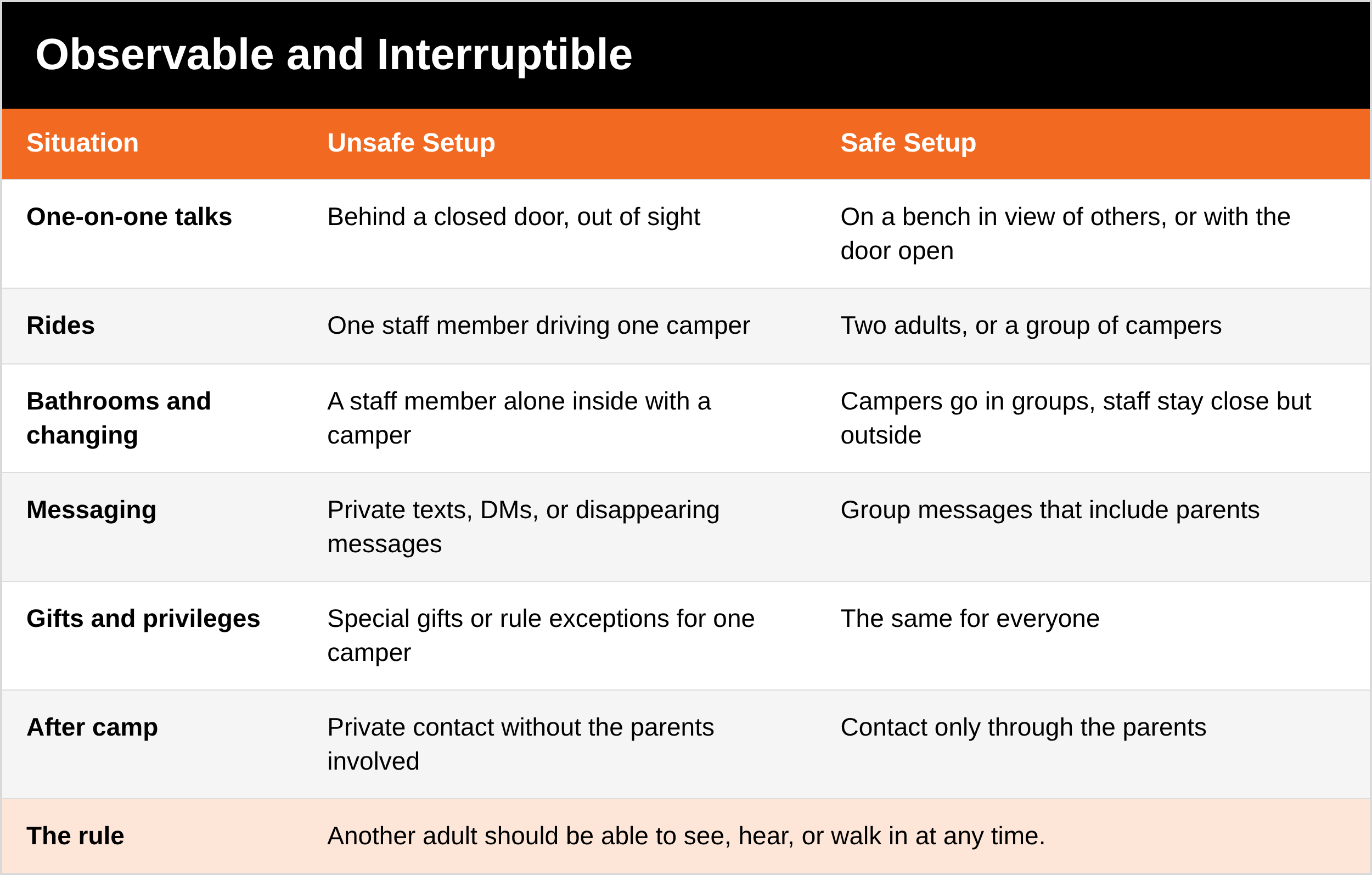
The best youth programs follow a simple rule: any interaction between an adult and a child should be observable and interruptible. Another adult should be able to see, hear, or walk in at any time.
Ask the camp for written rules covering:
One-on-one time between staff and campers
Touch
Bathrooms, showers, and changing areas
Cabins and sleeping areas
Rides and transportation
Gifts and special privileges
Photos, texting, and social media
Contact after camp ends
A child who's homesick or upset still deserves a private, caring conversation. That can happen on a bench in view of others, or with the door open.
Privacy and dignity don't require isolation.
Grooming Warning Signs at Camp
Grooming is a gradual process where someone builds trust with a child, and often with the family and the organization, to gain access and create secrecy. It rarely starts with anything that looks wrong. It usually starts with attention that looks positive.
At camp, watch and listen for:
A staff member who keeps finding reasons to be alone with one child
Gifts, extra snacks, special privileges, or rule exceptions for one camper
"You're my favorite" or "You're more mature than the other kids"
Secret jokes, nicknames, or private messages
Sexualized jokes or comments about a child's body
Unnecessary touch, tickling, wrestling, or lap sitting
Private rides or "special trips" off the property
Anger or defensiveness when someone questions them
A child who becomes emotionally dependent on one adult
One odd interaction doesn't prove anything. A pattern of secrecy, isolation, favoritism, and boundary testing is something you never ignore.
I cover these warning signs in much more detail in The Creepy Coach series.
A Real-World Example
Kanakuk Kamps in Branson, Missouri, is one of the largest Christian sports camps in the country. Pete Newman was a respected director there. In 2010, he pleaded guilty to sexually abusing children and was sentenced to two life sentences plus 30 years. A later civil lawsuit claimed he abused 57 children. Court records show camp leaders were warned about his behavior as early as 1999, yet he stayed on staff until 2009.
Some survivors were also required to sign non-disclosure agreements as part of legal settlements. That led to "Trey's Law," named after survivor Trey Carlock. In 2025, Missouri and Texas both passed versions of it, so NDAs can no longer be used to silence survivors of child sexual abuse in those states.
The lesson is not that faith-based camps or sports camps are dangerous. The lesson is that a great reputation and a respected title do not replace written rules, supervision, and outside reporting.
The Prepared Protector Checks the System, Not the Smile
The most dangerous adults are rarely the ones who make you uneasy. They're often the most liked person in the room. That's why a Prepared Protector doesn't judge a camp by how friendly the staff seem. You judge it by its rules, who enforces them, and what happens when someone breaks one.
Not Every Risk Comes From an Adult
Many parents never think to ask about this one. Kids can harm other kids too.
Ask how the camp handles:
Bullying and hazing
Dares and pranks that go too far
Harassment and threats
Sexual behavior between campers
Older or bigger campers targeting younger ones
Taking or sharing photos of other kids
Find out how staff supervise the times when problems are most likely: cabins after lights out, bathrooms and showers, changing areas, free time, and bus rides.
Serious misconduct should never be written off as "horseplay," and it should never be "settled" by forcing kids to shake hands and apologize. A good camp separates the kids involved, protects the child who was harmed, notifies parents, and reports to authorities when the law requires it.
Overnight Camp Questions
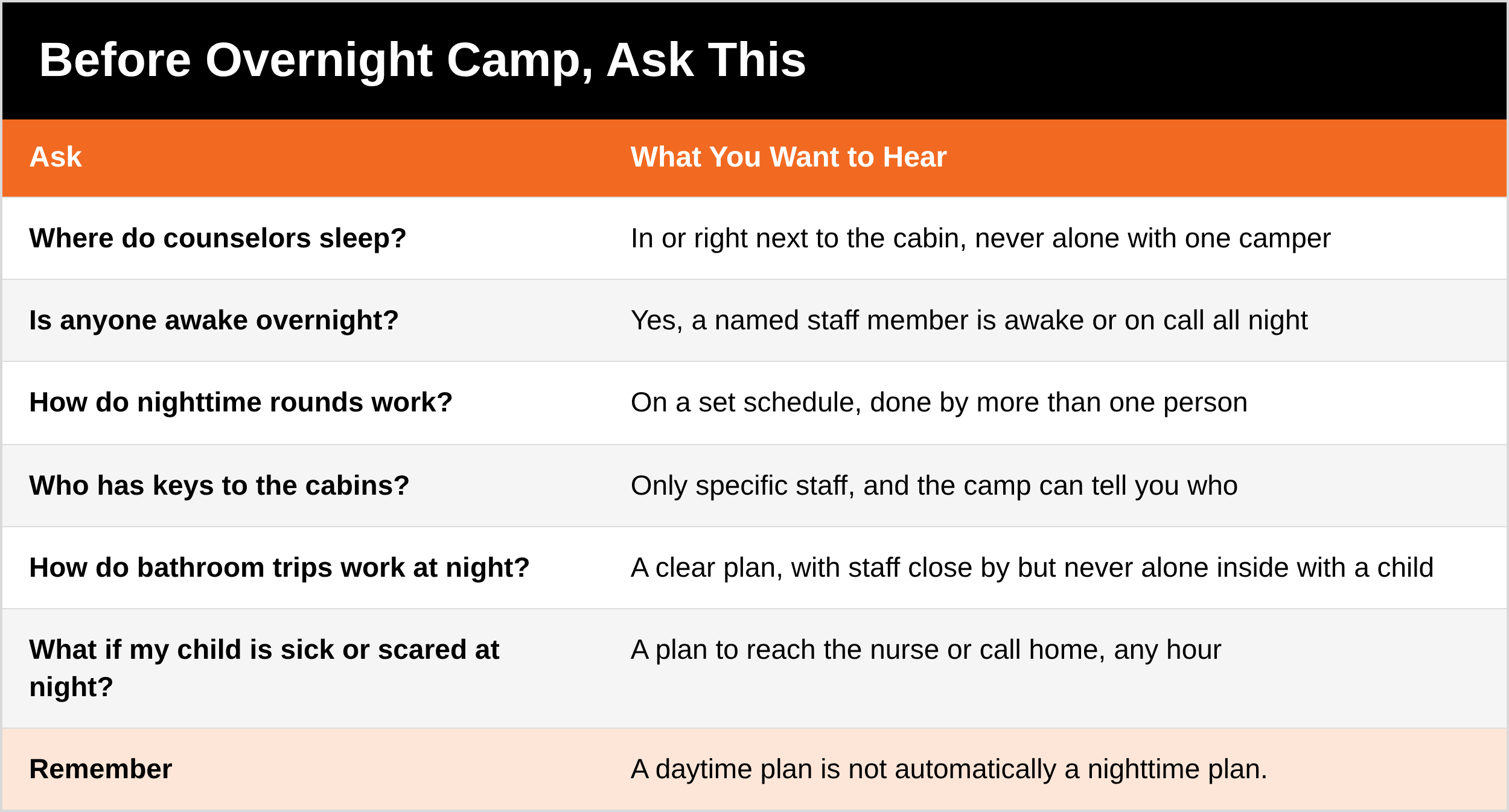
A daytime plan is not automatically a nighttime plan. For overnight camps, ask:
Where do counselors sleep in relation to campers?
Is anyone awake and monitoring overnight?
How do nighttime rounds work?
Who has keys to the cabins?
How do bathroom trips work after lights out?
What happens if a child gets sick, scared, or wants to call home at night?
Also talk with your child about privacy, changing, and what to do if another camper or an adult comes into their space or makes them uncomfortable. We'll cover the exact words to use in Part 4.
Phones, Photos, and Private Contact
Phones have changed the game. An adult doesn't need to get your child alone in a room anymore. They can get your child alone in a text thread.
Staff should never:
Privately message campers
Use disappearing-message apps with campers
Connect with campers on personal social media accounts
Keep up a private relationship after camp without the parents involved
Ask whether staff can use personal phones around campers, who's allowed to photograph kids, where photos are stored, and who posts them.
Here's something new to think about. Camp photos posted publicly can be copied and misused. Today, an ordinary photo of a child can be altered with AI into something harmful. That's a good reason to ask about the camp's photo policy and to opt out of public posting if you're not comfortable. If an image of your child is ever misused, NCMEC's free Take It Down service can help get it removed. I cover AI-altered images and sextortion in Who's Talking to Your Kids? Part 2.
Teach your child: no private online contact with a counselor or older camper, ever, without you knowing about it.
Pickup, Visitors, and Custody
Access isn't only about staff. It's also about who can walk in, and who can walk out with your child.
Give the camp a list of every person allowed to pick up your child, and anyone who is not allowed
Provide current court documents if custody or a protective order affects pickup
Ask how the camp checks ID at pickup
Ask how same-day changes are verified
A strong camp won't release a child because an adult seems familiar, is persuasive, gets angry, or says "Mom said it was fine." They'll verify it with the contact information already on file.
Ask how visitors, vendors, and guest instructors check in, wear identification, and stay out of areas where children are.
What to Say
"Can you walk me through your screening process for staff, volunteers, and drivers?"
"What's your written rule on one-on-one time between staff and campers?"
"How do you supervise cabins and bathrooms at night?"
"Can staff text or message campers? What about after camp?"
"How do you handle it when one camper is harming another?"
"If I have a concern, who can I report it to outside your chain of command?"
A camp that welcomes these questions is a camp that has thought about them.
Remember: Trust should be backed up by transparency, clear boundaries, and accountability. A good camp shows you all three.
Trust Your Gut
If you leave a conversation with a camp director feeling unsettled, pay attention to that. You don't need proof of a problem to choose a different program. Awareness gives you time. Time gives you options.
5 Quick Wins You Can Start Today
Ask the "everyone" question. "Does your screening apply to drivers, contractors, and volunteers too?"
Ask for the one-on-one rule in writing. If they don't have one, that's your answer.
Check the photo policy. Opt out of public posting if you're not comfortable.
Make your pickup list. Who can pick up your child, who can't, and how the camp verifies changes.
Say the phone rule. "No private messages with a counselor or older camper, ever, without me knowing."
Remember
A background check is a starting point, not a program. Ask who has access to your child, ask for the rules in writing, and trust a camp that welcomes your questions more than one with a great reputation.
Coming Up in Part 3
In Part 3, we'll shift to emergencies: medical care, allergies, water safety, heat, and severe weather. You'll learn why "the camp gets alerts on a phone" isn't a weather plan, and which questions show you whether a camp is truly ready when something goes wrong.
Get Started Today
Get the free Summer Camp Safety Checklist for Parents. Every question from this article is in it. Print it, bring it to your camp tour, and check things off as you go. DM the word [KEYWORD] on Instagram or Facebook and I'll send it to you. [Get it here: LINK]
Go Deeper
The Family Safety Toolkit. It includes the Summer Camp Safety Checklist, the trusted-adults checklist, Family Tech Rules, and 17 more practical checklists. That's 244 pages, for $19.99. [Get it here: LINK]
Coming soon: the Child Safety Manual. The full family guide, with a model staff-boundaries policy to hold any camp's rules up against, an Authorized Pickup and Contact Form, and a step-by-step plan for when a photo of your child is misused.
Tools I recommend: The child safety gear and books I actually recommend are in my Children's Safety Amazon store. https://amzn.to/4hcldVo
The full series:
Summer Camp Safety, Part 1: Who's Really Watching Your Kids? https://www.preparednotparanoid.com/pnp-library/choose-a-safe-summer-camp
Summer Camp Safety, Part 3 [LINK]
Summer Camp Safety, Part 4: Preparing Your Child and the Conversation After Camp [LINK]
Related reading:
The Creepy Coach, Part 1: "Creepy" Is Not a Look. It's a Pattern. [LINK]
The Creepy Coach, Part 2: The Red Flags That Should Stop You Cold [LINK]
Who's Talking to Your Kids? Part 2: Sextortion and AI-Generated Images [LINK]
My Body, My Boundaries, Part 4: Sleepovers, Safe Words, and When Kids Harm Kids https://www.preparednotparanoid.com/pnp-library/sleepover-safety
Child Safety Resource Center [LINK]
References
American Camp Association. Accreditation FAQ. https://www.acacamps.org/node/331
Centers for Disease Control and Prevention. Preventing Child Sexual Abuse Within Youth-Serving Organizations.
U.S. Center for SafeSport. Minor Athlete Abuse Prevention Policies (MAAPP). https://uscenterforsafesport.org/category/maapp-articles/
Praesidium. Abuse-prevention guidance for youth-serving organizations. https://www.praesidiuminc.com/
Wikipedia. Kanakuk Kamps. https://en.wikipedia.org/wiki/Kanakuk_Kamps
Missouri Independent. Kehoe signs into law Missouri bill voiding NDAs in child sex abuse cases (June 10, 2025). https://missouriindependent.com/2025/06/10/kehoe-signs-into-law-missouri-bill-voiding-ndas-in-child-sex-abuse-cases/
National Center for Missing & Exploited Children. Take It Down. https://takeitdown.ncmec.org/
Disclaimer
This article is for general informational and educational purposes only. It is designed to help families recognize warning signs and start important conversations. It is not a substitute for professional advice, training, or services, including legal, medical, mental health, or law enforcement guidance. No safety plan, checklist, or training can guarantee 100% protection. Laws and reporting requirements vary by state and change over time, so check your state and county for the exact rules where you live. Prepared Not Paranoid and Larry Betz are not responsible for the content of third-party websites or resources linked here and make no guarantee of their accuracy or completeness. Affiliate disclosure: I've linked to products from my Amazon store that I personally recommend. As an Amazon Associate, I earn from qualifying purchases, at no extra cost to you. Thank you for supporting my work.
If you suspect a child is being abused, contact local law enforcement, your state's child protective services, or the Childhelp National Child Abuse Hotline at 1-800-422-4453 (call or text) right away. If a child is in immediate danger, call 911.
Awareness gives you time. Time gives you options.
The Prepared Protector is someone who's decided that loving someone means being ready for them, not just hoping things go fine.
Prepared Not Paranoid. Protecting the Most Vulnerable Among Us.