Fire Extinguishers, Fire Blankets, and Escape Ladders
By Larry Betz | Prepared Not Paranoid https://www.preparednotparanoid.com/
Updated November 9, 2026
A fire extinguisher only helps if it's the right type, within reach, and in trained hands. Here's how to choose, place, and use yours, plus the fires an extinguisher can't stop.
In Part 1, we covered smoke alarms and carbon monoxide detectors, the tools that warn you. This part is about the tools that help you respond: fire extinguishers, fire blankets, and a second way out.
A working fire extinguisher is one of the most important, affordable, and overlooked tools in your home safety plan. It can stop a small fire before it becomes a life-altering disaster. But only if you have the right type, it's within reach, and you know how to use it.
Fire Extinguishers: Know What You Need
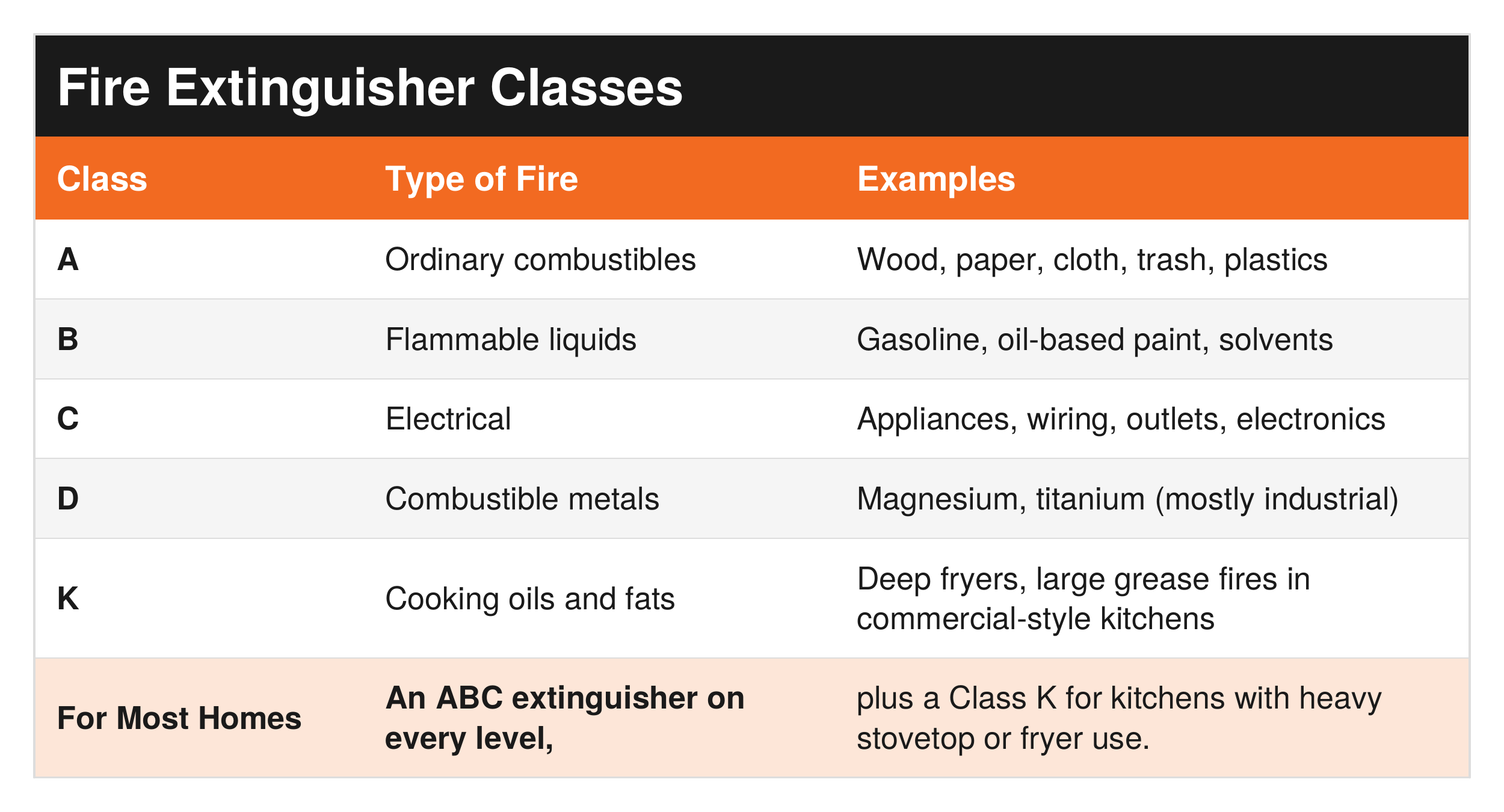
Fire extinguishers are rated by class, based on the type of fire they're designed to put out. Many home extinguishers cover more than one class.
Class A: Ordinary combustibles like wood, paper, cloth, trash, and many plastics
Class B: Flammable liquids like gasoline, oil-based paint, and solvents
Class C: Electrical fires in appliances, wiring, and outlets
Class D: Combustible metals (mostly found in industrial settings)
Class K: Cooking oils and fats, like a deep fryer
Recommendation: For most homes, keep ABC extinguishers in multiple key locations, and consider a Class K extinguisher for kitchens with heavy stovetop or fryer use.
Never use water on a grease fire. It can make burning oil explode outward.
Best Places to Keep a Fire Extinguisher in Your Home
To be effective, extinguishers need to be:
Visible
Reachable within seconds
Mounted or placed near, but not right next to, likely fire sources
Recommended placement:
Kitchen: Mount near an exit, not directly above or next to the stove
Garage: Near workbenches, gas cans, or tool areas
Laundry room: Especially if you have a gas dryer
Hallways: Outside bedrooms and living areas
Near fireplaces or wood stoves
Every level of your home, including the basement
Pro Tip: In a fire, you want to grab the extinguisher with a clear escape route behind you. Never place it in a dead end or a cornered space.
Fire Extinguisher Maintenance
Check the pressure gauge monthly. The needle should be in the green zone.
Shake or flip dry chemical extinguishers a couple of times a year to keep the powder from settling and packing.
Replace or recharge after every use, even a partial one.
Professional maintenance: Rechargeable extinguishers should be serviced about every 6 years.
Replace disposable extinguishers about every 12 years, or sooner if damaged, even if never used. Check the date on the label.
Vehicle Fire Extinguishers
A 2.5 lb. ABC-rated extinguisher is a common recommendation for cars and trucks.
Mount it securely within easy reach, like under the driver's seat or in the cargo area. A loose extinguisher can roll, get damaged, or lose its safety pin.
Check the pressure gauge monthly.
Replace it after any use, or if it's damaged.
Heat and Fire Extinguishers in Vehicles
Here in Arizona, this matters.
Pressure concerns:
Most portable fire extinguishers (dry chemical, CO2, clean agent) are stored under pressure, typically around 100 to 195 psi.
Heat makes the gas inside expand, raising the internal pressure.
Many extinguishers are rated for storage only up to about 120°F. Check the temperature range printed on the label.
A closed car in an Arizona summer can easily top 150°F inside, well beyond that range.
Risks:
Pressure relief: If it gets hot enough, the extinguisher may vent through its safety valve, leaving it useless when you need it.
Seal and hose damage: Rubber and plastic parts break down faster in extreme heat.
Powder caking: Repeated heat cycles can cause dry chemical powder to clump, reducing effectiveness.
Best practices for extreme summer heat:
Choose the right model: Look for one rated and listed for vehicle use, and check the label's temperature range.
Mount it securely, out of direct sunlight: under a seat, in a console, or in a thermal sleeve.
Check it monthly. If the gauge is in the green, you're good. If it's over-pressurized or in the red, replace or service it.
Shake dry chemical units every couple of months.
Expect a shorter service life. Manufacturers note that extreme heat shortens an extinguisher's life, so plan to replace a vehicle extinguisher more often than one kept indoors.
Fire Extinguisher Education: Everyone in the Home Should Know This
Having extinguishers in the right places is only half of it. Knowing how to use one under stress is just as important. In an emergency, there's no time to read instructions. Every adult, and every responsible teenager, in your home should know when to use a fire extinguisher and how to use it.
Use the PASS Method
P: Pull the pin
A: Aim the nozzle at the base of the fire
S: Squeeze the handle
S: Sweep side to side at the base until the fire is out
Walk through these steps out loud with your family. Keep simple instructions near each extinguisher if you can.
When to Use a Fire Extinguisher, and When Not To
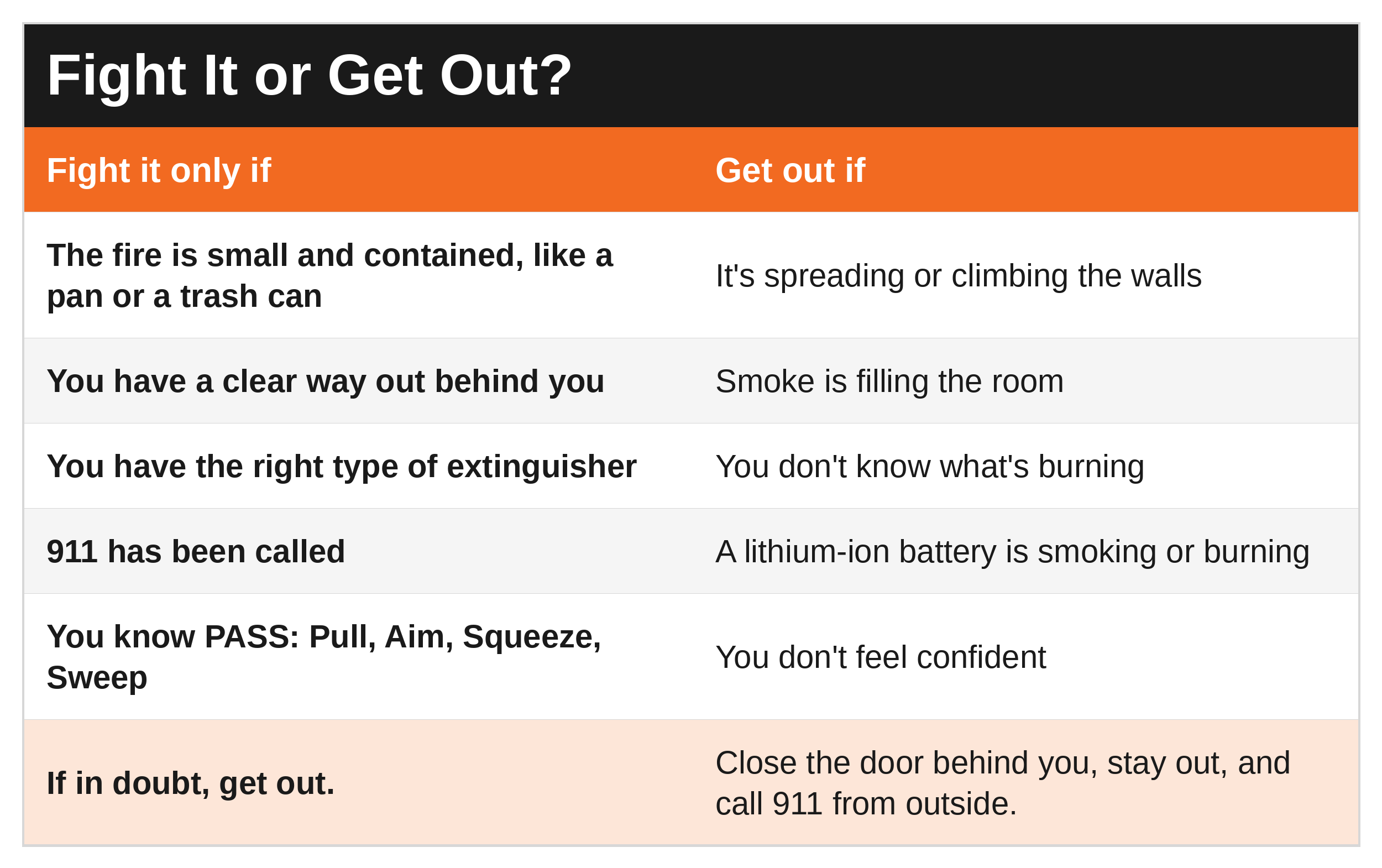
Only try to put out a fire if:
The fire is small and contained (like a trash can or a pan)
You have a clear escape route
You have the right type of extinguisher
911 has been called, by you or someone else
Do not try to fight a fire if:
It's spreading quickly
Smoke is filling the room
You're unsure what's burning (electrical? grease?)
You don't feel confident using the extinguisher
Rule of thumb: If in doubt, get out. Use the extinguisher only to clear your escape route if you have to.
Make Fire Safety a Family Conversation
Walk through where every extinguisher is located
Role-play scenarios, especially in the kitchen
Include extinguisher training in your family emergency plan
Teach kids to get out, stay out, and call 911. Kids should never try to fight a fire themselves.
What to Say to Your Kids
"If you ever see fire or smoke, don't try to put it out and don't stop for toys. Yell 'FIRE!' and get out. Go straight to our meeting spot. Grown-ups handle the fire extinguisher."
Lithium-Ion Battery Fires: When an Extinguisher Won't Work
E-bikes, scooters, hoverboards, power tool batteries, and even phone chargers run on lithium-ion batteries. When one fails, it can go into thermal runaway, a chain reaction where the battery keeps heating itself and releases flammable, toxic gas. These fires grow fast and can flare back up after they look like they're out.
The U.S. Consumer Product Safety Commission (CPSC) knew of 19 deaths from e-bike, e-scooter, and hoverboard fires from January 2021 through November 2022. Fire officials warn that a regular home extinguisher won't put out a battery in thermal runaway.
If a battery is smoking, popping, or hissing, get out. Close the door behind you and call 911 from outside.
Stay with it while it charges. Don't charge e-bikes or scooters overnight or while you're away, and use only the charger that came with it.
Charge away from your exits. Never charge in a hallway or by the front door, where a fire could block your way out.
Buy certified. Look for UL 2849 on e-bikes and UL 2272 on scooters and hoverboards.
Never put old batteries in the trash. Take them to a battery recycler. Call2Recycle.org can help you find one.
Fire Blankets: Fast, Simple Fire Suppression
Fire extinguishers are essential, but they're not ideal for every person or every situation. That's where a fire blanket, like the Prepared Hero Fire Blanket, comes in. Fire blankets are compact, easy to use, and give you a non-toxic, mess-free way to smother a small fire fast.
What Is a Fire Blanket?
A fire blanket is made of fire-resistant fiberglass designed to cut off a fire's oxygen and smother the flames. It's especially useful for:
Kitchen fires (a small grease or stovetop fire)
Trash can fires
Clothing fires
Candle or small appliance mishaps
Unlike an extinguisher, a fire blanket doesn't leave a cloud of chemical powder to clean up, and it has no pressure gauge to check. Inspect the pouch from time to time, and replace the blanket after any use.
Why the Prepared Hero Fire Blanket?
It's a compact, budget-friendly option that's:
Built from heat-resistant fiberglass (check the package for its rating)
Simple enough for kids, seniors, or anyone who's panicking
Easy to store near your stove, grill, or toolbox
Usable to wrap a person whose clothing has caught fire
It's a great first-response tool. It doesn't replace a fire extinguisher. It complements one. You'll find the fire blanket I recommend in my Safest House on the Block Amazon store.
Where to Keep Fire Blankets
Kitchen: In a visible spot, within arm's reach of the stove, but not directly above it
Garage or workshop: Near tools, batteries, or flammables
Near fireplaces or space heaters
Emergency kits or go bags: They're lightweight and portable
Bonus: In a pinch, a fire blanket can also be held up as a shield while you get out of a room with flames or intense heat.
How to Use a Fire Blanket
Pull down on the tabs to release it from the pouch.
Hold it in front of you as a shield, with your hands protected behind it.
Gently lay it over the fire. Don't throw it or flap it.
Turn off the heat source if it's safe to do so.
Leave it in place until the blanket and the fire are completely cool.
If someone's clothing catches fire: Stop, drop, and roll first, then wrap them in the blanket to smother the flames.
Second Way Out: Emergency Escape Ladders
A fire can block your main exit, like a hallway or stairwell, within seconds. An emergency escape ladder gives you a critical second way out, especially from upper floors.
Where to Keep Them
Put a ladder in every upper-floor bedroom, not just one per floor.
Store it where it's quick and easy to reach:
Under the bed
Inside the closet
Mounted on the wall near the window
Avoid attics or cluttered storage. Speed matters.
When to Use Them
Only when your main exit is blocked by smoke, heat, or flames.
Make sure the window opens fully and the ground below is clear (no obstacles, sharp fences, etc.).
It's not for convenience. It's for life-threatening situations.
Teach Your Family How to Use It
Practice setting up the ladder with your family, especially the kids.
Run a fire drill that includes opening the window and positioning the ladder.
Practice from a ground-floor window for safety, focusing on calm, deliberate movements.
Remind everyone: Once you're out, stay out. Never go back into a burning building.
Pro Tips
Use glow-in-the-dark tape or labels so the ladder is easy to find in the dark or in smoke.
Attach a laminated instruction tag to the ladder.
Show guests and babysitters where the ladder is and how to use it.
The Prepared Protector puts the right tool in reach, and knows when to drop it. Put an ABC extinguisher on every level, a fire blanket by the stove, and an escape ladder in every upper-floor bedroom. Walk your family through PASS and the ladder at least once. If the fire is growing or a battery is smoking, nobody fights it. Everyone gets out. The free Family Fire Escape Plan Worksheet helps you mark where every extinguisher, blanket, and ladder lives, and who grabs what.
Ask Yourself
Do I have an extinguisher on every level, and does everyone know where it is?
Could my teenager walk me through PASS right now?
If the hallway were full of smoke, how would each person get out of their bedroom?
Is anything with a lithium-ion battery charging overnight in my home?
Remember
The right tool, in the right place, in trained hands. If a fire is growing, forget the tools. Get out, stay out, and call 911.
Coming Up in Part 3: Your Escape Plan, the Knox Box, and Calling 911
In Part 3, we'll build your family's fire escape plan, cover what a Knox Box is and why firefighters love them, and walk through exactly what to say when you call 911.
Next in the series: Home Fire Safety Essentials- Part 3: Your Escape Plan, the Knox Box, and Calling 911
Get Started Today
Get the free Family Fire Escape Plan Worksheet. Map two ways out of every room, assign roles, choose your meeting spot, and log your fire drills, all on one printable worksheet. Get it free here
Quick Answers
What type of fire extinguisher do I need for my home?
For most homes, an ABC extinguisher on every level covers ordinary combustibles, flammable liquids, and electrical fires. Add a Class K for kitchens with heavy stovetop or fryer use. Keep each one visible, reachable within seconds, and near (but not right next to) likely fire sources.
How do you use a fire extinguisher?
Use the PASS method: Pull the pin, Aim the nozzle at the base of the fire, Squeeze the handle, and Sweep side to side at the base until it's out. Only fight a fire that's small and contained, when you have a clear way out behind you and the right type of extinguisher. If in doubt, get out.
Can a fire extinguisher put out a lithium-ion battery fire?
Fire officials warn that a regular home extinguisher won't put out a battery in thermal runaway. If an e-bike, scooter, or other battery is smoking, popping, or hissing, get out, close the door behind you, and call 911 from outside. Don't charge e-bikes or scooters overnight or while you're away.
Do I need an escape ladder for an upstairs bedroom?
A fire can block a hallway or stairwell within seconds, so put an escape ladder in every upper-floor bedroom, not just one per floor. Store it under the bed or in the closet, and practice setting it up from a ground-floor window. Mark where every ladder, extinguisher, and blanket lives on the free Family Fire Escape Plan Worksheet.
Go Deeper
Home Fire Safety Essentials. My complete family fire safety guide, with Parts 1 to 5 in one place, the Family Fire Escape Plan, and everything you need to know about CO alarms. Get it here
Coming soon: The Safest House on the Block is my complete home security manual, with a full chapter on Home Fire Safety Essentials plus doors, locks, cameras, and a full home security audit.
The Family Safety Toolkit. 20 ready-to-use checklists for kids, travel, home, and emergencies.
Coming soon: The Family Readiness Binder. Your family's emergency information, medical details, contacts, and plans, organized and ready before you need them, in an Essential and a Full edition.
Tools I recommend: You'll find the fire extinguishers, fire blankets, and escape ladders I recommend in my Safest House on the Block Amazon store, including my fire extinguisher picks.
The Full Series
Home Fire Safety Essentials- Part 1: Smoke Alarms and CO Detectors
Home Fire Safety Essentials- Part 2: Fire Extinguishers, Fire Blankets, and Escape Ladders (you are here)
Home Fire Safety Essentials- Part 3: Your Escape Plan, the Knox Box, and Calling 911
Home Fire Safety Essentials- Part 4: Fire Prevention: Stop Fires Before They Start
Related Reading
The Safest House on the Block- Part 8: Windows, Sliding Doors, and Security Film
The Safest House on the Block- Part 11: Making a Home Security Plan
Emergency Preparedness- Start Here: You Are Your Own First Responder
References
National Fire Protection Association, Fire Extinguisher Use and Placement and NFPA 10 (Standard for Portable Fire Extinguishers): https://www.nfpa.org
U.S. Fire Administration, Choosing and Using Fire Extinguishers: https://www.usfa.fema.gov/prevention/home-fires/prepare-for-fire/fire-extinguishers/
NFPA, Cooking Safety Tips: https://www.nfpa.org/education-and-research/home-fire-safety/cooking
U.S. Consumer Product Safety Commission, E-Scooter and E-Bike Injuries Soar: 2022 Injuries Increased Nearly 21%: https://www.cpsc.gov/Newsroom/News-Releases/2024/E-Scooter-and-E-Bike-Injuries-Soar-2022-Injuries-Increased-Nearly-21
Disclaimer
These suggestions are intended to help you and your family build awareness, confidence, and safer decision-making habits. No safety plan, checklist, or training can guarantee 100% protection. The goal is not to create fear, but to help guide families toward more informed, prepared, and practical safety decisions in everyday life. As an Amazon Associate, I earn from qualifying purchases. Product mentions reflect my own experience.
This article is for general informational and educational purposes only. It is not a substitute for training from your local fire department or the manufacturer's instructions. Always follow the label and manual for your specific extinguisher, fire blanket, or ladder. Fire codes vary by location, so check the rules in your state and county. Never risk your safety to fight a fire.
If a fire is growing, smoke is filling the room, or a battery is smoking, get out and call 911 from outside.
Awareness gives you time. Time gives you options.
The Prepared Protector is someone who's decided that loving someone means being ready for them, not just hoping things go fine.
Prepared Not Paranoid. Protecting the Most Vulnerable Among Us.