Your Home Fire Escape Plan, the Knox Box, and Calling 911
By Larry Betz | Prepared Not Paranoid https://www.preparednotparanoid.com/
Updated November 9, 2026
Your alarms and extinguishers buy you time. Your escape plan is what you do with it. Here's how to build one your family will actually remember, and practice it until it's automatic.
In Parts 1 and 2, we covered the gear: smoke and CO alarms, fire extinguishers, fire blankets, and escape ladders. But all the fire safety gear in the world won't help if your family doesn't know what to do when the alarm goes off.
Fires move fast. Today's synthetic furnishings and open floor plans mean that, according to the NFPA, you may have as little as two minutes to get out once the smoke alarm sounds.
One of the biggest lessons from my years as a Safety Director in the elevator industry: under stress, people don't rise to the occasion. They fall back on what they've practiced. Your family is no different. Most families haven't practiced at all. According to an NFPA survey, only one in three American households has made and practiced a home fire escape plan, and only 8% said their first thought on hearing a smoke alarm would be to get out. A well-rehearsed escape plan means everyone reacts quickly and confidently instead of freezing.
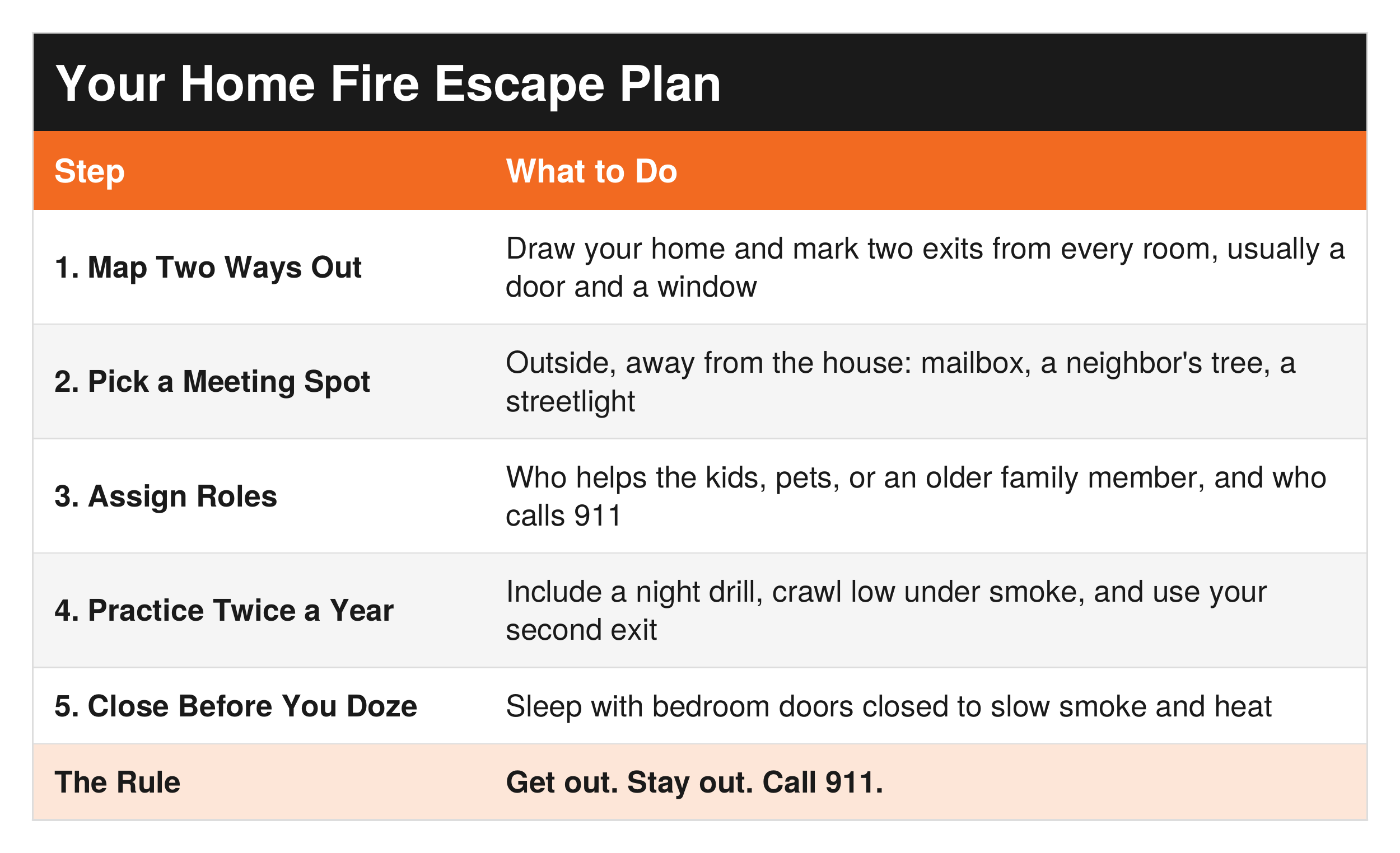
Create and Practice a Home Fire Escape Plan
Step 1: Map Two Ways Out
Draw a simple floor plan of your home showing every room, window, door, and possible exit. (The free worksheet linked at the end of this post has a grid for this.)
Mark two ways out of every room, usually a door and a window.
Make sure windows open easily from the inside, and that everyone knows how to open them.
The whole family should practice opening emergency escape windows, especially in the bedrooms. Check that screens and security bars have quick-release latches.
Step 2: Pick a Safe Meeting Spot
Choose a spot outside and away from the house where everyone will gather, like the mailbox, a neighbor's tree, or a streetlight.
Make sure it's visible, safe, and easy to reach.
The meeting spot is how you'll know, fast, who's out and who isn't.
Step 3: Assign Roles
Parents or adults: Account for the kids, pets, and any older or less mobile family members.
Older kids: Can help younger siblings get out, or call 911 once they're safely outside.
Everyone knows the rule: Never go back inside, for any reason. Tell firefighters if someone is missing.
Step 4: Practice the Plan, at Least Twice a Year
Run full fire drills, including at night and in bad weather.
Practice crawling low under smoke. The cleaner, cooler air is near the floor.
Practice the "back of the hand" door check: if a door, doorknob, or the crack around it is hot, use your second way out.
Simulate a blocked exit and use your second route.
Time it. Can everyone get out in under two minutes? Make it a challenge for the kids with a stopwatch, role-play, or a sticker chart.
Step 5: Close Before You Doze
Research from UL's Fire Safety Research Institute shows that a closed bedroom door can hold back smoke, heat, and flames and buy precious time. Sleep with bedroom doors closed. If you're trapped, keep the door closed, stuff towels or clothing in the gap, and signal from the window.
Important Message for Kids: Don't Hide. Get Outside.
Read this part to your kids, in your own words:
If there's ever a fire in our home, it's very important that you don't hide. Fires can be scary, and your first thought might be to hide under the bed or in a closet. But that makes it harder for firefighters to find you and help you. Instead, remember this: get out and stay out. Get outside as fast and as safely as you can, and go to our meeting spot.
If you see a firefighter in full gear, with a helmet, a mask, and a big jacket, they might look and sound a little scary. Don't be afraid. They're there to help you and keep you safe. Even if they're crawling or calling your name through their mask, go to them. They're heroes doing their job.
Make it real: Many fire departments will let kids meet a firefighter in full gear. Ask your local station. Seeing it once, calmly, takes the fear away.
Don't Forget: The Details That Make a Plan Work
A plan on paper is a good start. These are the details families most often miss.
Kids Who Sleep Through the Alarm
Many children don't wake up to a standard smoke alarm, especially younger kids in deep sleep. Don't assume they will.
Assign an adult to each child who may need help waking up and getting out.
Test it: during a planned night drill, see who wakes up on their own.
Consider a voice alarm that lets you record your own voice. Research has found many children respond better to a parent's voice than to a standard beeping tone. We covered that study in Part 1.
Family Members With Special Needs
If someone in your home has limited mobility, uses a wheelchair or walker, is hard of hearing, or is an aging parent:
Have them sleep on the ground floor, close to an exit, if possible.
Hard of hearing? Use smoke alarms with strobe lights and bed shakers.
Keep mobility aids, glasses, and hearing aids right next to the bed.
Assign a helper in the plan, and practice with them.
Let your local fire department know if someone in your home will need help getting out. Some departments keep a voluntary record for emergencies.
Pets
Never go back inside for a pet.
Include pets in your plan: who grabs the pet carrier or leash, only if it's safe on the way out.
Tell firefighters where your pet was last seen. They'll look.
The Bedside "Grab Spot"
Keep these right next to every bed so no one has to search in the dark:
Phone
Glasses (or contacts case)
Shoes
A flashlight
Car keys
Then teach the rule: grab only what's within arm's reach. Don't stop for anything else.
Babysitters, Grandparents, and Overnight Guests
Walk them through your plan the first time they stay: two ways out of their room, where the ladder is, and the meeting spot.
Leave your address and the plan posted on the fridge for babysitters, so they can tell 911 exactly where they are.
After the Fire
Getting out is the most important part, but have a plan for what comes next:
Where will your family stay? Agree on a relative, friend, or hotel ahead of time.
Out-of-area contact: Pick one person everyone checks in with.
Your home inventory and important papers: Keep copies of IDs, insurance policies, and your home inventory in a fireproof safe, and backed up off-site or in the cloud. It makes the insurance process far easier.
Put it all on paper. My free Family Fire Escape Plan Worksheet walks you through every step: your floor plan, two ways out of each room, roles, your meeting spot, special needs, and a drill log. Get it here: Family Fire Escape Plan Worksheet
The Knox Box: Secure Emergency Access for First Responders
A Knox Box (the residential version is called the Knox HomeBox) is a heavy-duty, wall-mounted lockbox that holds a key to your home. Only your local fire department, or authorized EMS, holds the master key. That lets responders get inside during an emergency without breaking down your door.
Why It's Important
Faster entry: Seconds count in a fire or medical emergency.
Less property damage: No forced entry means no broken doors or locks.
Critical for seniors and people with special needs: It's ideal for anyone who may not be able to get to the door, like an aging parent living alone.
Security Considerations
Controlled access: Fire departments keep master keys under strict security.
Tamper-resistant: Made from hardened steel and designed to resist break-ins.
Placement matters: Mount it where responders can find it, but not where it stands out to every passerby.
Best Placement
Near your main entry, but not in plain view from the street.
About 4 to 6 feet off the ground for easy access by responders.
Bolted securely into masonry, brick, or another solid surface.
Coordinate With Your Fire Department
Call your local fire department before you buy or install one. Not every department participates, and those that do may have placement requirements or approved models.
Keep the key inside updated if you ever change your locks.
Calling 911 and Marking Your Home Clearly
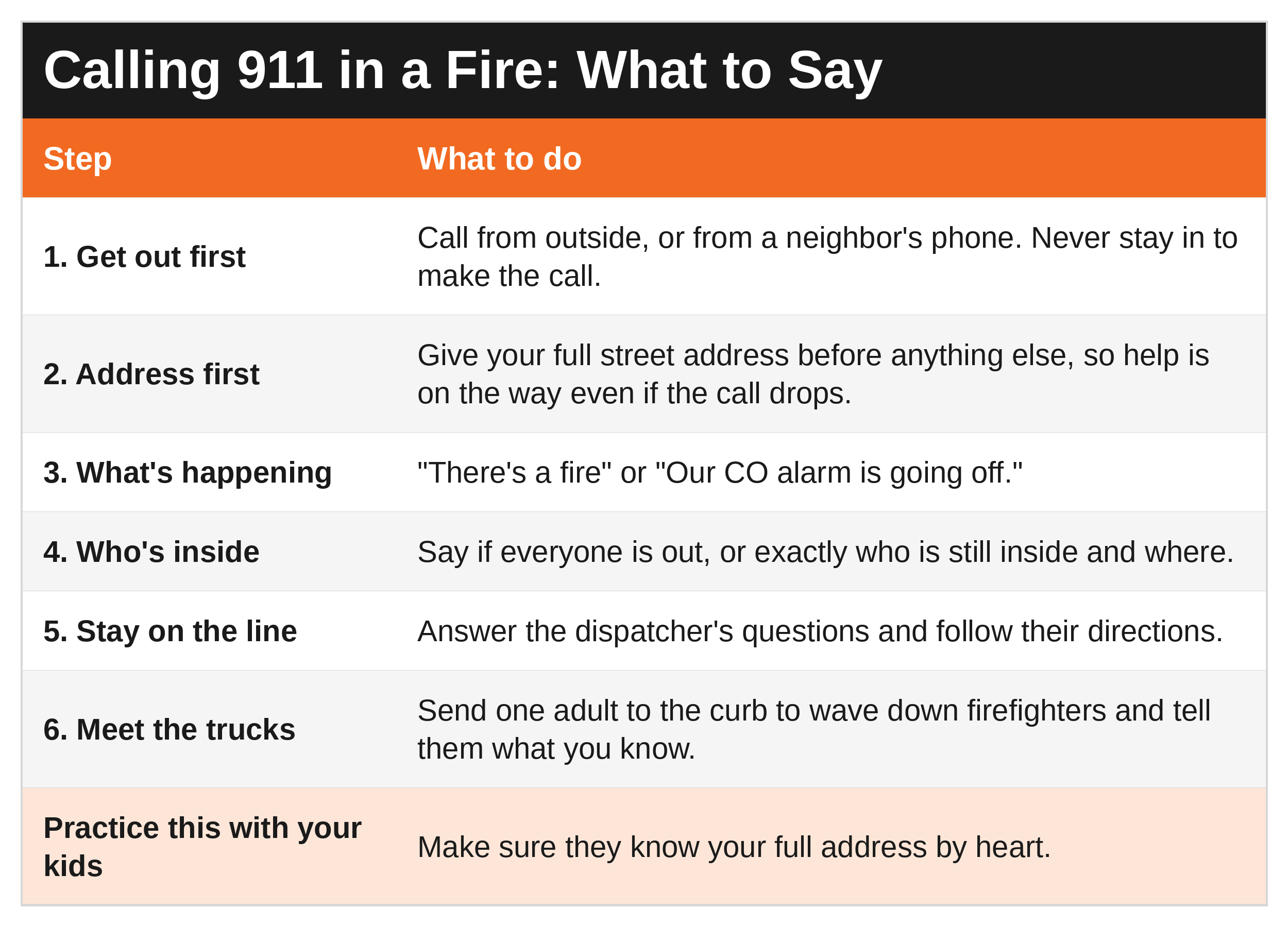
Call 911 immediately in any fire or life-threatening emergency, from outside the home. Give your address first, then the nature of the emergency.
Teach everyone in your home, including older children, how to make the call and what to say.
Clearly mark your home. House numbers should be large, reflective, and visible from the street, day and night.
Clear, visible numbers help the fire department and EMS find you fast, especially at night or in smoke.
What to Say When You Call 911
Practice this with your kids:
"There's a fire at [your full address]. Everyone is out of the house." (Or: "My mom is still inside.")
“Our carbon monoxide alarm is going off at [your full address]. Everyone is outside.”
Then stay on the line and do what the dispatcher tells you.
Pro Tip: A Knox Box paired with a well-practiced escape plan gives first responders the best possible chance to protect lives and property, even if you can't get to the door yourself.
The Prepared Protector practices the plan before the alarm ever sounds. Map two ways out of every room, pick a meeting spot, and give every adult a job, including who wakes the kids and who helps Grandma. Then run the drill at night, twice a year, until everyone can get out in under two minutes without thinking about it. The free Family Fire Escape Plan Worksheet puts your two ways out, your meeting spot, and every adult's job on one page.
Ask Yourself
Does every person in my home know two ways out of their bedroom?
When was the last time we actually practiced, at night?
Could a fire truck find my house numbers in the dark?
Do my kids know our full address well enough to tell 911?
Remember
Fire safety doesn't have to be complicated. With the right tools, a little preparation, and regular practice, you can protect your home and the people you love. Most fires are preventable. When one does happen, being prepared makes all the difference. Teach your family, check your equipment, and review your plan.
Coming Up in Part 4: Fire Prevention: Stop Fires Before They Start
In Part 4, we'll walk through your home room by room and fix the most common fire hazards before they ever start, from the stove and space heaters to the dryer and the chargers.
Next in the series: Home Fire Safety Essentials- Part 4: Fire Prevention: Stop Fires Before They Start
Get Started Today
Get the free Family Fire Escape Plan Worksheet. Map two ways out of every room, assign roles, choose your meeting spot, and log your fire drills, all on one printable worksheet. Get it free here
Quick Answers
How do I make a fire escape plan for my house?
Draw a simple floor plan and mark two ways out of every room, usually a door and a window. Pick a meeting spot outside and away from the house, like the mailbox or a streetlight. Give every adult a job, then practice at least twice a year, including at night.
What should a household fire escape plan include?
Two ways out of every room, a safe meeting spot, roles for who helps the kids, pets, and older family members, and who calls 911. Add the details families often miss: an adult assigned to each child who may sleep through the alarm, a bedside grab spot with a phone, glasses, shoes, and a flashlight, and where everyone will stay afterward. The rule never changes: get out, stay out, call 911.
Is there a home fire safety plan template I can use?
Yes. The free Family Fire Escape Plan Worksheet has a grid for your floor plan, two ways out of each room, roles, your meeting spot, special needs, and a drill log, all on one printable page. Post it on the fridge so babysitters and guests can follow it too.
How often should a family practice a fire escape plan?
At least twice a year, including a night drill and a drill with a blocked exit so everyone uses their second way out. Practice crawling low under smoke and checking doors with the back of your hand. Time it, and work toward everyone getting out in under two minutes.
Go Deeper
Home Fire Safety Essentials. My complete family fire safety guide, with Parts 1 to 5 in one place, the Family Fire Escape Plan, and everything you need to know about CO alarms. Get it here
Coming soon: The Safest House on the Block is my complete home security manual, with a full chapter on Home Fire Safety Essentials plus doors, locks, cameras, choosing the best available secure area, and a full home security audit.
For a complete guide to building a safe room, The Home Security Bible is coming in 2027.
The Family Safety Toolkit. 20 ready-to-use checklists for kids, travel, home, and emergencies.
Coming soon: The Family Readiness Binder. Your family's emergency information, medical details, contacts, and plans, organized and ready before you need them, in an Essential and a Full edition.
Tools I recommend: You'll find the escape ladders, reflective house numbers, smoke alarms, and fire safety gear I recommend in my Safest House on the Block Amazon store.
The Full Series
Home Fire Safety Essentials- Part 1: Smoke Alarms and CO Detectors
Home Fire Safety Essentials- Part 2: Fire Extinguishers, Fire Blankets, and Escape Ladders
Home Fire Safety Essentials- Part 3: Your Escape Plan, the Knox Box, and Calling 911 (you are here)
Home Fire Safety Essentials- Part 4: Fire Prevention: Stop Fires Before They Start
Related Reading
Emergency Preparedness- Start Here: You Are Your Own First Responder
Go Bag and Emergency Bug-Out Bag- Part 2: Preparing to Leave Your Home
The Safest House on the Block- Part 11: Making a Home Security Plan
References
National Fire Protection Association, Escape Planning: https://www.nfpa.org/education-and-research/home-fire-safety/escape-planning
UL Fire Safety Research Institute, Close Your Door: https://closeyourdoor.org
U.S. Fire Administration, Home Fire Escape Plans: https://www.usfa.fema.gov/prevention/home-fires/prepare-for-fire/escape-plans/
Knox Company, Knox HomeBox residential key box: https://www.knoxbox.com
Smith, G. A., Splaingard, M., Hayes, J. R., & Xiang, H. (2006). Comparison of a personalized parent voice smoke alarm with a conventional residential tone smoke alarm for awakening children. Pediatrics, 118(4), 1623-1632. https://doi.org/10.1542/peds.2006-0125
Disclaimer
These suggestions are intended to help you and your family build awareness, confidence, and safer decision-making habits. No safety plan, checklist, or training can guarantee 100% protection. The goal is not to create fear, but to help guide families toward more informed, prepared, and practical safety decisions in everyday life. As an Amazon Associate, I earn from qualifying purchases. Product mentions reflect my own experience.
This article is for general informational and educational purposes only. It is not a substitute for guidance from your local fire department. Escape plans should fit your home, your family, and any special needs in your household. Knox Box programs and fire codes vary by location, so check the rules in your state and county.
In a fire, get out, stay out, and call 911 from outside.
Awareness gives you time. Time gives you options.
The Prepared Protector is someone who's decided that loving someone means being ready for them, not just hoping things go fine.
Prepared Not Paranoid. Protecting the Most Vulnerable Among Us.