What to Buy First, What to Add Next, and How to Build a Space You'll Actually Use
By Larry Betz | Prepared Not Paranoid https://www.preparednotparanoid.com/
Updated November 8, 2026
Most home gyms fail the same way. Someone gets motivated, buys a big machine or a pile of equipment, and six months later it's holding laundry.
I ran gyms for over 20 years, from my first independent gym in Williamsburg, Brooklyn, to a four-story, 17,000-square-foot strength and conditioning facility with a team of 12 trainers. Today I coach clients in my private studio here in Sedona. I've seen what people actually use, and what ends up collecting dust.
The good news: you can reach a high level of fitness with very little home gym equipment. The key is buying the right things in the right order.
Your strength and conditioning are part of being prepared. If you ever have to carry a child, help an aging parent up from a fall, move fast, or push through a long, hard day in an emergency, your body is the first piece of equipment you'll rely on. The U.S. Physical Activity Guidelines recommend muscle-strengthening work for all major muscle groups at least 2 days a week, and a home gym makes that easy to keep up.
Start With Four Questions
If you've decided to dedicate space in your home to a gym, start by asking yourself:
What is my goal?
What is my training experience?
How much space am I willing to dedicate to the gym?
What is my budget to get started?
Your answers decide everything that comes next.
If you're a seasoned gym-goer, you're probably used to a wide variety of commercial equipment and amenities. Unless you have ample space and a significant budget, it will be nearly impossible to copy that experience at home. That's okay. You don't need to.
Home Gym Equipment: What to Buy, in Order
So far in this series, we've covered bodyweight exercises and aerobic training. The first step in adding equipment is resistance bands, and I break down every type in Garage Gym Essentials. From there, the list below runs from the most versatile, cost-effective, and space-saving options to the more specialized, larger, and more expensive ones.
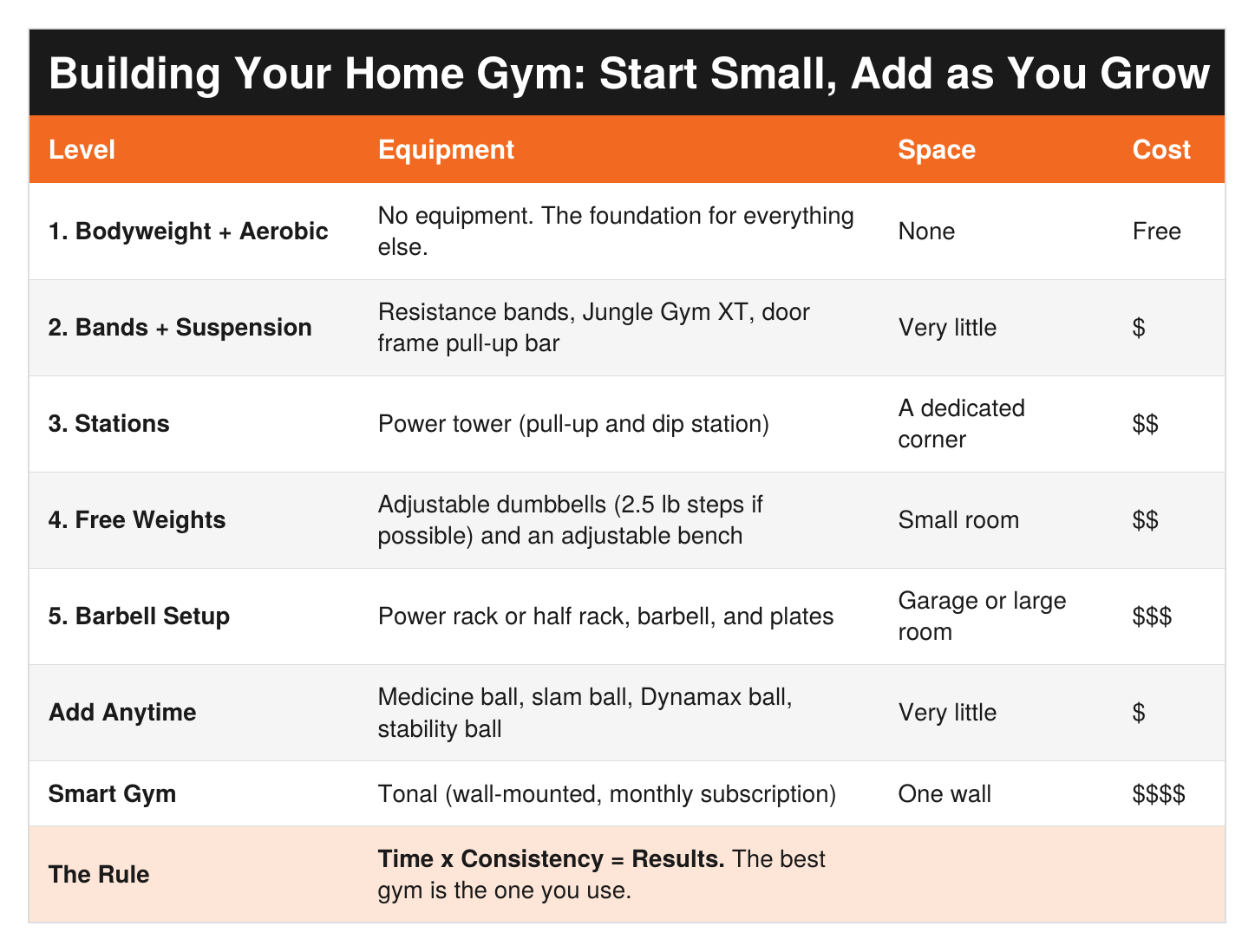
Level 1: Bands, Suspension, and a Pull-Up Bar
Jungle Gym XT (Suspension Trainer)
The Jungle Gym XT from Lifeline Fitness is a versatile, rugged suspension training system built for full bodyweight workouts. It has adjustable straps, durable handles, and foot cradles, so you can do a wide range of exercises that hit every muscle group from different positions.
The dual anchor points let you mount it in all kinds of spaces, like a door frame or a pull-up bar. It's portable and sets up indoors or outdoors, which makes it one of the best strength training tools for the money.
Door Frame Pull-Up Bar
A door frame pull-up bar is compact and convenient. It attaches to most standard door frames without permanent mounting or hardware, using leverage and friction to stay secure.
Most are made from durable steel, support a lot of weight, and offer several grip positions: wide, narrow, and neutral. It's a great tool for building your upper body, and it doubles as an anchor point for resistance bands and the Jungle Gym XT.
Level 2: The Power Tower
A Power Tower (an adjustable-height pull-up and dip station) is the next step. This is a standalone piece of equipment, so it needs a dedicated spot in your home.
It lets you do:
Pull-up variations
Dips
Push-ups with a deeper range of motion
Leg tucks
Band-assisted and band-resisted exercises
One caution: be careful attaching the Jungle Gym XT to a power tower. It can shift during use.
Level 3: Adjustable Dumbbells and a Bench
Adjustable Dumbbell Set
Dumbbells bring big benefits, especially for coordination and exercise variety. Each arm moves on its own and has to stabilize its own weight, which promotes balanced muscle development and better coordination. The number of exercises you can do with a pair of dumbbells is almost endless, which makes them an essential tool for a complete workout.
From my experience as a trainer: depending on your fitness level and any injuries, jumping 5 pounds at a time can be too much. If you have the space and the budget, look for a dumbbell set that increases in 2.5-pound increments. Small jumps keep you progressing without getting hurt.
Adjustable Weight Training Bench
A good adjustable bench is the next piece to add. It opens up a huge range of strength exercises. Look for a backrest that adjusts to flat, incline, and decline positions.
Level 4: The Barbell Setup
This step is a bigger commitment in both space and money: a barbell, plates, and a half rack or power rack.
Power Rack
A power rack (also called a squat rack or power cage) is built for serious strength training. It has a sturdy steel frame with two to four vertical posts connected by horizontal bars, creating a stable, secure structure. Racks can be freestanding or wall-mounted.
Adjustable safety bars and J-hooks let you do squats, bench presses, deadlifts, and overhead presses with added safety, even when you train alone. Many racks also offer add-ons like pull-up bars, dip stations, pulley attachments, and weight storage pegs.
Add Anytime: Medicine Balls, Slam Balls, and Stability Balls
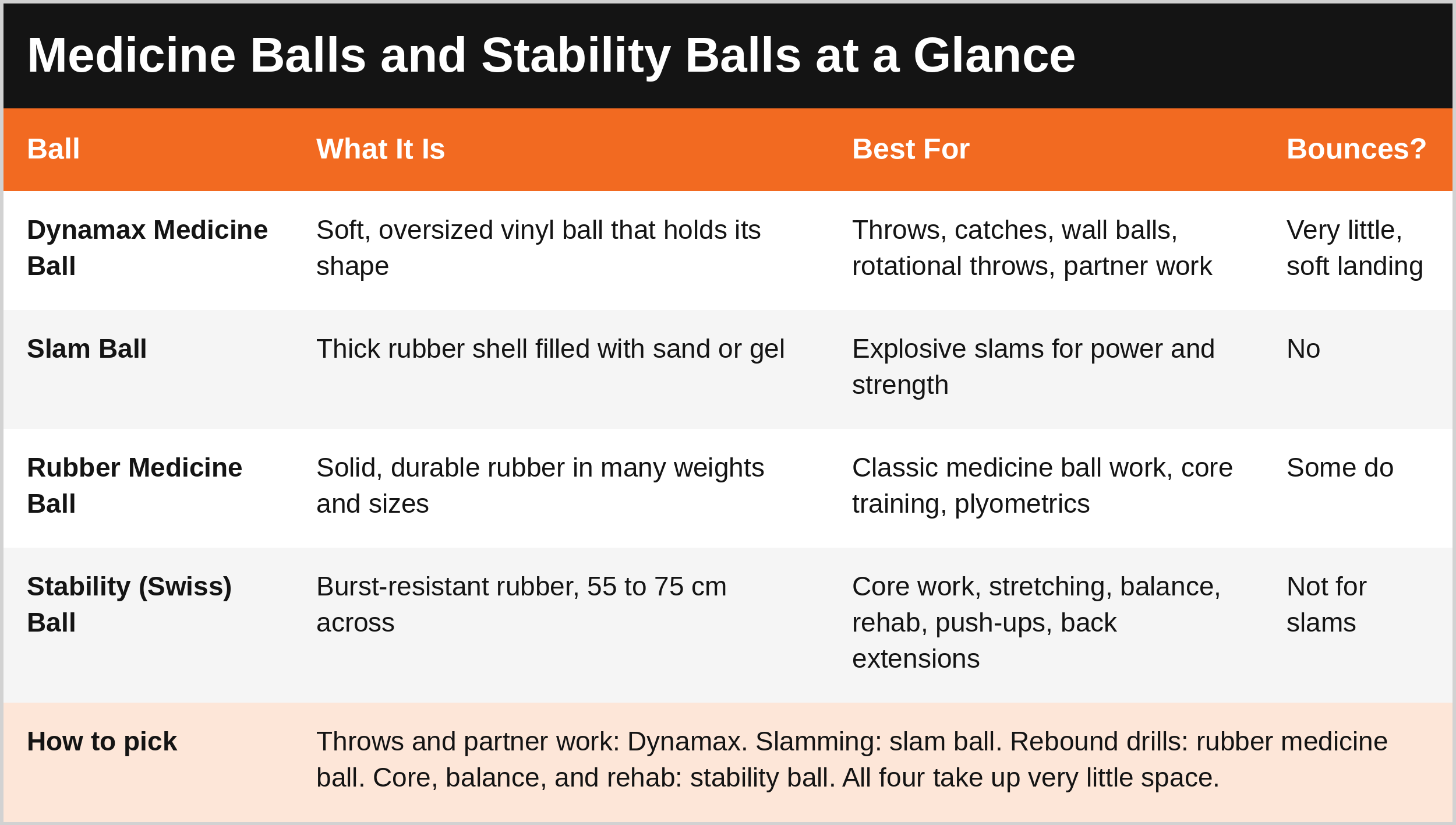
These take up very little space and add power, core, and conditioning work at any level. There are three main types of medicine balls, each built for a different job:
Dynamax Medicine Balls: Soft, oversized balls, usually durable vinyl filled with material that holds their shape. Built for high-intensity throws, catches, and partner work. The cushioned outside safely absorbs impact on exercises like wall balls and rotational throws.
Slam Balls: Rugged, dense balls made to be slammed into the ground. Thick rubber shells filled with sand or gel, so they don't bounce. Perfect for explosive power and strength work, and the dead bounce protects both your floor and the ball.
Rubber Medicine Balls: Solid rubber, durable, and resilient. They come in many weights and sizes and work for traditional medicine ball workouts, core training, and plyometrics. Unlike slam balls, some rubber medicine balls bounce, which makes them useful for rebound and dynamic movements.
Stability (Swiss) Ball
A stability ball is made from durable, burst-resistant rubber, typically 55 to 75 centimeters across. It's great for core work, stretching, balance training, and rehabilitation exercises. It also works as a support for push-ups, sit-ups, and back extensions, which makes it an essential piece for any home gym.
The Smart Gym Option: Tonal
Tonal is an expensive option, but a popular one. It's a wall-mounted home gym that uses digital weight (electromagnetic resistance) instead of plates. It has a touchscreen and adjustable arms that let you do a wide variety of exercises for every muscle group.
Tonal offers personalized programs and real-time feedback, tracking your progress and adjusting the resistance based on your performance. It does require a monthly subscription for its guided workouts, coaching, and software updates. If space is tight and budget isn't, it's an efficient all-in-one setup.
Creating the Environment
The equipment is only half of it. Good flooring, lighting, and ventilation make your space more comfortable, and a comfortable space is one you'll actually use.
Time x Consistency = RESULTS!
Flooring
I recommend good rubber flooring with interlocking sides. In my own home gym I use American Floor Mats Fit-Lock 3/8-inch heavy-duty interlocking rubber tiles (24" x 24"). They've served me well.
I do not recommend "horse stall mats." They can smell, and they drift apart over time and become a nuisance.
Lighting
A well-lit home gym is safer, more enjoyable, and more productive. Good light helps you see your form, your footing, and your equipment.
Fans and Ventilation
Here in Arizona, good ventilation is huge for staying consistent through our hot summers. I have two Big Ass Fans, and they WORK! Do not cheap out on ventilation. If your gym is miserable in July, you won't train in July.
Keep It Safe for the Whole Family
Store weights low and on racks. Plates and dumbbells left on the floor or stacked high are a tripping and crushing hazard, especially for small kids.
Anchor what can tip. Power towers, racks, and storage shelves should sit on level ground, and wall-mounted gear should go into studs.
Keep kids out when no one is training. A closed door or a simple gate keeps little hands off bands, pulleys, and loaded bars.
Check your gear. Look over bands, straps, and pins before each session and replace anything worn.
The Prepared Protector builds strength for the people who count on them. You don't need a full gym to get there. Pick one piece of equipment you'll use 3 times a week, set it up somewhere you'll want to train, and add the next piece only when you've outgrown the last one.
Ask Yourself
Which piece of equipment would I use three times a week?
Where in my home would I train, and is it comfortable year-round?
Am I buying for the athlete I am now, or the one I hope to be?
Remember
The best home gym isn't the biggest one. It's the one you use. Start small, buy in the right order, and make the space somewhere you want to be.
Get Started Today
Every session in your new gym should start with a good warm-up. My free Dynamic Warm-Up Guide walks you through the same warm-up I give my new clients, with a video demo for every move. [Get it here: LINK]
Track your progress with my free Training Log, so you can see every rep and every pound you add. [Get it here: LINK]
Be ready for more than the gym: physical readiness is one part of being prepared. My free Emergency Preparedness bundle includes the Go Bag Checklist, the Mobile Command Center Checklist, and the First Aid and Trauma Checklist. [Comment or DM "[KEYWORD]" / or download it here: LINK]
Go Deeper
The Family Safety Toolkit includes 20 ready-to-use checklists across home, family, travel, and preparedness, so your whole family has a plan. [Get the Toolkit here: LINK]
Coming soon: my complete fitness guide. Full programs for building strength and conditioning at home, from your first band to your first barbell.
Tools I recommend: You'll find the bands, pull-up bars, suspension trainers, and home gym gear I recommend in my Amazon store. https://link.amazon/B00AACEyH
Related reading:
Strength Training Foundations, Part 3: Bodyweight Exercises, Lower Body and Core https://www.preparednotparanoid.com/pnp-library/fitness-lesson-3
Strength Training Foundations, Part 4: Bodyweight Exercises, Upper Body https://www.preparednotparanoid.com/pnp-library/strength-training-foundations-part-4
Aerobic Fitness: An Introduction https://www.preparednotparanoid.com/pnp-library/aerobic-fitness-introduction
Garage Gym Essentials: Resistance Bands and Setting Up Your Space https://www.preparednotparanoid.com/pnp-library/garage-gym-essentials
References
U.S. Department of Health and Human Services. (2018). Physical Activity Guidelines for Americans, 2nd edition. https://health.gov/our-work/nutrition-physical-activity/physical-activity-guidelines/current-guidelines
Disclaimer
These suggestions are intended to help you and your family build awareness, confidence, and safer decision-making habits. No safety plan, checklist, or training can guarantee 100% protection. The goal is not to create fear, but to help guide families toward more informed, prepared, and practical safety decisions in everyday life. As an Amazon Associate, I earn from qualifying purchases. Product mentions reflect my own experience.
This article is for general informational and educational purposes only. It is not medical advice and is not a substitute for guidance from your physician or a qualified fitness professional. Check with your doctor before starting a new exercise program, especially if you have an injury, a health condition, or haven't trained in a while. Follow each manufacturer's instructions for assembly, mounting, and weight limits. Stop any exercise that causes pain, dizziness, or chest discomfort.
If someone is badly hurt, has chest pain, trouble breathing, or collapses during exercise, call 911.
Awareness gives you time. Time gives you options.
The Prepared Protector is someone who's decided that loving someone means being ready for them, not just hoping things go fine.
Prepared Not Paranoid. Protecting the Most Vulnerable Among Us.