How to Spot It, What to Say, and What to Do When It Happens
By Larry Betz | Prepared Not Paranoid https://www.preparednotparanoid.com/
Cyberbullying doesn't stop when the school bell rings. It comes home in your child's pocket, and a lot of kids never say a word about it. Here's how to spot it, the 4 moves to teach your kids now, and when to bring in the school or the police.
For most of us, the bully was a kid with a name and a face. You knew where they'd be. When you got home and shut the door, it was over until tomorrow.
That door doesn't close anymore.
Hooked: The Hidden Dangers of Social Media, written by Justin Nichols, puts it plainly: before social media, bullying usually ended at the school gates. Now it follows children home.
Nearly half of U.S. teens (46%) have been bullied or harassed online, according to the Pew Research Center's 2022 survey of teens 13 to 17. The CDC's 2023 Youth Risk Behavior Survey found about 1 in 6 high school students were bullied electronically in the past year.
In Part 1, we looked at how the apps keep your family scrolling. In Part 2, we looked at what your family gives away. Part 3 is about what happens when someone uses those same apps to go after your child.
What Cyberbullying Looks Like
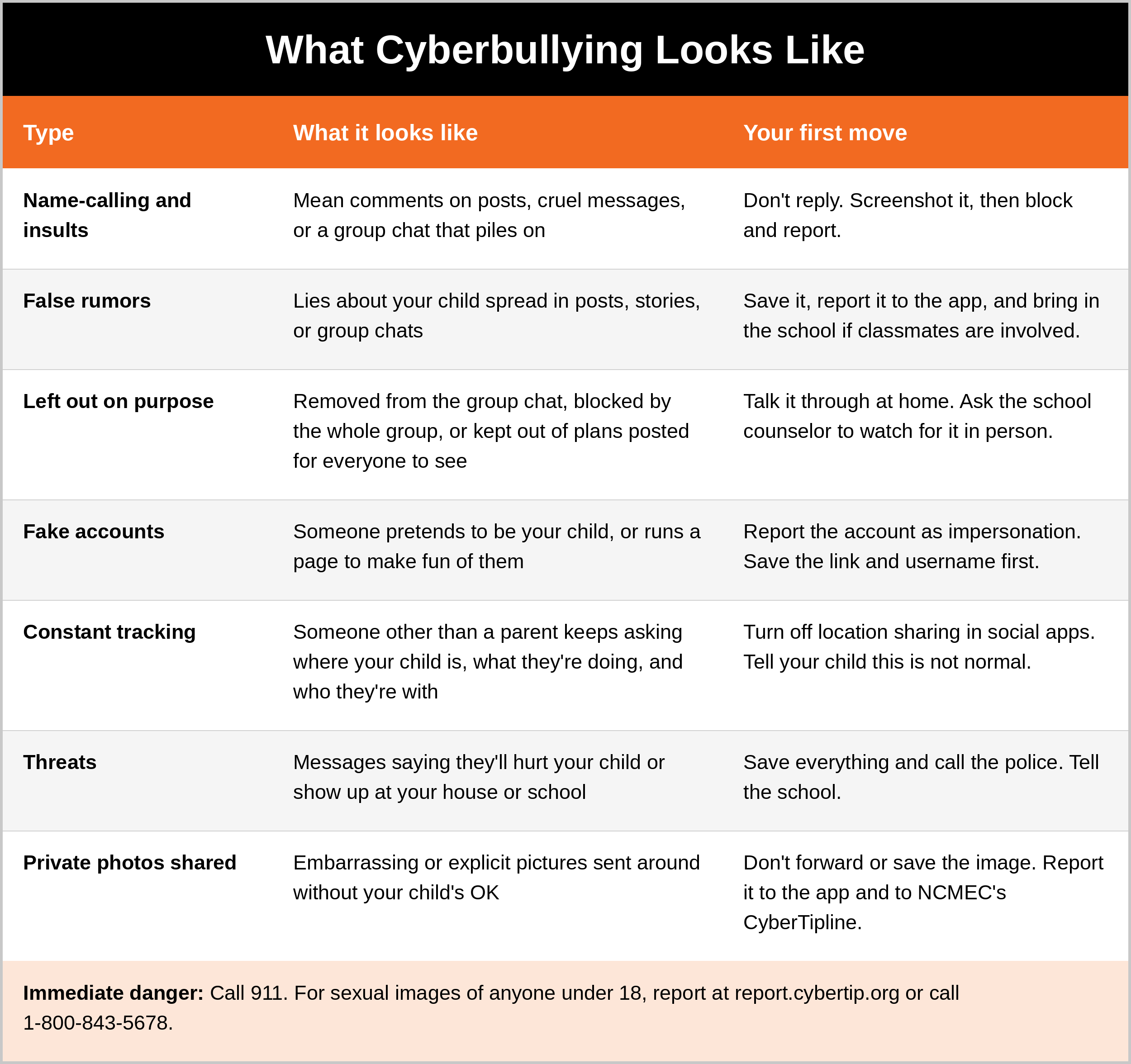
Cyberbullying is bullying that happens on a phone, tablet, computer, or game. It isn't always a mean comment. Sometimes it's a group chat your child got kicked out of. Sometimes it's a fake account with their name on it.
Here's what kids report most, from Pew's survey:
Name-calling. 32% of teens have been called an offensive name online.
False rumors. 22% have had lies spread about them.
Constant tracking. 15% say someone other than a parent keeps asking where they are, what they're doing, and who they're with.
Threats. 10% have been physically threatened.
Private images shared. 7% have had explicit images of them shared without their OK.
Older teen girls get hit the hardest. Pew found 54% of girls ages 15 to 17 have been through at least one of these.
The difference from the playground is the reach. A cruel post can be seen by the whole school in an hour. It can be screenshotted and passed around after it's deleted. It can come from an account with no name. It can show up at 1:00 a.m.
Get the free Family Social Media Reset. Notifications, phone-free zones, a charging spot outside the bedroom, age-by-age rules, and a full page on what to do if cyberbullying happens, with a family agreement everyone signs. Get it free here
Why Kids Don't Tell You
Here's the hard part. Many kids who are bullied online never tell a parent.
KidsHealth, from Nemours Children's Health, says kids often stay quiet for two reasons: they're ashamed, or they're afraid their phone will be taken away.
Think about that second one. From your child's side, telling you could mean losing the phone, which means losing their friends, their group chat, and their whole social life. So they keep it to themselves and carry it alone.
If the price of telling you is losing the phone, a lot of kids will choose silence.
The fix is a promise, made out loud, before anything happens: "If something online feels wrong, tell me. You won't lose your phone for telling."
Then keep it. If you take the phone the first time they come to you, they won't come to you the second time.
For the house rule that goes with this, see Rule 13 (No Punishment for Asking for Help) in Who's Talking to Your Kids? Part 4: Family Tech Rules That Actually Work.
Warning Signs Your Child Is Being Cyberbullied
Since your child may not tell you, watch for the signs. StopBullying.gov and KidsHealth point to changes like these:
Upset during or after using the phone, or nervous and jumpy when a message comes in
Big changes in phone use. Suddenly on it all the time, or suddenly won't touch it
Hiding the screen when you walk by, or changing the subject when you ask about it
Accounts deleted, or new ones appearing
Pulling away from friends, family, and things they used to enjoy
Not wanting to go to school, practice, or group events
Grades slipping, angry outbursts, or changes in sleep or appetite
One bad day isn't a pattern. A few of these together, especially around the phone, is worth a calm conversation.
Ask Yourself
If my child were being bullied online, would they tell me? What would they be afraid would happen?
Have I noticed changes in my child's mood that seem to follow the phone?
Does my child know what to do in the first five minutes, before they come find me?
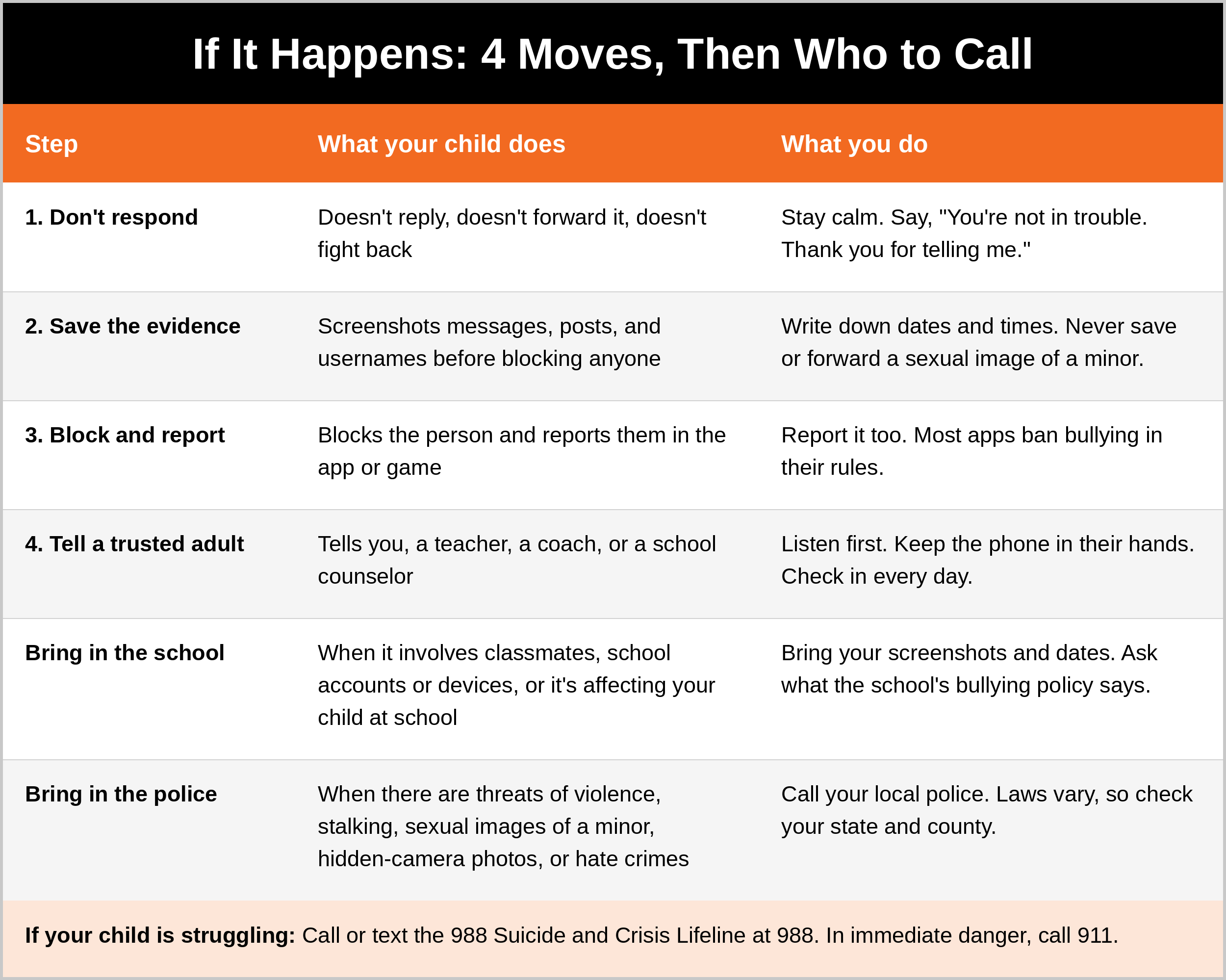
If It Happens: The 4 Moves
Teach these now, while things are calm. A child who already knows the moves won't freeze when it happens.
1. Don't respond. Don't reply, don't forward it, and don't fight back. A reaction is what the bully wants, and fighting back can turn your child into part of the problem.
2. Save the evidence. Take screenshots of the messages, posts, and usernames, and write down the dates and times. Do it before blocking anyone, because blocking can hide the messages. StopBullying.gov says to keep this record so you can report it.
3. Block and report. Block the person, then report them in the app, game, or site. Most platforms ban bullying in their rules and will remove the content or the account.
4. Tell a trusted adult. A parent, a teacher, a coach, or a school counselor. Nobody handles this alone.
One important exception: if the bullying involves a sexual image of your child or any other minor, don't screenshot, save, or forward the image itself. Possessing or sharing explicit images of children is a serious crime, even when you're trying to help, and that includes AI-made fakes. Save the usernames, links, and messages, and let law enforcement collect the image. For the full steps, see Who's Talking to Your Kids? Part 2: Sextortion and AI-Generated Images.
When to Bring In the School
Bring in the school when the bullying involves classmates, happens on school accounts or devices, or is affecting your child at school. Bring your screenshots and dates, and ask what the school's bullying policy says. StopBullying.gov notes that many states require schools to address cyberbullying, and some cover off-campus behavior that affects school.
When to Call the Police
StopBullying.gov says cyberbullying is a crime and should be reported to law enforcement when it involves:
Threats of violence
Sexually explicit messages or photos involving a minor
Photos or video taken where someone expects privacy
Stalking or hate crimes
There is no federal bullying law, and some states treat other kinds of cyberbullying as crimes too. Check your state and county for the exact laws where you live.
If a sexual image of your child is posted, report it to NCMEC's CyberTipline at report.cybertip.org or 1-800-843-5678, and use the platform's report button to ask for removal. Under the Take It Down Act, if a covered platform doesn't take it down within 48 hours, the FTC says to report it at TakeItDown.ftc.gov. NCMEC's free Take It Down tool can help keep the image from spreading to other sites.
The Prepared Protector listens first.
When your child finally tells you, how you react in the first 30 seconds decides whether they ever tell you again. Stay calm. Say, "You're not in trouble. Thank you for telling me." Keep the phone in their hands. Make the plan together. The Prepared Protector is someone who's decided that loving someone means being ready for them, not just hoping things go fine.
If Your Child Is the One Doing It
Nobody wants to get this call. If you do, don't brush it off. KidsHealth's advice is to deal with it head on instead of hoping it goes away:
Say it plainly: the behavior isn't acceptable, whatever started it.
Set a consequence, and follow through if it happens again.
Work with the school and the counselor.
Look at what they see at home. Kids copy the way adults talk online and in the car about other people.
Your child isn't a bad kid for making a bad choice. Owning it now is how they learn.
If Your Child Sees It Happen
Most kids are bystanders, not targets. Teach them they don't have to join in, and they don't have to stay silent. StopBullying.gov says peers can help by supporting the child being targeted. A few safe ways to help:
Don't like, share, or comment on the post.
Report it in the app.
Send the child being targeted a kind message, or sit with them at lunch.
Tell a trusted adult.
What to Say
When your child tells you: "You're not in trouble. Thank you for telling me. We're going to figure this out together, and you're keeping your phone."
To your younger child, ahead of time: "If anyone online is mean to you or says something that makes you feel bad, don't answer. Come get me. You won't lose your tablet for telling."
To your teen: "I'm not going to call anyone without talking to you first, unless you're in danger. But I need to see it so I can help."
To the school: "My child is being harassed online by students here. I have screenshots with dates and times. What does your bullying policy say, and what happens next?"
To your child, if they're the one bullying: "I love you, and what you did isn't OK. We're going to make it right, starting today."
5 Quick Wins You Can Start Today
Make the promise out loud: "You won't lose your phone for telling."
Teach the 4 moves: don't respond, save it, block and report, tell an adult.
Show your child how to take a screenshot and how to report and block in the apps they use.
Ask your child to name two trusted adults besides you.
Watch for changes in mood that follow the phone, and ask about them calmly.
Remember
Bullying used to stop at the school door. Now it follows your child home. You can't take every cruel message off the internet, but you can make sure your child never has to carry it alone.
That's the Hooked Series
Part 1 showed how the apps keep your family scrolling. Part 2 showed what your family gives away while they scroll. Part 3 showed what to do when someone uses those apps to hurt your child. The thread through all three is the same: the family runs the phones, and kids talk to parents who listen.
Quick Answers
How common is cyberbullying?
Very common. In Pew Research Center's 2022 survey, 46% of U.S. teens ages 13 to 17 said they had been bullied or harassed online. The CDC's 2023 Youth Risk Behavior Survey found 16% of high school students were electronically bullied in the past year.
What are the signs my child is being cyberbullied?
Being upset during or after using the phone, big changes in phone use, hiding the screen, deleting accounts, pulling away from friends and activities, not wanting to go to school, and changes in grades, sleep, or appetite.
What should my child do if they're cyberbullied?
Don't respond, save the evidence with screenshots and dates, block and report the person in the app, and tell a trusted adult. Don't screenshot or forward sexual images of a minor; save the usernames and messages and report it.
When should I call the police about cyberbullying?
When it involves threats of violence, sexual messages or images of a minor, photos taken where someone expects privacy, stalking, or hate crimes. Laws vary, so check your state and county. In immediate danger, call 911.
Get Started Today
Get the free Family Social Media Reset. Notifications, phone-free zones, a charging spot outside the bedroom, age-by-age rules, and a full page on what to do if cyberbullying happens. [Get it here: https://www.preparednotparanoid.com/downloads-cyber-safety]
Go Deeper
Hooked: The Hidden Dangers of Social Media (Written by Justin Nichols). This post shows how to spot cyberbullying and what to do first. Hooked goes further: what social media does to mental health, comparison, and body image, how predators use the same apps to reach kids, and a 5-step plan to take your family's time back. Get it here
The Family Safety Toolkit. 20 complete safety checklists, including the full Family Tech Rules checklist with the Family Communication and If Something Happens steps. Get it here
Tools I recommend: A family charging station outside the bedroom, a simple alarm clock so the phone doesn't have to be one, and other tools for kids and families are in my Children's Safety Amazon store.
The Full Series
Part 3: Cyberbullying: When It Follows Your Child Home (you are here)
Related Reading
Hooked- Part 2: The "Fun" Quiz That Answers Your Security Questions
Who's Talking to Your Kids? Part 2: Sextortion and AI-Generated Images
Who's Talking to Your Kids? Part 4: Family Tech Rules That Actually Work
References
Pew Research Center, Teens and Cyberbullying 2022 (Dec 2022): https://www.pewresearch.org/internet/2022/12/15/teens-and-cyberbullying-2022/
CDC, Youth Risk Behavior Survey Data Summary and Trends Report, 2013 to 2023: https://www.cdc.gov/yrbs/dstr/pdf/YRBS-2023-Data-Summary-Trend-Report.pdf
CDC MMWR, Frequent Social Media Use and Experiences with Bullying Victimization, Persistent Feelings of Sadness or Hopelessness, and Suicide Risk Among High School Students, 2023 (Oct 2024): https://www.cdc.gov/mmwr/volumes/73/su/su7304a3.htm
StopBullying.gov, Report Cyberbullying: https://www.stopbullying.gov/cyberbullying/how-to-report
StopBullying.gov, Prevent Cyberbullying: https://www.stopbullying.gov/cyberbullying/prevention
StopBullying.gov, Laws, Policies, and Regulations: https://www.stopbullying.gov/resources/laws
KidsHealth (Nemours), Cyberbullying: https://kidshealth.org/en/parents/cyberbullying.html
Federal Trade Commission, Did someone share an explicit image of your child online? Take these steps (Oct 2026): https://consumer.ftc.gov/consumer-alerts/2026/10/did-someone-share-explicit-image-your-child-online-take-these-steps
National Center for Missing and Exploited Children, CyberTipline and Take It Down: https://report.cybertip.org and https://takeitdown.ncmec.org
Hooked: The Hidden Dangers of Social Media, Justin Nichols (2025)
These suggestions are intended to help you and your family build awareness, confidence, and safer decision-making habits. No safety plan, checklist, or training can guarantee 100% protection. There will always be people who try to exploit vulnerability, opportunity, trust, or positions of power. The goal is not to create fear, but to help guide families toward more informed, prepared, and practical safety decisions in everyday life. This article is not legal, medical, or mental health advice. Bullying and harassment laws vary by state, so check your state and county for the rules where you live. If you're worried about your child's mood, sleep, or safety, talk with their doctor, a school counselor, or a licensed counselor. App settings and reporting steps change often, so check the current menus on your family's devices. As an Amazon Associate, I earn from qualifying purchases.
If you are in immediate danger, call 911. If your child is struggling or talking about hurting themselves, call or text the 988 Suicide and Crisis Lifeline at 988. If a child is being threatened or pressured for images, report it to NCMEC's CyberTipline at report.cybertip.org or 1-800-843-5678.
Awareness gives you time. Time gives you options.
The Prepared Protector is someone who's decided that loving someone means being ready for them, not just hoping things go fine.
Prepared Not Paranoid. Protecting the Most Vulnerable Among Us.