Don't Click. Don't Call. Don't Pay. Don't Share. Then Stop, Verify, and Tell.
By Larry Betz | Prepared Not Paranoid https://www.preparednotparanoid.com/
The best way to avoid scams isn't memorizing every new trick. It's having one simple plan your whole family uses on every text, call, email, and pop-up. The 4 D's tell you what not to do. Stop, Verify, Tell tells you what to do instead.
Your phone buzzes. "Your account has been locked due to suspicious activity. Verify your identity now or lose access." There's a link, and a 24-hour deadline.
A few minutes later, a different message: a toll you supposedly didn't pay. Then a voicemail from "your bank." Then a pop-up on the laptop telling you to call Microsoft right now.
Different stories, same playbook. Every one of them is trying to get you to act before you think.
Why Scams Work on Smart People
Scams don't work because people are careless. They work because they're built to get around your judgment.
Almost every scam uses the same four levers:
Urgency: "Act now or lose your account."
Fear: "There's a warrant for your arrest."
Authority: "This is your bank, the IRS, Microsoft, the police."
Secrecy: "Don't tell anyone. Stay on the line."
The numbers show how well it works. The Federal Trade Commission reports that people lost about $16 billion to fraud in 2025, the highest on record. Imposter scams, where someone pretends to be a company, a government agency, or someone you love, were the most reported type of fraud.
The good news is that the defense doesn't change, no matter what the story is.
The 4 D's of Cyber Safety
When something unexpected shows up and pushes you to act, the answer is the same four words.
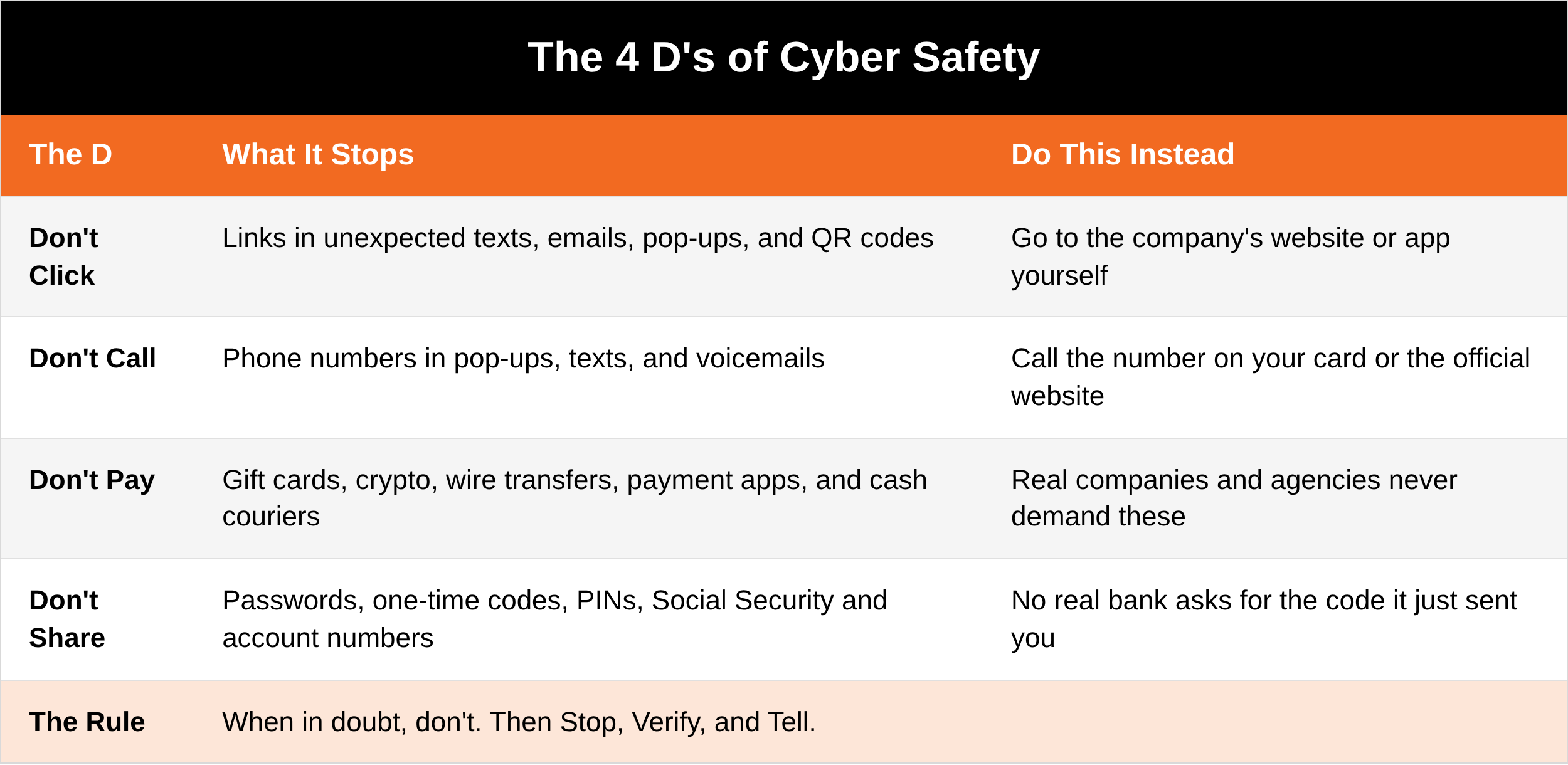
Don't Click. Links in unexpected texts, emails, and pop-ups are how scammers get you to fake login pages and malware. If a message says there's a problem with your account, close it and go to the company's website or app yourself.
Don't Call. The phone number in a pop-up, a text, or a voicemail goes straight to the scammer. Caller ID can be faked too. Call the number on the back of your card or on the company's official website.
Don't Pay. Gift cards, cryptocurrency, wire transfers, payment apps, and cash handed to a courier are a scammer's favorite payments, because the money is hard or impossible to get back. The FTC puts it plainly: anyone who demands payment by gift card is always a scammer.
Don't Share. Passwords, one-time codes, PINs, your Social Security number, and account numbers stay with you. No real bank or company will ever ask you for the code they just texted you.
Get the free Scam Stopper Plan. The 4 D's, Stop, Verify, Tell, the red flags to watch for, a family plan page, and a fridge card for every adult in the house. Get it free here
The Other Half: Stop, Verify, Tell
The 4 D's tell you what not to do. Stop, Verify, Tell tells you what to do instead. It's the same method from Scam Proofing the People You Love, Part 4, and it works for every age.
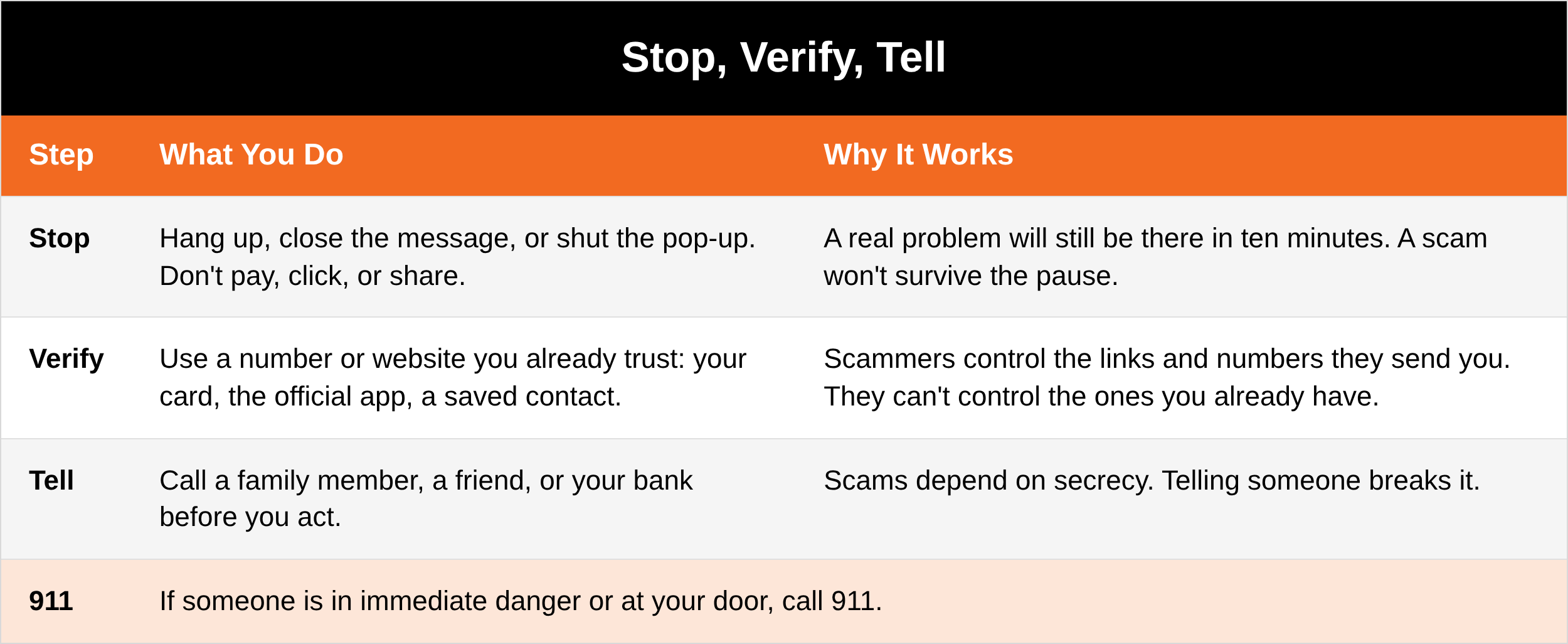
Stop. End the contact. Hang up, close the message, shut the pop-up. A real problem will still be there in ten minutes. A scam won't survive the pause.
Verify. Check through a number or website you already trust: the number on your card, the official app, a saved contact. Never the number or link the message gave you.
Tell. Call a family member, a friend, or your bank before you act. Scammers count on secrecy. The moment you tell someone, the scam usually falls apart.
The Prepared Protector controls the clock.
Every scam tries to set the pace for you: five minutes, 24 hours, "stay on the line." The Prepared Protector takes the clock back. Slow down, verify, and talk to someone you trust. The Prepared Protector is someone who's decided that loving someone means being ready for them, not just hoping things go fine.
What It Looks Like in Real Life
The "bank" text. "Unusual login detected. Click here to verify." Don't click. Open your bank's app yourself, or call the number on your card. (Scam Proofing, Part 2 covers bank impersonators.)
The frozen screen. A pop-up says your computer is infected and to call Microsoft now. Don't call. Close the browser or shut the computer down. Part 3 of this series covers this one in detail.
The panic call. A voice that sounds like your grandson says he's in trouble and needs money. Don't pay. Hang up and call him back on the number you have, or ask for your family code word. (Why Every Family Needs a Code Word, Part 1 explains how.)
The fake invitation. An email invites you to a party, but you have to "download and install" to see it. Don't click. (The Fake Party Invitation Scam shows how it works.)
If You Already Clicked
It happens to smart people every day. What matters is how fast you move.
Stop all contact. Don't reply, don't call back, and don't pay anyone who offers to "recover" your money.
Call your bank or card company using the number on your card. Ask them to stop or dispute the payment.
Change your passwords from a different, trusted device, starting with your email.
Report it at ReportFraud.ftc.gov. If your personal information was exposed, go to IdentityTheft.gov for a recovery plan.
The Cyber Safety guide has the full recovery checklist, including what to do if you gave someone remote access to your computer.
What to Say
To your parents: "If anyone ever calls, texts, or emails asking for money, a code, or your password, it's a scam until you've checked with me. I'll never be upset that you called."
To your teens: "If a message makes you panic, that's the signal to slow down. Screenshot it and show me before you click anything."
To the caller: "I'll call the bank directly." Then hang up.
Ask Yourself
Does everyone in my house know the 4 D's?
Would my parents call me before buying a gift card for someone on the phone?
Do I have my bank's real fraud number saved in my phone?
5 Quick Wins You Can Start Today
Say the 4 D's out loud at dinner tonight: Don't Click, Don't Call, Don't Pay, Don't Share.
Save your bank and card fraud numbers in your phone as contacts.
Let unknown calls go to voicemail.
Tell your parents: anyone who asks for a gift card is a scammer. Every time.
Pick two people everyone in the family can call before acting on anything urgent.
Remember
Don't click, don't call, don't pay, don't share. Then stop, verify, and tell someone. A real emergency can wait ten minutes. A scam can't.
Coming Up in Part 2
Toll Texts, Missed Packages, and the QR-Code Mystery Box. The newest text and package scams, how scammers seem to know where you've been, and why you should never scan the QR code on a box you didn't order.
Quick Answers
What are the 4 D's of cyber safety?
Don't click, don't call, don't pay, and don't share. When an unexpected text, call, email, or pop-up pushes you to act, don't click its links, don't call its numbers, don't pay by gift card, crypto, wire, or payment app, and don't share passwords, codes, or personal information.
What is Stop, Verify, Tell?
It's what to do instead. Stop: end the contact. Verify: check through a number or website you already trust, never the one in the message. Tell: talk to a family member, friend, or your bank before you act.
What should I do if I clicked a scam link?
Stop all contact, call your bank or card company using the number on your card, change your passwords from a trusted device starting with your email, and report it at ReportFraud.ftc.gov. If personal information was exposed, use IdentityTheft.gov.
Do real companies ever ask for payment by gift card?
No. According to the FTC, anyone who demands payment by gift card is always a scammer. Gift cards are for gifts, not payments.
Get Started Today
Get the free Scam Stopper Plan. The 4 D's, Stop, Verify, Tell, the red flags to watch for, what to do if you already clicked, a family plan page, and a fridge card for every adult in the house. Get it here
Go Deeper
Cyber Safety: A Beginner's Guide to Securing Your Digital Footprint and Avoiding Online Scams. The full playbook: identity theft, phishing texts and calls, AI voice scams, passwords and two-factor sign-in, account monitoring, secure networks, and more, in plain language. Get it here
The Family Safety Toolkit. 20 complete safety checklists, including Protecting Older Adults from Scams and Financial Exploitation and Family Tech Rules, so the whole family has the same plan. Get it here
Tools I recommend: Call blockers, privacy screens, and other tools that help protect your family's devices and information are in my Cyber Safety Amazon store.
The Full Series
Part 1: The 4 D's That Stop Most Scams (you are here)
Part 2: Toll Texts, Missed Packages, and the QR-Code Mystery Box
Part 3: The Fake Virus Pop-Up and Tech Support Scams (coming next)
Part 4: Passwords and Two-Factor Sign-In
Part 5: Catch Fraud Early: Alerts, Credit Freezes, and Virtual Cards
Part 6: Your Mailbox and Your Glove Box
Related Reading
Scam Proofing the People You Love, Part 4: Build Your Family's Fraud Plan
Scam Proofing the People You Love, Part 2: "This Is Your Bank Calling"
References
Federal Trade Commission, FTC Data Show People Reported Losing $3.5 Billion to Imposter Scams in 2025 (June 2026): https://www.ftc.gov/news-events/news/press-releases/2026/06/ftc-data-show-people-reported-losing-3-point-5-billion-imposter-scams-2025
Federal Trade Commission, Avoiding and Reporting Gift Card Scams: https://consumer.ftc.gov/articles/avoiding-and-reporting-gift-card-scams
Federal Trade Commission, Report fraud: https://reportfraud.ftc.gov
IdentityTheft.gov, Report identity theft and get a recovery plan: https://www.identitytheft.gov
FBI Internet Crime Complaint Center: https://www.ic3.gov
These suggestions are intended to help you and your family build awareness, confidence, and safer decision-making habits. No safety plan, checklist, or training can guarantee 100% protection. There will always be people who try to exploit vulnerability, opportunity, trust, or positions of power. The goal is not to create fear, but to help guide families toward more informed, prepared, and practical safety decisions in everyday life. This article is not legal or financial advice. Reporting rules vary, so check your state and county for the exact rules where you live. As an Amazon Associate, I earn from qualifying purchases.
If you are in immediate danger, call 911. If you've been scammed, report it at ReportFraud.ftc.gov or IC3.gov. Adults 60 and older can call the National Elder Fraud Hotline at 1-833-FRAUD-11 (1-833-372-8311).
Awareness gives you time. Time gives you options.
The Prepared Protector is someone who's decided that loving someone means being ready for them, not just hoping things go fine.
Prepared Not Paranoid. Protecting the Most Vulnerable Among Us.