How one private word stops AI voice scams, fake pickups, and bad nights away from home
By Larry Betz | Prepared Not Paranoid https://www.preparednotparanoid.com/
A family code word is one private word that only your family knows. It costs nothing, takes five minutes to set up, and it does three jobs no app or lock can do: it proves a caller is really your family, it keeps your kids from leaving with the wrong person, and it gives them a way out when something feels wrong.
Imagine this. It's a Tuesday afternoon. Your phone rings, and it's your daughter's voice. She's crying. She's been in an accident, someone is hurt, and she needs money right now. Please don't tell Dad.
The voice is right. The panic is right. Your hands are already shaking.
Now imagine the same afternoon from your son's side. He's standing outside school, and a friendly adult he's seen once or twice walks up. "Your mom got held up at work. She asked me to grab you."
Two different moments. Same problem. Someone is counting on you, or your child, to believe them before you check. A family code word is how you check.
Why a Family Code Word Matters More Now
For years, the code word was something parents set up for school pickups. Then the phone changed the game.
Criminals can now copy a person's voice from a few seconds of audio, often pulled from a video posted on social media or a voicemail greeting. The Federal Trade Commission warned families about AI voice cloning in family emergency scams back in March 2023.
On December 3, 2024, the FBI went further. In a public service announcement about criminals using artificial intelligence for fraud (I-120324-PSA), one of its first tips was to create a secret word or phrase with your family to verify their identity.
When the FBI tells families to set up a code word, that's not paranoia. That's the plan.
The scale is real too. The FTC reports that people lost $3.5 billion to imposter scams in 2025, from more than 1 million reports. A scammer pretending to be someone you love is one of the oldest versions of that scam, and AI just made it more convincing.
One Word, Three Jobs
Here's what makes a family code word worth five minutes of your time. The same word works in three very different moments.
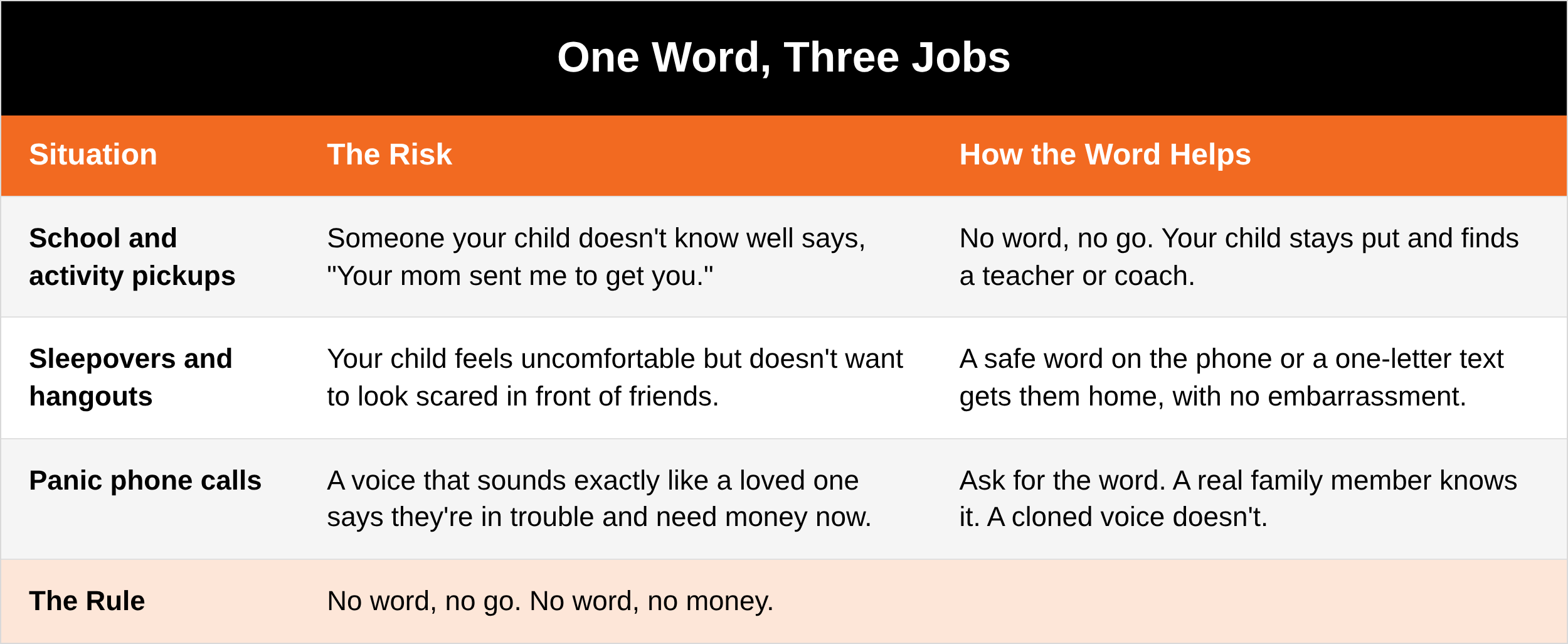
Job 1: It verifies a panic call. If a call or video sounds like your grandson, your daughter, or your spouse, and they need money right now, you ask for the word. A real family member knows it. A cloned voice doesn't. I cover the grandparent scam in detail in Scam Proofing the People You Love, Part 3.
Job 2: It protects pickups. If anyone other than Mom or Dad says, "Your mom sent me," your child asks for the word. No word, no go, even with someone they know. Toddler to Teen, Part 2 walks through the lines people use on kids.
Job 3: It gets your child out. A safe word on the phone, or a single text, tells you "Come get me now" without your child having to say it in front of friends. My Body, My Boundaries, Part 4 covers the X-Plan and the no-questions promise that makes it work.
Get the free Family Code Word Plan. It walks your family through choosing the word, an approved pickup list, the X-Plan, a family agreement, and wallet cards for the kids and grandparents. Get it free here
The Panic Call: What to Do in the First 60 Seconds
The scam call depends on one thing: getting you to act before you think. Fear, urgency, and secrecy are the whole playbook. "Don't tell anyone." "There's no time." "Pay with gift cards, a wire, crypto, or cash to a courier."
Your job is to break that pressure. A real emergency can wait 60 seconds while you verify.
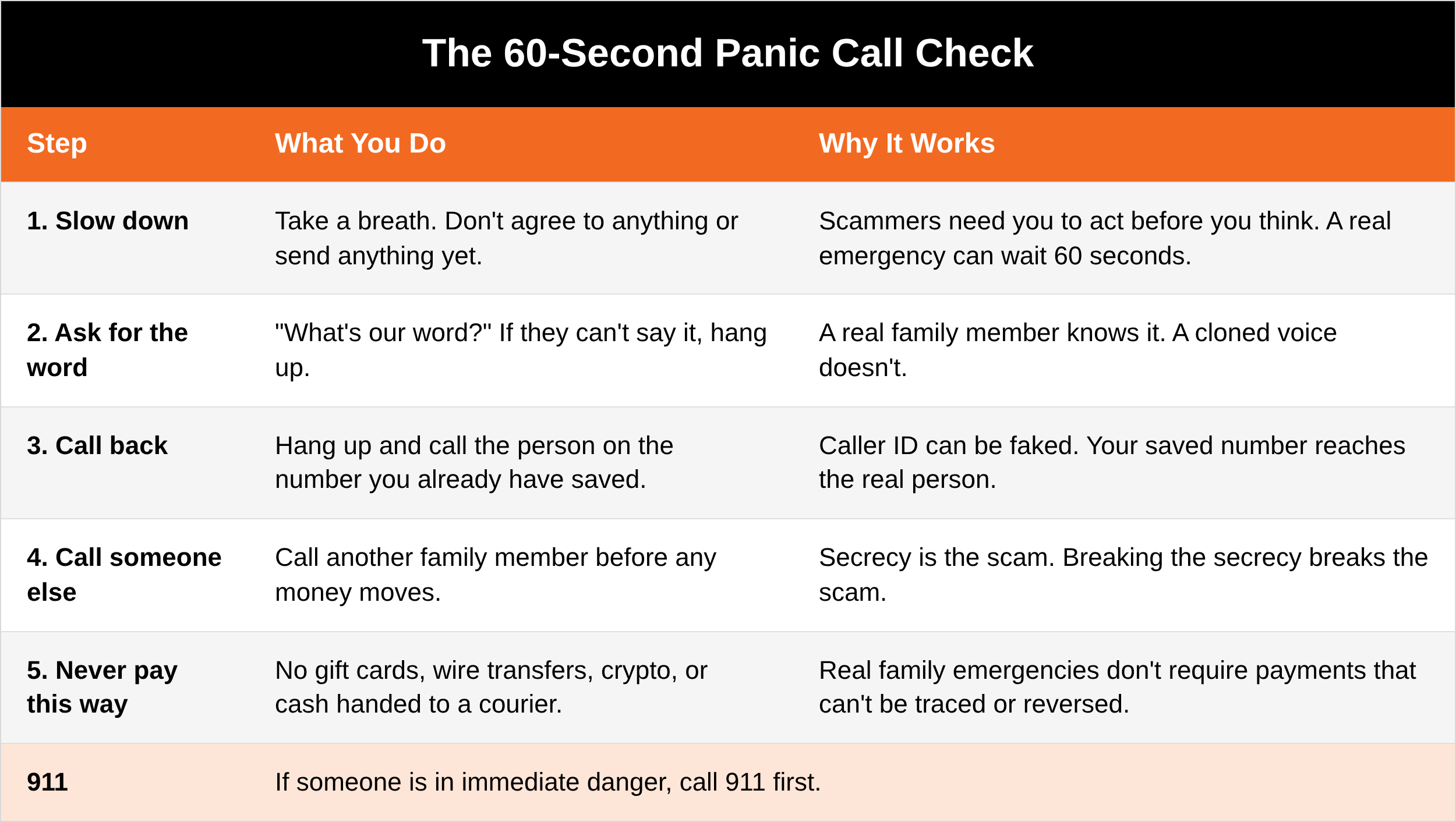
A few things to know before that call ever comes:
Caller ID can be faked. A call can look like it's coming from your daughter's number and still be a scammer. Hang up and call the number you already have saved.
"Don't tell anyone" is the red flag. Real family emergencies welcome help. Scams need secrecy. Breaking the secrecy breaks the scam.
Video can be faked too. The FBI warns that criminals now use AI to make fake photos and video of real people, not just voices.
The Prepared Protector sets the word before the panic call, not during it.
In the moment, fear makes everyone easier to fool. A plan you made at the kitchen table on a calm night is the one that works when your heart is pounding. The Prepared Protector is someone who's decided that loving someone means being ready for them, not just hoping things go fine.
What to Say
To your parents or grandparents: "If you ever get a call that sounds like me or one of the kids and we need money, ask for our word. If we can't say it, hang up and call me. I'll never be mad that you checked."
To your kids: "If anyone besides Mom or Dad comes to get you, they have to say our word. If they don't, you don't go. You find your teacher. You'll never be in trouble for it."
Ask Yourself
Does our family have a code word? Would my parents remember it on a panic call?
If someone told my child "Your mom sent me," what would my child do?
Are there videos of my kids or grandkids talking on a public social media account?
5 Quick Wins You Can Start Today
Bring up the code word at dinner tonight. You'll pick the word together in Part 2.
Make sure every family member has the others' numbers saved, so a call back takes seconds.
Ask the teens and grandkids to set their social media accounts to private.
Tell your parents the rule out loud: no word, no money.
Ask your child's school how it checks who's allowed to pick up.
Remember
One private word does three jobs. It verifies a panic call, protects a pickup, and gives your child a way out. No word, no go. No word, no money.
Coming Up in Part 2
How to Pick, Share, and Practice Your Family Code Word. What makes a good word (and what never to use), who should know it, what to tell the school and the grandparents, how to practice without scaring the kids, and when to change it.
Quick Answers
What is a family code word?
A family code word is a private word or short phrase that only your family knows. You use it to prove who you are on a suspicious call, to verify anyone picking up your child, and to give kids a way to say "Come get me" without saying it out loud.
Does the FBI recommend a family code word?
Yes. In a December 3, 2024 public service announcement (I-120324-PSA) about criminals using AI to commit fraud, the FBI advised families to create a secret word or phrase to verify each other's identity.
Can a code word stop an AI voice clone scam?
It's one of the best defenses there is. A scammer can copy a voice from a short video, but can't copy a word that was never posted, texted, or said in public. Ask for the word, then hang up and call back on a number you already have saved.
Should kids have a code word for school pickup?
Yes. Teach one rule: anyone other than Mom or Dad who picks them up must say the word, with no exceptions. If they can't, your child doesn't go and gets a teacher. The free Family Code Word Plan includes an approved pickup list for the school.
Get Started Today
Get the free Family Code Word Plan. Set up a family code word that stops strangers and scam callers cold, with a pickup list, the X-Plan, a family agreement, and wallet cards for the kids and grandparents. Get it here
Go Deeper
The Family Safety Toolkit. 20 complete safety checklists in one place, covering child safety, senior scams and fraud, home security, travel, and emergencies, so the code word becomes part of a full family plan. Get it here
Cyber Safety: A Beginner's Guide to Securing Your Digital Footprint and Avoiding Online Scams. Lock down the social media posts, videos, and personal details scammers use to clone a voice and make their story believable. Get it here
Coming soon: The Family Readiness Binder. Your family's emergency contacts, approved pickup list, medical details, and plans, organized in one place so anyone can find them fast. Coming in an Essential and a Full edition.
Tools I recommend: The child safety gear and books I actually recommend for families are in my Children's Safety Amazon store.
The Full Series
Part 1: One Word, Three Jobs (you are here)
Next in the series: Why Every Family Needs a Code Word, Part 2: How to Pick, Share, and Practice Your Word
Related Reading
Scam Proofing the People You Love, Part 3: Scams That Pull at the Heart
My Body, My Boundaries, Part 4: Sleepovers, Safe Words, and When Kids Harm Kids
Cyber Safety, Part 1: The 4 D's That Stop Most Scams (plus the free Scam Stopper Plan)
References
FBI Internet Crime Complaint Center, Criminals Use Generative Artificial Intelligence to Facilitate Financial Fraud, PSA I-120324-PSA (December 3, 2024): https://www.ic3.gov/PSA/2024/PSA241203
Federal Trade Commission, Scammers Use AI to Enhance Their Family Emergency Schemes (March 2023): https://consumer.ftc.gov/consumer-alerts/2023/03/scammers-use-ai-enhance-their-family-emergency-schemes
Federal Trade Commission, FTC Data Show People Reported Losing $3.5 Billion to Imposter Scams in 2025 (June 2026): https://www.ftc.gov/news-events/news/press-releases/2026/06/ftc-data-show-people-reported-losing-3-point-5-billion-imposter-scams-2025
These suggestions are intended to help you and your family build awareness, confidence, and safer decision-making habits. No safety plan, checklist, or training can guarantee 100% protection. There will always be people who try to exploit vulnerability, opportunity, trust, or positions of power. The goal is not to create fear, but to help guide families toward more informed, prepared, and practical safety decisions in everyday life. School pickup policies and reporting rules vary, so check with your school and check your state and county for the exact rules where you live. As an Amazon Associate, I earn from qualifying purchases.
If you are in immediate danger, call 911. If you've been targeted by a scam, report it at ic3.gov. Adults 60 and older can call the National Elder Fraud Hotline at 1-833-FRAUD-11 (1-833-372-8311).
Awareness gives you time. Time gives you options.
The Prepared Protector is someone who's decided that loving someone means being ready for them, not just hoping things go fine.
Prepared Not Paranoid. Protecting the Most Vulnerable Among Us.