Five minutes at the kitchen table, and a few mistakes that can make the word useless
By Larry Betz | Prepared Not Paranoid https://www.preparednotparanoid.com/
A family code word only works if three things are true: it's a word no one outside your family could guess, the right people know it, and everyone has practiced using it. Setting one up takes one evening. Getting any of those three wrong can turn it into a word that protects no one.
In Part 1, we covered why every family needs a code word: it verifies a panic call, protects a pickup, and gives your child a way out. This part is the how.
Here's where families usually go wrong. They pick the dog's name, which is all over their social media. They write the word on the school pickup form. Their child tells a best friend, because it felt like a fun secret. A month later, nobody remembers it at all.
None of that takes much to fix. It just takes a plan.
Step 1: Pick a Word No One Could Guess
A good family code word is easy for your family to remember under stress and impossible for anyone else to figure out.
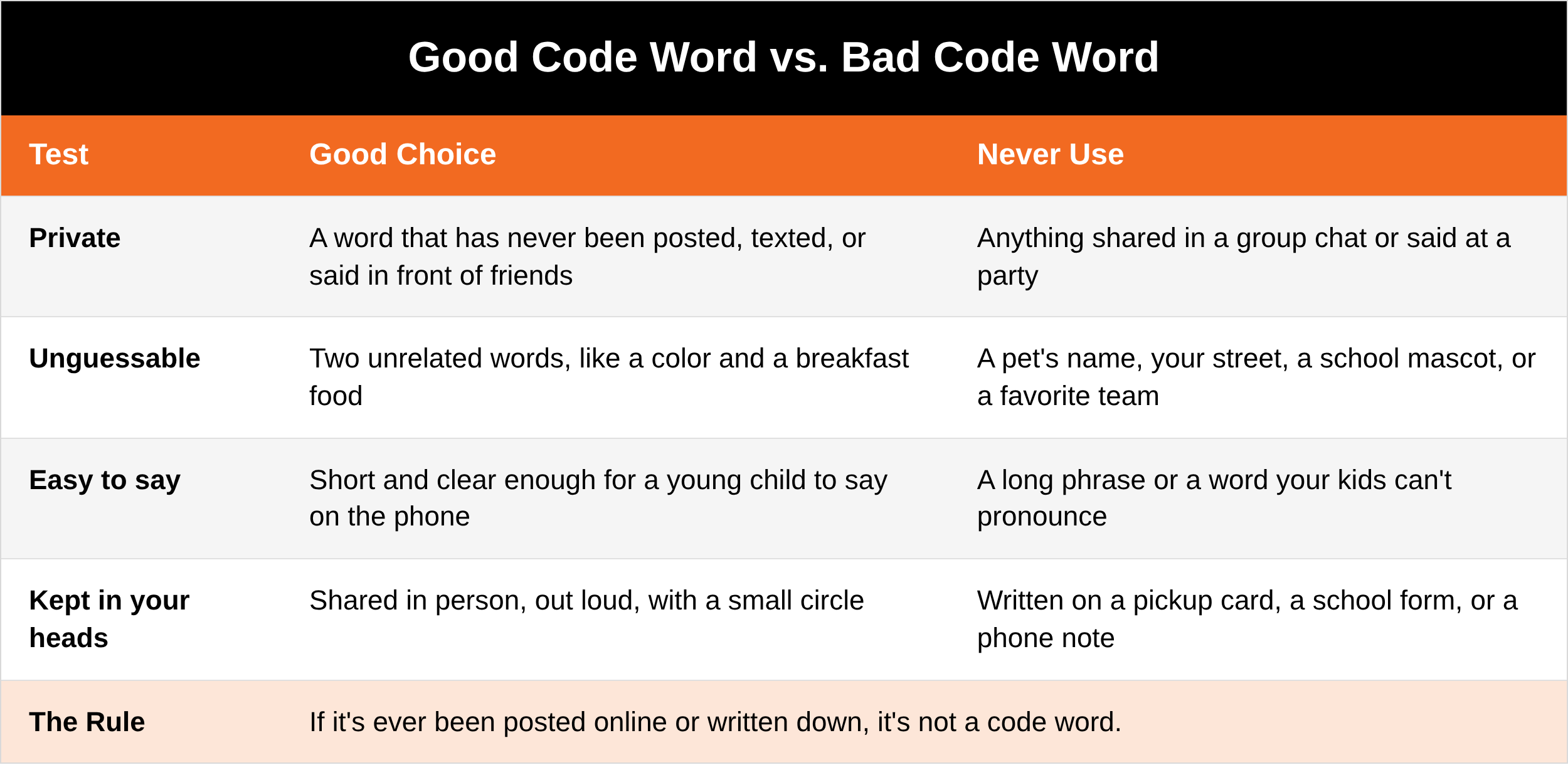
Make it private. It should never have been posted, texted to a group chat, or said in front of friends and neighbors.
Make it unguessable. Skip anything a stranger could find in five minutes: a pet's name, your street, a school mascot, a favorite team, a birthday, or anything that shows up on your social media.
Make it easy to say. Two unrelated words often work well, like a color and a breakfast food. Young kids need something short they can say clearly on the phone, even when they're upset.
Pick it together. Kids remember a word they helped choose. Let them suggest a few options, then the adults make the final call.
Step 2: Decide Who Knows It
Keep the circle small. Every extra person is one more way the word can leak.
Always: parents and the kids.
Usually: grandparents and any adult you'd trust to pick up your child in an emergency.
Not the word: the school, coaches, camps, and sitters you don't know well. They get your approved pickup list with names and phone numbers, never the word itself.
Get the free Family Code Word Plan. It includes a fill-in approved pickup list for the school, a family agreement everyone signs, and wallet cards for the kids and grandparents. Get it free here
Step 3: Share It the Right Way
How you share the word matters as much as the word itself.
Say it in person, out loud. Not by text, email, or a group chat. Messages get forwarded, screenshotted, and hacked.
Never write it down. Not on a pickup card, a school form, a sticky note, or a note in your phone. Keep it in your heads.
Tell kids what it's for. A code word protects them. It is never a secret they keep from Mom and Dad, and no adult should ever ask them to keep one.
That last point matters. A child should learn that safe words protect them and unsafe secrets hurt them. If you've read My Body, My Boundaries, Part 4, you've seen how the safe word and the X-Plan work together on a sleepover.
Step 4: Tell the School and the Grandparents
The school and activities. Give the front office, coaches, and camps your approved pickup list, with names and phone numbers. Ask how they check who's allowed to pick up, and ask them to call you before releasing your child to anyone new. Summer Camp Safety, Part 2 covers the questions to ask.
The grandparents. Their rule is simple: no word, no money. If a call sounds like a grandchild in trouble, they ask for the word, hang up, and call you on the number they already have saved. Make sure they know you'll never be upset that they checked.
Step 5: Practice Without Scaring the Kids
A word nobody has practiced is a word nobody uses. Practice should feel like a game, not a fire drill.
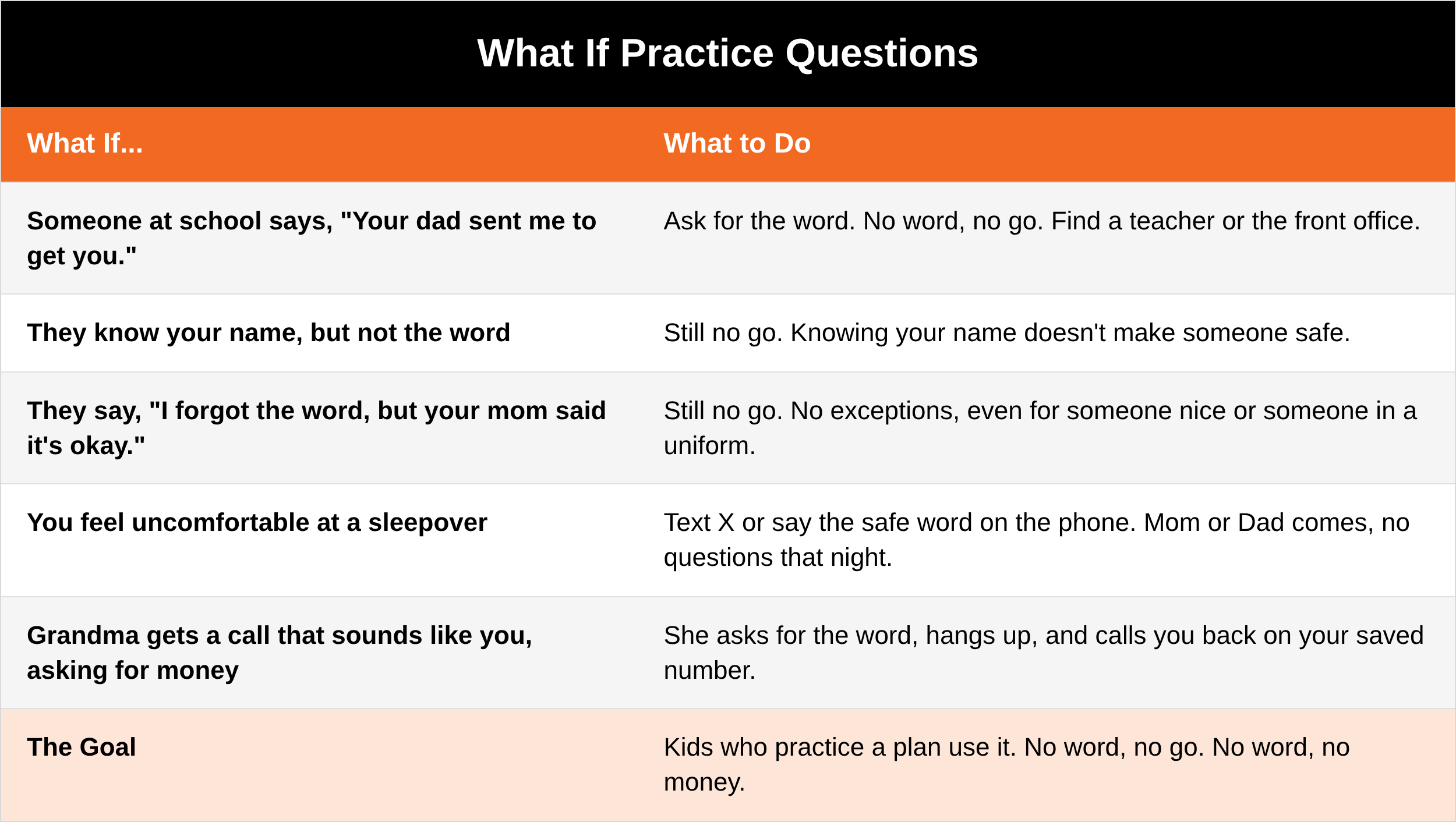
Once a month: ask one "What If" question at dinner or in the car. Keep it light and praise good answers.
Every 3 months: a quick quiz on the word, the meeting spot, and phone numbers, the same check from Red Cell Your Family, Part 6.
Every 6 months: review the whole plan, including who knows the word and who's on the pickup list.
Kids who practice a plan use it. Kids who heard about it once usually freeze.
The Prepared Protector keeps the word alive.
Picking the word is the easy part. Keeping it private, keeping the circle small, and practicing it a few minutes a month is what makes it work on the worst day. The Prepared Protector is someone who's decided that loving someone means being ready for them, not just hoping things go fine.
Step 6: Know When to Change It
Change your family code word when:
It's been used. Once someone has said it in front of others, it's not private anymore. Pick a new one.
Someone outside the circle learns it. A friend overheard it, or a child shared it.
Your circle changes. A new caregiver, a custody change, or someone who used to know it shouldn't anymore.
At your 6-month review, if anyone isn't sure they'd remember it.
What to Say
To your kids: "We're going to pick a family word tonight. Only our family knows it. If anyone besides Mom or Dad comes to get you, they have to say it. If they don't, you don't go, even if they seem nice. You'll never be in trouble for saying no."
To your parents: "We set up a family word. If you ever get a call that sounds like one of us asking for money, ask for the word. If they can't say it, hang up and call me. Even if it sounds exactly like us."
To the school: "Here's our approved pickup list. Please call me before you release our child to anyone who isn't on it."
Ask Yourself
Could someone guess our word from our social media?
Is our word written down anywhere, like a form, a card, or a phone note?
When did we last practice it?
5 Quick Wins You Can Start Today
Pick your family code word tonight, together, at the kitchen table.
Check that it doesn't appear anywhere on your social media.
Tell your parents in person, along with the rule: no word, no money.
Give the school your approved pickup list, with names and numbers only.
Put a reminder on your calendar for a 6-month review.
Remember
Pick it together. Share it in person. Never write it down. Practice it once a month. Change it after it's used.
That's the Series
One private word, set up in one evening, protects your kids at pickup, gives them a way out of a bad situation, and stops the scam call that sounds just like someone you love. Two parts, one word, and a lot more peace of mind.
Quick Answers
What makes a good family code word?
A good family code word is private, impossible to guess, and easy to say under stress. Two unrelated words often work well. Never use a pet's name, a street, a school mascot, a favorite team, a birthday, or anything that appears on social media.
Should I write our family code word down?
No. Keep it in your heads. Don't put it on a pickup card, a school form, or a note in your phone. Give the school your approved pickup list with names and phone numbers instead, never the word.
How often should we change our family code word?
Change it after it's been used in front of others, if someone outside the family learns it, or when caregivers or custody change. Review the whole plan every 6 months.
How do I teach a young child a code word without scaring them?
Make it a game. Let them help pick the word, then ask one "What If" question a month at dinner or in the car, like "What if someone at school says Dad sent them?" Praise good answers, and tell them they'll never be in trouble for saying no.
Get Started Today
Get the free Family Code Word Plan. Set up a family code word that stops strangers and scam callers cold, with a fill-in pickup list, the X-Plan, a family agreement, and wallet cards for the kids and grandparents. Get it here
Go Deeper
The Family Safety Toolkit. 20 complete safety checklists in one place, covering child safety, senior scams and fraud, home security, travel, and emergencies, so the code word becomes part of a full family plan. Get it here
Coming soon: the Child Safety Manual. Safe-word practice drills by age, a full sleepover and late-over planner, and the complete guide to keeping kids safe at home, online, in activities, and away from home.
Coming soon: The Family Readiness Binder. Your family's emergency contacts, approved pickup list, medical details, and plans, organized in one place so anyone can find them fast. Coming in an Essential and a Full edition.
Tools I recommend: The child safety gear and books I actually recommend for families are in my Children's Safety Amazon store.
The Full Series
Part 2: How to Pick, Share, and Practice Your Word (you are here)
Related Reading
My Body, My Boundaries, Part 4: Sleepovers, Safe Words, and When Kids Harm Kids
Cyber Safety, Part 1: The 4 D's That Stop Most Scams (plus the free Scam Stopper Plan)
References
FBI Internet Crime Complaint Center, Criminals Use Generative Artificial Intelligence to Facilitate Financial Fraud, PSA I-120324-PSA (December 3, 2024): https://www.ic3.gov/PSA/2024/PSA241203
Federal Trade Commission, Scammers Use AI to Enhance Their Family Emergency Schemes (March 2023): https://consumer.ftc.gov/consumer-alerts/2023/03/scammers-use-ai-enhance-their-family-emergency-schemes
These suggestions are intended to help you and your family build awareness, confidence, and safer decision-making habits. No safety plan, checklist, or training can guarantee 100% protection. There will always be people who try to exploit vulnerability, opportunity, trust, or positions of power. The goal is not to create fear, but to help guide families toward more informed, prepared, and practical safety decisions in everyday life. School pickup policies, custody arrangements, and reporting rules vary, so check with your school and check your state and county for the exact rules where you live. As an Amazon Associate, I earn from qualifying purchases.
If you are in immediate danger, call 911. If you've been targeted by a scam, report it at ic3.gov. Adults 60 and older can call the National Elder Fraud Hotline at 1-833-FRAUD-11 (1-833-372-8311).
Awareness gives you time. Time gives you options.
The Prepared Protector is someone who's decided that loving someone means being ready for them, not just hoping things go fine.
Prepared Not Paranoid. Protecting the Most Vulnerable Among Us.