The Low-Tech Ways Thieves Find Your Name, Your Money, and Your Front Door
By Larry Betz | Prepared Not Paranoid https://www.preparednotparanoid.com/
Mail theft doesn't take a hacker. It takes a mailbox nobody checked and a car with the registration in the glove box. A few simple habits keep your checks, your credit, and your home address out of the wrong hands.
For five posts, we've talked about screens: texts, pop-ups, passwords, and alerts. This one is different.
Some of the easiest information a thief can get never touches a computer. It's sitting in the box at the end of your driveway. It's in the glove box of the car you left in the airport lot for a week.
Your mailbox holds bank statements, checks, new credit cards, and pre-approved offers. Your car holds your name, your home address, and sometimes the remote that opens your garage.
Neither one needs a password. Let's fix that.
Step 1: Treat Your Mailbox Like a Front Door
You lock your front door every night. Your mailbox holds a lot of the same things a thief would want from inside your house, and most of them sit there unlocked.
Here's what a thief is looking for:
Checks. A stolen check can be "washed" with chemicals, then rewritten with a new name and a bigger amount. The FBI and the U.S. Postal Inspection Service warned in 2025 that reports of check fraud nearly doubled from 2021 to 2023, with a significant amount of it tied to stolen mail.
New cards. A debit or credit card in an envelope is a card someone else can activate.
Pre-approved offers. A thief fills one out, changes the mailing address, and a few days later has a credit card in your name.
Four Habits That Close the Door
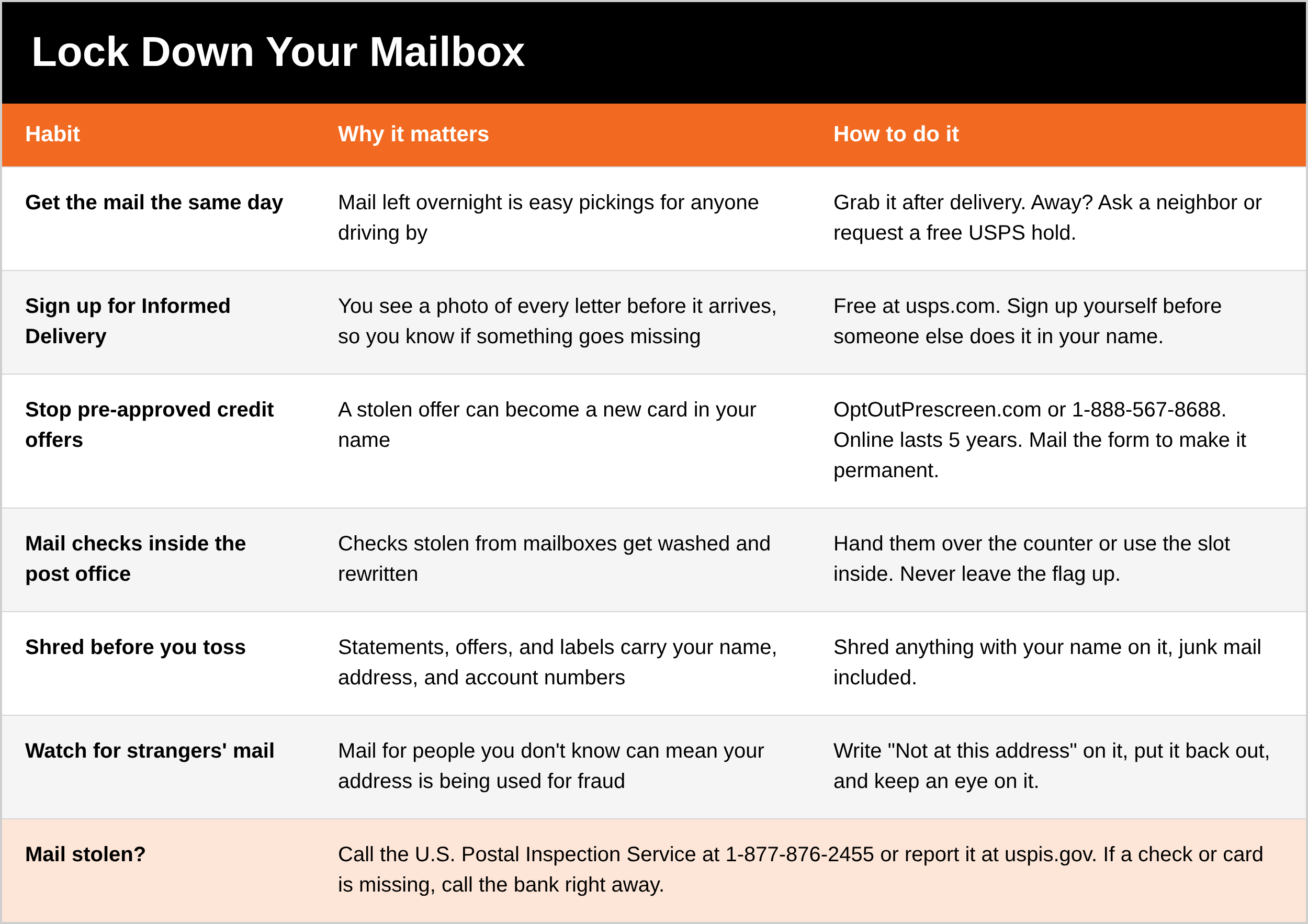
Get the mail the same day. The Postal Inspection Service says don't leave mail in the box overnight. If you're away, ask a neighbor you trust, or ask the post office to hold it. A mail hold is free.
Sign up for Informed Delivery. It's a free service from USPS that emails you a picture of every letter headed to your mailbox that day. If your bank statement shows up in the email and not in the box, you know right away. Sign up yourself at usps.com. Thieves have been caught signing up in other people's names so they know exactly when a new card is coming. Get there first.
Stop the pre-approved offers. Go to OptOutPrescreen.com or call 1-888-5-OPT-OUT (1-888-567-8688). It's run by the credit bureaus and it stops those offers for five years. To stop them for good, start online and mail in the signed form they send you.
Mail checks inside the post office. Don't put a check in your mailbox and raise the flag. That little red flag tells everyone driving by there's something worth taking. Hand it over the counter or drop it in the slot inside.
One more thing to watch: if you start getting mail for people who don't live with you, especially names you've never heard of, pay attention. Your address could be used as a drop point for fraud.
Get the free Scam Stopper Plan. The 4 D's and Stop, Verify, Tell in one plan, plus the red flags to watch for, what to do if you already clicked, and a fridge card for every adult in the house. Get it free here
Step 2: Clean Out the Glove Box
Now walk out to your car and open the glove box. What's in there?
For most families, it's the registration, the insurance card, a few old receipts, maybe some mail you meant to drop off. Every one of those has your name and home address on it.
Here's why that matters.
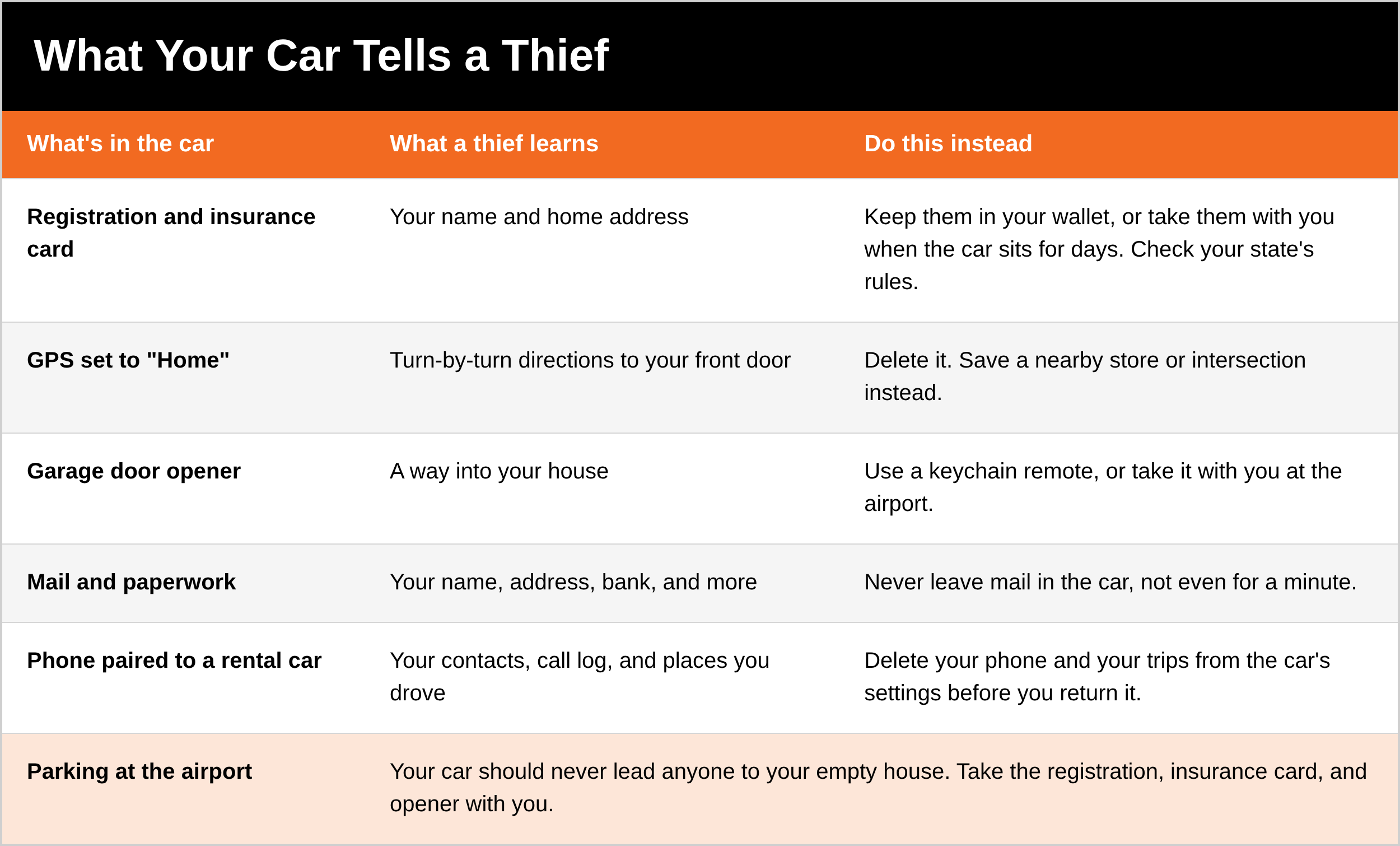
You park at the airport for a family trip. Someone breaks a window. They don't just get what's in the car. They get your home address from the registration, directions from the GPS, and a key to the garage. They also know you're not home, because your car is sitting in a lot at the airport.
This isn't just a "what if." Police departments around the country have warned about thieves who break into cars, use the registration or the GPS to find the house, then open the garage with the owner's own remote.
Three Fixes You Can Make Today
Never set "Home" in your GPS. Delete it. Save a store, a gas station, or an intersection near your house instead. It gets you close enough to drive the rest of the way, and it tells a stranger nothing.
Take the paperwork with you. Keep your registration and insurance card in your wallet, or at least take them with you when the car will sit somewhere for days. Most states now accept a digital insurance card on your phone. Rules on carrying your registration vary, so check your state and county for the exact rules where you live.
Don't leave the garage opener in the car. Switch to a small keychain remote, or take the visor remote with you when you park at the airport, a trailhead, or anywhere the car will sit alone.
Renting a Car? Delete Yourself Before You Return It
When you pair your phone with a rental car, the car can save your contacts, your call log, and every place you drove, including your hotel. The FTC warns that if you don't delete it, the next renter can see it.
Two quick habits:
If you only need to charge your phone, use a plug-in car charger or a power bank, not the car's USB port. The FTC says that port can pull data from your phone.
Before you turn in the keys, open the car's settings, find your phone in the list of paired devices, and delete it. Clear any saved trips or addresses too.
The full pickup-to-return list is in The Family Safety Toolkit's Rental Car Safety and Readiness Checklist.
The Prepared Protector checks more than one mailbox and more than one glove box. Older parents are a favorite target for mail theft. Many still mail checks and get paper statements, and many have never heard of Informed Delivery. Sign them up. Check their glove box and their GPS while you're at it. Then do the same for your college student's car before it heads back to campus. The Prepared Protector is someone who's decided that loving someone means being ready for them, not just hoping things go fine.
What to Say
To your parents: "Let's sign you up for Informed Delivery. You'll get an email with a picture of your mail every morning, so if a check or a card goes missing, you'll know that day."
To your teen with a new license: "Don't keep anything in the car with our address on it, and don't set 'Home' in the GPS. Use the gas station on the corner instead."
To the family before a trip: "Registration, insurance card, and garage opener come with us. Nothing in the car should lead anyone back to the house."
Ask Yourself
If someone took my mail today, how long would it take me to notice?
If someone broke into my car right now, would they know where I live?
Is my parents' mail, and their car, any safer than mine?
5 Quick Wins You Can Start Today
Sign up for Informed Delivery at usps.com.
Opt out of pre-approved credit offers at OptOutPrescreen.com.
Delete "Home" from your car's GPS and save a nearby store instead.
Move the registration and insurance card from the glove box to your wallet, after checking your state's rules.
Mail your next check from inside the post office, not your home mailbox.
Remember
Thieves don't always need your passwords. Sometimes they just need your mailbox or your glove box. Lock down both, and your home address stays where it belongs: with you.
That's the Series
You've made it through all six parts. You know the 4 D's, how to spot fake texts and pop-ups, how to lock your accounts, how to catch fraud early, and now how to protect your mail and your car. That's more than most families ever learn. Share it with the people you love.
Quick Answers
How can I protect my mail from theft?
Pick up your mail the same day it's delivered, sign up for USPS Informed Delivery, and mail checks from inside the post office instead of your home mailbox. If you think your mail was stolen, call the U.S. Postal Inspection Service at 1-877-876-2455.
Is it safe to save my home address in my car's GPS?
It's safer not to. If your car is stolen or broken into, a saved "Home" address gives a thief directions to your house. Save a nearby store or intersection instead, and don't leave a garage door opener in the car.
Should I keep my car registration in the glove box?
Your registration and insurance card show your name and home address. Many people keep them in a wallet instead, especially when the car will be parked for days, like at the airport. Rules vary by state, so check yours.
How do I stop pre-approved credit card offers?
Go to OptOutPrescreen.com or call 1-888-5-OPT-OUT (1-888-567-8688). That stops prescreened offers for five years. To stop them permanently, start the request online, then sign and mail the form you're sent.
Get Started Today
Get the free Scam Stopper Plan. The 4 D's, Stop, Verify, Tell, the red flags to watch for, what to do if you already clicked, a family plan page, and a fridge card for every adult in the house. [Get it here: https://www.preparednotparanoid.com/downloads-cyber-safety]
Go Deeper
Cyber Safety: A Beginner's Guide to Securing Your Digital Footprint and Avoiding Online Scams. This post covers the mailbox and the glove box. The guide goes further: protecting business and company mail, spotting when your address is being used as a drop point, when a P.O. box makes sense, valet mode, and how to protect your car on long trips, all in plain language. Get it here
The Family Safety Toolkit. 20 complete safety checklists, including the Home Vacation Checklist, the Rental Car Safety and Readiness Checklist, and Protecting Older Adults from Scams and Financial Exploitation. Get it here
Tools I recommend: Locking mailboxes, shredders, and other tools that help protect your home are in my Amazon store, The Safest House on the Block.
The Full Series
Part 1: The 4 D's That Stop Most Scams
Part 2: Toll Texts, Missed Packages, and the QR-Code Mystery Box
Part 4: Passwords and Two-Factor Sign-In
Part 5: Catch Fraud Early: Alerts, Credit Freezes, and Virtual Cards
Part 6: Your Mailbox and Your Glove Box (you are here)
Related Reading
References
U.S. Postal Inspection Service, Mail Theft tips and reporting
Federal Trade Commission, What To Know About Prescreened Offers
Patch, Baltimore County Official: Don't Make It Easy for Thieves
These suggestions are intended to help you and your family build awareness, confidence, and safer decision-making habits. No safety plan, checklist, or training can guarantee 100% protection. There will always be people who try to exploit vulnerability, opportunity, trust, or positions of power. The goal is not to create fear, but to help guide families toward more informed, prepared, and practical safety decisions in everyday life. This article is not legal, financial, or technical advice. Rules on carrying your registration and proof of insurance vary, so check your state and county for the exact rules where you live. As an Amazon Associate, I earn from qualifying purchases.
If you are in immediate danger, call 911. If you think your mail was stolen, call the U.S. Postal Inspection Service at 1-877-876-2455 or report it at uspis.gov. If a check or card is missing, call your bank right away using the number on the back of your card. Adults 60 and older can call the National Elder Fraud Hotline at 1-833-FRAUD-11 (1-833-372-8311).
Awareness gives you time. Time gives you options.
The Prepared Protector is someone who's decided that loving someone means being ready for them, not just hoping things go fine.
Prepared Not Paranoid. Protecting the Most Vulnerable Among Us.