Two Free Steps That Turn Months of Damage Into Minutes
By Larry Betz | Prepared Not Paranoid https://www.preparednotparanoid.com/
A credit freeze is free, takes a few minutes online at each credit bureau, and stops thieves from opening new accounts in your name. Pair it with account alerts on your phone, and you'll know about a bad charge in minutes instead of months.
Here's how most families find out about fraud. A bill shows up for a card they never opened. A collection agency calls about a loan they never took out. By then, the thief has had weeks, sometimes months, to run up the damage.
It's not a rare problem. In 2025, people filed more than 1.3 million identity theft reports with the FTC, and credit card fraud was the most common kind.
In Part 4, we put two locks on your accounts. This post is about the other half of the plan: finding out fast if something gets through, and slamming the door on accounts that were never yours to begin with.
Both steps are free. You can do both tonight.
Step 1: Turn On Alerts Tonight
Your bank and credit card already watch your account for fraud. Alerts let you watch it too, in real time.
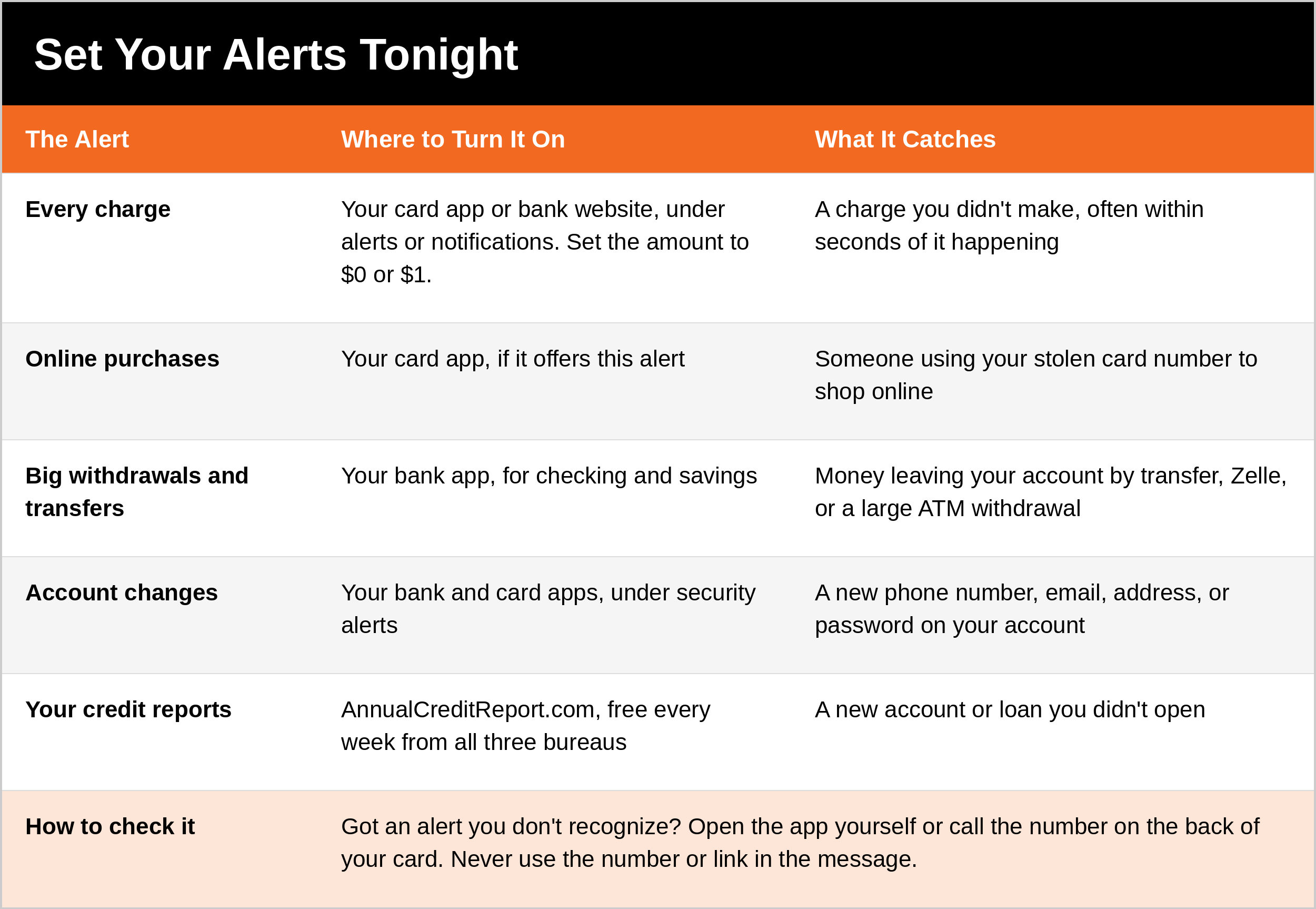
Open your card's app or your bank's website and look for "alerts" or "notifications." Most families have never touched this menu. Here's what to turn on:
Every charge. Set the alert for any purchase over $0 or $1. Your phone dings every time your card is used. If it dings and you're sitting on the couch, you know right away.
Big withdrawals and transfers. Money leaving your checking or savings by transfer or Zelle should never be a surprise.
Account changes. If someone changes the phone number, email, or address on your account, you want to know before they do anything else. That's often the first move a thief makes.
Yes, you'll get more notifications. That's the point. A ding you expected takes one second to swipe away. A ding you didn't expect just saved you hours on the phone with your bank.
Check Your Credit Reports for Free
Alerts watch the accounts you have. Your credit report shows the accounts you don't know about.
You can pull your credit reports from all three bureaus, Equifax, Experian, and TransUnion, free, every week, at AnnualCreditReport.com. That's the only official site. Others may charge you or be fake.
Look for accounts you didn't open, addresses you never lived at, and credit checks from companies you never contacted.
Get the free Scam Stopper Plan. The 4 D's and Stop, Verify, Tell in one plan, plus the red flags to watch for, what to do if you already clicked, and a fridge card for every adult in the house. Get it free here
The Fake Alert Scammers Send
Here's the catch. Once you start getting real alerts, scammers know you'll trust them. So they send fake ones.
In an FTC look at text scam reports, the fake bank fraud alert was one of the most common. It looks like this:
WARNING
BANK FRAUD ALERT: Did you attempt a purchase of $1,263.89 at an electronics store? Reply YES or NO.
This is what the fake fraud alert text looks like. Most people reply NO. Then the "fraud department" calls.
You reply NO, because you didn't buy anything. A minute later, your phone rings. It's "the fraud department," and they're ready to help you protect your money. They ask you to confirm your card number, read them a code, or move your money to a "safe" account.
There was never a real charge. The text was bait.
The rule: never answer a fraud alert through the text, link, or number in the message. Open your bank's app yourself, or call the number on the back of your card. If the charge is real, it'll be there. (We walk through the fake bank call step by step in Scam Proofing Part 2.)
Step 2: Freeze Your Credit
Alerts tell you when something happens. A credit freeze stops the biggest thing from happening in the first place.
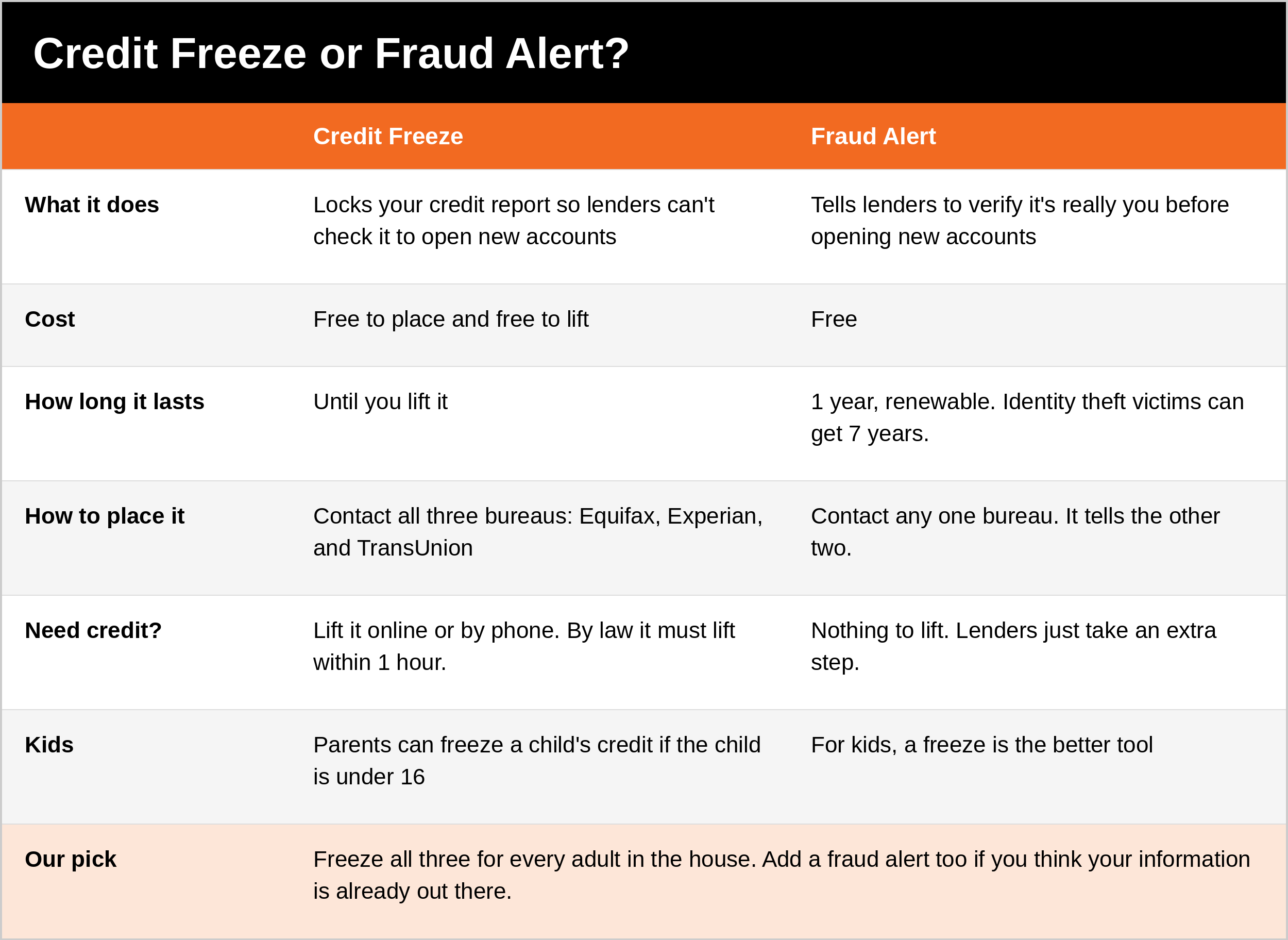
When a thief has your name, birthday, and Social Security number, they don't need your cards. They open new ones, in your name. Before a lender approves a new card or loan, it checks your credit report. A freeze locks that report. No credit check, no new account.
Here's what most people don't know:
It's free. Federal law has made credit freezes free to place and free to lift since 2018.
It doesn't hurt your credit score. Your cards, loans, and mortgage keep working like normal.
You can lift it fast. Need a car loan or a new phone plan? Lift the freeze online or by phone, and by law it has to come off within an hour. Freeze it again when you're done.
You have to do all three. Equifax, Experian, and TransUnion each need their own freeze. Each one gives you a PIN or account to lift it later. Keep those somewhere safe.
What About a Fraud Alert?
A fraud alert is different. It doesn't lock your report. It tells lenders to take an extra step to make sure it's really you before they open anything. It's free, lasts one year, and you only have to contact one bureau, which tells the other two.
A freeze is stronger. If you think your information is already out there, after a data breach or a lost wallet, do both.
Don't Forget the Kids
Children are a favorite target because nobody checks a child's credit. A thief can use a child's Social Security number for years before anyone finds out, often when that child applies for a first car loan or student loan.
If your child is under 16, you can freeze their credit for free. The bureaus will create a file just so they can freeze it. You'll need to show you're the parent, usually with a birth certificate and Social Security card.
The Prepared Protector freezes more than one file.
Freezing your own credit takes one sitting. Then sit down with your parents and do theirs. Older adults are a top target, and most have never heard of a credit freeze. Do your kids' too. It's one evening of work that protects every person in your house for years. The Prepared Protector is someone who's decided that loving someone means being ready for them, not just hoping things go fine.
Bonus: Shop Online With a Virtual Card Number
Every time you type your card number into a website, you're trusting that store to keep it safe. When that store gets hacked, your number goes with it.
Some credit card companies now offer virtual card numbers. It's a stand-in number tied to your real account. The store sees the stand-in, never your real number. If that store is breached, you delete the virtual number and your real card keeps working.
Check your card's app to see if it offers them. They're especially handy for a small website you've never bought from before, or a free trial you're worried you'll forget to cancel.
One honest limit: a virtual number protects you from a store's data breach. It won't help if a scammer talks you into reading off your real card number or a code. That's still on you.
What to Say
To anyone who texts or calls about a fraud alert: "I'll check it in my app." Then hang up and do exactly that.
To your parents: "Let's freeze your credit together this weekend. It's free, it won't change anything about your cards, and it stops anyone from opening a credit card in your name."
To your teen when they're ready for a first card or loan: "Your credit is frozen to protect you. When it's time, we'll lift it together, and then we'll put it right back."
Ask Yourself
Would I know today if someone used my card yesterday?
When was the last time I looked at my credit report?
Are my parents' and kids' credit frozen, or just mine?
5 Quick Wins You Can Start Today
Turn on an alert for every charge on every card you use.
Pull your free credit reports at AnnualCreditReport.com and look for anything you don't recognize.
Freeze your credit at Equifax, Experian, and TransUnion, and store the PINs somewhere safe.
Put a date on the calendar to help your parents freeze theirs.
If your kids are under 16, request a freeze for them too.
Remember
You can't stop every data breach. You can make sure that when your information gets out, a thief can't open anything with it, and you find out about a bad charge in minutes, not months.
Coming Up in Part 6
Your Mailbox and Your Glove Box. The everyday places thieves find your information without ever touching a computer, from the mail on your porch to the paperwork in your car, plus why you should never set "Home" in your car's GPS.
Quick Answers
Does a credit freeze hurt my credit score?
No. A credit freeze doesn't affect your credit score, and your existing cards and loans keep working. It only stops new lenders from checking your credit report, which keeps thieves from opening accounts in your name.
How do I freeze my credit?
Contact each of the three credit bureaus, Equifax, Experian, and TransUnion, online or by phone. It's free. Online or phone freezes go into effect within one business day, and you can lift one within an hour when you need new credit.
What's the difference between a credit freeze and a fraud alert?
A credit freeze locks your credit report so lenders can't check it. A fraud alert leaves your report open but tells lenders to verify your identity first. A freeze is stronger. A fraud alert lasts one year and only takes one call.
Is a credit lock the same as a credit freeze?
They work in a similar way, but a credit lock is a product the bureaus sell, and it may come with a monthly fee. A credit freeze is free and guaranteed by federal law. The FTC says if you want the free option, choose a freeze.
Get Started Today
Get the free Scam Stopper Plan. The 4 D's, Stop, Verify, Tell, the red flags to watch for, what to do if you already clicked, a family plan page, and a fridge card for every adult in the house. [Get it here: https://www.preparednotparanoid.com/downloads-cyber-safety]
Go Deeper
Cyber Safety: A Beginner's Guide to Securing Your Digital Footprint and Avoiding Online Scams. This post gives you the alerts and the freeze. The guide gives you the whole system: the other files thieves use that most people never freeze, protecting your tax refund and Social Security, credit locks and monitoring services compared, and exactly what to do the day you find fraud, all in plain language. Get it here
The Family Safety Toolkit. 20 complete safety checklists, including Protecting Older Adults from Scams and Financial Exploitation, with the everyday safeguards every family should have in place for their parents. Get it here
Tools I recommend: Tools that help protect your family's identity and accounts are in my Cyber Safety Amazon store.
The Full Series
Part 1: The 4 D's That Stop Most Scams
Part 2: Toll Texts, Missed Packages, and the QR-Code Mystery Box
Part 4: Passwords and Two-Factor Sign-In
Part 5: Catch Fraud Early: Alerts, Credit Freezes, and Virtual Cards (you are here)
Part 6: Your Mailbox and Your Glove Box
Related Reading
References
Federal Trade Commission, What To Know About Credit Freezes and Fraud Alerts: https://consumer.ftc.gov/articles/what-know-about-credit-freezes-and-fraud-alerts
Federal Trade Commission, Credit Freeze or Fraud Alert: What's Right for Your Credit Report?: https://consumer.ftc.gov/articles/credit-freeze-or-fraud-alert-whats-right-your-credit-report
Federal Trade Commission, Starting today, new federal law allows consumers to place free credit freezes and yearlong fraud alerts (Sept 2018): https://ftc.gov/news-events/press-releases/2018/09/starting-today-new-law-allows-consumers-place-free-credit-freezes
USA.gov, How to place or lift a security freeze on your credit report: https://usa.gov/credit-freeze
Federal Trade Commission, How To Protect Your Child From Identity Theft: https://consumer.ftc.gov/articles/how-protect-your-child-identity-theft
Consumer Financial Protection Bureau, New protections available for minors under 16: https://www.consumerfinance.gov/about-us/blog/new-protections-available-minors-under-16
Federal Trade Commission, You now have permanent access to free weekly credit reports (Oct 2023): https://consumer.ftc.gov/consumer-alerts/2023/10/you-now-have-permanent-access-free-weekly-credit-reports
Federal Trade Commission, FTC testifies before Joint Economic Committee on agency's efforts to combat fraud (March 2026): https://www.ftc.gov/news-events/news/press-releases/2026/03/ftc-testifies-joint-economic-committee-agencys-efforts-combat-fraud
Experian, Identity Theft Statistics (2025 FTC data): https://www.experian.com/blogs/ask-experian/identity-theft-statistics/
Federal Trade Commission, Data Spotlight: text message scams: https://www.ftc.gov/system/files/ftc_gov/pdf/texts-spotlight-final.pdf
Capital One, What are virtual card numbers and how do they work?: https://www.capitalone.com/learn-grow/money-management/what-are-virtual-card-numbers/
These suggestions are intended to help you and your family build awareness, confidence, and safer decision-making habits. No safety plan, checklist, or training can guarantee 100% protection. There will always be people who try to exploit vulnerability, opportunity, trust, or positions of power. The goal is not to create fear, but to help guide families toward more informed, prepared, and practical safety decisions in everyday life. This article is not legal, financial, or technical advice. Some states have their own rules on credit freezes and reporting, so check your state and county for the exact rules where you live. As an Amazon Associate, I earn from qualifying purchases.
If you are in immediate danger, call 911. If you find an account or charge you didn't make, call the bank or card company right away using the number on the back of your card, then report it at IdentityTheft.gov. Adults 60 and older can call the National Elder Fraud Hotline at 1-833-FRAUD-11 (1-833-372-8311).
Awareness gives you time. Time gives you options.
The Prepared Protector is someone who's decided that loving someone means being ready for them, not just hoping things go fine.
Prepared Not Paranoid. Protecting the Most Vulnerable Among Us.