Warm Up to Move, Roll Out What's Tight
By Larry Betz | Prepared Not Paranoid https://www.preparednotparanoid.com/
Updated November 9, 2026
Here's a mistake I've watched people make for decades: they walk into the gym, sit on the floor, hold a hamstring stretch for a minute, and then go straight under a heavy bar.
It feels like the responsible thing to do. For lifting, though, it's not the best way to get ready.
In my years running gyms and training clients, a lot of them post-rehab or older adults, the warm-up is one of the first things I fix. A good warm-up doesn't just loosen you up. It gets your joints, muscles, and nervous system ready for the work ahead, and it's one of the simplest ways to stay injury-free.
Staying strong and moving well is part of being prepared. You can't protect anyone if you're sidelined with an injury you could have prevented.
Movement Preparation
Movement preparation, also called a dynamic warm-up, is a complete approach to getting your body ready for physical activity. It goes beyond simple stretching. It prepares your body for the specific demands of the workout or sport you're about to do.
Stretching vs. Movement Preparation for Weight Lifting
Before a weight lifting session, it's important to understand the difference between stretching and movement preparation.
Stretching, especially static stretching, means holding a muscle in a lengthened position to increase flexibility and muscle length. It's beneficial for improving long-term flexibility and for relaxing your muscles after a workout. Static stretching right before lifting, though, can temporarily decrease muscle strength and power, especially with long holds (research points to holds of 60 seconds or more per muscle).
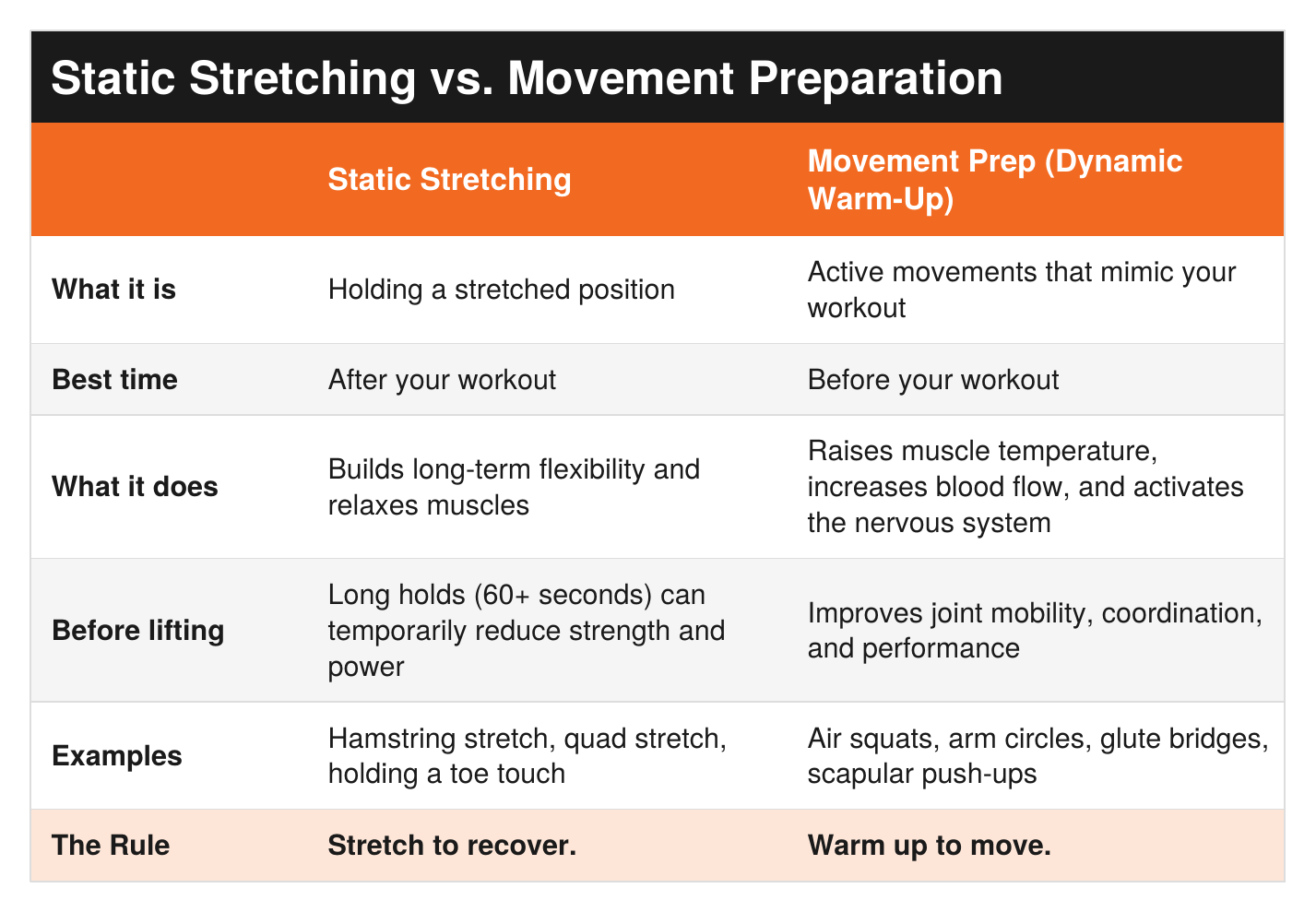
Movement preparation uses active movements that mimic the exercises you're about to do, such as:
Scapular push-ups
Arm circles
Glute bridges
Bodyweight squats
This increases blood flow, raises muscle temperature, and wakes up your nervous system, which improves how quickly and smoothly your muscles respond.
A dynamic warm-up better prepares your body for lifting by improving joint mobility, reducing the risk of injury, and helping you perform at your best.
That makes it the better choice before you lift. Save the long static stretches for after.
My Dynamic Warm-Up
This is the same warm-up I give my new clients. Sixteen moves, head to toe.
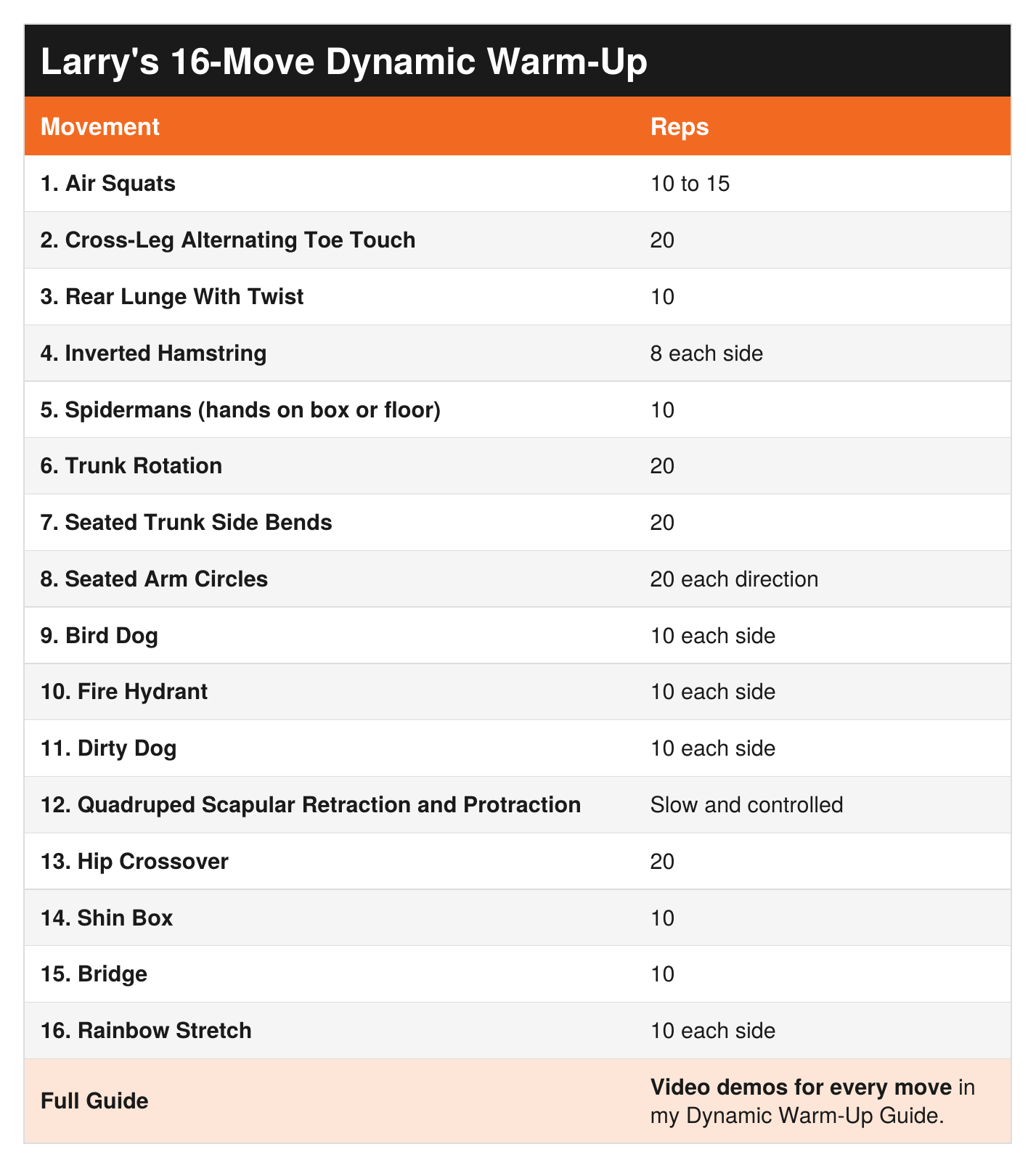
My free Dynamic Warm-Up Guide takes you head to toe in about 10 minutes, with a video demo for every move. Get it free here.
Self-Myofascial Release (SMR)
Self-myofascial release (SMR) is a technique used to relieve tension and improve how your muscles and fascia (the connective tissue that surrounds your muscles) function.
Purpose: SMR aims to relieve tightness, improve flexibility, and speed up recovery. It's often described as breaking up adhesions and scar tissue to improve muscle and joint function. Current research suggests much of the benefit comes from how your nervous system responds to the pressure: muscles relax, tension drops, and range of motion improves.
Tools used: Foam rollers, massage balls, and other specialized tools designed to apply pressure to specific areas of the body.
Technique: Use your body weight to apply sustained pressure to specific muscle groups and trigger points. Work each tender spot for about 30 to 90 seconds, spending 3 to 5 minutes total on an area. The pressure helps release muscle knots (trigger points), which are tight areas of fascia, and restores normal blood flow and function to the area.
Self-Care: Self-Myofascial Release Tools
Different areas of your body need different tools to really get into the tissue. Here's a list to help you find the right one for you.
Foam Roller: A cylinder of dense foam used to apply pressure to large muscle groups. Foam rollers help release muscle tightness, improve blood flow, and increase range of motion.
Massage Ball: A small ball, firm or air-filled, used to target specific knots and trigger points. Great for hard-to-reach areas like the glutes, shoulders, and feet.
Massage Stick (e.g., Tiger Tail): A handheld tool with a rolling mechanism that lets you apply deep pressure. Useful for working out knots and promoting circulation, especially in the legs and back.
Percussion Massager (e.g., Theragun): A handheld device that delivers rapid, concentrated pulses for deep tissue massage. Effective for reducing muscle soreness, improving flexibility, and speeding recovery.
Half Spike Ball: A versatile SMR tool with a half-dome shape and a textured surface. It gives you targeted pressure on specific muscle groups to relieve tension and knots. The stable base combines with the challenge of a massage ball, and the textured points help stimulate blood flow and muscle recovery.
Stretching Strap: A long, non-elastic strap with loops that helps you stretch deeper while keeping good form. Especially useful for the hamstrings, shoulders, and hips.
Putting It All Together
Mobility, stability, stretching, movement preparation, and self-myofascial release all belong in your routine.
Mobility and stability are the foundation of good movement. They let you handle daily activities and sports with ease and confidence.
Stretching improves flexibility and range of motion.
Movement preparation primes your body for exercise by improving blood flow, muscle activation, and joint mobility.
Self-myofascial release tools like foam rollers, massage balls, and percussion massagers relieve muscle tension, improve recovery, and help prevent injuries.
Put these practices together and you'll improve your overall functional fitness, reduce discomfort, and protect your long-term well-being.
Warm up before you lift, roll out what's tight after. The free Dynamic Warm-Up Guide is a simple warm-up routine to get your body ready to move and help prevent injury.
The Prepared Protector doesn't skip the ten minutes that keep them in the game. Warm up before you train, roll out what's tight, stretch when you're done. You can't protect anyone from the sidelines.
Ask Yourself
Do I warm up before I lift, or do I just stretch and start?
Where does my body feel tight most often, and do I have the right tool for that area?
Am I spending a few minutes on recovery after I train?
Remember
Warm up to move. Stretch to recover. A few minutes of movement prep before you lift is one of the simplest ways to train harder and stay injury-free.
Get Started Today
Get the free Dynamic Warm-Up Guide. A simple warm-up routine to get your body ready to move and help prevent injury. Get it free here.
Get the free First Aid and Trauma Guide. What to keep on hand and what to know so you can act fast when someone is hurt. Get it free here.
The Go Bag Checklist, the Mobile Command Center Checklist, and the First Aid and Trauma Checklist are all inside The Family Safety Toolkit. For a comprehensive family safety guide, pick up your copy of The Family Safety Toolkit.
Quick Answers
Should I stretch before lifting weights?
Use a dynamic warm-up instead. Long static holds right before lifting, especially 60 seconds or more per muscle, can briefly reduce strength and power. Save static stretching for after your workout.
What is movement preparation?
Movement preparation, or a dynamic warm-up, uses active moves like scapular push-ups, arm circles, glute bridges, and bodyweight squats. It raises muscle temperature, increases blood flow, and wakes up your nervous system for the work ahead.
How long should I foam roll a tight spot?
Work each tender spot for about 30 to 90 seconds, and spend about 3 to 5 minutes total on an area. Use your body weight for steady pressure, and back off if it becomes sharp pain.
Which self-myofascial release tool should I start with?
A foam roller covers large muscle groups, and a massage ball reaches smaller spots like the glutes, shoulders, and feet. Those two handle most needs; add a massage stick, percussion massager, or stretching strap as you go.
Tools I Recommend
For the foam rollers, massage balls, percussion massagers, and stretching straps I use, see my Recovery Amazon store, and for more mobility and training gear, my Fitness Amazon store.
The Full Series
Related Reading
References
Chaabene, H., Behm, D. G., et al. (2019). Acute Effects of Static Stretching on Muscle Strength and Power: An Attempt to Clarify Previous Caveats. Frontiers in Physiology. https://www.frontiersin.org/articles/10.3389/fphys.2019.01468/full
Behm, D. G., and Wilke, J. (2019). Do Self-Myofascial Release Devices Release Myofascia? Rolling Mechanisms: A Narrative Review. Sports Medicine.
Disclaimer
These suggestions are intended to help you and your family build awareness, confidence, and safer decision-making habits. No safety plan, checklist, or training can guarantee 100% protection. The goal is not to create fear, but to help guide families toward more informed, prepared, and practical safety decisions in everyday life. As an Amazon Associate, I earn from qualifying purchases. Product mentions reflect my own experience.
This article is for general informational and educational purposes only. It is not medical advice and is not a substitute for guidance from your physician, physical therapist, or a qualified fitness professional. Check with your doctor before starting a new exercise program, especially if you have an injury, a health condition, or haven't trained in a while. Stop any movement that causes sharp pain. Avoid rolling or using a percussion massager directly on bones, joints, the front of the neck, or any area with a recent injury, blood clot, or swelling.
If you have sudden severe pain, chest pain, or trouble breathing, stop and call 911.
Awareness gives you time. Time gives you options.
The Prepared Protector is someone who's decided that loving someone means being ready for them, not just hoping things go fine.
Prepared Not Paranoid. Protecting the Most Vulnerable Among Us.