Flexibility Starts in Your Nervous System
By Larry Betz | Prepared Not Paranoid https://www.preparednotparanoid.com/
Updated November 9, 2026
"I'm just not flexible." I've heard that from clients for as long as I've been training people. Most of them believe their muscles are simply too short, and the only fix is to pull on them harder and longer.
Here's the good news: flexibility isn't only about your muscles. A big part of it lives in your nervous system, and your nervous system can be trained.
Over the years, a lot of my work has been post-rehab training and helping older adults stay strong and mobile. Understanding how stretching actually works changes how you stretch, and the results you get. Moving well is part of being prepared. When you need to get down on the floor, lift a child, help a parent up, or move fast, you want a body that cooperates.
Understanding Stretching: The Role of the Central Nervous System
Contrary to popular belief, the benefits of stretching don't come mainly from making muscles longer. They come largely from the response of your central nervous system (CNS).
When you stretch, sensory receptors in your muscles and tendons, called muscle spindles and Golgi tendon organs, send signals to your CNS. These signals help your CNS judge the right length-tension relationship and adjust muscle tone to match.
This feedback reduces muscle stiffness and increases your tolerance to the stretch, which shows up as better flexibility.
In simple terms: stretching trains your nervous system to let your muscles relax and lengthen further without firing a protective contraction. That's how you improve overall mobility and range of motion.
The Role of Fascia
Fascia is the connective tissue that surrounds your muscles, organs, and other structures. It plays an important role in stretching and range of motion.
Research has shown that fascia is packed with sensory nerve endings that report back to your CNS, which makes it highly responsive to input. When you stretch, that two-way communication between your nervous system and your fascia helps adjust tension and stiffness.
This nervous system and fascia connection helps your tissues adapt, allowing for:
Greater flexibility
Less stiffness
Better movement patterns
Better muscle function
A lower risk of injury
Understanding the role of fascia is one more reason stretching belongs in your routine.
The Six Types of Stretching
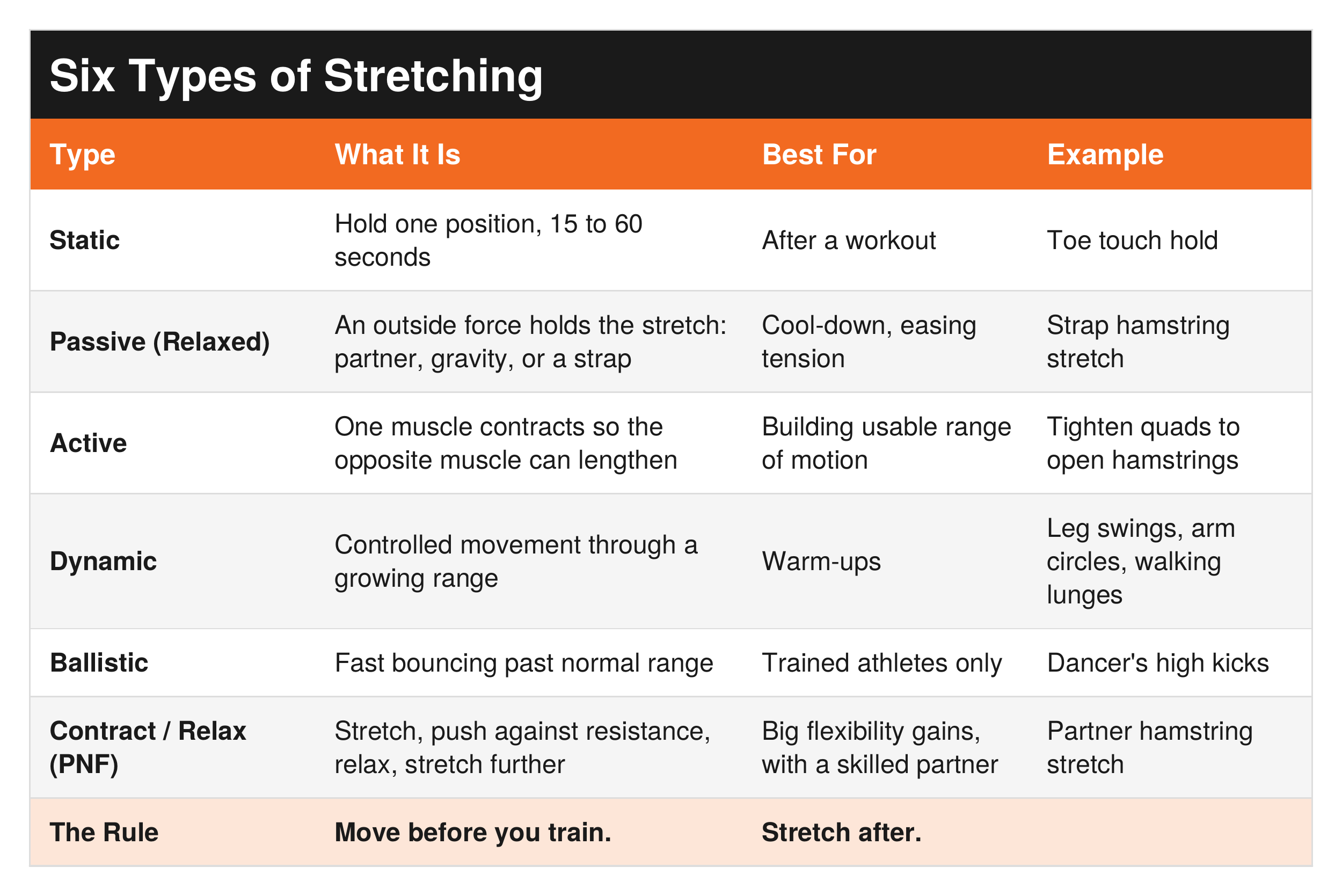
1. Static Stretching
You hold a stretch for an extended period, typically 15 to 60 seconds. For example, reaching down to touch your toes and holding that position stretches your hamstrings and lower back.
Static stretching is great for improving flexibility. It's usually done after a workout, when your muscles are warm, and it helps with recovery and reducing muscle soreness.
2. Passive (Relaxed) Stretching
You get into a stretch position and hold it with help from an outside force: a partner, gravity, or a stretching device.
For example, lie on your back with one leg extended and use a strap to pull that leg toward you. That stretches your hamstrings passively.
Passive stretching is effective for cooling down and reducing muscle tension, because your muscles can relax and lengthen without working.
3. Active Stretching
In active stretching, one muscle (the agonist) contracts while the target muscle (the antagonist) lengthens.
This is called reciprocal inhibition, and it's the core reason active stretches work. When one side of a joint contracts, your nervous system tells the opposite side to relax.
Example: contract the muscles on the front of your leg (quadriceps) to increase the range of motion on the back of your leg (hamstrings).
4. Dynamic Stretching
A dynamic stretch uses motion through the stretch instead of holding one position. You move parts of your body and gradually increase your reach, your speed, or both.
Examples: leg swings, arm circles, and walking lunges.
Dynamic stretching gets your muscles ready for exercise by raising your body temperature and heart rate, improving blood flow and flexibility without reducing strength. That's why it's the go-to for a warm-up. (More on this in Part 3, including my full 16-move warm-up.)
5. Ballistic Stretching
Ballistic stretching uses rapid, bouncing movements to push a muscle past its normal range of motion. For example, a dancer might do high kicks to stretch the hamstrings.
It can increase range of motion, but it carries a high risk of injury, like muscle tears and strains, because the muscle is explosively forced into an extended range.
Unless your body has adapted to that kind of force and your activity requires it, ballistic stretching probably isn't worth the risk for the average person.
6. Contract / Relax Stretching (PNF)
This technique, a form of PNF (proprioceptive neuromuscular facilitation), combines stretching and contracting the target muscle:
The muscle is passively stretched.
It's contracted isometrically (pushing without moving) against resistance while in the stretched position.
It's relaxed, then stretched again through the new, increased range of motion.
Hamstring example: Lie on the floor with one leg flat. Lift the other leg as high as you can. At that end range, push your heel into your partner's hand for about 7 seconds. Then relax and let your partner take you further into the hamstring stretch.
This technique is highly effective for increasing flexibility and is often used in physical therapy and athletic training. Because it uses a partner and strong contractions, work with someone who knows the technique, and never force the stretch.
Stretch Smart
Whatever type of stretching you use, these six rules keep it safe and make it work better.
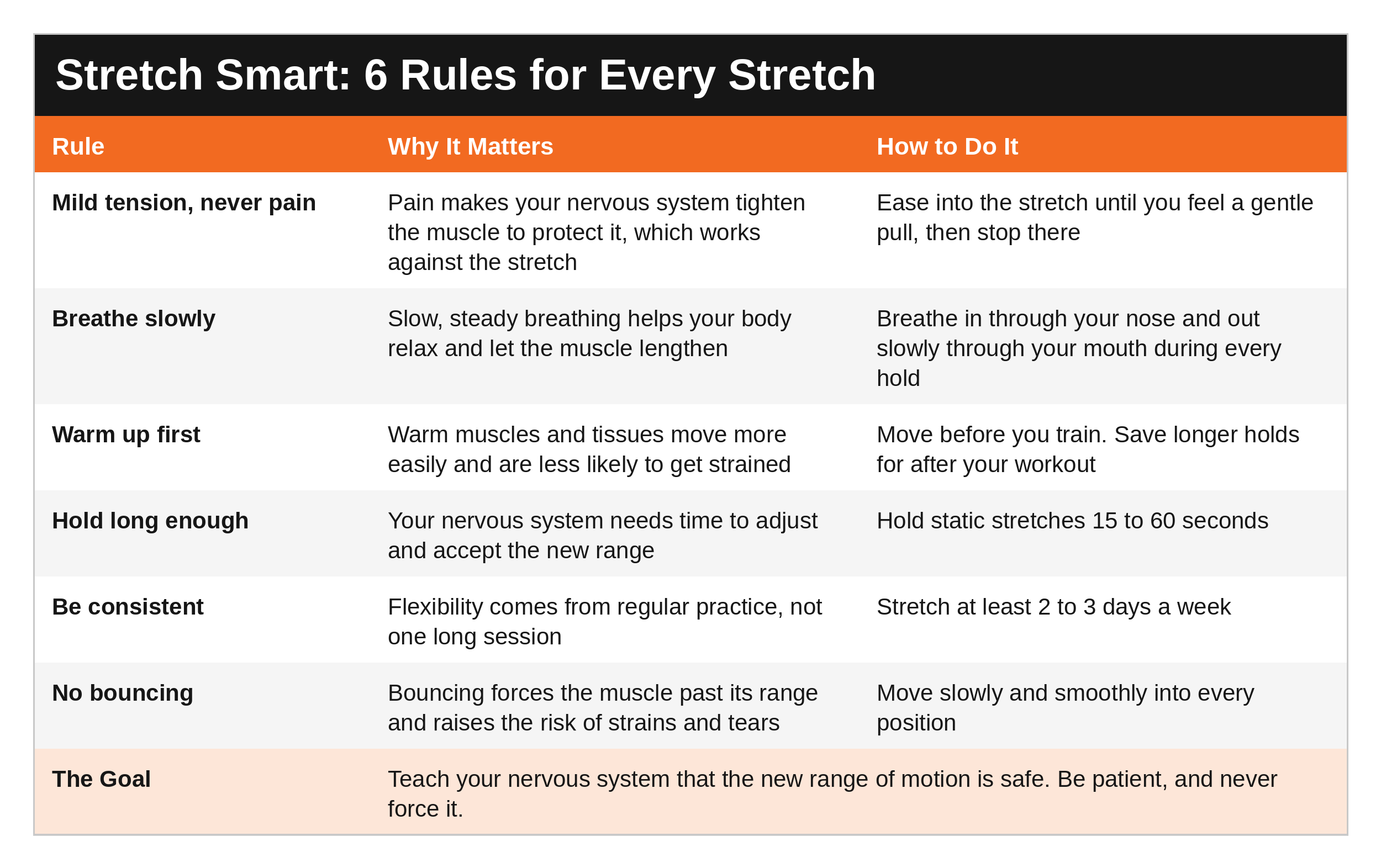
Move before you train, stretch after. The free Dynamic Warm-Up Guide is a simple warm-up routine to get your body ready to move and help prevent injury.
The Prepared Protector trains a body that cooperates. Getting down to a child on the floor, reaching a parent who's fallen, twisting to grab a bag in a hurry. A few minutes of the right stretching, at the right time, keeps you ready for all of it.
Ask Yourself
Do I stretch before I train, or after? Is that the right time for the type of stretch I'm doing?
Am I forcing stretches, or giving my nervous system time to let go?
Which type of stretching fits my body and my goals right now?
Remember
Flexibility is trained in your nervous system, not just your muscles. Move before you train. Stretch after. Be patient, breathe, and never force it.
Coming Up in Part 3: Movement Preparation, Self-Myofascial Release, and the Tools I Recommend
Next, in Part 3, we put it to work: movement preparation, my full 16-move warm-up, self-myofascial release, and the tools I recommend.
Next in the series: Mobility, Stability, Stretching, and Self Care- Part 3: Movement Preparation, Self-Myofascial Release, and the Tools I Recommend
Get Started Today
Get the free Dynamic Warm-Up Guide. A simple warm-up routine to get your body ready to move and help prevent injury. Get it free here.
Get the free First Aid and Trauma Guide. What to keep on hand and what to know so you can act fast when someone is hurt. Get it free here.
The Go Bag Checklist, the Mobile Command Center Checklist, and the First Aid and Trauma Checklist are all inside The Family Safety Toolkit. For a comprehensive family safety guide, pick up your copy of The Family Safety Toolkit.
Quick Answers
Does stretching make muscles longer?
Not mainly. Most of the gain comes from your nervous system learning to tolerate the stretch and let the muscle relax and lengthen further without a protective contraction.
Should I stretch before or after a workout?
Use dynamic stretching, like leg swings, arm circles, and walking lunges, to warm up before you train. Save static holds of 15 to 60 seconds for after your workout, when your muscles are warm.
Is ballistic stretching safe?
It uses fast, bouncing movements to force a muscle past its normal range, which carries a high risk of strains and tears. Unless your sport demands it and your body has adapted to it, it probably is not worth the risk.
What is PNF stretching?
PNF, or contract and relax stretching, has you stretch a muscle, push against resistance in that position for about 7 seconds, then relax and stretch further. It works well, but do it with a partner who knows the technique and never force it.
Tools I Recommend
For the stretching straps and mobility tools I use, see my Fitness Amazon store, and for foam rollers and recovery gear, my Recovery Amazon store.
The Full Series
Related Reading
References
Behm, D. G., et al. (2016). Acute effects of muscle stretching on physical performance, range of motion, and injury incidence in healthy active individuals: a systematic review. Applied Physiology, Nutrition, and Metabolism.
Weppler, C. H., and Magnusson, S. P. (2010). Increasing Muscle Extensibility: A Matter of Increasing Length or Modifying Sensation? Physical Therapy.
Schleip, R., et al. Fascia: The Tensional Network of the Human Body (fascial innervation).
American College of Sports Medicine. ACSM's Guidelines for Exercise Testing and Prescription (flexibility recommendations).
Disclaimer
These suggestions are intended to help you and your family build awareness, confidence, and safer decision-making habits. No safety plan, checklist, or training can guarantee 100% protection. The goal is not to create fear, but to help guide families toward more informed, prepared, and practical safety decisions in everyday life. As an Amazon Associate, I earn from qualifying purchases. Product mentions reflect my own experience.
This article is for general informational and educational purposes only. It is not medical advice and is not a substitute for guidance from your physician, physical therapist, or a qualified fitness professional. Check with your doctor before starting a new exercise or stretching program, especially if you have an injury, a health condition, or haven't trained in a while. Stretch to mild tension, never pain, and stop any movement that causes sharp pain.
If you have sudden severe pain, chest pain, or trouble breathing, stop and call 911.
Awareness gives you time. Time gives you options.
The Prepared Protector is someone who's decided that loving someone means being ready for them, not just hoping things go fine.
Prepared Not Paranoid. Protecting the Most Vulnerable Among Us.