Gear That Buys Time When Seconds Matter
By Larry Betz | Prepared Not Paranoid https://www.preparednotparanoid.com/
A person with severe bleeding can die in as little as a few minutes. An ambulance often takes longer than that to arrive. That gap is where a trauma kit, and someone who knows how to use it, makes the difference. A car crash, a fall from a ladder, a kitchen knife, a power tool that slips. None of these wait for the professionals. Here are the trauma kit essentials I carry, how to use them, and where to keep them so you can reach them in seconds.
In Part 1, we built a first aid kit for the everyday stuff: cuts, scrapes, and burns. This post covers the injuries that can take a life before help arrives.
The Priority: Bleeding, Then Breathing, Then Warmth
When someone is badly hurt, the order matters.
Bleeding first. Uncontrolled bleeding is the leading cause of preventable death after an injury.
Breathing second. Make sure air can get in and out.
Warmth third. Someone who has lost blood gets cold fast, and cold makes shock worse.
Every item below supports one of those three jobs.
Core Trauma Kit Items
Nitrile gloves, in a bright color. Blue, purple, or orange, not black. Bright gloves let you see blood on your hands, so you know if you've missed a wound.
Two tourniquets, minimum. I carry the CAT (Combat Application Tourniquet). One may not be enough for a bad injury, and you may need one for a second person.
Permanent marker. To write the time a tourniquet goes on.
Hemostatic gauze (like QuikClot or Celox). Gauze treated with an agent that helps blood clot faster. It's used to pack deep wounds.
Compressed gauze. Plain gauze for packing a wound or building up pressure.
Pressure bandage. An Israeli bandage or a mini compression bandage holds firm pressure on a wound so your hands are free.
Vented chest seals (a pair). For an open wound to the chest or back. Carry two, because a wound that goes through has an entry and an exit.
Mylar emergency blanket. Keeps an injured person warm and helps slow shock.
Trauma shears. To cut through clothing, seatbelts, and boots so you can find the wound fast.
Pen light. To see the wound and check eyes in low light.
CPR face shield. A barrier for rescue breaths.
A note on airway gear: Some trauma kits include a nasopharyngeal airway (NPA), a soft tube that keeps the airway open. It's a useful tool, but only use it if you've been trained, and never use one on someone with a head or facial injury. If you haven't had the training, focus on bleeding control and leave the NPA for later.
Why the Tourniquet Matters
A tourniquet stops blood flow to an arm or leg when a wound is bleeding too fast for pressure alone. Used correctly, it can save a life in the time it takes help to arrive.
The two tourniquets I trust:
CAT (Combat Application Tourniquet): A windlass rod, a strap, and a hook-and-loop closure. It's easy to apply with one hand, which matters if you're the one who's hurt.
SOFT-T Wide: A wider strap and a metal windlass, which some find more comfortable and durable. In my experience, though, it's nearly impossible to apply to yourself with one hand.
Both are on the list of tourniquets recommended by the Committee on Tactical Combat Casualty Care (CoTCCC). Pick one, buy two, and practice with them until you can put one on fast.
Beware of counterfeit tourniquets. Fake tourniquets are sold online for a fraction of the price, and they look almost identical. They've been known to break when tightened, at the exact moment someone's life depends on them. Buy from the manufacturer or an authorized dealer, not the cheapest listing you can find. If the price looks too good to be true, it is. The same goes for hemostatic gauze.
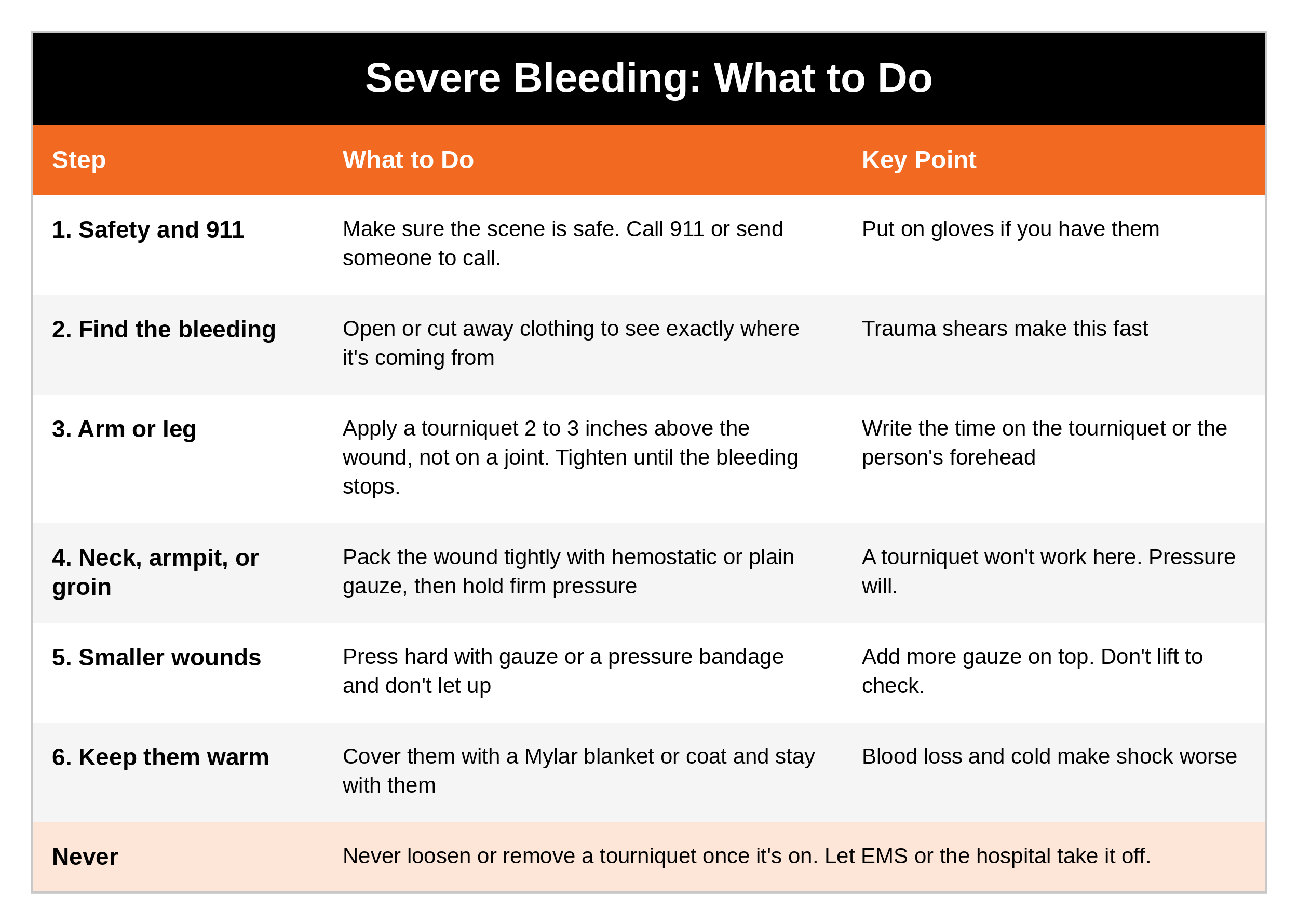
What to Do: Severe Bleeding
Gear is only half the job. Here's the whole sequence on one page.
Signs bleeding is life-threatening:
Blood that's spurting or pulsing
Blood that won't stop flowing or is pooling on the ground
Clothing or bandages soaked through with blood
A missing arm or leg
The person becoming confused or unresponsive
Packing a wound: For a deep wound to the neck, armpit, or groin, where a tourniquet won't fit, push gauze directly into the wound until it's full, then press down hard with both hands. Hold firm pressure for at least 3 minutes with hemostatic gauze, and longer with plain gauze. If blood soaks through, add more on top. Don't pull out what's already there.
The best way to learn this is hands-on. A Stop the Bleed class takes about an hour, it's often free, and it puts a tourniquet in your hands. Part 4 covers training in detail.
Rescue Support Items
These round out a trauma kit for car crashes, falls, and injuries away from home:
SAM splint for broken bones and sprains
Triangle bandage for slings and securing splints
ACE wrap for sprains and holding dressings in place
Burn dressing for burns too big for the first aid kit
Sterile saline for flushing wounds and eyes
CPR and AED reference card so you have the steps in front of you under stress
LifeVac (optional), an anti-choking device. It doesn't replace back blows and abdominal thrusts, which always come first.
Headlamp so both hands stay free
Biohazard bag for used gloves and bloody dressings
Eye shield to protect an injured eye
Instant cold pack for swelling
Seatbelt cutter for getting someone out of a vehicle
Pulse oximeter (optional) to check oxygen level and heart rate
Staging: Where You Keep It Matters
A trauma kit locked in the trunk or buried in a closet won't help in the first few minutes. The test is simple: can you reach it in 10 seconds?
On your body:
Ankle kit: a tourniquet and gauze strapped to your lower leg
Belly pouch: a slim kit worn at the waist
Shoulder bag: a small sling bag with a fuller kit
For more on what I carry every day, see my Everyday Carry (EDC) guide.
In your vehicle:
Glove box or center console: within reach of the driver
Door pocket: a tourniquet you can grab without moving
Headrest kit: I carry two Dark Angel Medical Headrest Trauma Kits in my truck, mounted where anyone in the vehicle can reach them. I covered vehicle staging in Mobile Command Center, Part 3.
At home: A home medical bag with your fullest trauma kit, kept with your first aid kit in a spot everyone in the family knows.
At work: An IFAK (Individual First Aid Kit) in your desk, locker, or work bag.
Check every kit twice a year, along with your first aid kits. Make sure nothing has been used, expired, or damaged, and that the tourniquets are still in their packaging and ready to go.
Final Thoughts
You'll probably never need your trauma kit. That's the hope. But if you're ever the first person on the scene of a crash, or someone you love is hurt badly at home, those few minutes before help arrives are the ones that count. A trauma kit and the knowledge to use it turn you from a bystander into someone who can act.
Want the bleeding control basics on one page? The free First Aid and Trauma Guide puts what to keep on hand and what to do first on one page, so you can act fast when someone is hurt.
Ask Yourself
Could I reach a tourniquet in 10 seconds right now, at home, in the car, or at work?
Do I know how to apply a tourniquet to myself with one hand?
Did I buy my tourniquet from a trusted source, or the cheapest listing I could find?
Remember
Bleeding first, then breathing, then warmth. Carry two tourniquets from a trusted source, keep your kit where you can reach it in seconds, and get hands-on training. Once a tourniquet is on, leave it on.
Coming Up in Part 3: Medications Every Kit Should Have
Next, we stock the medicine side of your kits. Part 3 covers the everyday pain, allergy, and stomach medications every kit should have, plus diabetic support and naloxone.
Next in the series: First Aid and Trauma- Part 3: Medications Every Kit Should Have
Get Started Today
Get the free First Aid and Trauma Guide. What to keep on hand and what to know so you can act fast when someone is hurt. Print it and keep it with your kits. Get it free here
Get the free Family Emergency Plan. Write down your meeting spots, emergency contacts, and who in your family needs extra help, so everyone knows the plan before something happens. Get it free here
Quick Answers
What should be in a trauma kit?
Bright nitrile gloves, at least two tourniquets, a permanent marker, hemostatic and compressed gauze, a pressure bandage, a pair of vented chest seals, trauma shears, and a mylar blanket. Those items cover the three priorities: bleeding first, then breathing, then warmth.
How many tourniquets should I carry?
At least two. One may not be enough for a severe injury, and you may need one for a second person. Stick with models recommended by the Committee on Tactical Combat Casualty Care, like the CAT, and buy from the manufacturer or an authorized dealer, because counterfeits can break when tightened.
How do you pack a wound?
For a deep wound to the neck, armpit, or groin where a tourniquet will not fit, push gauze into the wound until it is full, then press hard with both hands. Hold pressure for at least 3 minutes with hemostatic gauze, and longer with plain gauze. If blood soaks through, add more on top without pulling out what is already there.
Where should I keep a trauma kit?
Anywhere you can reach it in about 10 seconds: on your body, in the glove box or door pocket of your vehicle, in a home medical bag everyone in the family knows about, and in your desk or bag at work. A kit locked in the trunk or buried in a closet will not help in the first few minutes.
Go Deeper
The Family Safety Toolkit. 20 ready-to-use checklists for kids, travel, home, and emergencies, so your family has the steps in front of you instead of trying to remember them under stress.
Coming soon: The Family Emergency Preparedness Manual. The blog series cover each topic on its own. The Manual connects your vehicle, go bags, first aid, backup power, and communications into one family plan, with the worksheets, checklists, and drills you won't find on the blog.
Tools I recommend: The first aid kits, trauma gear, and medical supplies I recommend are in my Amazon store: First Aid, Everyday Carry, and Mobile Command Center.
The Full Series
First Aid and Trauma, Introduction- First Aid vs Trauma Care
First Aid and Trauma- Part 3: Medications Every Kit Should Have
First Aid and Trauma- Part 5: Kits for Kids, Seniors and Caregivers
Related Reading
Setting Up Your Mobile Command Center- Part 3: Essential Safety Equipment
Go Bag and Emergency Bug-Out Bag- Part 3: Comprehensive Emergency Supply List
References
American College of Surgeons. Stop the Bleed: How to stop the bleed.
Committee on Tactical Combat Casualty Care (CoTCCC). Recommended devices and adjuncts: limb tourniquets.
North American Rescue. Counterfeit CAT tourniquet awareness.
American Red Cross. Choking first aid: back blows and abdominal thrusts.
American Heart Association. CPR and first aid guidelines.
Disclaimer
These suggestions are intended to help you and your family build awareness, confidence, and safer decision-making habits. No safety plan, checklist, or training can guarantee 100% protection. This article is for general informational and educational purposes only. It is not medical advice and is not a substitute for hands-on first aid and bleeding control training or care from a medical professional. Affiliate disclosure: I've linked to products from my Amazon store that I personally recommend. As an Amazon Associate, I earn from qualifying purchases, at no extra cost to you. Thank you for supporting my work.
For severe bleeding or any medical emergency, call 911.
Awareness gives you time. Time gives you options.
The Prepared Protector is someone who's decided that loving someone means being ready for them, not just hoping things go fine.
Prepared Not Paranoid. Protecting the Most Vulnerable Among Us.