The Symptoms, What to Do When the Alarm Sounds, and What "70 ppm" Really Means
By Larry Betz | Prepared Not Paranoid https://www.preparednotparanoid.com/
Updated November 9, 2026
Carbon monoxide poisoning feels like the flu. Here's how to tell the difference, what to do the second the alarm sounds, and why your alarm may stay quiet at low levels.
Carbon monoxide doesn't announce itself. You can't see it, smell it, or taste it, and the first signs feel like a bad flu: a headache, an upset stomach, a little dizziness. Families go to bed thinking they're coming down with something. Knowing the carbon monoxide poisoning symptoms, and what to do when the alarm sounds, is what keeps that night from becoming a tragedy.
Why It Matters
According to the CDC, more than 400 people in the U.S. die every year from accidental carbon monoxide poisoning not linked to fires, and more than 100,000 end up in the emergency room. Carbon monoxide comes from anything that burns fuel: furnaces, water heaters, gas stoves, fireplaces, generators, grills, and cars.
CO safety comes down to two things: prevention and early warning. Keep fuel-burning appliances maintained, and have working CO alarms in the right places. The CDC recommends battery-operated or battery-backup CO alarms near every sleeping area.
What to Do If Your CO Alarm Sounds
Read this part first, and make sure everyone in your home knows it.
Get everyone outside to fresh air right away, pets too. Don't stop to open windows or look for the source.
Call 911 from outside.
Don't go back in until firefighters or the gas company tell you it's safe.
If anyone has symptoms, like a headache, nausea, dizziness, or confusion, get them checked by a medical professional, even if they start to feel better outside.
Never silence the alarm and go back to bed. An alarm that goes off and then quiets down may mean the levels dropped for a moment, not that the problem is gone.
It Feels Like the Flu
Carbon monoxide poisoning symptoms include headache, dizziness, weakness, upset stomach, vomiting, chest pain, and confusion. That's why it's so easy to miss.
Here's how to tell the difference.
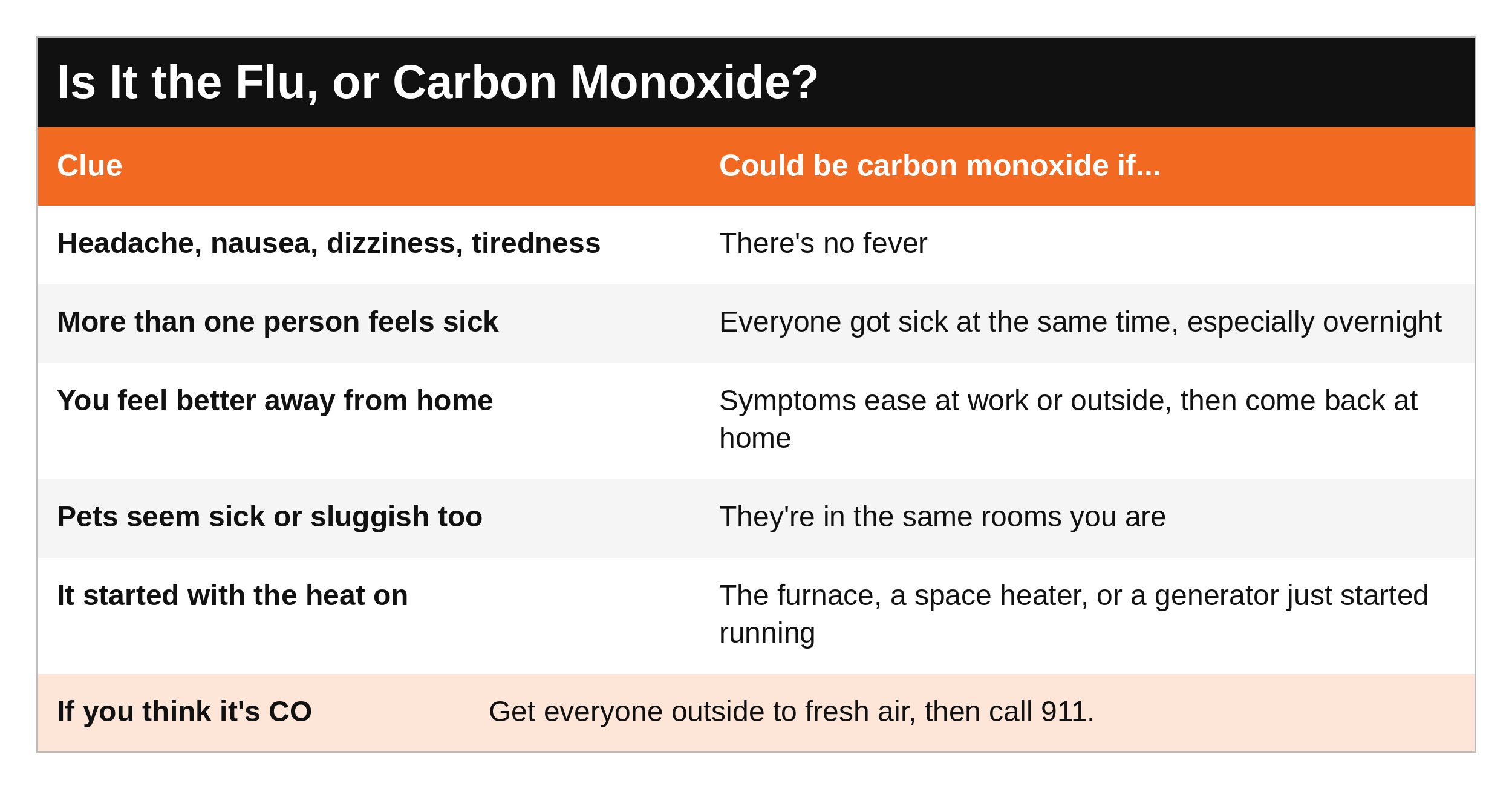
If more than one person in the home suddenly feels "flu-like" at the same time, especially overnight, treat it as a CO emergency. Get everyone outside and call 911.
Who's most at risk: babies and young children, older adults, pregnant women, and anyone with heart or lung problems can be hurt sooner and by lower levels. Pets can get sick too. Anyone who's asleep or has been drinking may never notice the symptoms at all.
What "ppm" Means, and Why Your Alarm Waits
PPM means parts per million, a measurement of how much carbon monoxide is in the air. What matters is both the level and how long you breathe it. A level like 70 ppm may not knock you down right away, but hours of it, especially while you sleep, can make you very sick.
Home CO alarms in the U.S. are built to a standard called UL 2034, which uses time and level together so the alarm doesn't go off every time someone lights the fireplace.
Here's how fast it has to sound.
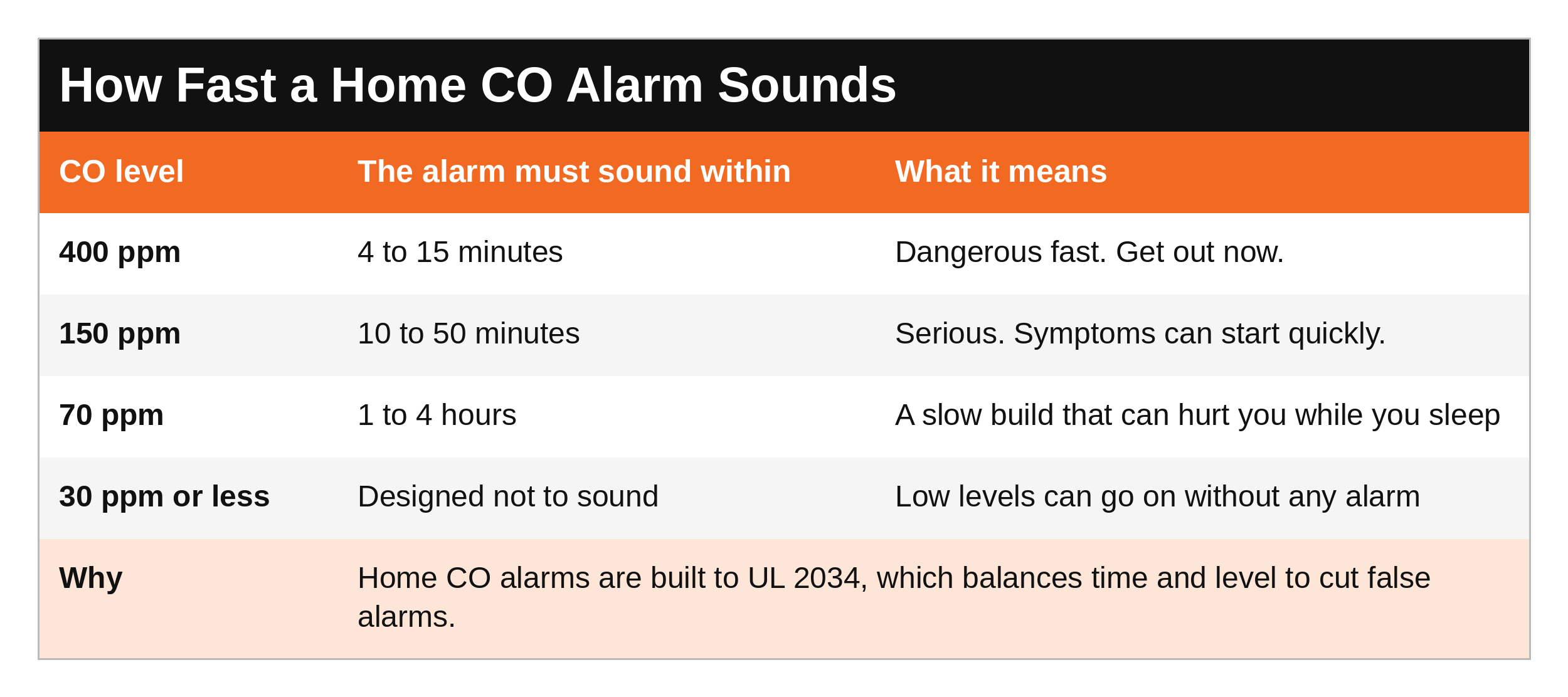
This is why a CO alarm can be working exactly as designed and still not go off right away when levels are rising slowly. At low, steady levels, most home alarms are designed not to sound at all.
If you want to see low levels, a CO alarm with a digital ppm display and peak memory shows you what it's sensing, even before it alarms. Some families who are especially sensitive, like those with a newborn or someone with heart disease, also add a low-level CO monitor that's designed to warn at lower readings than a standard alarm.
When the Risk Is Highest
Winter, when furnaces, space heaters, and fireplaces are running and the house is closed up.
Power outages, when people run generators, grills, or camp stoves to stay warm or cook. Never use a generator, grill, or camp stove inside, or in a garage, even with the door open. Keep generators at least 20 feet from windows, doors, and vents.
The attached garage. Never run a car in an attached garage, even with the garage door open. CO can move into the house through the door between them.
Heating with the oven. Never use a gas oven or stove to heat your home.
Where to Put CO Alarms
If you do nothing else, cover every level of your home and every sleeping area. Add one near the door to an attached garage and in any room above the garage. Keep alarms out of dead-air corners, away from bathrooms where steam collects, and not right next to fuel-burning appliances unless the manual says it's OK.
The sensor types and what changes at altitude are covered in Home Fire Safety Essentials, Part 1. The short version: choose an electrochemical sensor, and if you live at elevation, check the alarm's rated altitude. Read Part 1: Smoke Alarms and CO Detectors
The Test Button "Gotcha"
Pressing the Test button usually checks the speaker and the electronics, not whether the sensor still works. Keep testing monthly, but also:
Check the replace-by date on every alarm. Most CO alarms last about 5 to 10 years. Follow the date on the unit.
Write that date on the alarm or somewhere you'll see it.
Have fuel-burning appliances serviced every year.
What to Look For in a CO Alarm
You don't need the most expensive alarm. You need the right features.
Here's what matters most.
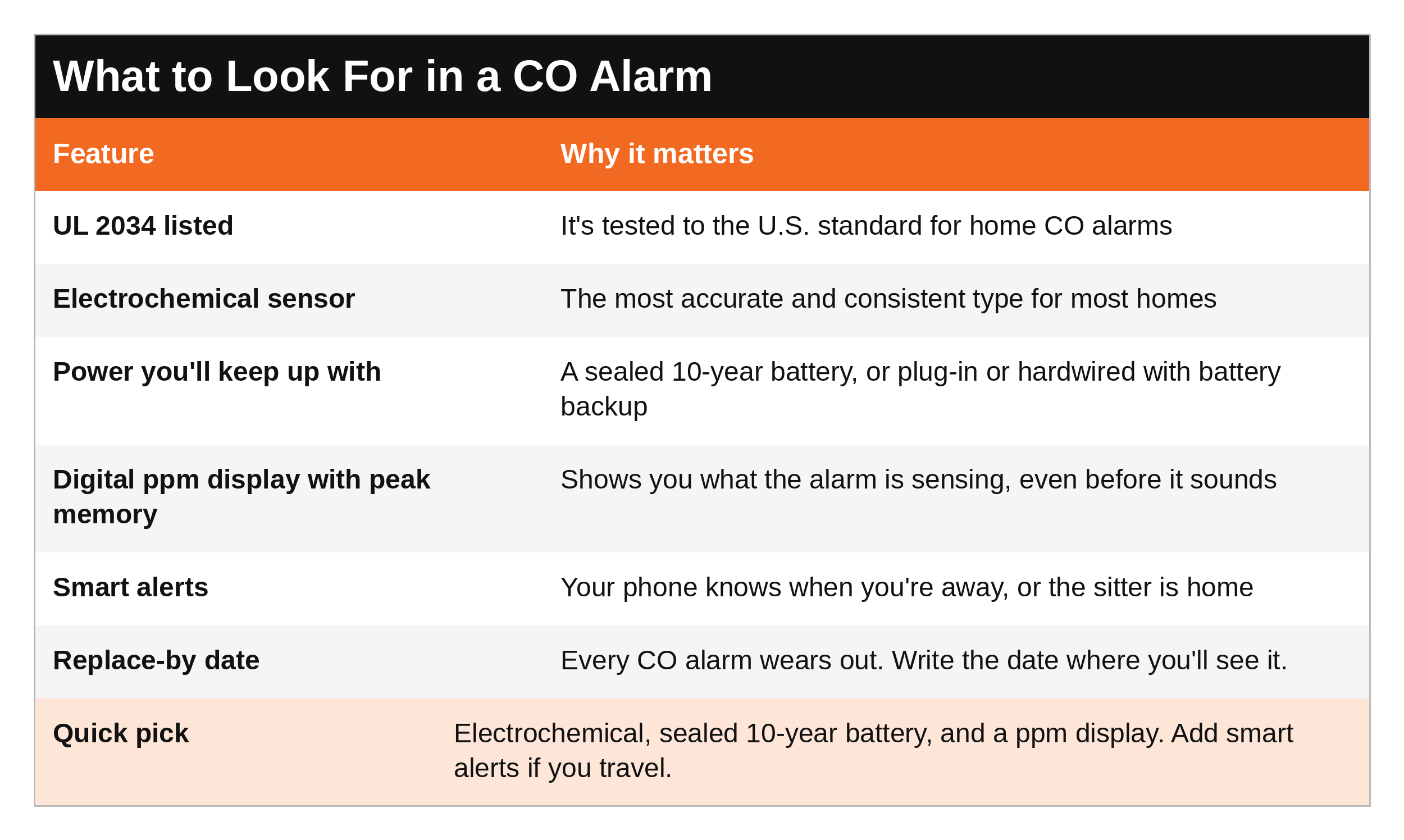
Quick pick: most homes should choose an electrochemical CO alarm with a sealed 10-year battery and a digital ppm display, and add smart alerts if you travel or have a sitter at home. The specific models I recommend are in my Amazon store, where I can keep them current.
What to Say
To your family:
"If the CO alarm goes off, we don't look for the problem. We get out, pets too, and call 911 from the yard."
"If more than one of us feels sick at the same time, we go outside first and figure it out later."
To a relative or neighbor running a generator during an outage:
"Can we move that out to at least 20 feet from the house? The exhaust can come right in through a window."
To a babysitter or house guest:
"That's the CO alarm. If it goes off, take the kids outside and call 911, then call me."
SCAN for Carbon Monoxide
S - See your environment. Walk your home and find every fuel-burning appliance, the garage door, and every sleeping area. Is there an alarm near each one?
C - Create space. Keep generators, grills, and cars away from your living space. Fresh air outside is your safe space.
A - Act deliberately. When the alarm sounds, get out, call 911, and don't go back in.
N - Never doubt your gut feelings. If the whole family feels off at once, don't talk yourself out of it. Go outside.
The Prepared Protector checks the date, not just the button. Tonight, walk every level of your home and look at each CO alarm. Find the replace-by date, write it where you can see it, and make sure there is an alarm outside every bedroom. Then teach everyone, sitter included, the rule: alarm sounds, everyone out, call 911. The free When the CO Alarm Sounds download walks your family through exactly what to do the moment the alarm goes off.
Ask Yourself
Do I have a CO alarm on every level and outside every bedroom?
Do I know the replace-by date on each one?
Does everyone in my home, including the sitter, know what to do if it goes off?
If the power went out tonight, where would our generator, grill, or camp stove go?
Remember
Carbon monoxide feels like the flu and gives no warning you can see or smell. Put alarms on every level and near every bedroom, replace them on schedule, never run a generator or car where the exhaust can get inside, and when the alarm sounds, get everyone out and call 911.
This post covers carbon monoxide. Parts 1 to 4 of the series cover the rest: smoke alarms, extinguishers, escape plans, and fire prevention.
Get Started Today
Get the free When the CO Alarm Sounds download. What to do the moment your CO alarm goes off, who to call, and when it is safe to go back inside, ready to print and keep where everyone can see it. Get it free here
Get the free Lights Out download. Power outages are when many families run a generator, grill, or camp stove in the wrong place. Lights Out helps your family plan for an outage before the lights go out, so you stay warm, fed, and safe without bringing CO into your home. Get it free here
Get the free Family Fire Escape Plan Worksheet. Map two ways out of every room, assign roles, choose your meeting spot, and log your fire drills. Get it free here
Quick Answers
What should I do if my carbon monoxide alarm goes off?
Get everyone outside to fresh air right away, pets too, without stopping to open windows or look for the source. Call 911 from outside, and don't go back in until firefighters or the gas company tell you it's safe. The free When the CO Alarm Sounds download puts these steps on one page you can post where everyone can see it.
How can I tell if it's the flu or carbon monoxide poisoning?
Carbon monoxide poisoning feels like the flu: headache, dizziness, weakness, upset stomach, and confusion. Suspect CO when there's no fever, when more than one person gets sick at the same time (especially overnight), when you feel better away from home, or when pets seem sick too. If you think it's CO, get everyone outside and call 911.
Why didn't my CO alarm go off right away?
Home CO alarms are built to the UL 2034 standard, which balances time and level to cut false alarms. At 70 ppm an alarm has 1 to 4 hours to sound, and at 30 ppm or less most alarms are designed not to sound at all. That's why the alarm can be working exactly as designed while levels rise slowly.
Where should carbon monoxide detectors be placed in a home?
Put a CO alarm on every level of your home and near every sleeping area, plus one near the door to an attached garage and in any room above the garage. Keep them out of dead-air corners and away from bathrooms where steam collects. Check the replace-by date on each one, since most CO alarms last about 5 to 10 years.
Go Deeper
Home Fire Safety Essentials. My complete family fire safety guide, with Parts 1 to 5 in one place, the Family Fire Escape Plan, and everything you need to know about CO alarms. Get it here
Coming soon: The Safest House on the Block. Fire and carbon monoxide are two of the dangers inside your home. The book covers the rest of it: how criminals choose a home, every common ruse at the door, doors, locks, windows, lighting, cameras, Wi-Fi, a full fire safety chapter, and a complete family security plan with a SWOT analysis for your own home.
The Family Safety Toolkit. 20 ready-to-use checklists for kids, travel, home, and emergencies.
Coming soon: The Family Readiness Binder. Your family's emergency information, medical details, contacts, and plans, organized and ready before you need them, in an Essential and a Full edition.
Tools I recommend: The CO alarms, smoke alarms, and fire safety gear I recommend are in my Safest House on the Block Amazon store.
The Full Series
Home Fire Safety Essentials- Part 1: Smoke Alarms and CO Detectors
Home Fire Safety Essentials- Part 2: Fire Extinguishers, Fire Blankets, and Escape Ladders
Home Fire Safety Essentials- Part 3: Your Escape Plan, the Knox Box, and Calling 911
Home Fire Safety Essentials- Part 4: Fire Prevention: Stop Fires Before They Start
Home Fire Safety Essentials- Part 5: Carbon Monoxide (you are here)
Related Reading
Emergency Preparedness- Start Here: You Are Your Own First Responder
Go Bag and Emergency Bug-Out Bag- Part 2: Preparing to Leave Your Home
The Safest House on the Block- Part 4: Home Invasion Tactics C: Setups and Ambushes
References
Centers for Disease Control and Prevention (CDC). Carbon Monoxide Poisoning: Facts and Prevention. https://www.cdc.gov/carbon-monoxide
UL Standard 2034, Single and Multiple Station Carbon Monoxide Alarms (alarm response times as published by BRK/First Alert). https://www.brkelectronics.com/faqs/diy/what_levels_of_co_cause_an_alarm
U.S. Consumer Product Safety Commission. Carbon Monoxide Information Center. https://www.cpsc.gov
U.S. Environmental Protection Agency. Protect Your Family and Yourself from Carbon Monoxide Poisoning. https://www.epa.gov
Betz, L. Home Fire Safety Essentials. Prepared Not Paranoid.
Disclaimer
These suggestions are intended to help you and your family build awareness, confidence, and safer decision-making habits. No safety plan, checklist, or training can guarantee 100% protection. The goal is not to create fear, but to help guide families toward more informed, prepared, and practical safety decisions in everyday life. As an Amazon Associate, I earn from qualifying purchases. Product mentions reflect my own experience.
This article is for general informational and educational purposes only. It is not medical advice or a substitute for guidance from your fire department, gas utility, or a licensed professional. Always follow your alarm's manual for placement and replacement. CO alarm laws vary by location, and many require alarms in homes with fuel-burning appliances or attached garages, so check the rules in your state and county.
If your CO alarm sounds or anyone has symptoms, get everyone outside to fresh air and call 911.
Awareness gives you time. Time gives you options.
The Prepared Protector is someone who's decided that loving someone means being ready for them, not just hoping things go fine.
Prepared Not Paranoid. Protecting the Most Vulnerable Among Us.