Saunas, Cold Plunges, Red Light, and More: What's Worth Your Time?
By Larry Betz | Prepared Not Paranoid https://www.preparednotparanoid.com/
Updated November 9, 2026
Training gets all the attention. Recovery is where the work actually pays off.
For centuries, cultures around the world have turned to heat and cold for their physical and mental benefits. Sweat lodges and hot springs, ice baths and therapeutic steam: temperature-based recovery has long played a role in healing and resilience.
Today, these practices are back under the banner of "biohacking," with influencers and experts promoting the latest trends. Every week seems to bring a new product or protocol claiming to boost performance, speed up recovery, or slow aging. Some of those claims are overhyped or driven by marketing. But many of these tools do have real research behind them and practical value, especially when they're part of a consistent, realistic recovery plan.
Why Recovery Is Part of Being Prepared
Here at Prepared Not Paranoid, we say fitness is the foundation of preparedness. Being ready to carry a child to safety, help an aging parent up after a fall, or get through a long, hard day starts with a body that's strong, mobile, and able to bounce back.
After more than 20 years running gyms, with a specialty in post-rehab and the aging population, I've seen how much recovery matters. You don't get stronger during the workout. You get stronger when you recover from it.
What This Series Covers
In seven parts, we'll break down the most popular recovery tools: what each one is, what it claims to do, and most importantly, what the current research says. Personal experience and preference matter, but the goal is clear, unbiased information so you can decide what's worth your time, money, and energy.
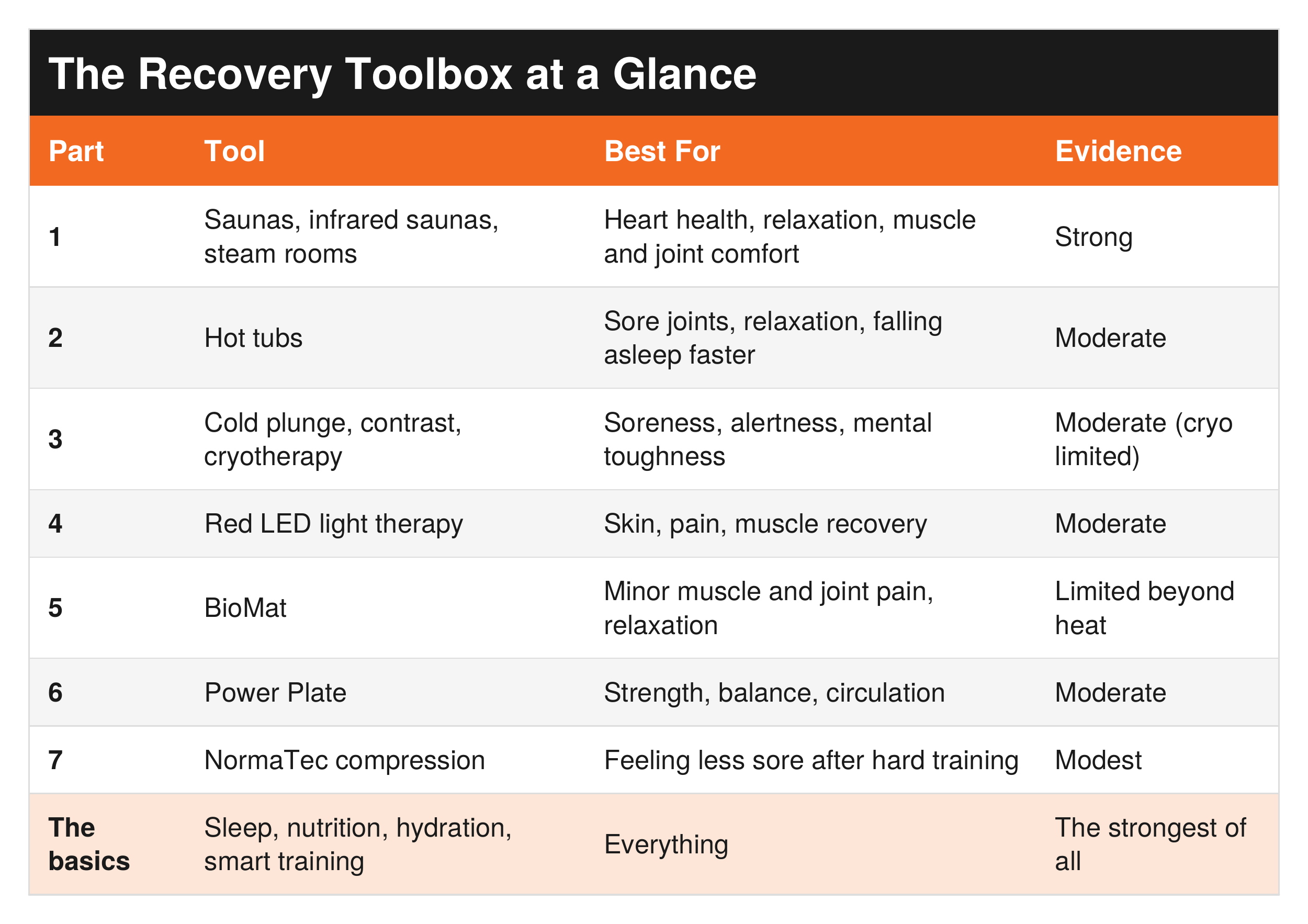
Part 1: Saunas, Infrared Saunas, and Steam Rooms. How they differ, what the research supports, and home options for every budget. Read Part 1
Part 2: Hot Tubs. How heat, buoyancy, and water pressure help you recover, plus the safety limits every family should know. Read Part 2
Part 3: Cold Plunges, Contrast Therapy, and Cryotherapy. The real benefits, the right temperatures and times, and when not to plunge. Read Part 3
Part 4: Red LED Light Therapy. How it works, how to read wavelength and dose, and FDA cleared vs. registered. Read Part 4
Part 5: BioMat Therapy. Far-infrared heat, crystals, and ions, and what the evidence actually says. Read Part 5
Part 6: Power Plate Whole-Body Vibration. Strength, balance, and recovery, especially for older adults. Read Part 6
Part 7: NormaTec Compression Therapy. Do compression boots really speed recovery? Read Part 7
Whether your goal is faster muscle recovery, less soreness, better sleep, or better long-term health, this series will help you understand how and when to use these tools as part of a well-rounded recovery plan.
Start With the Basics
Before you buy anything, remember this: no recovery tool replaces the basics. Sleep, nutrition, hydration, and smart training do most of the work. The tools in this series help you recover a little better on top of that foundation.
The best recovery tool is the one you'll actually use, consistently and safely.
Recovery starts before the workout, too. A good warm-up gets your body ready to move and lowers your risk of injury. My free Dynamic Warm-Up Guide walks you through a simple routine. Get it free here.
Safety Before You Start
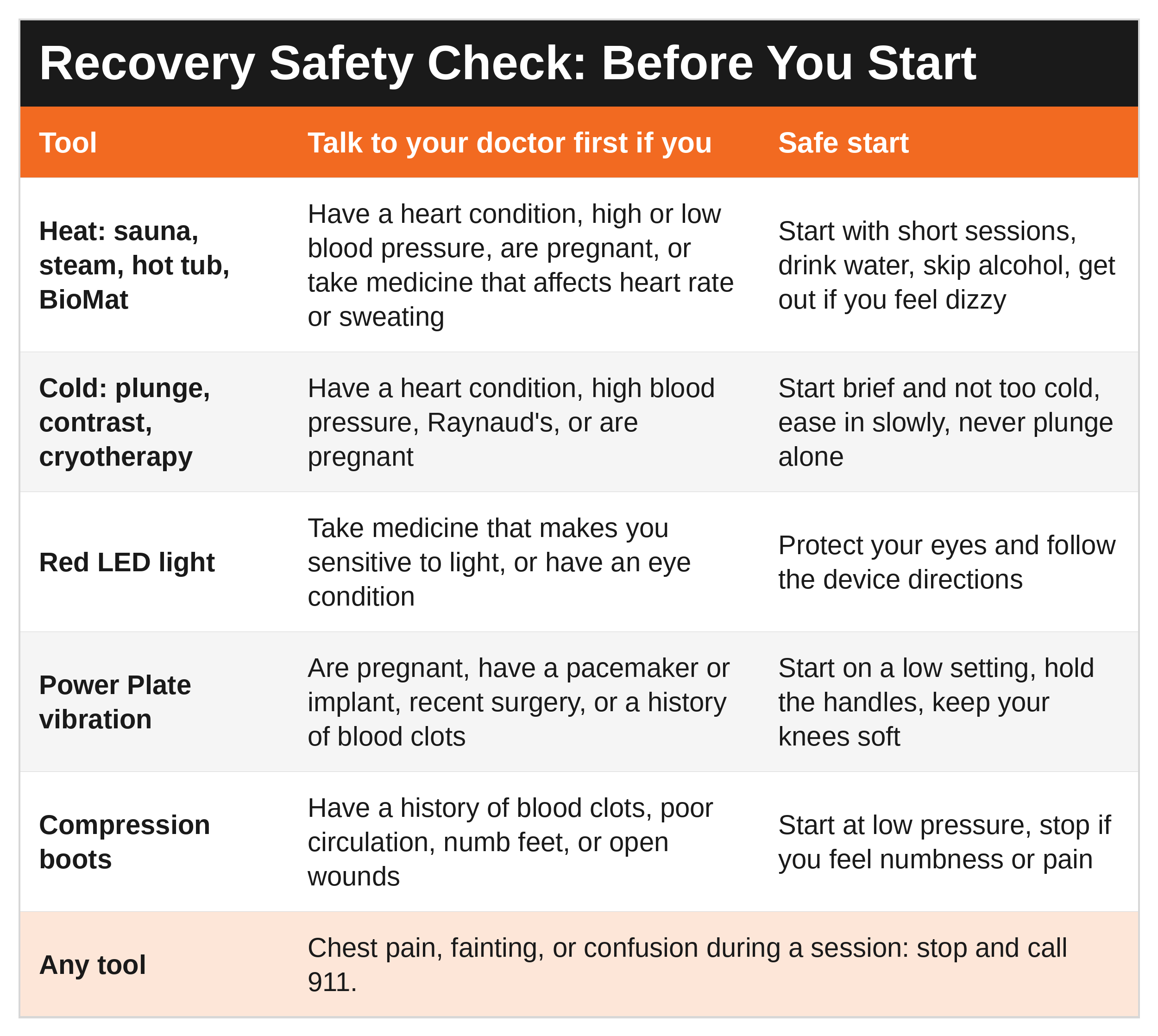
Heat, cold, light, vibration, and compression all put real demands on your body. Most healthy adults handle them well, but some conditions call for a conversation with your doctor first. Here's a quick check before you try any of them.
Warm up before you train, recover after. The free Dynamic Warm-Up Guide gives you a simple warm-up routine to get your body ready to move and help prevent injury.
The Prepared Protector recovers on purpose. The people who count on you need you strong, rested, and ready, not sidelined. Cover sleep, food, water, and easy movement first. Then add one tool at a time, start gently, and pay attention to how your body responds.
Ask Yourself
What's my real goal: less soreness, better sleep, joint comfort, or long-term health?
Am I covering the basics first: sleep, food, water, and easy movement?
What fits my space, my budget, and my health?
Remember
Recovery is where the work pays off. Start with the basics, choose tools backed by research, and use them consistently. A body that recovers well is a body that's ready when someone needs you.
Coming Up in Part 1: Saunas, Infrared Saunas, and Steam Rooms
In Part 1, we start with heat: traditional saunas, infrared saunas, and steam rooms. You'll learn how they differ, what the research supports, and home options for every budget.
Next in the series: Recovery Strategies- Part 1: Saunas, Infrared Saunas, and Steam Rooms
Get Started Today
Get the free Dynamic Warm-Up Guide. A simple warm-up routine to get your body ready to move and help prevent injury. Get it free here.
Quick Answers
Do recovery tools like saunas and cold plunges actually work?
Some do, and some are overhyped. Saunas, cold water immersion, red light therapy, and compression all have research behind them, but the benefits are usually modest. They work best on top of good sleep, nutrition, hydration, and smart training.
What is the most important part of recovery?
Sleep, food, water, and easy movement do most of the work. No recovery tool replaces those basics. Get them right first, then add one tool at a time.
Who should talk to a doctor before using heat or cold therapy?
Anyone with a heart condition, high or low blood pressure, diabetes, a history of blood clots, a pacemaker or other implanted device, or who is pregnant. The same goes for anyone taking medication that affects heart rate, blood pressure, or sensitivity to heat or light.
How do I choose the right recovery tool?
Start with your goal: less soreness, better sleep, joint comfort, or long-term health. Then pick the tool that fits your space, your budget, and your health, and that you will actually use consistently.
Go Deeper
Coming soon: The Family Nutrition Manual, Volume 1: Everyday Nutrition. Recovery starts with what you eat and drink. Volume 1 brings the nutrition side together in one place: the nutrition basics, the supplements I keep on hand, and everyday family eating, from building a plate and feeding kids, teens, athletes, and seniors to meal prep and kitchen food safety.
Tools I recommend: For the recovery gear I use, see my Recovery Amazon store, and for home training equipment, my Fitness Amazon store.
The Full Series
Recovery Strategies- Part 1: Saunas, Infrared Saunas, and Steam Rooms
Recovery Strategies- Part 3: Cold Plunges, Contrast Therapy, and Cryotherapy
Recovery Strategies- Part 6: Power Plate Whole-Body Vibration
Related Reading
References
The sources for each recovery tool are listed at the end of each part in this series. Key reviews include:
Laukkanen, J. A., et al. (2018). Cardiovascular and other health benefits of sauna bathing: A review of the evidence. Mayo Clinic Proceedings, 93(8), 1111-1121. https://doi.org/10.1016/j.mayocp.2018.04.008
Bleakley, C., et al. (2012). Cold-water immersion (cryotherapy) for preventing and treating muscle soreness after exercise. Cochrane Database of Systematic Reviews, (2), CD008262. https://doi.org/10.1002/14651858.CD008262.pub2
Leal-Junior, E. C. P., et al. (2015). Effect of phototherapy (low-level laser therapy and light-emitting diode therapy) on exercise performance and markers of exercise recovery: A systematic review with meta-analysis. Lasers in Medical Science, 30(2), 925-939. https://doi.org/10.1007/s10103-013-1465-4
Maia, F., et al. (2024). Effects of lower-limb intermittent pneumatic compression on sports recovery: A systematic review and meta-analysis. Biology of Sport, 41(4), 263-275. https://doi.org/10.5114/biolsport.2024.133665
Disclaimer
These suggestions are intended to help you and your family build awareness, confidence, and safer decision-making habits. No safety plan, checklist, or training can guarantee 100% protection. The goal is not to create fear, but to help guide families toward more informed, prepared, and practical safety decisions in everyday life. As an Amazon Associate, I earn from qualifying purchases. Product mentions reflect my own experience.
This article is for general informational and educational purposes only. It is not medical advice and is not a substitute for guidance from your physician. Talk to your doctor before starting any new recovery practice, especially heat or cold therapy, if you have a heart condition, high or low blood pressure, diabetes, a history of blood clots, a pacemaker or other implanted device, are pregnant, or take medication that affects your heart rate, blood pressure, or sensitivity to heat or light. Avoid alcohol before heat or cold sessions, stay hydrated, and never use a cold plunge or hot tub alone. Keep children and older adults closely supervised around any heat or cold therapy.
If you or someone with you has chest pain, faints, or feels confused during any recovery session, stop and call 911.
Awareness gives you time. Time gives you options.
The Prepared Protector is someone who's decided that loving someone means being ready for them, not just hoping things go fine.
Prepared Not Paranoid. Protecting the Most Vulnerable Among Us.