Toxic Chemicals to Avoid- Part 4: Chemicals in Personal Care Products
What's in the Bottle in Your Shower, and What to Do About It (2026)
By Larry Betz | Prepared Not Paranoid https://www.preparednotparanoid.com/
Most people assume the FDA approves shampoo and lotion before it reaches the shelf. It doesn't. Except for color additives, cosmetic products and ingredients don't need FDA approval before they're sold.
Think about what you used this morning: shampoo, conditioner, body wash, deodorant, lotion, toothpaste, maybe sunscreen or makeup. The average adult uses several of these every day. Your skin absorbs some of what you put on it, and you breathe in what you spray. Small daily exposures add up over years.
Here's the good news. You don't need to throw out everything in your bathroom this weekend. You need to know which ingredients deserve a second look, how to read the label, and how to replace products one at a time as they run out.
Harmful Chemicals and Additives in Personal Care Products
Many personal care products, including skin care items, hair care products, and cosmetics, contain chemicals that have raised health concerns. Below is a detailed list of some of these potentially harmful ingredients, their common uses, and associated health risks.
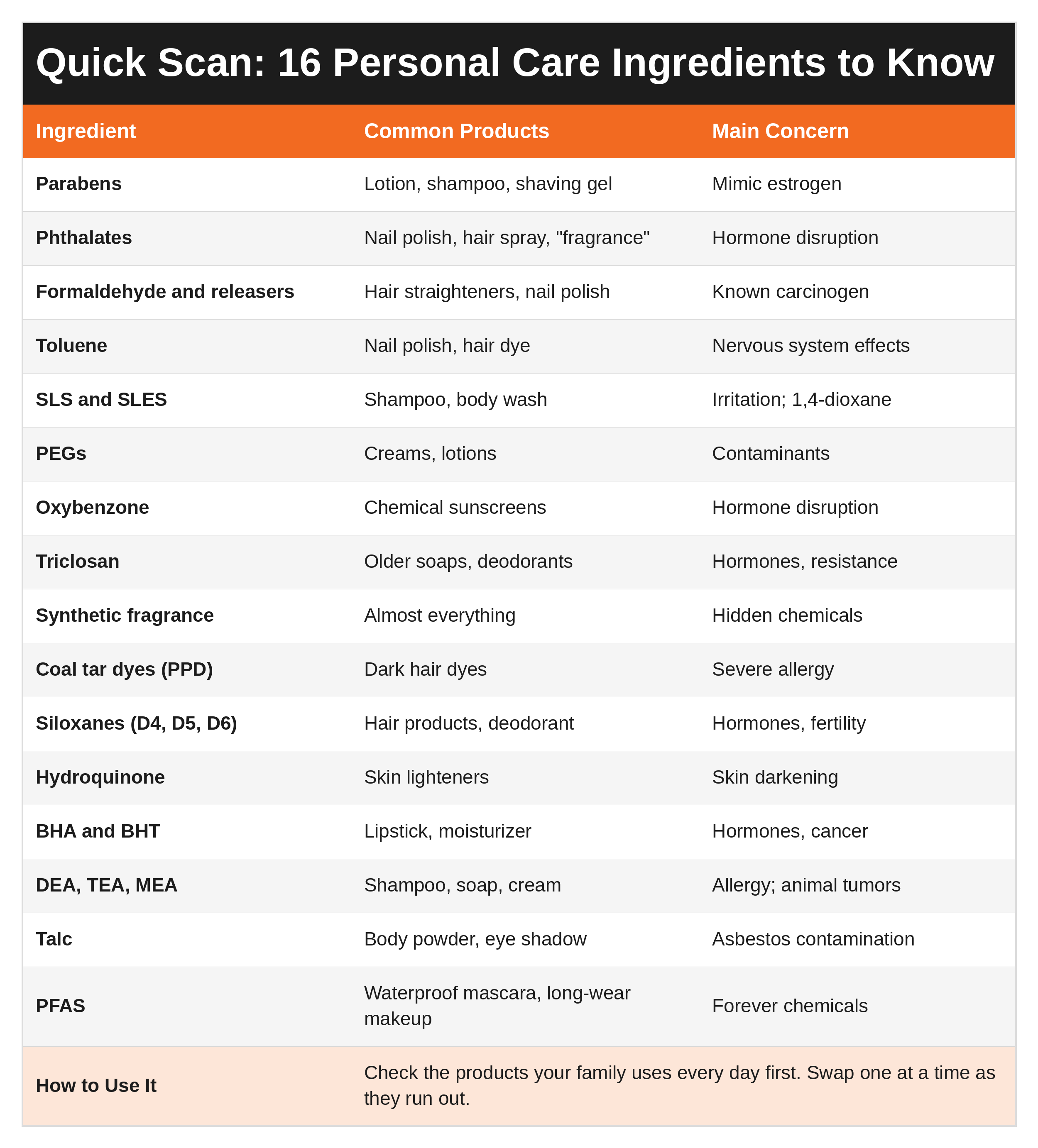
Start with the quick-scan chart, then read the details for the ingredients you find in your own bathroom.
1. Parabens (e.g., Methylparaben, Propylparaben, Butylparaben)
Found in: Used as preservatives in cosmetics, moisturizers, shampoos, and shaving gels to prevent microbial growth.
Health concerns: Parabens can mimic estrogen in the body, potentially disrupting hormone function and have been detected in breast cancer tissues, suggesting a possible link to cancer. That finding came from a small 2004 study and doesn't prove parabens cause cancer, and the FDA says it doesn't have evidence that parabens as used in cosmetics harm people. Still, the longer-chain parabens (propylparaben and butylparaben) show the strongest estrogen-like activity, and the European Union has restricted them. "Paraben-free" products are easy to find.
2. Phthalates (e.g., Dibutyl Phthalate (DBP), Diethyl Phthalate (DEP))
Found in: Used in nail polishes, hair sprays, and as solvents in fragrances to increase flexibility and longevity.
Health concerns: Phthalates are known endocrine disruptors and have been linked to reproductive and developmental issues, including reduced sperm count and congenital disabilities.
What's changed: FDA surveys show phthalate use in cosmetics has dropped, and DBP is now rare. DEP is still used in fragrance, and since fragrance ingredients don't have to be listed one by one, you usually can't tell. One more reason to choose "fragrance-free."
3. Formaldehyde and Formaldehyde-Releasing Preservatives (e.g., DMDM Hydantoin, Quaternium-15)
Found in: Used in nail polishes, hair straightening treatments, and as preservatives in various cosmetics.
Health concerns: Formaldehyde is a known carcinogen; exposure can cause skin irritation, allergic reactions, and has been linked to certain cancers.
Names to look for: formaldehyde, formalin, methylene glycol, DMDM hydantoin, quaternium-15, imidazolidinyl urea, diazolidinyl urea, and bronopol. The last six slowly release formaldehyde to keep the product from spoiling.
A warning about hair straightening treatments. Some "keratin" or "Brazilian" straightening treatments release formaldehyde gas when the hair is heated with a flat iron. In a large NIH study of more than 33,000 women (the Sister Study, 2022), women who used hair straightening products more than four times a year had a higher risk of uterine cancer than women who never used them. Some products labeled "formaldehyde-free" still contain methylene glycol, which turns into formaldehyde when heated. If you're pregnant, skip these treatments entirely. The FDA announced plans to ban formaldehyde in these products in 2023, and as of October 2026, it still hasn't proposed the rule.
4. Toluene
Found in: Used in nail polishes and hair dyes to suspend pigments and create a smooth finish.
Health concerns: Toluene can affect the central nervous system, leading to headaches, dizziness, and has been linked to developmental harm in fetuses. At home, paint nails in a well-ventilated room and look for polish labeled "3-free" or higher (free of toluene, formaldehyde, and DBP).
5. Sodium Lauryl Sulfate (SLS) and Sodium Laureth Sulfate (SLES)
Found in: Used as surfactants (chemical able to trap dirt and grease) in shampoos, cleansers, and body washes to create lather.
Health concerns: SLS and SLES can cause skin and eye irritation; SLES may be contaminated with 1,4-dioxane, a potential carcinogen. It won't appear on the label, because it's a contaminant, not an ingredient.
Quick tip: Ingredients with "-eth" in the name (sodium laureth sulfate, ceteareth, steareth) or "PEG" are made with a process that can leave 1,4-dioxane behind. For products you use every day, especially on kids, choose cleansers without them.
6. Polyethylene Glycols (PEGs)
Found in: Used as thickeners, solvents, and softeners in creams, lotions, and shampoos.
Health concerns: PEGs can be contaminated with ethylene oxide and 1,4-dioxane. Ethylene oxide is a known human carcinogen, and 1,4-dioxane is a likely one.
7. Oxybenzone
Found in: Used in sunscreens and moisturizers with SPF to absorb UV radiation.
Health concerns: Oxybenzone is a suspected endocrine disruptor and has been linked to hormone disruption and potential reproductive harm in animal studies. FDA studies published in JAMA in 2019 and 2020 found that oxybenzone and other chemical sunscreen ingredients are absorbed into the bloodstream at levels high enough that the FDA asked for more safety data.
Don't stop wearing sunscreen. Skin cancer is a proven, serious risk, especially here in Arizona. Switch, don't quit. The FDA has proposed that only two sunscreen ingredients, zinc oxide and titanium dioxide, be recognized as safe and effective based on current data. Look for a mineral sunscreen, SPF 30 or higher, broad spectrum. For babies under 6 months, keep them in the shade and ask your pediatrician before using any sunscreen.
8. Triclosan
Found in: Used as an antimicrobial agent in soaps, toothpastes, and deodorants.
Health concerns: Triclosan can contribute to antibiotic resistance and is an endocrine disruptor, potentially affecting thyroid function.
What's changed: In 2016, the FDA banned triclosan and 18 other antibacterial ingredients from consumer hand and body washes, because companies couldn't show they were safe for daily use or worked better than plain soap and water. You may still find it in older or imported products. Plain soap and water work.
9. Synthetic Fragrances
Found in: Used in a wide range of personal care products to impart scent.
Health concerns: Fragrance mixtures can contain numerous undisclosed chemicals, some of which may cause allergies, dermatitis, respiratory issues, and potential hormone disruption. Under U.S. law, a company can list all of them as one word: "fragrance" or "parfum."
Know the difference: "Unscented" can mean a masking fragrance was added to cover the chemical smell. "Fragrance-free" means no fragrance was added. For kids and anyone with asthma, eczema, or allergies, choose fragrance-free.
10. Coal Tar Dyes (e.g., p-Phenylenediamine)
Found in: Used in hair dyes and some cosmetics to provide color.
Health concerns: Coal tar dyes are potential carcinogens and can cause severe allergic reactions. p-Phenylenediamine (PPD) is one of the most common causes of severe skin reactions, including facial swelling. These hair dyes must carry instructions to do a patch test 48 hours before every use. Do it, every time.
11. Siloxanes (e.g., Cyclotetrasiloxane)
Found in: Used in hair products, deodorants, and moisturizers to soften, smooth, and moisten. On labels, look for cyclotetrasiloxane (D4), cyclopentasiloxane (D5), cyclohexasiloxane (D6), and "cyclomethicone."
Health concerns: Some siloxanes are endocrine disruptors and may impair fertility; they are also harmful to aquatic life. The European Union already restricts D4 and D5 in rinse-off products and is extending limits to leave-on cosmetics in 2027.
12. Hydroquinone
Found in: Used in skin lightening creams to reduce pigmentation.
Health concerns: Hydroquinone is linked to ochronosis, a skin disorder that causes blue-black darkening that may be permanent, and may be a potential carcinogen.
What's changed: Since 2020, over-the-counter skin lighteners with hydroquinone can't be legally sold in the U.S. It's prescription-only now. The FDA warns against buying these online, because some imported lighteners have also been found to contain mercury.
13. BHA (Butylated Hydroxyanisole) and BHT (Butylated Hydroxytoluene)
Found in: Used as preservatives in lipsticks, moisturizers, and other cosmetics (and in some foods; see Part 1 of this series).
Health concerns: BHA and BHT are potential endocrine disruptors and may cause cancer. The National Toxicology Program lists BHA as "reasonably anticipated to be a human carcinogen" based on animal studies.
14. Ethanolamines (e.g., DEA, TEA, MEA)
Found in: Used as emulsifiers and foaming agents in shampoos, soaps, and creams. Look for names like cocamide DEA.
Health concerns: Ethanolamines can cause allergic reactions and have been linked to liver tumors in animal studies. California lists DEA and cocamide DEA as chemicals known to the state to cause cancer.
Two More to Know: Talc and PFAS
Talc is a soft mineral used in baby powder, body powder, eye shadow, blush, and dry shampoo. The problem isn't talc itself. Talc is mined from the ground, and it can be contaminated with asbestos, which causes mesothelioma and other cancers. FDA testing has found asbestos in some talc cosmetics. The FDA proposed required asbestos testing in 2024, then withdrew it in November 2025. There's still no required testing. Choose cornstarch or arrowroot powder instead. For babies, the American Academy of Pediatrics advises against powders altogether, because breathing in the dust can harm their lungs.
PFAS, the "forever chemicals," are added to some cosmetics to make them long-lasting or waterproof. They show up most in waterproof mascara, long-wear foundation, eyeliner, and lip products. In December 2025, the FDA reported finding 51 PFAS intentionally added to more than 1,700 cosmetic products, and said it didn't have enough data to confirm most of them are safe. There's still no federal ban, though several states, including California, Colorado, Minnesota, and Washington, have banned them in cosmetics. On a label, look for "PTFE" or anything with "fluoro" in the name.
The New Cosmetic Rules: Where They Stand
In December 2022, Congress passed the first major update to cosmetic law in more than 80 years, called the Modernization of Cosmetics Regulation Act (MoCRA). Companies now have to register with the FDA, keep safety records, and report serious reactions. That's real progress. But several of the rules that matter most for families still aren't in place.
Here's where each one stands.
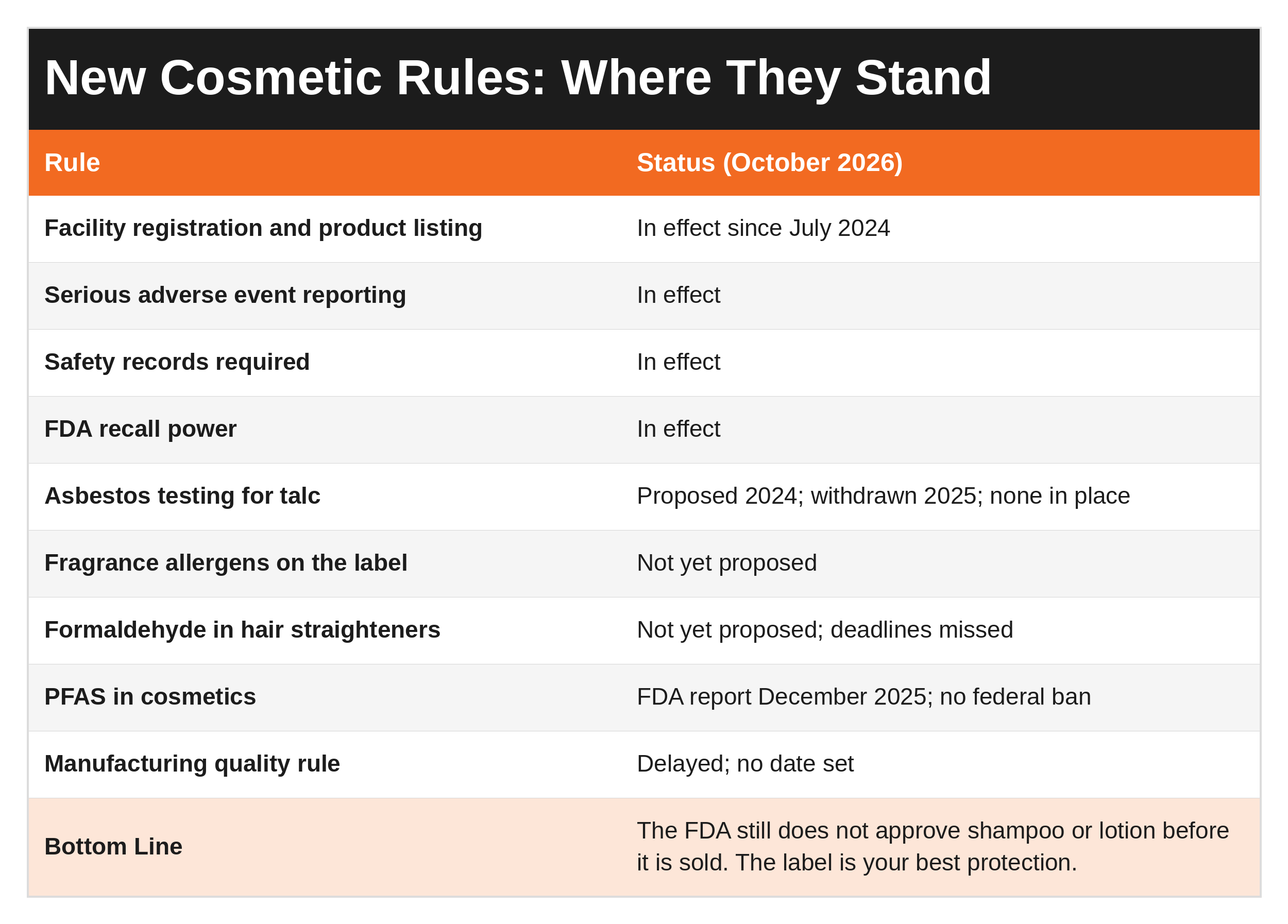
Until those rules are finished, the label and your own choices are your family's best protection.
How to Read a Personal Care Label
Step 1: Find the ingredient list. Ingredients are listed from most to least, down to 1 percent.
Step 2: Check the first five ingredients. These make up most of the product.
Step 3: Look for the red flags: parabens, "fragrance" or "parfum," DMDM hydantoin, quaternium-15, oxybenzone, triclosan, PEG, "-eth" ingredients, DEA, and anything with "fluoro."
Step 4: Don't trust the front of the bottle. "Natural," "clean," "non-toxic," "dermatologist recommended," and "hypoallergenic" have no legal definition for cosmetics.
Step 5: Use a tool when you're in a hurry. An app like Yuka scans the barcode and flags concerning ingredients in seconds (see Part 7 of this series).
Smart Swaps, One Product at a Time
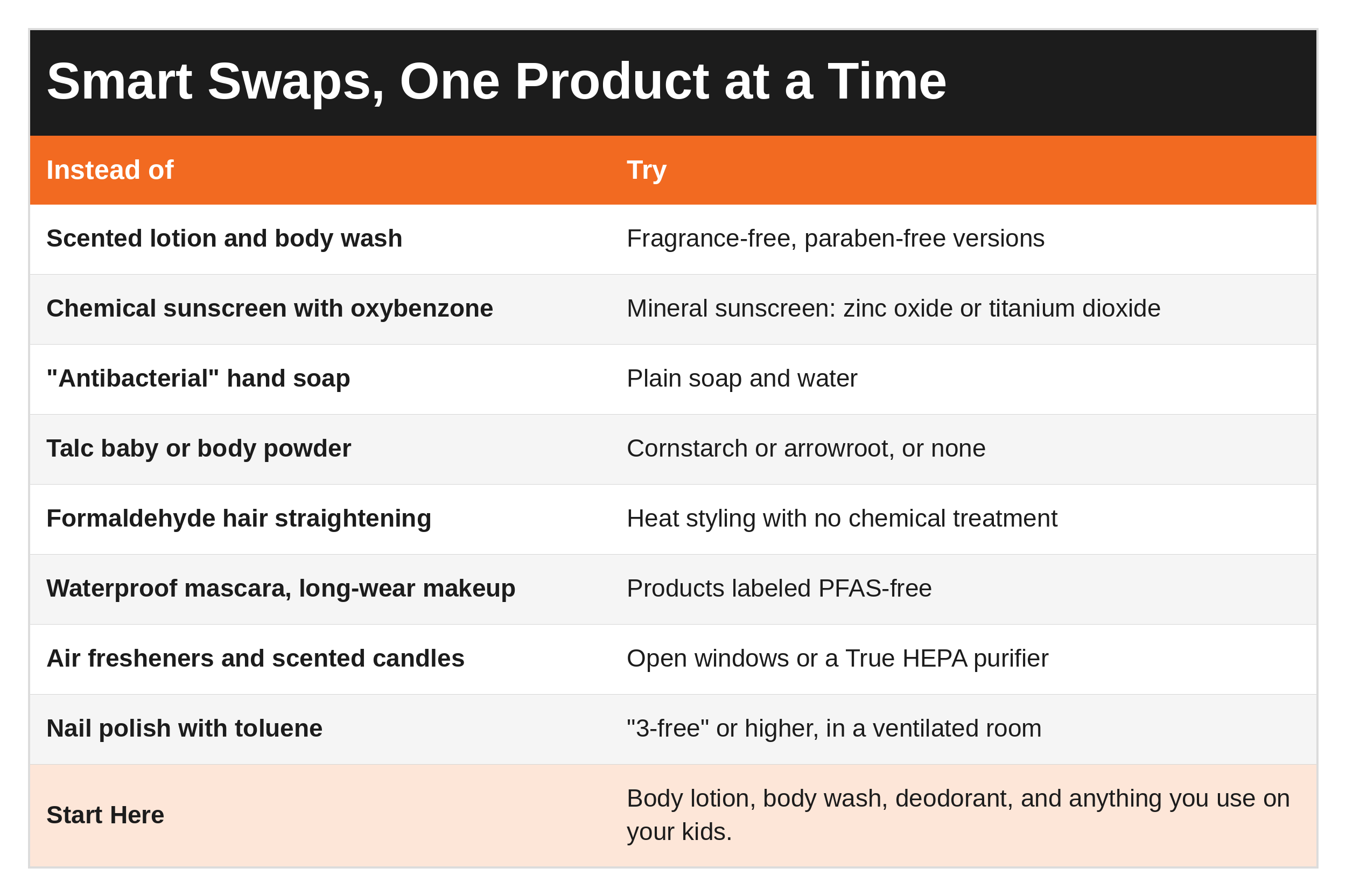
You don't need to replace your whole bathroom at once. When a product runs out, replace it with a better one. Start with the products you use the most, on the most skin, every day, and the products you use on your kids.
Here are the easiest swaps to start with.
Your Go-Bag Hygiene Kit
Personal care is part of preparedness. Your go-bag and emergency supplies should include soap, toothpaste, deodorant, sunscreen, and baby wipes or diaper cream if you have little ones. In an emergency, you may use these every day for weeks, with no way to shop for something better. Build your hygiene kit from the same clean products you use at home: plain bar soap, fragrance-free wipes, mineral sunscreen, and a fluoride toothpaste without triclosan. Bar soap and travel sizes also save space and weight.
Ask Yourself
Do I know what's in the products I use on my skin every single day?
Which of my products list "fragrance," and do I really need it?
Am I using the safest sunscreen for my family, or just the one I always buy?
What will I replace first when it runs out?
Remember
You don't have to be perfect, and you don't have to do it all at once. Read the label, swap one product at a time, and choose simple over scented. Small, steady changes protect your family for years.
Get Started Today
[FREE DOWNLOAD: TO BE CHOSEN AFTER THE BINDER REVIEW]
Go Deeper
The Prepared Not Paranoid Family Nutrition Guide. This post covers the ingredients to watch for. The guide's full chapter adds the state-by-state PFAS cosmetic bans, every formaldehyde-releasing ingredient name, the complete swap list, a family action checklist, and the "Ingredients to Avoid" wallet card so you can check labels in the store. [Get it here: LINK]
Tools I recommend: The mineral sunscreen, fragrance-free soaps, and True HEPA air purifier I recommend are in my Amazon store. https://amzn.to/4yM747h
Related reading:
Toxic Chemicals to Avoid: Introduction https://www.preparednotparanoid.com/pnp-library/toxic-chemicals-intro
Toxic Chemicals to Avoid, Part 1: Reading Labels and Food Additives to Avoid https://www.preparednotparanoid.com/pnp-library/toxic-chemicals-lesson-1
Toxic Chemicals to Avoid, Part 5: Endocrine Disruptors https://www.preparednotparanoid.com/pnp-library/toxic-chemicals-lesson-1-9axkp-mxse9-ekwcw
Toxic Chemicals to Avoid, Part 7: Tools Like Yuka That Do the Work for You https://www.preparednotparanoid.com/pnp-library/toxic-chemicals-lesson-1-9axkp-mxse9-ekwcw-bdger
References
U.S. Food and Drug Administration. Modernization of Cosmetics Regulation Act of 2022 (MoCRA). Checked October 2026. https://www.fda.gov/cosmetics/cosmetics-laws-regulations/modernization-cosmetics-regulation-act-2022-mocra
U.S. Food and Drug Administration. Report on the Use of PFAS in Cosmetic Products and Associated Risks. December 2025.
U.S. Food and Drug Administration. Testing Methods for Detecting and Identifying Asbestos in Talc-Containing Cosmetics: proposed rule (December 2024) and withdrawal (November 2025).
CNN Health. FDA misses another deadline on proposed ban on formaldehyde in hair straightening products. January 5, 2026. https://abc17news.com/cnn-health/2026/01/05/fda-misses-another-deadline-on-proposed-ban-on-formaldehyde-in-hair-straightening-products/
Chang CJ, et al. Use of straighteners and other hair products and incident uterine cancer. Journal of the National Cancer Institute, 2022.
U.S. Food and Drug Administration. Safety and Effectiveness of Consumer Antiseptics: final rule. September 2016.
Matta MK, et al. Effect of sunscreen application on plasma concentration of sunscreen active ingredients. JAMA, 2019 and 2020.
Darbre PD, et al. Concentrations of parabens in human breast tumours. Journal of Applied Toxicology, 2004.
National Toxicology Program. Report on Carcinogens, 15th Edition.
U.S. Food and Drug Administration. Skin lightening products and hydroquinone, consumer information.
California Toxic-Free Cosmetics Act (AB 2762), effective January 1, 2025.
American Academy of Pediatrics. Guidance on baby powder and infant sun protection.
Disclaimer
This article is for general informational and educational purposes only. It is not medical advice. Talk with your doctor or dermatologist about any skin condition, prescription product, or product you use during pregnancy. Affiliate disclosure: I've linked to products from my Amazon store that I personally recommend. As an Amazon Associate, I earn from qualifying purchases, at no extra cost to you. Thank you for supporting my work.
If someone has swelling of the face or throat or trouble breathing after using a product, call 911.
Awareness gives you time. Time gives you options.
The prepared protector is someone who's decided that loving someone means being ready for them, not just hoping things go fine.
Prepared Not Paranoid. Protecting the Most Vulnerable Among Us.