From Your First Easy Jog to Safe Sprinting
By Larry Betz | Prepared Not Paranoid https://www.preparednotparanoid.com/
Updated November 9, 2026
Sometimes getting to safety means moving faster than a walk: crossing a busy street when a car runs the light, getting to a child who's wandered toward the road, or covering ground fast when there's no time to waste.
Jogging builds the engine. Sprinting adds the gear you hope you never need but are glad you have. This post is the full companion guide to Section 4 of my free 90-Day Aerobic Fitness Program. Read it here for the "why" and the "how," then use the program to track every session. Get it free here.
The Benefits of Jogging
A stronger heart and lungs. Jogging strengthens your heart, improves circulation, and increases lung capacity.
Weight management. It burns a significant number of calories.
Mood and sleep. Running releases endorphins, the "runner's high," and can improve sleep and mental clarity.
A longer life. A large study of more than 55,000 adults found that running, even 5 to 10 minutes a day at slow speeds, was linked to a much lower risk of death from all causes and from heart disease.
Start Smart: Why Jogging Needs a Plan
Jogging is higher impact than walking, and it puts more stress on your knees, ankles, and hips. Your heart and lungs adapt faster than your joints, tendons, and bones. That's why so many new runners get hurt: their engine is ready before their frame is.
Wear proper running shoes with good support and cushioning.
Start on softer surfaces, like grass or trails, instead of concrete or asphalt.
Don't push through pain. If something hurts, stop, assess, and adjust.
Get your form checked. A running coach can evaluate your posture, stride, and foot placement, and spot issues like overpronation (flat feet) or poor arm movement before they lead to injury.
Start Here: Your Walk-Jog Check-In
Before your first session, test yourself and write down your numbers. Then repeat the check-in on Day 30, Day 60, and Day 90.
What's your longest continuous jog?
What's your 1-mile walk-jog time?
What's your RPE after 10 minutes of walk-jog?
Any aches or pains? Where?
RPE is your Rate of Perceived Exertion: how hard it feels to you on a 0-to-10 scale. Most of your jogging should be at RPE 5 to 6, where you can still talk but can't sing.
Your 12-Week Walk-Jog Plan
If you're new to jogging or coming back after a long break, start with a walk-jog combination. You alternate between walking and jogging so your body adapts gradually. Every session starts with a 5-minute warm-up walk and ends with a 5-minute cool-down walk. Do three sessions a week, with a rest or walk day in between.
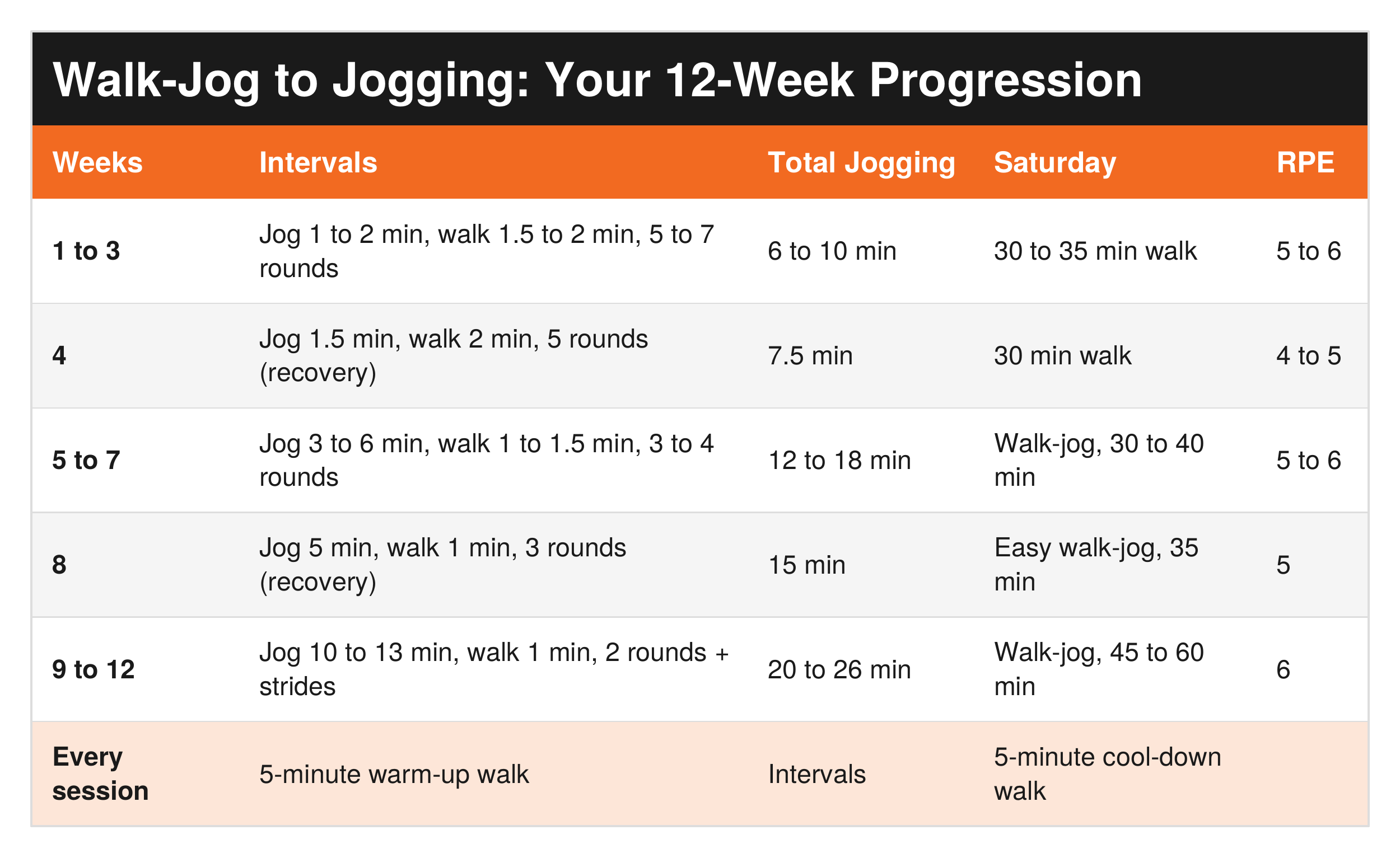
By Week 12, you'll be jogging about 26 minutes on weekdays and building a Saturday walk-jog session of up to 60 minutes, depending on your age, health, and injuries. The full week-by-week plan and a printable tracker are in Section 4 of the 90-Day Program.
How Fast Should You Progress?
You'll often hear the 10% rule: increase your jogging time or distance by no more than 10% a week. It's a good guide, but it isn't magic. One study of new runners found that a slower program built on the 10% rule had about the same injury rate as a standard one.
What matters most is listening to your body:
Change one thing at a time, time or distance, not both.
Take a recovery week every fourth week.
Repeat a week if it felt hard, or if anything aches.
Rest days are part of the plan. That's when your body adapts.
From Jogging to Sprinting
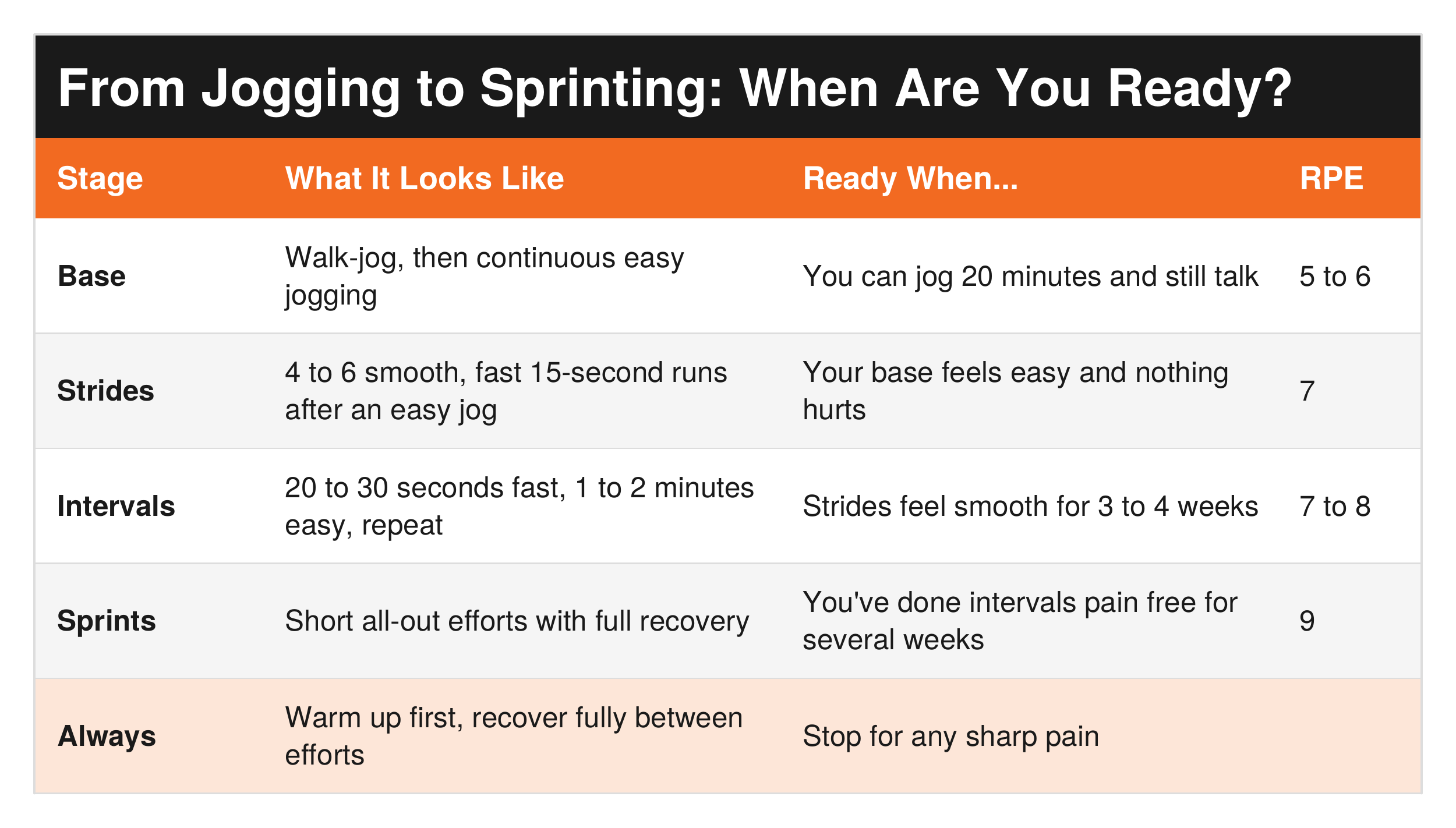
Sprinting is the last progression in aerobic training. It's the most intense, and it puts the most stress on your muscles and cardiovascular system. Before you sprint, you need a solid foundation of aerobic fitness from regular jogging. That foundation prepares your body for the demands and lowers your risk of injury.
Step 1: Strides
Strides are the safe first step toward speed. In the 90-Day Program, they start in Weeks 11 and 12. After an easy jog, run 4 strides of about 15 seconds at a smooth, fast pace, about RPE 7. That's quick but relaxed, not an all-out sprint. Walk back to recover between each one.
Step 2: Intervals
Once strides feel smooth for a few weeks, try interval training:
Warm up with a 5-to-10-minute easy jog.
Run fast for 20 to 30 seconds, then jog or walk for 1 to 2 minutes to recover.
Repeat for 20 to 30 minutes total.
Cool down with an easy walk.
This is a form of high-intensity interval training (HIIT). Research shows short, hard intervals can improve fitness and heart health in a fraction of the time of steady training. As you get fitter, you can lengthen the fast efforts and shorten the recovery.
Step 3: Sprints
True sprints are short, all-out efforts with full recovery between them. They build power, speed, and strength in your legs and core, and they can improve your running economy, so your everyday jogging becomes faster and more efficient.
Always warm up first. Dynamic movements before, gentle stretching after.
Recover fully between efforts.
Stop for any sharp pain. Hamstring strains are the most common sprinting injury.
Consider a coach to refine your sprint technique.
Safety First
Talk to your doctor first, especially if you have a heart condition, high blood pressure, joint problems, past injuries, or you've been inactive.
Warm up before every session. My free Dynamic Warm-Up Guide takes you head to toe in about 10 minutes. Get it free here.
Stop and get checked if you feel chest pain or pressure, dizziness, unusual shortness of breath, or sharp joint pain.
Respect old injuries. If jogging bothers a past injury, go back a week, switch to walking or rucking, or try a cardio machine.
Run where you're safe and visible. Face traffic, wear bright colors, and carry your phone and ID.
Follow the walk-jog plan one week at a time. The free 90-Day Aerobic Fitness Program gives you a walking and walk-jog plan that builds your endurance step by step.
The Prepared Protector builds speed the patient way. Base first, then strides, then intervals, then sprints. The day you have to close the distance to a child near the road, you want a body that's ready for it, not one that pulls a hamstring on the first step.
Ask Yourself
Is my engine ahead of my frame? Do my joints feel as ready as my lungs?
Am I changing one thing at a time, or adding time and distance together?
Have I earned strides yet, or do I need a few more weeks of base?
Remember
Build the engine first, then add speed. Walk-jog your way to a solid base, progress slowly, listen to your body, and add strides, intervals, and sprints only when you've earned them.
Coming Up in Part 3: Speed, Agility, and Quickness: Train to Stop, Turn, and Go
Next, in Part 3, we train the skills that keep you on your feet: speed, agility, and quickness, for athletes and for fall prevention.
Next in the series: Aerobic Fitness- Part 3: Speed, Agility, and Quickness: Train to Stop, Turn, and Go
Get Started Today
Get the free 90-Day Aerobic Fitness Program. A 90-day walking and walk-jog plan that builds your endurance step by step. Get it free here.
Get the free Dynamic Warm-Up Guide. A simple warm-up routine to get your body ready to move and help prevent injury. Get it free here.
Quick Answers
How should a beginner start jogging?
Start with walk-jog intervals instead of continuous running, take the Start Here check-in, and follow a 12-week plan that builds slowly. By Week 12, you will be jogging about 26 minutes on weekdays.
Is the 10% rule for running safe?
It is a good guide, but it is not magic. One study of new runners found a slower program built on the 10% rule had about the same injury rate as a standard one, so listen to your body and repeat a week if it felt hard or anything aches.
What are strides?
Strides are short, smooth runs of about 15 seconds at a fast but relaxed pace, about RPE 7, done after an easy jog. They are the safe first step toward speed and start in Weeks 11 and 12 of the 90-Day Program.
How much running do you need for health benefits?
Not much to start. A large study of more than 55,000 adults found that running even 5 to 10 minutes a day at slow speeds was linked to a much lower risk of death from all causes and from heart disease.
Tools I Recommend
For the running shoes, reflective gear, and running accessories I use, see my Fitness Amazon store, and for foam rollers and recovery gear, my Recovery Amazon store.
The Full Series
Aerobic Fitness- Part 1: Walking and Rucking: The Foundation of Real-World Fitness
Aerobic Fitness- Part 3: Speed, Agility, and Quickness: Train to Stop, Turn, and Go
Aerobic Fitness- Part 4: Modified Strongman Training: Real-Life Strength
Aerobic Fitness- Part 5: Cardio Machine Buyer’s Guide: Train Through Any Weather
Related Reading
References
Lee, D. C., et al. (2014). Leisure-time running reduces all-cause and cardiovascular mortality risk. Journal of the American College of Cardiology, 64(5), 472-481. https://doi.org/10.1016/j.jacc.2014.04.058
Buist, I., et al. (2008). No effect of a graded training program on the number of running-related injuries in novice runners: A randomized controlled trial. American Journal of Sports Medicine, 36(1), 33-39. https://doi.org/10.1177/0363546507307505
Gibala, M. J., Little, J. P., MacDonald, M. J., & Hawley, J. A. (2012). Physiological adaptations to low-volume, high-intensity interval training in health and disease. Journal of Physiology, 590(5), 1077-1084. https://doi.org/10.1113/jphysiol.2011.224725
U.S. Department of Health and Human Services. (2018). Physical Activity Guidelines for Americans, 2nd edition. https://health.gov/our-work/nutrition-physical-activity/physical-activity-guidelines/current-guidelines
Centers for Disease Control and Prevention. Measuring Physical Activity Intensity. https://www.cdc.gov/physical-activity-basics/measuring/index.html
Disclaimer
These suggestions are intended to help you and your family build awareness, confidence, and safer decision-making habits. No safety plan, checklist, or training can guarantee 100% protection. The goal is not to create fear, but to help guide families toward more informed, prepared, and practical safety decisions in everyday life. As an Amazon Associate, I earn from qualifying purchases. Product mentions reflect my own experience.
This article is for general informational and educational purposes only. It is not medical advice and is not a substitute for guidance from your physician or a qualified fitness professional. Running and sprinting carry a risk of injury. Talk to your doctor before starting any new exercise program, especially if you have a medical condition, past injuries, or have been inactive. Stop any activity that causes pain, dizziness, or chest discomfort.
If you have chest pain, severe shortness of breath, or feel faint while running, stop and call 911.
Awareness gives you time. Time gives you options.
The Prepared Protector is someone who's decided that loving someone means being ready for them, not just hoping things go fine.
Prepared Not Paranoid. Protecting the Most Vulnerable Among Us.