Stop, Turn, and Go: Quick Feet for Real Life
By Larry Betz | Prepared Not Paranoid https://www.preparednotparanoid.com/
Updated November 9, 2026
You step off a curb, and a car comes out of nowhere. In that split second, you have to stop, change direction, and get out of the way. Your eyes see it, but it's your legs, balance, and reaction time that save you.
Speed, agility, and quickness (SAQ) might bring up images of elite athletes on a field. The carryover to daily life is huge, though. Maybe you play pickleball or tennis, where you're constantly moving and changing direction. Maybe you're chasing a toddler who just bolted. Or maybe you just want to catch yourself before a fall. A few SAQ drills in your program help you be more prepared for whatever life throws at you.
This post is the full companion guide to Section 5 of my free 90-Day Aerobic Fitness Program. Read it here for the "why" and the "how," then use the program to track every drill. Get it free here.
Speed: Two Different Kinds
Speed in Field Sports
Multidirectional speed. Soccer, rugby, and hockey players move forward, backward, sideways, and diagonally. That takes agility, quick changes of direction, and the ability to speed up and slow down fast.
Short bursts. Field sports are mostly short bursts, not sustained top speed, repeated throughout a game.
Repeat sprint ability. The capacity to sprint again and again with little recovery, and keep performing.
Speed in Sprinting
Linear speed. Sprinters run in a straight line as fast as possible, focused on form, starts, and holding top speed.
Acceleration and maximal velocity. Explosive power to get up to speed, then efficient technique to stay there.
Short and intense. Think of the difference between a sprinter and a marathoner. Sprinting is fast and short. A marathon is long and slower.
What Is Agility?
Agility is the ability to rapidly and efficiently slow down, stop, change direction, and speed back up. It combines balance, coordination, speed, and strength, so you can move smoothly from one movement to the next.
The Four Pieces of Agility
Deceleration. Slowing down under control. It takes strong lengthening (eccentric) muscle contractions in your legs to absorb the force. Good technique here protects your joints and ligaments, including against non-contact ACL tears and other knee and ankle injuries.
Stopping. Coming to a complete stop with strength, stability, and balance.
Change of direction. Shifting direction quickly by pivoting or shifting your weight smoothly, without losing balance or momentum.
Reacceleration. Getting back up to speed with explosive power from your fast-twitch muscle fibers.
Quickness is closely related. It's your ability to move rapidly and explosively in any direction, combining physical speed with reaction time.
Why SAQ Matters in Everyday Life
SAQ training isn't just for athletes. By improving coordination and reaction time, it helps you move through crowded places, react quickly to avoid danger, and catch yourself before a fall. Better balance and stability lower your injury risk during everyday activities.
That matters even more as we age. A major review of the research found that balance and functional exercise reduced the rate of falls in older adults by about 24%. Controlled agility drills are one way to build exactly those skills.
It all starts with being strong and being able to break inertia, to get your body moving from a standstill.
Start Here: Your Speed and Agility Check-In
Before your first session, test yourself at a steady, controlled effort, not all-out, and write down your numbers. Repeat the check-in on Day 30, Day 60, and Day 90.
5-10-5 shuttle time
T-Drill time
Box drill: your balance and control, on a 1-to-5 scale
Sprint and stop: how many steps it takes you to stop
The 6 Cone Drills
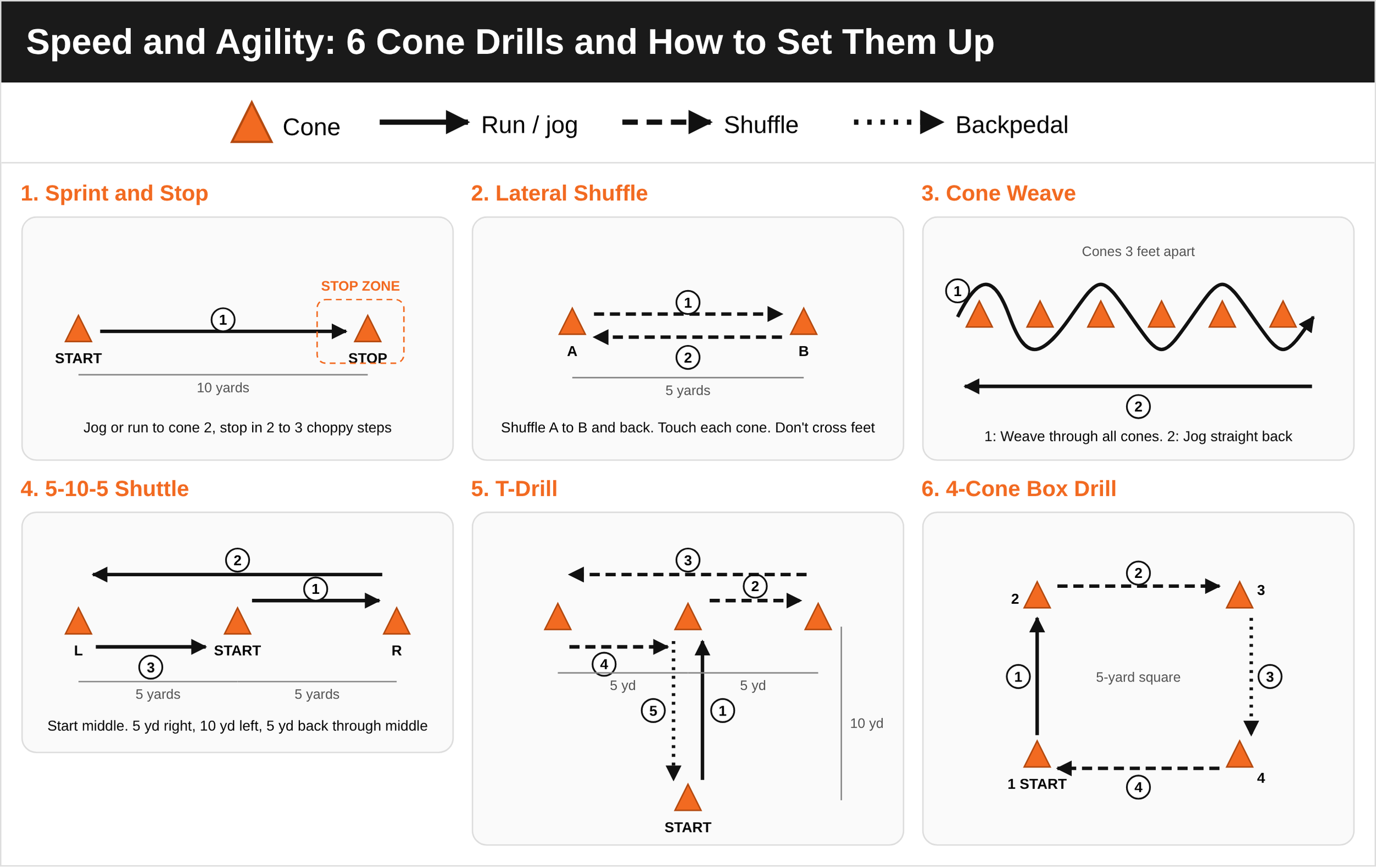
All you need is 4 to 6 cones (water bottles work too) and some open space. Start at half speed and learn each pattern before you add speed. Rest 60 to 90 seconds between reps so every rep is quality.
1. Sprint and Stop (Deceleration)
Set two cones 10 yards apart. Jog or run to the second cone and stop in 2 to 3 short, choppy steps, hips low and chest up. This teaches you to stop safely, which protects your knees. Cue: "Sit into the stop."
2. Lateral Shuffle
Place two cones 5 yards apart. Shuffle side to side, touching each cone, without crossing your feet. Stay low in an athletic stance. Cue: "Low hips, quick feet, don't cross."
3. Cone Weave (Slalom)
Line up 6 cones about 3 feet apart. Weave through them, then jog straight back to the start. Stay on the balls of your feet with your eyes up. Cue: "Short steps around each cone."
4. 5-10-5 Shuttle (Pro Agility)
Set three cones in a line, 5 yards apart. Start at the middle cone. Run 5 yards right and touch the line, 10 yards left and touch the line, then 5 yards back through the middle. Cue: "Plant, push, and go."
5. T-Drill
Set four cones in a "T": a start cone, a middle cone 10 yards ahead, and a cone 5 yards to each side of the middle. Run forward to the middle, shuffle right, shuffle left across to the far cone, shuffle back to the middle, then backpedal to the start. Cue: "Face forward the whole time."
6. 4-Cone Box Drill
Set four cones in a 5-yard square. Run forward to cone 2, shuffle right to cone 3, backpedal to cone 4, and shuffle left back to the start. Then go the other direction. Cue: "Stay balanced at every corner."
Your 12-Week Speed and Agility Plan
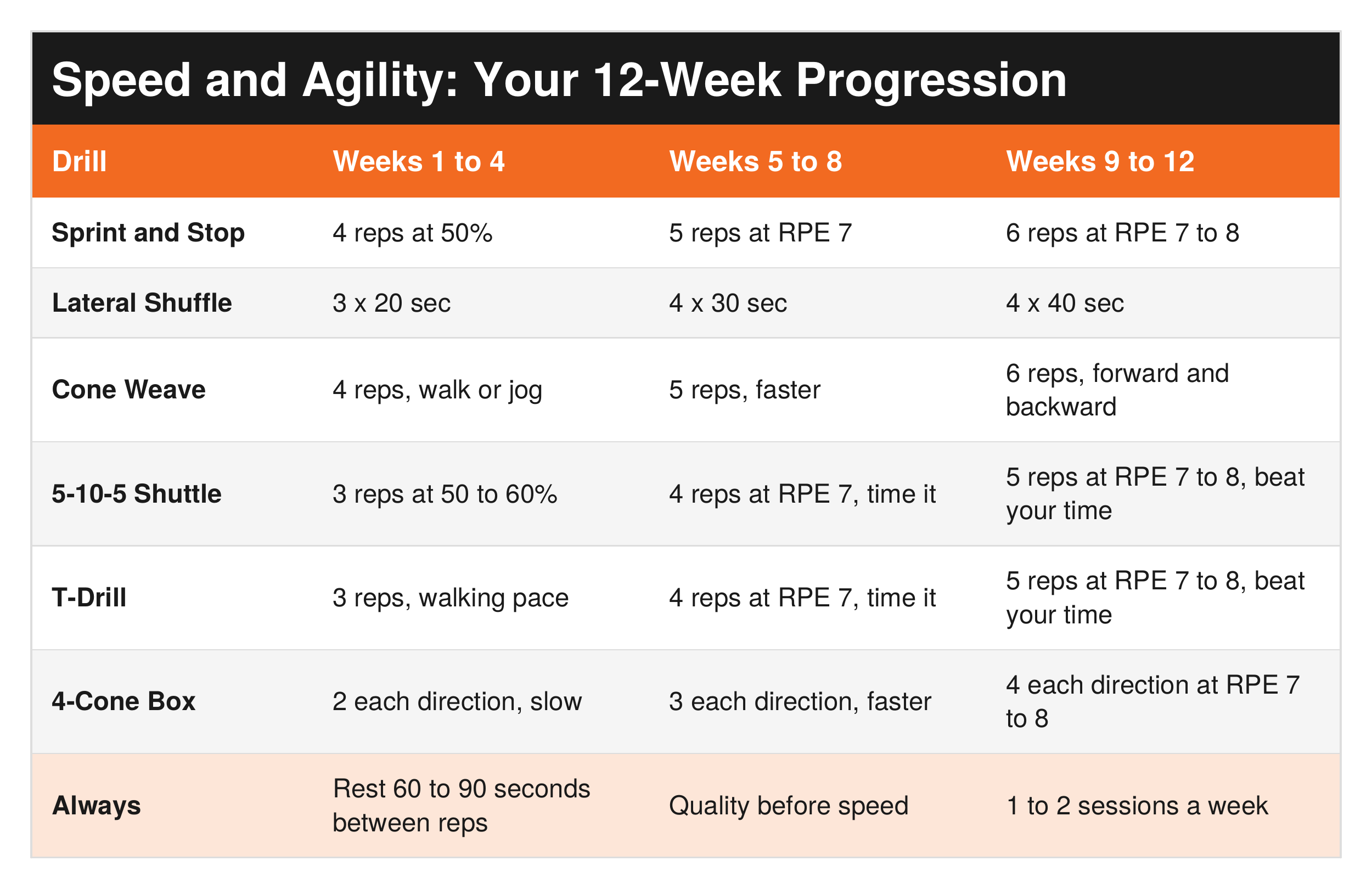
Do SAQ 1 to 2 times a week, right after your warm-up, when you're fresh. Weeks 1 to 4 are about learning the patterns. Weeks 5 to 8 build speed. Weeks 9 to 12 sharpen it.
The full plan and a printable tracker, with a quality score for every session, are in Section 5 of the 90-Day Program. Quality comes before speed, every time.
Ready for More?
Once the six cone drills feel smooth, you can add:
Ladder drills, like in-and-outs, for foot speed and coordination.
Box jumps onto a low, sturdy box for explosive power. Step down, don't jump down.
A 40-yard dash to test acceleration and top-end speed.
Safety First
Warm up thoroughly. Agility work is fast and explosive, so cold muscles are a risk. My free Dynamic Warm-Up Guide takes you head to toe in about 10 minutes. Get it free here.
Use a flat, non-slip surface with good shoes. Grass or turf is ideal.
Talk to your doctor first if you have knee, ankle, or hip problems, balance issues, or a heart condition.
Respect old injuries. Walk the pattern instead of running it if you need to.
Stop for any sharp pain, and stop the session when your form gets sloppy.
Score every drill for quality, then add speed. The free 90-Day Aerobic Fitness Program gives you a walking and walk-jog plan that builds your endurance step by step.
The Prepared Protector trains the split second. Stopping on a dime, stepping out of a car's path, catching yourself before you hit the ground. Six cones and ten minutes a week build the reactions you'll need when there's no time to think.
Ask Yourself
If I had to stop and change direction suddenly, could I do it without losing my balance?
Am I learning each pattern at half speed before I speed up?
Could these drills help a parent or grandparent stay steadier on their feet?
Remember
Agility is the skill of stopping, turning, and going under control. Learn each drill slowly, keep quality ahead of speed, and you'll build the reactions that keep you safe on the field, on the street, and at home.
Coming Up in Part 4: Modified Strongman Training: Real-Life Strength
Next, in Part 4, we pick things up and carry them: modified strongman training with carries, drags, and lifts that build real-world strength and work capacity.
Next in the series: Aerobic Fitness- Part 4: Modified Strongman Training: Real-Life Strength
Get Started Today
Get the free 90-Day Aerobic Fitness Program. A 90-day walking and walk-jog plan that builds your endurance step by step. Get it free here.
Get the free Dynamic Warm-Up Guide. A simple warm-up routine to get your body ready to move and help prevent injury. Get it free here.
Protecting an aging parent? Balance and quick reactions are key to fall prevention. My Staying Steady series walks you through it, from the strength and balance work to making their home safer, room by room. The Senior Fall Prevention and Emergency Information Checklist is inside The Family Safety Toolkit. For a comprehensive family safety guide, pick up your copy of The Family Safety Toolkit.
Quick Answers
What is SAQ training?
SAQ stands for speed, agility, and quickness. It trains you to accelerate, stop, change direction, and react fast, skills that carry over to sports, crowded places, and avoiding danger in daily life.
Is agility training good for older adults?
Yes, when it is controlled and done safely. A major review found that balance and functional exercise reduced the rate of falls in older adults by about 24%, and controlled agility drills build those same skills.
How do I start agility drills safely?
Warm up thoroughly first, since agility work is fast and explosive. Start slow, focus on clean footwork and balance before speed, and score each session for quality.
Do I need special equipment for agility training?
Not much. All 6 cone drills need just 4 to 6 cones, and water bottles work too, plus some open space. Start at half speed and rest 60 to 90 seconds between reps so every rep is quality.
Tools I Recommend
For the agility cones, ladders, and training gear I use, see my Fitness Amazon store, and for foam rollers and recovery gear, my Recovery Amazon store.
The Full Series
Aerobic Fitness- Part 1: Walking and Rucking: The Foundation of Real-World Fitness
Aerobic Fitness- Part 3: Speed, Agility, and Quickness: Train to Stop, Turn, and Go
Aerobic Fitness- Part 4: Modified Strongman Training: Real-Life Strength
Aerobic Fitness- Part 5: Cardio Machine Buyer’s Guide: Train Through Any Weather
Related Reading
References
Sheppard, J. M., & Young, W. B. (2006). Agility literature review: Classifications, training and testing. Journal of Sports Sciences, 24(9), 919-932. https://doi.org/10.1080/02640410500457109
Sherrington, C., et al. (2019). Exercise for preventing falls in older people living in the community. Cochrane Database of Systematic Reviews, 2019(1), CD012424. https://doi.org/10.1002/14651858.CD012424.pub2
Lauersen, J. B., Bertelsen, D. M., & Andersen, L. B. (2014). The effectiveness of exercise interventions to prevent sports injuries: A systematic review and meta-analysis of randomised controlled trials. British Journal of Sports Medicine, 48(11), 871-877. https://doi.org/10.1136/bjsports-2013-092538
U.S. Department of Health and Human Services. (2018). Physical Activity Guidelines for Americans, 2nd edition. https://health.gov/our-work/nutrition-physical-activity/physical-activity-guidelines/current-guidelines
Disclaimer
These suggestions are intended to help you and your family build awareness, confidence, and safer decision-making habits. No safety plan, checklist, or training can guarantee 100% protection. The goal is not to create fear, but to help guide families toward more informed, prepared, and practical safety decisions in everyday life. As an Amazon Associate, I earn from qualifying purchases. Product mentions reflect my own experience.
This article is for general informational and educational purposes only. It is not medical advice and is not a substitute for guidance from your physician or a qualified fitness professional. Speed and agility drills carry a risk of injury. Talk to your doctor before starting any new exercise program, especially if you have joint problems, balance issues, past injuries, or a heart condition. Stop any activity that causes pain or dizziness.
If someone falls and is injured, or has chest pain or sudden dizziness during exercise, call 911.
Awareness gives you time. Time gives you options.
The Prepared Protector is someone who's decided that loving someone means being ready for them, not just hoping things go fine.
Prepared Not Paranoid. Protecting the Most Vulnerable Among Us.