Carry, Drag, and Push: Strength for the Real World
By Larry Betz | Prepared Not Paranoid https://www.preparednotparanoid.com/
Updated November 9, 2026
In an emergency, strength isn't about how much you can bench press. It's about whether you can carry your go bag and a child at the same time, drag an injured person out of danger, or push a stalled car off the road. It's carrying, pushing, pulling, and dragging, often while you're breathing hard.
That's exactly what modified strongman training builds. This post is the full companion guide to Section 6 of my free 90-Day Aerobic Fitness Program. Read it here for the "why" and the "how," then use the program to track every session. Get it free here.
What Is Modified Strongman Training?
Modified strongman training (MST) takes traditional strongman exercises and equipment and adapts them for a much wider range of fitness levels and goals. It builds functional strength, power, endurance, mental toughness, and overall athleticism using unconventional heavy objects and big, full-body movements.
When you stick to the basics, there's a low learning curve for most of the movements. That makes MST ideal for beginners as well as seasoned lifters, and for anyone who wants to live a healthy, strong, and more prepared life.
What the Research Says
It builds real strength and power. A study comparing strongman training with traditional weight training found both improved strength and performance, with strongman holding its own as an effective option.
It trains your core under real conditions. Research on strongman events like carries found they challenge the muscles that stabilize your spine in ways traditional lifts don't.
Grip strength matters for your health. A large international study of nearly 140,000 adults found weaker grip strength was linked to a higher risk of death and heart disease. Carries build grip like few other exercises do.
Strength training is medicine. It supports muscle, bone, metabolism, and independence as we age.
The Two Tools That Give You the Most
In my opinion, for overall fitness, MST gives you a ton of benefit for the time you put in, and the two tools that give you the most variety take up very little space in a home gym:
A push sled, like the Tank M1. Push it, drag it, and pull it with a rope.
A few kettlebells in different weights. I like competition kettlebells. They're all the same size no matter the weight, and they're more comfortable than other kettlebells in certain positions. Kettlebells also work for many other exercises, like swings, snatches, and clean and presses.
Nice to have: a large old truck tire for flipping (a full-body exercise) and striking with a sledgehammer (great for endurance). Unless you have plenty of space and want to dive deep into strongman, though, a sled and kettlebells will give you great training sessions.
Start Here: Your Strongman Check-In
Before your first session, test yourself at a steady, controlled effort, not all-out, and write down your numbers. Repeat the check-in on Day 30, Day 60, and Day 90.
Farmer's carry distance at a set weight (write down the weight)
Suitcase carry distance, each side
Sled push time for 20 yards at a set load
Your RPE after 3 rounds of your exercises
RPE is your Rate of Perceived Exertion, from 0 to 10. Most strongman work in the program is at RPE 6 to 7.
The 8 Core Exercises
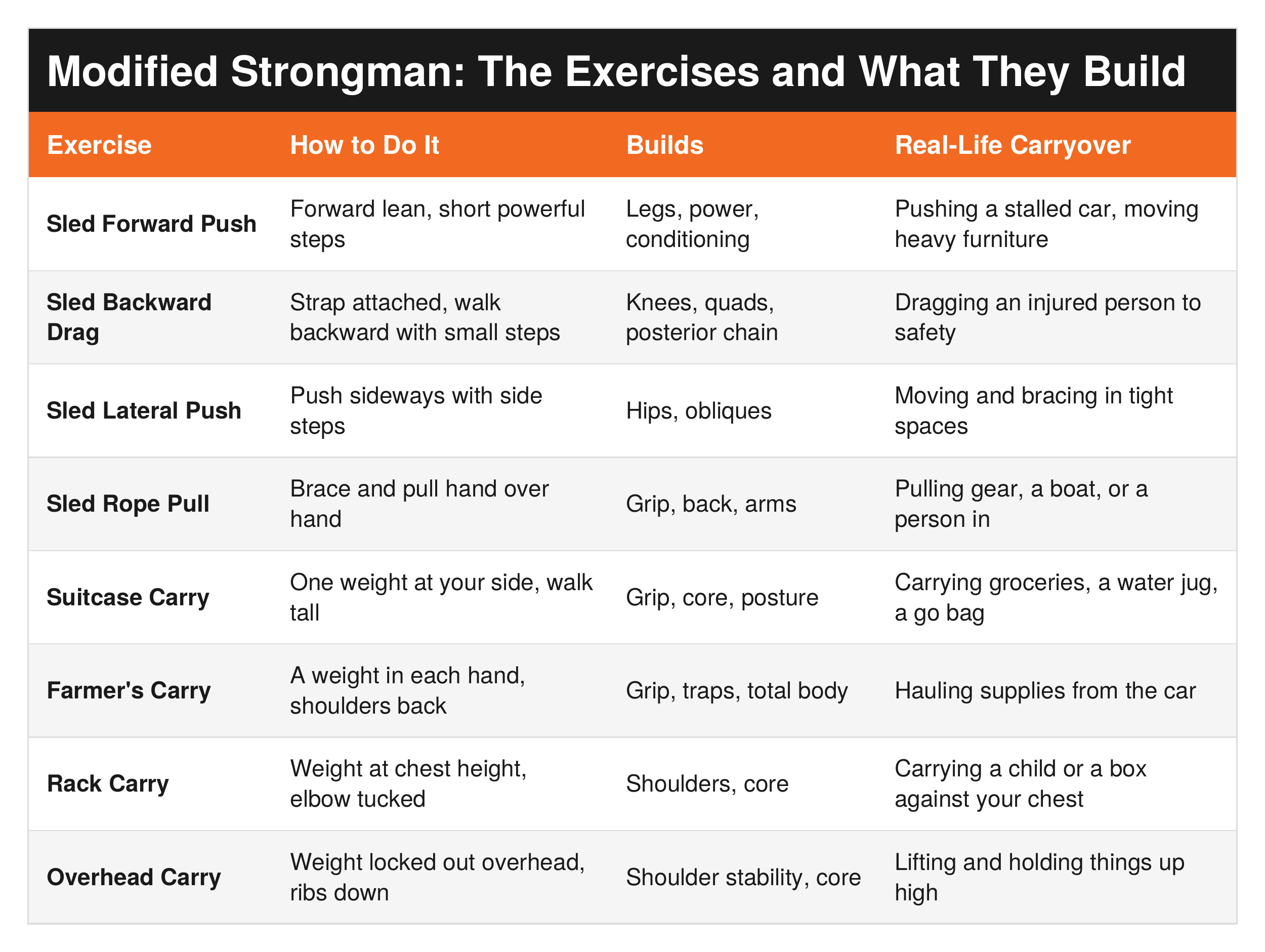
Here are the eight exercises in the 90-Day Program, how to do them, and how they carry over to real life.
Sled Exercises
Forward Push. Push the sled over a set distance, driving through your legs and keeping a strong core. Builds lower-body strength, power, and endurance.
Backward Drag. Attach a harness or strap and drag the sled backward. Works your quads, hamstrings, glutes, and lower back, and is easy on the knees.
Lateral Push. Push the sled sideways to build lateral strength and agility in your obliques, hips, and legs.
High/Low Push. Alternate between high and low hand positions on the handles to work different muscles and add variety.
Rope Pull. Attach a thick rope (2 inches thick, about 50 feet long) to the front, brace your feet, and pull the sled to you hand over hand. Great for grip and back strength.
Kettlebell Carries
Suitcase Carry. One kettlebell at your side, like carrying a suitcase. Builds grip and one-sided strength, and challenges your core to keep you upright against the uneven load.
Farmer's Carry. A kettlebell in each hand, shoulders back, controlled steps. A total-body builder for grip, traps, and posture.
Rack Carry. Hold the kettlebell close to your chest, with your elbow bent and the bell resting on your forearm and biceps. Builds shoulder stability, upper-body strength, and core control.
Overhead Carry. Hold the kettlebell overhead with your arm fully locked out. Builds shoulder stability and overhead strength, and demands serious core control. You can do it with one arm or two. Use a weight you can fully control. If it's over your head, you don't want to drop a heavy metal ball on yourself.
Why One-Sided Carries Work So Well
Carrying one kettlebell at a time creates an uneven (asymmetrical) load. Your core has to work harder to keep you stable, which builds the kind of core strength you use when you carry a bag, a toddler, or a water jug on one side.
Your 12-Week Strongman Plan
Train strongman 1 to 2 times a week. Rest 60 to 90 seconds between sets. Start with a weight you could carry for twice the distance, and build from there. Work toward sessions of up to 30 to 45 minutes, depending on your age, health, and injuries.
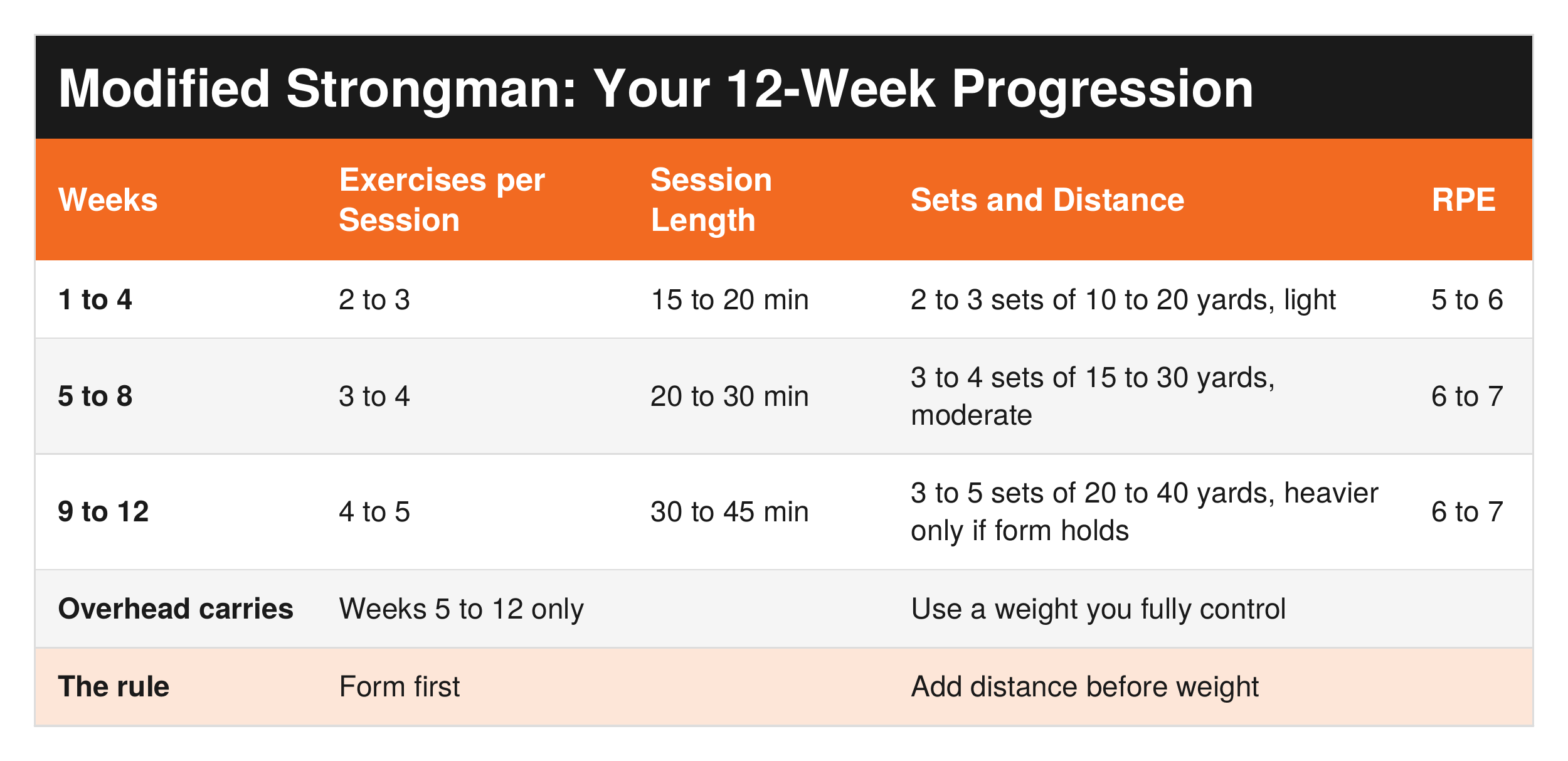
The full week-by-week sets and distances for every exercise, plus a printable tracker, are in Section 6 of the 90-Day Program.
How to Progress
Form first. Your form should look the same on the last step as the first.
Distance before weight. Add a little distance first. Add weight when your last set feels as solid as your first at RPE 6 or below.
Overhead carries come later, in Weeks 5 to 12 of the program.
Safety First
Talk to your doctor first, especially if you have back, shoulder, or joint problems, high blood pressure, a heart condition, or past injuries.
Warm up before every session. My free Dynamic Warm-Up Guide takes you head to toe in about 10 minutes. Get it free here.
Brace your core and breathe. Don't hold your breath for long efforts.
Respect old injuries. Choose the sled drag over carries, or lighter loads, if something bothers a past injury.
Clear your path. Make sure your sled lane and carry route are flat and free of obstacles.
Stop for any sharp pain, dizziness, or chest discomfort.
Track every carry, drag, and push. The free 90-Day Aerobic Fitness Program gives you a walking and walk-jog plan that builds your endurance step by step.
The Prepared Protector trains for the load they'll actually carry. A go bag on your back, a child on your hip, a neighbor who needs to be dragged clear. A sled and a few kettlebells turn that strength into something you can count on, even when you're out of breath.
Ask Yourself
Could I carry my go bag and help someone else at the same time?
How strong is my grip, and how long could I hold on?
Do I have space for a sled and a few kettlebells at home?
Remember
Real-life strength is carrying, pushing, pulling, and dragging. A sled and a few kettlebells build all of it. Start light, keep your form perfect, add distance before weight, and track your progress.
Coming Up in Part 5: Cardio Machine Buyer's Guide: Train Through Any Weather
Next, in Part 5, we bring your training indoors: a buyer's guide to rowers, SkiErgs, air bikes, stationary bikes, and treadmills, so you can train through any weather.
Next in the series: Aerobic Fitness- Part 5: Cardio Machine Buyer’s Guide: Train Through Any Weather
Get Started Today
Get the free 90-Day Aerobic Fitness Program. A 90-day walking and walk-jog plan that builds your endurance step by step. Section 6 has all 8 strongman exercises with a 12-week plan, and Section 7 shows how to combine them with walking, rucking, jogging, and agility into a full Preparedness Hour. Get it free here.
Get the free Dynamic Warm-Up Guide. A simple warm-up routine to get your body ready to move and help prevent injury. Get it free here.
Train with the bag you would actually carry. The Go Bag Checklist inside The Family Safety Toolkit shows you what to pack. For a comprehensive family safety guide, pick up your copy of The Family Safety Toolkit.
Quick Answers
What is modified strongman training?
It is strongman training adapted for everyday people: carries, drags, pushes, and pulls with a sled and kettlebells. It builds the strength you would use to carry a go bag and a child, drag an injured person out of danger, or push a stalled car off the road.
What equipment do I need for strongman training at home?
Two tools give you the most variety in very little space: a push sled, like the Tank M1, that you can push, drag, and pull with a rope, and a few kettlebells in different weights.
Why are one-sided carries so effective?
Carrying one kettlebell at a time creates an uneven load, so your core has to work harder to keep you stable. That builds the kind of core strength you use when you carry a bag or a child on one side.
Why does grip strength matter?
A large international study of nearly 140,000 adults found weaker grip strength was linked to a higher risk of death and heart disease. Carries build grip strength every session.
Tools I Recommend
For the Tank M1 push sled, competition kettlebells, sled ropes, and harnesses I use, see my Fitness Amazon store, and for foam rollers and recovery gear, my Recovery Amazon store.
The Full Series
Aerobic Fitness- Part 1: Walking and Rucking: The Foundation of Real-World Fitness
Aerobic Fitness- Part 3: Speed, Agility, and Quickness: Train to Stop, Turn, and Go
Aerobic Fitness- Part 4: Modified Strongman Training: Real-Life Strength
Aerobic Fitness- Part 5: Cardio Machine Buyer’s Guide: Train Through Any Weather
Related Reading
Strength Training Foundations- Part 4: Bodyweight Exercises, Upper Body and Conditioning
Go Bag and Emergency Bug-Out Bag- Part 1: Go Bag Necessities
References
Winwood, P. W., et al. (2015). Strongman vs. traditional resistance training effects on muscular function and performance. Journal of Strength and Conditioning Research, 29(2), 429-439. https://doi.org/10.1519/JSC.0000000000000629
Winwood, P. W., Keogh, J. W. L., & Harris, N. K. (2011). The strength and conditioning practices of strongman competitors. Journal of Strength and Conditioning Research, 25(11), 3118-3128. https://doi.org/10.1519/JSC.0b013e318212daea
McGill, S. M., McDermott, A., & Fenwick, C. M. (2009). Comparison of different strongman events: Trunk muscle activation and lumbar spine motion, load, and stiffness. Journal of Strength and Conditioning Research, 23(4), 1148-1161. https://doi.org/10.1519/JSC.0b013e318198f8f7
Leong, D. P., et al. (2015). Prognostic value of grip strength: Findings from the Prospective Urban Rural Epidemiology (PURE) study. The Lancet, 386(9990), 266-273. https://doi.org/10.1016/S0140-6736(14)62000-6
Westcott, W. L. (2012). Resistance training is medicine: Effects of strength training on health. Current Sports Medicine Reports, 11(4), 209-216. https://doi.org/10.1249/JSR.0b013e31825dabb8
Disclaimer
These suggestions are intended to help you and your family build awareness, confidence, and safer decision-making habits. No safety plan, checklist, or training can guarantee 100% protection. The goal is not to create fear, but to help guide families toward more informed, prepared, and practical safety decisions in everyday life. As an Amazon Associate, I earn from qualifying purchases. Product mentions reflect my own experience.
This article is for general informational and educational purposes only. It is not medical advice and is not a substitute for guidance from your physician or a qualified fitness professional. Strength training carries a risk of injury. Talk to your doctor before starting any new exercise program, especially if you have back, shoulder, or joint problems, a heart condition, past injuries, or have been inactive. Stop any activity that causes pain, dizziness, or chest discomfort.
If you have chest pain, severe shortness of breath, or feel faint while training, stop and call 911.
Awareness gives you time. Time gives you options.
The Prepared Protector is someone who's decided that loving someone means being ready for them, not just hoping things go fine.
Prepared Not Paranoid. Protecting the Most Vulnerable Among Us.